Search This Blog

Showing posts with label High Speed Rail. Show all posts

Friday, July 19, 2013

The Myth of High Speed Rail

"When plunder becomes a way of life for a group of men living together in society, they create for themselves, in the course of time, a legal system that authorizes it and a moral code that glorifies it." — Frederic Bastiat

For the past two years I have been writing about the myth of high speed passenger rail. (See my blog from May 12, 2012 — “The Train to Nowhere, Part Deux”) In my May 12th blog I addressed the history of rail in the United States and talked about the proposed $7 billion dollar high speed rail from Victorville, California to Las Vegas, California. Since that time the name of the project has changed from DesertXpress to XpressWest and the United States Department of Transportation’s Federal Railroad Administration has nixed the requested $5.5 billion dollar loan.

On July 17th the Washington Post reported:

“WE’VE SEEN some bad policy ideas but not many more awful than the proposal to extend a $5.5 billion low-interest, 35-year federal loan to a West Coast start-up for a high-speed rail connection between Southern California and Las Vegas. This time, though, we are happy to report, common sense has prevailed: The Obama administration has stopped the project.

Backed by wealthy casino moguls, who in turn enjoyed the support of Senate Majority Leader Harry Reid (D-Nev.), a company called XpressWest wanted to lay tracks between Vegas and lonely Victorville, Calif., some 81 miles east of downtown Los Angeles. Several times larger than the largest amount ever loaned under the obscure federal Railroad Rehabilitation and Improvement Financing Program, the federal money would cover 80 percent of the project’s costs. The supposed public benefits were reduced carbon emissions, less auto traffic and, of course, more jobs.

What XpressWest struggled to explain was why taxpayers should bet on a proposition that private investors apparently found too risky: hordes of travelers driving to Victorville, parking their cars and then boarding the train for an 80-minute ride to Vegas — as opposed to driving the whole way, flying or taking “My Party Ride,” a limo-like bus trip for up to 30 passengers at $99 each, including food and drinks.

The whole thing had the makings of a boondoggle, for which taxpayers would eventually end up paying. Yet multiple federal and state agencies had given environmental and regulatory approvals, leaving the crucial matter of the loan up to the Transportation Department. Given the project’s political connections, DOT’s thumbs-up seemed inevitable — until June 28, when then-Secretary Ray LaHood, as one of his final acts in office, sent XpressWest Chairman Anthony Marnell II a letter saying that the department had decided to “suspend further consideration” of the loan.”

LaHood, in his June 28 letter to the company, cited "serious issues" with the application in the decision to cut the project off. He suggested the company was having difficulty ensuring that the project would be built with enough American products like U.S-made steel and iron.

Some of the letter was redacted, but LaHood also suggested concerns about the sheer size of the loan and the risk, and the company's apparent failure to submit additional documentation on other participants in the project.

"After several years of engagement with no resolution to the thresholdXpressWest-Train issues addressed in this letter and the significant uncertainties still surrounding the project, we have decided to suspend further consideration of XpressWest's loan request," LaHood wrote. The request had been under consideration with both his department and the Federal Railroad Administration.
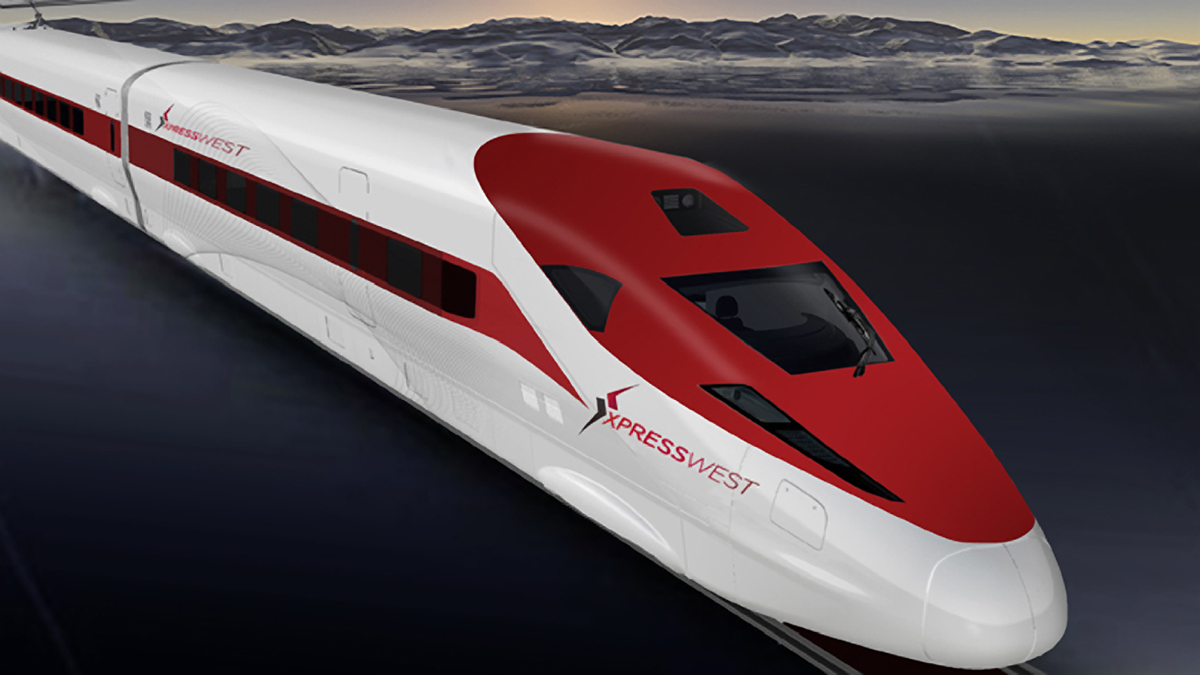
The decision is a major blow to the project, as the federal loan was expected to make up the bulk of funding for the $6.9 billion rail line.

The 185-mile line was billed as the most advanced and fastest in the U.S. According to the company, it would connect Southern California and Vegas with an 80-minute train ride.

Yet critics warned that costs could spiral and ridership projections might be too rosy, and that such a massive federal investment was not wise.

The XpressWest line is running into a wall after another project — a proposed magnetic levitation (Maglev) train with a similar route — also ran into recent problems, as state planners backed away from that project and federal funding ran dry.

Sen. Jeff Sessions, (R-Alabama), top Republican on the Senate Budget Committee, and Rep. Paul Ryan, (R-Wisconsin)., chairman of the House Budget Committee, had earlier revealed they'd been told about the department's decision on XpressWest. The two lawmakers had been among the toughest critics of the project and loan, calling it "costly, wasteful and risky."

On February 12, 2013 Laura Carroll Reported in the Las Vegas Review Journal:

“At best, it could be another 18 months before any ground is broken on the XpressWest project - the same time frame backers gave the Las Vegas Review-Journal in 2009.

The reality of a high-speed train shuttling travelers between Victorville, Calif., and Las Vegas hinges on funding of $5.5 billion from the Railroad Rehabilitation and Improvement Financing, which is administered by the Federal Railroad Administration. XpressWest's first loan application was submitted in December 2010 and is still under review.

The nearly $7 billion project will largely be financed from this loan, if approved, and the rest in private equity investment.

At Tuesday's meeting of the Las Vegas Convention and Visitors Authority board of directors, XpressWest Chief Operating Officer Andrew Mack, said it could be six months before a decision is made on the application. If approved, it would be still another year before ground is broken.

"It's really dependent on the RRIF pay," Mack said. "That's really driving the schedule.

The train would be built adjacent to Interstate 15 with service every 20 minutes and one-ways taking about 80 minutes. The average fare is less than $100, Mack said. Each train would seat between 500 and 600 passengers.

If construction eventually starts, XpressWest estimates that 80,000 direct and indirect construction jobs will be created, with a third of those going to Southern Nevadans. The estimated economic output of the rail line during its lifetime is $7.8 billion.

In Las Vegas, two potential sites have been chosen for train stations: one across from the Rio and the other across from Mandalay Bay.”

The Transportation Department later said in a statement that "XpressWest has the ability to revive its application by significantly revising its request."

The project still has a powerful supporter in Congress — Senate Majority Leader Reid, as well as Republican Nevada Sen. Dean Heller.

According to the Las Vegas Review-Journal, Reid claims the administration has not "permanently foreclosed" the possibility of an investment. He stressed Friday that he plans to keep pushing for "this vital investment." Obviously this decision is a death blow to Reid and the backers of the project — a decision I totally agree with. (See the Fox News report from March 13, 2013)

According to an August 2012 tax risk assessment by the libertarian Reason Foundation should the Victorville to Las Vegas train commercial revenues fail to pay operating costs and debt service, the project would not have enough money to repay the federal loan, resulting in a default that would make Solyndra look like small change. Taxpayers would lose up to $6.5 billion in principal and any unpaid interest, an amount that could climb to more than $7.5 billion if a full six-year deferment of repayment is granted. The Taxpayer Risk Assessment identifies a number of concerns that could result in taxpayer losses.

This Taxpayer Risk Assessment examines the financial risks to taxpayers of the proposed XpressWest high-speed rail project from Victorville to Las Vegas. There would be no need for a Taxpayer Risk Analysis without government (taxpayer) involvement. For example, if a bus company were to establish a new service between Victorville and Las Vegas, there would be no taxpayer financial exposure under normal circumstances. The company would either succeed or fail depending on its ability to cover its costs through various commercial activities. As with private loans, the ability to secure the loan depends on the bank’s assessment of its successfully pay off — a natural inhibitor of risky propositions. XpressWest is intended to be self-supporting, with the construction and financing expenses and operating expenses covered by commercial revenues, principally passenger fares. Tellingly, the project sponsors are apparently unable to arrange conventional private sector financing and seek a federal loan with a subsidized interest rate, which would pass the risks on to taxpayers if the forecasted ridership should fail to materialize. Moreover, in the event of financial difficulty, state and local taxpayers could face significant pressure to provide funding to complete the system or to subsidize its operations. Thus, a Taxpayer Risk Assessment is necessary.

This Taxpayer Risk Analysis reviews ridership, revenue and capital cost forecasts to the extent that they are available. The principal focus is on ridership, since the repayment of the proposed federal loan from taxpayers is entirely dependent upon commercial revenues, principally the fares that will be paid by riders and ancillary revenues, such as advertising.

1. A Speculative Consumer Market: The greatest risk is that the potential consumer market for the train is far smaller, in geographical terms, than is assumed in the project documentation. There is no parallel for large numbers of drivers and airline passengers to travel well outside the urban areas in which they live to connect to a train (or plane) to any destination, much less one so close to Southern California as Las Vegas. As a result, common sense finds ridership and revenue likely to be a mere fraction of forecast. This would likely make repayment of the federal loan impossible. This risk to taxpayers of an exaggerated market is “unknown, but potentially severe.”

2. Materially Changed Circumstances: Even if the consumer market were geographically as large as assumed, growth in the Las Vegas tourist market has been far below forecasts in recent years. As a result, the base ridership figures are implausibly exaggerated and need to be revised downward. The ridership and revenue risk to XpressWest from this factor is high and risks make paying the federal debt impossible, calling for a taxpayer bailout.

3. Ridership and Revenue Forecast Model Concerns: The international record indicates that rail projects tend to average approximately 39% less in ridership than forecast. Specific factors of the ridership forecast for the Victorville to Las Vegas train indicate that actual ridership is likely to be 39% to 70% less than forecasted, even after adjustment for the materially changed circumstances. These factors include an optimistic estimate of the base year market, a market growth rate greater than in pre-recession years, an optimistic assumption of attraction from cars and an optimistic bus attraction assumption. Such rosy predictions increase the likelihood that the federal loan would not be repaid.

4. Capital Cost Escalation: Capital cost escalation for rail projects has been pervasive in similar projects, suggesting that capital cost escalation is likely to occur on the Victorville to Las Vegas train, leaving the project impossible to complete and triggering a default on the federal loan. Governments (federal, state and local) would be faced with difficult decisions about whether to complete the project, at elevated costs, with public funding or to fund dismantlement of a partially completed system.

5. Likely Commercial Losses: Even if there is no capital cost escalation, it is unlikely that the business plan for this project is flexible enough to deal with all the variations discussed above without suffering either higher costs or commercial revenue shortfalls. This inflexibility could lead to a default on the federal loan with the loss paid by taxpayers. Further, political pressure to keep the train operating could lead to a federal Amtrak-style takeover with subsidies, or the train could be operated with state and/or local subsidies. The risk of taxpayer loss from this factor is evaluated at “high.”

6. Higher Cost for Highway Expansion: Use of the median of I-15 for the Victorville to Las Vegas train could preclude the most cost-effective options to expand highway capacity. This would increase costs to taxpayers and highway users. The risk of higher expansion costs on I-15 is evaluated as “moderate.”

In 1991 I was involved with the proposed Maglev line from Anaheim to Las Vegas. This was to be a cooperative venture between Transrapid (the German consortium pushing their Maglev technology), The California High Speed Rail Corporation, and Bechtel to design, build and operate a Maglev train from Disneyland to Las Vegas. The technology seemed sound but there were two major problems. One is that they could not get a permit from Caltrans to use any right of way along the I-15 corridor and two; they could not find any investors. Eventually the right of way issue was solved by an act of the California Legislature, but there still was no money coming forth.

The majority of high-speed rail lines require large government subsidies from both general taxpayers and drivers. Even with generous subsidies, traveling by high-speed rail is still more expensive than flying for 12 of the 23 most popular high-speed rail routes in the world. Evidence suggests it can only be competitive on routes that are 200 to 500 miles in length.

High-speed rail is also very expensive to build. Most new routes cost at least $10 million per mile to construct. The cheapest European rail line costs more than $50,000 per seat to operate annually. A U.S. high-speed rail line would need ridership of 6 million to 9 million people per year to break even. The high-speed Acela service, despite operating in the busy Northeast Corridor, averages only 3.4 million passengers per year.

Advocates cite other advantages for high-speed rail, but most fall apart under close examination:

Environment: High-speed rail creates more pollution than it prevents because building a high-speed rail line is very energy-intensive.

Economic development: High-speed rail does not create much new development; it merely redirects development from one area to another.

Mobility: High-speed rail is unlikely to improve mobility since most of its potential passengers already travel by air.

Choice: Customers can already choose between a low-cost bus, a fast plane or a personalized car trip.

Most countries have built high-speed rail to relieve passenger overcrowding on their existing lines. The U.S. lacks this overcrowding, which suggests consumer demand for high-speed rail may not be there. Furthermore, freight rail dominates track usage, and railroad companies are reluctant to relinquish capacity, as is evident in the discussions surrounding the proposed multimodal passenger terminal in downtown Atlanta.

Any U.S. rail operator will have to compete on the same terms that cause Amtrak to lose large amounts of money each year. Railways are subject to outdated labor laws that were enacted when railroads did not face competition. Operating a passenger railroad in the existing regulatory environment is not a profitable proposition.

Our core cities, where people are most likely to board high-speed trains, are much less dense than European or Asian cities, which also limits the potential market.

The U.S. has far higher rates of car ownership than most other countries. Gas taxes are lower, road tolls are less common, and many cities — especially in the South and West — have grown up around the automobile.

As a result, high-speed rail is best regarded as a luxury toy this country cannot afford. For far less money, we could create a world-class highway and aviation system with first-rate bus and airplane service and far more flexibility.

We’d like to think that cost and feasibility concerns ultimately derailed this crazy train, but that is not what Mr. LaHood emphasized in his letter. Rather, he faulted XpressWest for not guaranteeing that it would get steel and other manufactured goods from U.S. suppliers. We disagree with protectionist “Buy America” thinking; still, in this case it at least shows that the project’s job-creation potential was always limited by the fact that no U.S. manufacturer makes high-speed rail cars or the needed heavy steel rails and electrification systems. However imperfect his rationale, Mr. LaHood reached the right result, and that’s cause for celebration.

Saturday, May 12, 2012

The Train to Nowhere, Part Deux

"Government is instituted for the common good; for the protection, safety, prosperity, and happiness of the people; and not for profit, honor, or private interest of any one man, family, or class of men." — John Adams

May 10th was the 143rd anniversary of the completion of the Transcontinental Railroad. On this day in 1869, the presidents of the Union Pacific and Central Pacific railroads meet in Promontory, Utah, and drive a ceremonial last spike into a rail line that connects their railroads. This made transcontinental railroad travel possible for the first time in U.S. history. No longer would western-bound travelers need to take the long and dangerous journey by wagon train, and the West would surely lose some of its wild charm with the new connection to the civilized East. Nor would goods have to travel by ship on the odious journey around the Cape Horn and the Straits of Magellan to reach San Francisco.

Since at least 1832, both Eastern and frontier statesmen realized a need to connect the two coasts. It was not until 1853, though, that Congress appropriated funds to survey several routes for the transcontinental railroad. The actual building of the railroad would have to wait even longer, as North-South tensions prevented Congress from reaching an agreement on where the line would begin.

One year into the Civil War, a Republican-controlled Congress passed the Pacific Railroad Act (1862), guaranteeing public land grants and loans to the two railroads it chose to build the transcontinental line, the Union Pacific and the Central Pacific. With these in hand, the railroads began work in 1866 from Omaha and Sacramento, forging a northern route across the country. In their eagerness for land, the two lines built right past each other, and the final meeting place had to be renegotiated.

The original Act's long title was “An Act to aid in the construction of a railroad and telegraph line from the Missouri river to the Pacific Ocean, and to secure to the government the use of the same for postal, military, and other purposes”. It was based largely on a proposed bill originally reported six years earlier on August 16, 1856, to the 34th Congress by the Select Committee on the Pacific Railroad and Telegraph. Signed into law by the President Abraham Lincoln on July 1, 1862, the 1862 Act authorized extensive land grants in the Western United States and the issuance of 30-year government bonds (at 6 percent) to the Union Pacific Railroad and Central Pacific Railroad (later the Southern Pacific Railroad) companies in order to construct a transcontinental railroad. Section 2 of the Act granted each Company contiguous rights of way for their rail lines as well as all public lands within 200 feet on either side of the track.

Section 3 granted an additional 10 square miles of public land for every mile of grade except where railroads ran through cities or crossed rivers. The method of apportioning these additional land grants was specified in the Act as being in the form of "five alternate sections per mile on each side of said railroad, on the line thereof, and within the limits of ten miles on each side" which thus provided the companies with a total of 6,400 acres for each mile of their railroad. (The interspersed non-granted area remained as public lands under the custody and control of the U.S. General Land Office.) The U.S. Government Pacific Railroad Bonds were authorized by Section 5 to be issued to the companies at the rate of $16,000 per mile of tracked grade completed west of the designated base of the Sierra Nevadas and east of the designated base of the Rocky Mountains. Section 11 of the Act provided that the issuance of bonds "shall be treble the number per mile" (to $48,000) for tracked grade completed over and within the two mountain ranges (but limited to a total of 300 miles at this rate), and doubled (to $32,000) per mile of completed grade laid between the two mountain ranges.

The Act also specified that the gauge of the track (the distance between the inside flange of opposing rails) be standardized at 4 feet, 8.5 inches. This is the standard gauge used for all railroads and urban rail today. Until the approval of the Transcontinental Railroad there were tracks of varying gauges throughout the United States. This caused a lack of standards in rolling stock and the inability to connect various lines with one another.

The U.S. Government Bonds constituted a lien upon the railroads and all their fixtures, and all were repaid in full (with interest) by the companies as and when they became due. Section 10 of the 1864 amending Act Statutes at Large, additionally authorized the two companies to issue their own "First Mortgage Bonds" in total amounts up to (but not exceeding) that of the bonds issued by the United States, and that such company issued securities would have priority over the original Government Bonds.

From 1850-1871, the railroads received more than 175 million acres of public land — an area more than one tenth of the whole United States and larger in area than Texas.

Railroad expansion provided new avenues of migration into the American interior. The railroads sold portions of their land to arriving settlers at a handsome profit. Lands closest to the tracks drew the highest prices, because farmers and ranchers wanted to locate near railway stations.

Harsh winters, staggering summer heat, Indian raids and the lawless, rough-and-tumble conditions of newly settled western towns made conditions for the Union Pacific laborers — mainly Civil War veterans of Irish descent--miserable. The overwhelmingly immigrant Chinese work force of the Central Pacific also had its fair share of problems, including brutal 12-hour work days laying tracks over the Sierra Nevada Mountains. On more than one occasion, whole crews would be lost to avalanches, or mishaps with explosives would leave several dead.

For all the adversity they suffered, the Union Pacific and Central PacificThe_Last_Spike_1869 workers were able to finish the railroad — laying nearly 2,000 miles of track — by 1869, ahead of schedule and under budget. Journeys that had taken months by wagon train or weeks by boat now took only days. Their work had an immediate impact: The years following the construction of the railway were years of rapid growth and expansion for the United States, due in large part to the speed and ease of travel that the railroad provided.

The completion of the Transcontinental Railroad was not only a great feat of engineering; it was also needed for the economic expansion of the United States. It connected the Atlantic and Pacific Oceans and made us one country. We now had a unified nation connected by a ribbon of steel and the telegraph lines that ran alongside of the railroad.

For years the nation traveled and shipped on rails. It was the primary means of intercontinental transportation and communication. There were high profile trains like the New York Central’s Empire State and the Santa Fe’s Super Chief. A passenger could travel from New York City to Los Angeles, via Chicago, in comfort and elegance while enjoying the scenery of the great southwest from the glass-domed observation cars.

Two things brought an end to passenger rail travel in the United States — the interstate highway system and the growth and safety of air travel.super-chief-albuquerque Rather than taking four days to travel from New York City to Los Angeles you could fly the same distance in eight hours. With the explosion of the auto industry in the 1950’s Americans were now seeing the USA in the personal automobile where they had the freedom to go where they pleased when the pleased. With the completion of the interstate highway system in 1978 rail passenger service was about dead and the railroads knew it. This is why they gave up on transcontinental passenger service and devoted their resources and money to freight service.

Now we have a new resurgence in passenger rail service, a resurgence the railway companies want no part of. We have AMTACK, a government owned corporation, that runs passenger trains at a billion dollar loss each year — money out of the taxpayer’s pocket. We also have a federal government that wants to push passenger rail service at the expense of the taxpayers — spending money we don’t have to finance something called High-Speed Rail. (See: Does California Really Need High Speed Rail? And Why High Speed Rail is Obama's Fantasy.)

The latest example of this fantasy is something called the DesertXpress, a proposal to build a privately funded high-speed rail passenger train from Victorville, California, to Las Vegas, Nevada.

The proposal would provide an alternative to automobile travel between the Los Angeles area to Las Vegas along Interstate 15 as well as an alternative to airline travel. Interstate Highway 15 is a direct automobile route between the two regions and carries heavy traffic. Greyhound buses cover the route in between five and seven hours, while automobiles take around four hours. Currently, there is no passenger train service to Las Vegas. Amtrak last operated passenger train service to Las Vegas in 1997 on its Desert Wind route, which was cancelled due to budget cuts.

The city of Victorville was selected as the location for the westernmost terminal since extending the train line farther into the Los Angeles basin through the Cajon Pass would be prohibitively expensive. Victorville is about 40 mi from Riverside, where a station was proposed for the California high-speed rail line. The station would include free parking and through-checking of baggage straight to the Las Vegas Strip resorts. A future extension would include a new link to the California High-Speed Rail station in Palmdale.

The train would travel at speeds of up to 150 mph and would make the 186desertxpress2 mile trip from Victorville to Las Vegas in about 1 hour 30 minutes, shaving about two hours off the travel time. The backers of the project are currently in the process of raising funds for its construction, estimated at between 4 to 5 billion dollars. The cost would be about $21 million per mile, typical of European HSR construction. The project is planned to begin construction in early 2012 and start full service by early 2016.The problem is that no private investors are interested and the planners are looking to the Federal Railroad Administration for a 5 billion dollar loan — similar to Solyndra, and we know how well that went. The question is: would you drive to Victorville, park your car, and take a train to Las Vegas to save two and a half hours and have no car in Las Vegas?

Richard N. Velotta writes in the Las Vegas Desert Sun in February, 2011:

“Ever since plans to build a high-speed train from Las Vegas to Victorville, Calif., were unveiled, developers have been adamant about one point — they wouldn’t ask taxpayers to fund it.

But DesertXpress Enterprises has no qualms about borrowing from taxpayers — and borrowing big — for a project that skeptics say has little chance of gaining the ridership needed to pay for it.

The company has applied for a $4.9 billion loan through a federal program to construct what is billed as a $6 billion project. Since the plan was presented nearly two years ago, the cost estimate has ballooned from $4 billion.

The Federal Railroad Administration will hire an independent analyst to determine if ridership estimates, $50 one-way fares and other related revenue will be enough to repay the loan and prevent taxpayers from getting stuck with the bill.

The company, which is waiting for environmental clearances before it can begin preliminary design and engineering on the 185-mile route, requested the loan through the federal Railroad Rehabilitation & Improvement Financing program.

Under the program, funding may be used to develop or establish new railroad facilities, and direct loans can finance up to 100 percent of a railroad project with repayment periods of up to 35 years and interest rates the same as what the government is charged.

If approved, the loan would be more than four times the amount the program has lent to 28 railroad projects since 2002.

Since then, it has loaned $1.02 billion with the largest loan, $233 million, going to the Dakota, Minnesota & Eastern Railroad in 2003.”

……

“Developers chose Victorville because most passenger traffic in cars pass through the high-desert community en route to Las Vegas on I-15.

After critics ripped the Victorville end point, the company announced plans to build an extension west to Palmdale, where a station for the California high-speed rail project is planned.

The project also has been criticized because Sen. Harry Reid, D-Nev., a longtime supporter of a magnetic levitation system between Las Vegas and Los Angeles, withdrew his support and began backing DesertXpress in 2009. Reid said he was frustrated by the lack of progress on the maglev project, but critics said the switch was because DesertXpress investor Sig Rogich formed a campaign support group for Reid’s re-election months before the change in support.

DesertXpress officials have said a maglev is too expensive, but boosters of the technology say long-term costs are about the same because of the higher maintenance expense for traditional rail compared with the frictionless maglev, which is propelled on a magnetic field.”

Again Mr. Velotta writes on March 26, 2012 in the Desert Sun:

I want to know if Sen. Harry Reid is getting frustrated with your lack of progress the way he did with the backers of a proposed maglev project.

You know the one I mean — the project that would have gone all the way to Los Angeles and Anaheim and better served Nevadans wanting to go to Southern California as well as Californians looking to come to Las Vegas.

The one with the technology capable of scaling Cajon Pass, unlike your technology.

The one embraced by several communities that viewed the line as a high-speed link between airports that could be used by commuters catching planes.

The senator pulled the financial rug from under the maglev project. Sure, he said he was frustrated that nothing had been accomplished in 30 years of maglev planning. But once the federal government passed legislation in 2008 to finance the engineering for a demonstration project, the senator managed to hijack that $45 million to other transportation projects a year later.”

…..

“I also want to know, DesertXpress, if you’re still confident in the Las Vegas-Victorville transportation model after all the scorn you’ve endured in the past four years. Aren’t you tired of hearing people say, “Victorville?” in disbelief when you explain that you’re asking Southern Californians to drive there, park their cars and board a train to take them on what would be the easier leg of the journey to Las Vegas? Let’s not forget, either, that our California visitors would have no car once they arrived in Nevada and would have to rely on public transportation, taxis or a rental. Never mind that there’s virtually no upside to Las Vegans looking to go to Southern California, either.

I’d like to know if you’ve rethought the maglev technology since the commercially operating line in Shanghai is maintaining a more than 99 percent on-time efficiency rating after eight years in service. Isn’t it about time we stop calling maglev “unproven?”

I know, your suppliers are all friends and steel-wheel-on-rail guys, the same ones who dominate policy at the Federal Railroad Administration. There’s virtually no hope that this is going to change with that good ol’ boy network in place, despite President Barack Obama’s urging to get the fastest train in the world deployed in the United States. I don’t think he was talking about a 150 mph system that most don’t consider to be high-speed rail anymore.”

As Mr. Mr. Velotta so eloquently points out folks in Nevada have no need for the DesertXpress. Suppose they want to go to Disneyland. What do they do? Take the train from Las Vegas to Victorville than rent a car to journey the next 70 or so miles to Anaheim. I don’t think so. In essence the DesertXpress is a one way train to take folks from Los Angeles, Riverside, and orange counties to Las Vegas and back for $100 dollars each way.

In 1991 I was involved with the proposed Maglev line from Anaheim to Las Vegas. This was to be a cooperative venture between Transrapid (the German consortium pushing their Maglev technology), The California High Speed Rail Corporation, Bechtel to design, build and operated a Maglev lain from Disneyland to Las Vegas. The technology seemed sound but there were two major problems. One is that they could not get a permit from Caltrans to use any right of way along the I-15 corridor and two; they could not find any investors. Eventually the right of way issue was solved by an act of the California Legislature, but there still was no money coming forth.

At the time there were no revenue generating Maglev lines anywhere in the world, not even in Germany. There were many nations interested, but no one wanted to pony up any bucks. Eventually, in January 2001, the Chinese signed an agreement with the German maglev consortium Transrapid to build an EMS high-speed maglev line to link Pudong International Airport with Longyang Road Metro station on the eastern edge of Shanghai. This Shanghai Maglev Train demonstration line, or Initial Operating Segment (IOS), has been in commercial operations since April 2004 and now operates 115 (up from 110 daily trips in 2010) daily trips that traverse the 19 miles between the two stations in just 7 minutes, achieving a top speed of 431 km/h (268 mph), averaging 266 km/h (165 mph). On a 12 November 2003 system commissioning test run, the Shanghai maglev achieved a speed of 501 km/h (311 mph), which is its designed top cruising speed for longer intercity routes. Unlike the old Birmingham maglev technology, the Shanghai maglev is extremely fast and comes with on time – to the second – reliability of greater than 99.97% The cost of this 19 mile line was 1.3 billion dollars — all paid by the Chinese government or about 68.4 million per mile. The line is totally subsidized by the Chinese government. The Birmingham line was closed before it ever opened.

In 1990, while working with the German Federal Railway (Deutsche90-0427 Bundesbahn), I had the opportunity to ride the maglev Transrapid 07 on the 31.5 kilometer (19.5 mile) near Emsland, Germany. The line is a figure-8 loop running between Dörpen and Lathen with turning loops at each end. The train achieved 420 km/h (260 mph).with little or no vibration or noise. I was convinced that this was the future or rail transportation until our host, an executive with the DB cast his doubts on the future of Transrapid. He as doubtful that a maglev line would ever be built in Germany due to the present rail infrastructure in the country. He also said, that because there was no real example of a revenue generating line private investment would be hard to come by and it would take government to finance such a project and subsidize it forever.

Klaus was right. The Transrapid/Bechtel Anaheim to Las Vegas maglev died a quick death and Bechtel lost several million dollars before pulling out of the venture. It was not until the Chinese decided to build an EMS line to show off for the 2004 Sumer Olympics and the benefits of their socialist state that any semblance of a revenue generating maglev line was constructed.

Now a private concern wants to build a steel-wheel train from Victorville to Las Vegas with a loan from the taxpayers. On May 10, 2012 Ainsley Earhardt of Fox News gave a good report on the status and hurdles facing DesertXpress Enterprises and the Victorville to Las Vegas train. (Click here to see her report)

While the city fathers in Victorville would like to see business generated in their high desert city the DesertXpress is not the way to go, To this day they have not been able to make the Southern California Logistic Airport (the old George AFB) a success. The only way this rail scheme can be built is for the federal government to pony up the taxpayer money. There is nothing in Article I, Section 8 of the Constitution allowing them to do so. Why should a taxpayer in Montana or Arkansas be on the hook for 5 billion dollars for something they will never use nor achieve any benefit from? To me this is just another Solyndra project that the masterminds in Washington and Nevada want. If it’s that great why don’t the big hotel-casinos in Vegas pony up the bucks? I doubt that businessmen like Steve Wynn will make such an investment if he cannot see a good return.

Monday, April 16, 2012

Does California Really Need High Speed Rail?

"To take from one, because it is thought his own industry and that of his fathers has acquired too much, in order to spare to others, who, or whose fathers, have not exercised equal industry and skill, is to violate arbitrarily the first principle of association, the guarantee to everyone the free exercise of his industry and the fruits acquired by it." — Thomas Jefferson

I have written several articles on the folly of building a high speed rail line from San Francisco to Los Angeles. KQED News now reports that the California legislature is ready to approve the issuance of bonds to begin construction of the boondoggle:

The High-Speed Rail Authority unanimously approved a revised business plan Thursday afternoon in San Francisco. Board members voted 6-0, with one absent vote, to trim costs by about $30 billion.

The project is now estimated to cost about $68.4 billion — far more than what voters agreed to in 2008 when they authorized the project.

Vice Chairman Dan Richard praised the plan for cutting costs by using existing rail lines.

"This plan [ties] high-speed rail… to regional and local transportation systems in a much stronger fashion than our draft plan did, both in the Central Valley, here in the San Francisco Bay Area and in Southern California," Richard said.

Chairman Bob Balgenorth said the project would put thousands of people to work and bring California into the future.

"It's time for us to catch up with the rest of the world," Balgenorth said. "We used to be the leaders of transportation in California. We’ve fallen behind. But this is an opportunity to move forward."

Fernando Santillan, 26, came to board meeting from Fresno to support the project. Santillan says he would use high-speed rail for business. He believes it would help keep young professionals and university graduates in Fresno, rather than losing them to more bustling cities.

"There's a lot of talent in Fresno that would benefit from connecting to other like-minded professionals in the major cities, including San Jose, LA, San Francisco," he said. "And that would just exponentially increase our productivity, our creativity and the ideas we get from other cultural centers."

Most of the public speakers voiced strong support for the new plan, but a few, like Community Coalition on High-Speed Rail member Kathy Hamilton, opposed the project. Hamilton says the current plan is not the idea sold to voters back in 2008, and that the project is too expensive. Hamilton also doesn't believe ridership will be strong.

The plan will now go before the state legislature, where lawmakers will decide whether to authorize bonds to start construction.”

California’s fanciful bullet train project embodies everything that is wrong with government today. The state’s High-Speed Rail Authority on Tuesday released details of a revised business plan that claims laying down tracks from Los Angeles to San Francisco will now cost a mere $68 billion instead of $98 billion — as if that were a bargain.

In my history of working on public works projects I learned an important lesson. There are three budgets with every project. There is the political budget to convince voters that this project is a good deal. There is the engineer’s estimate that is based on past empirical data and the presumption that all will go as planned. And finally there is the final cost accounting that shows what was really spent due to changes in plans and cost overruns that are frequent in all public works projects. These cost overruns are the result of numerous causes but the most prevalent are; increased cost in labor and materials, changes in plans (contract change orders) due to redesign and change of materials, and delays caused by weather and other acts of God. The $68.4 billion is the political budget.

President Obama’s infatuation with the effort to create another government-subsidized rail entitlement means the rest of the country is on the hook for at least half of this still considerable sum. Retirees in Florida, ranchers in Montana, and school teachers in Mississippi, who will never ride California’s train, will be forced to pay for it anyway.

There is no warrant in the United States Constitution for subsidizing projects in a state that will benefit the people of that state. (Article I, Section 8).The closest on can come to finding justification for the subsidizing of an intra-state railroad is; “To establish post offices and post roads.” The Disneyesque California High Speed Rail is certainly not, by any stretch of the imagination a post office or a post road.

One might argue that the interstate highway system is similar to this high speed rail line. It is not. The Federal Interest Highway Act popularly known as the National Interstate and Defense Highways Act (Public Law 84-627), was enacted on June 29, 1956, when Dwight D. Eisenhower signed the bill into law. With an original authorization of 25 billion dollars for the construction of 41,000 miles (66,000 km) of the Interstate Highway System supposedly over a 10-year period, it was the largest public works project in American history through that time.

The beauty of the IHA was that it benefited all the people of the nation. It allowed that rancher in Montana to ship his cattle via truck to the stockyards in Kansas City or Chicago more effectively for less cost. It allowed the retiree in Florida to purchase things at the local Wal-Mart that were shipped from China to the Port of Los Angeles and then by rail to local distribution centers and finally by truck to their local Wal-Mart where they could be purchased at a lower costs. It allowed that school teacher in Mississippi to drive from her home to a town hundreds of miles distant for less cost and much safer. The Interstate Highway System benefited all of the people. Of course, over the ensuing years the original intent has been corrupted to include inter-modal transportation and pork projects like the Los Angeles Subway, a project that does not benefit the rancher, the retiree or the school teacher.

The money for the Interstate Highway and Defense Highways was handled in a Highway Trust Fund that paid for 90 percent of highway construction costs with the states required to pay the remaining 10 percent. It was expected that the money would be generated through new taxes on fuel, automobiles, trucks, and tires. As a matter of practice, the Federal portion of the cost of the Interstate Highway System has been paid for by taxes on gasoline and diesel fuel.

Politicians asked Golden State voters in 2008 whether they wanted this shinyhigh-speed-rail new train set. Fifty-three percent said “sure,” without devoting much thought to the cost of their choice. To put $68 billion in perspective, five major airlines offer flights from Los Angeles to San Francisco for $200 or less — an amount that includes $39.60 in various taxes. Volume discounts aside, for the cost of the rail infrastructure, California could purchase 340 million round-trip tickets — enough to provide nine round-trip flights for each of the state’s documented residents.

Based on market capitalization, the state could even buy a few airlines — American, Delta, Jet Blue, Southwest and United — and have $40 billion left over. Taking to the skies quite simply is more efficient. It only takes an hour and 20 minutes to journey by air between Los Angeles to San Francisco. At best, a nonstop “high-speed” train would take an estimated two hours and 38 minutes, charging a pricey $326 fare. Based on the experience of Amtrak in the Northeast corridor, the trains will make so many stops that actual trip time would be closer to four hours.

Airlines already offer, on average, 61 flight options per day along this route, maximizing convenience. Granted, train passengers are not currently groped or photographed in the nude by the Transportation Security Administration (TSA) agents prior to boarding, but the solution to that problem is to abolish the TSA, not to create a $68 billion alternative.

I was involved with the proposed HSR in Texas. This line was supposed toTGV-Duplex_Paris run from Dallas to Houston via Austin and a spur to San Antonio. The line was a cooperative venture between Morrison-Knudsen and Bombardier of Canada. M-K would manage the project and Bombardier would furnish the rolling stock and electrification. They would be using the French TGV technology, the same trains that traverse the Chunnel between France and England. TGV had a proven track record in Europe and could run at speeds in excess of 250 mph.

At the time I believed that would be a great project for my firm to furnish mapping and Geographic Information Services (GIS) for. The Texas Railroad Commission, the state body that oversees all projects of this type, had given its tentative approval to the project and M-K was working on the preparation of the environmental impact report, something our GIS would help them with. I looked like the project was a go.

Then Southwest Airlines stepped into the fray. This proposed route of the HSR was also Southwest’s bread and butter in Texas. The CEO of Southwest began making the rounds of all the national TV shows decrying the disadvantages and horrors of steel-wheel trains. He claimed the in order to be safe the Texas HSR would have no at-grade crossing and would literally cut the state in half. Ranchers would not be able to drive their cattle from one end of their ranch to the other. Eventually he won the public relations battle and the Texas HSR went down the drain destroying the once great M-K construction company.

In its glory days, The Morrison Knudsen Company helped create the very fabric of America by building such mega structures as the Hoover Dam, the San Francisco-Oakland Bay Bridge and the Trans-Alaska pipeline. However, in 1995 after the Texas HSR debacle the 83-year-old construction firm, based in Boise, Idaho, was struggling to survive a devastating corporate crackup. Just six weeks after directors ousted the charismatic William Agee as chairman and chief executive officer, the company was frantically seeking $125 million in new bank loans needed by the end of this week to avert a bankruptcy filing. Eventually M-K was absorbed by the Washington Group.

If anyone believes that United, American, Southwest, and other commuter airline will sit still and allow a federal and state subsidized steel wheel train to cut into their most profitable routes they have a another thought coming. The same thing held true for the once proposed Bechtel-German Maglev Anaheim to Las Vegas HSR. Bechtel attempted to sell bonds, but there were no takers based on the ridership projections.

Another argument is jobs. No project should be created to create jobs. If this were the case we could dig a great ditch from Los Angeles to San Francisco using laborers with shovels. The great economist Milton Friedman commented on his experience in China while visiting a construction project and noticing the thousands of laborers toiling with shovels. When he inquired of his Chinese host why they were not using heavy earth moving equipment his host replied that look at all of the jobs we have created. Freidman’s retort was “why don’t you use spoons and you could create many more jobs.

What jobs will be created by the Disneyland Choo-Choo Train. Well to begin we will have jobs for the Architects, Civil, Electrical, and Mechanical Engineers, Environmental Scientists, Mappers, and Surveyors. These will not be new jobs, they will be professionals transferred from other projects. Firms like Bechtel, HNTB, HDR, URS, Parsons Brinkerhoff, and Harris will via for the design and construction management contracts. Support firms like Towill, Psomas, and David Evans will pursue the surveying and mapping contracts. Very few additional staff will be hired by these firms. The winners will simply obtain staff from the losers — that’s the way it works in these professions.

As for the equipment international firms like Siemens (Germany) ABB (Switzerland), and Bombardier (France) will furnish the electrification, systems, and rolling stock. Steel for the heavy rail will be supplied by firm in Japan, China, and Luxembourg. To my knowledge there is no firm in the United States manufacturing the heavy rail needed for HSR.

So what’s left for U.S. firms? All the local firms will furnish are concrete, bricks, heavy equipment operators, and laborers? All skilled labor for the systems will be supplied by the international firms mentioned above. Of course we will have the SEIU providing the people who will run the train — conductors, stewards, and janitors.

I suggest to Mr. Santillan that he consider using the Fresno Airport for his commuter needs. He can catch a low-priced flight to San Francisco, Los Angeles, San Diego or Sacramento from there. He can even connect to international flights to Paris or Tokyo. He does not need a $68 Billion plus taxpayer funded boondoggle to commute to L.A.

According to the High-Speed Rail Authority’s rather fanciful analysis, the expenditure makes financial sense because rail creates $76.1 billion in benefits, including $948,280,227 in carbon dioxide “savings,” $12.6 billion in time savings for drivers and a billion saved from “productivity increases” as travelers opt for a train instead of an airplane. All this assumes 19 million riders will get onboard each year. That’s hard to swallow, considering Amtrak’s most successful line, the Northeast corridor, boasts a mere 5.1 million customers.

The House Committee on Oversight and Government Reform opened an investigation on April 9 into this wasteful undertaking, which has already received $4 billion in funding from federal taxpayers. If it is true, as alleged, that some rail authority board members have been using the project to line their own pockets, California’s legislature ought to give voters a second chance at shutting down this boondoggle.

Click on the following links to read my previous comments on California High Speed Rail: August 28, 2010, March 1, 2011, January 23, 2011, February 28, 2012, February 21, 2011, February 8, 2011, September 7, 2010.

Tuesday, February 28, 2012

Will The Rising Price Of Gas Sink Obama?

"Excessive taxation will carry reason and reflection to every man's door, and particularly in the hour of election." — Thomas Jefferson

"With the average price of a gallon of gasoline rising 40 cents just last week, President Obama attacked Republicans [Thursday], trying to distract voters from his own failed energy policy. 'The American people aren't stupid,' Obama said. 'You know there are no quick fixes to this problem.' Obama has been in office for three years now. There is plenty the federal government can do to lower gas prices in three years. Problem is, everything Obama has done on energy has been designed to increase Americans' pain at the pump. Yes, oil and gas production is up in the United States. But this is happening in spite of Obama, not because of him. It is being driven entirely by increased production on state and private lands, areas where Obama has little power to shut down production. The reality is that Obama's goal has always been higher gas prices. His Energy Secretary Steven Chu famously told The Wall Street Journal in 2008, 'Somehow we have to figure out how to boost the price of gasoline to the levels in Europe.' And when Obama was asked by CNBC's John Harwood that same year if high gas prices actually 'helped' the United States, Obama said, 'I think that I would have preferred a gradual adjustment.' Americans aren't stupid. They remember Obama's words. They know that the only real regret Obama has about high gas prices is that he may get blamed for them at the ballot box." — Washington Examiner's Conn Carroll

President Barack Obama says there is no easy answer to the problem of rising energy prices, dismissing Republican plans to address the problem as little more than gimmicks. “We know there’s no silver bullet that will bring down gas prices or reduce our dependence on foreign oil overnight,” Obama said Saturday in his weekly radio and Internet address. Obama said Republicans have one answer to the oil pinch: Drill. “You know that’s not a plan, especially since we’re already drilling,” Obama said, echoing his remarks earlier in the week. “It’s a bumper sticker.”

Speaking of bumper stickers, remember “Yes We Can”, Mr. President? No one understands the concept better than the oil and gas industry. The main thing holding domestic energy companies back from making a stronger commitment to future domestic supplies is uncertainty. Capital hates uncertainty, avoids it like the plague. Your rhetoric may appease your radical environmental base, but it makes domestic energy producers hold back, fearful that you will punish their success, or that you will change the rules on them in the middle of the game.

Erasing uncertainty is the #1 thing you can do as a national leader if you truly desire to lower gasoline prices. Not only could it change the psychology of energy investing, there is still time for companies to change their 2012 investment plans.

Here is my humble 10-point plan: Things President Obama could (but won’t) do to reduce domestic gasoline prices by November 2012.

1. Commit to a strategic goal of North American energy security. That includes reasonable and responsible domestic drilling. That includes taking the lead on the Keystone XL Pipeline; we could find a way to make it happen while addressing the legitimate environmental concerns of Nebraskans. It includes a commitment to maintaining the Trans-Alaska Pipeline System and opening ANWR.

2. Ditch the anti-industry, anti-capitalist rhetoric. It is not the President’s or the government’s place to decide when an industry’s profitability is “high enough”. High oil company profits fund more drilling; more drilling means more future supply and lower prices. Besides, American oil companies are not owned by a cabal of wealthy executives, but by America’s pension funds, mutual funds and private investment accounts. “They” are “us”.

3. Stop targeting the oil industry for punitive tax treatment. States such as Texas and Louisiana have production tax abatement programs that have successfully encouraged new drilling. If you don’t believe that the threat of increased taxes discourages drilling, just ask Governor Perry or Governor Jindal.

4. Realize that Uncle Sam is in the energy business and is a partner in industry’s success. Oil and gas royalties are the federal government’s #2 source of revenue, after the income tax. Offshore slowdowns hurt not only industry and jobs, but government revenue.

5. Recognize that industry does not need to be led by government; industry needs to be unleashed and encouraged to innovate. The resurgence of the domestic energy sector was rooted in the private sector, not matter how much President Obama and Dr. Chu would like to take credit for it. The growth in North Dakota, Pennsylvania and Texas happened in spite of the federal government, not because of it.

6. Trust that no oil operator wants to be the “next BP”. The BP spill costthe-andy-griffith-show that company something on the order of $40 billion. Industry safety and environmental commitment is motivated more out of self-interest and less out of fear of the government. When it comes to federal regulation, the nation would be better served by Sheriff Taylor, not Barney Fife.

7. Return offshore permitting to the pre-Macondo pace. Your overreaction to the BP Spill has cost on the order of 500,000 barrels per day of domestic oil production from the Gulf of Mexico. The ridiculous “Worst Case Discharge” calculation as a routine part of offshore permitting is engineering malpractice, in my humble opinion. The professional staff of the Bureau of Safety and Environmental Enforcement is capable of reasoned regulation, but they currently operate in fear of their political masters.

8. Declare hydraulic fracturing & well design to be the regulatory domain of the states, not the EPA. Geology and environment vary widely; Pennsylvania is not Louisiana is not North Dakota is not California. It is insanity to think that one broadly-applied set of rules can be applied to regulate industry without suffocating development.

9. Rescind the recently-enacted royalty rate increase for new onshore Federal oil and gas leases. Secretary Salazar’s stated rationale for increasing the government’s take by a whopping 50% – from 12.5% to 18.75% of gross production – was to equate onshore royalties with the offshore royalty rate. That makes no sense. Higher royalties mean less drilling, poorer economics of production and premature abandonment of wells. Besides, an IHS-CERA Study recently showed that the federal government’s total take of offshore cash flows makes the Gulf of Mexico the second-most punitive fiscal regime in the world, after Hugo Chavez’s Venezuela. In keeping with the First Rule of Holes, rolling back the royalty rate increase may be the first thing the government should do if it is serious about reducing energy prices.

10. Encourage development of a nationwide distribution system of natural gas as a transportation fuel. Natural gas is clean, abundant and nearly 100% domestic. Its potential as a transportation fuel has scarcely been tapped.

Bonus #11: Get real about the promise of alternative fuels. Recently you said: “You’ve got a bunch of algae out there; If we can figure out how to make energy out of that, we’ll be doing alright.” Maybe so, but I will stick my neck out and say it ain’t gonna happen, at least not in my lifetime, not on a scale that will impact pump prices.

Let’s face it the industrialized world runs on petroleum. Fuel to power your SUV is not the only use of oil. There is petroleum in almost everything we use today — from aspirin to shoes and from clothing to road paving. Even my trash cans are made with petroleum. We use oil for almost everything.

Say we want to reduce our dependency on oil is nonsense. Yes, in time we may be able to find other viable sources of energy to power or transportation needs, but it won’t happen under government. Everything the government touches turns to crap — just look at Solyndra. As Herman Cain says, “how’s that working for you?”

As for Europe their gas prices are high due to the incredible amount of taxes they heap on the prices of a gallon or litter of gas. These taxes subsidize their “wonderful, cheap” public transportation and some of their social welfare programs. Do we want that? I don’t think so.

The radical environmentalists and progressive masterminds will tout public800px-Acela_old_saybrook_ct_summer2011 transportation. They will tell is to take the train, light rail or bus like the Europeans. This is another fantasy being promoted by uniformed people. Yesterday I was watching Fox News and saw Shepard Smith touting the ACELA Express Train from NYC to Washington, D.C. This is a train that travels a distance of 456 miles and carries 8,800 passengers per day. Wow, a real contribution to our transportation needs, and its operated by AMTRAK — a highly subsidized operation that lost $1.2 billion in 2010 and was deemed a failure by its founder.

Most private transportation companies have been forced to apply real world solutions in these difficult economic times, yet Amtrak rolls on, acting as if they were exempt from the problem.

An independent 2009 study of Amtrak’s operations and revenue offered some startling facts;

Forty-one of Amtrak’s 44 routes lost money in 2008 with losses ranging from nearly $5 to $462 per passenger depending upon the line, according to analysis by Pew’s Subsidyscope.

“The line with the highest per passenger subsidy—the Sunset Limited, which runs from New Orleans to Los Angeles—carried almost 72,000 passengers last year. The California Zephyr, which runs from Chicago to San Francisco, had the second-highest per passenger subsidy of $193 and carried nearly 353,000 passengers in 2008. Pew’s analysis indicates that the average loss per passenger on all 44 of Amtrak’s lines was $32, about four times what the loss would be using Amtrak’s figures: only $8 per passenger. (Amtrak uses a different method for calculating route performance).

The Northeast Corridor has the highest passenger volume of any Amtrak route, carrying nearly 10.9 million people in 2008. The corridor’s high-speed Acela Express made a profit of about $41 per passenger. But the more heavily utilized Northeast Regional, with more than twice as many riders as the Acela, lost almost $5 per passenger.”

According to the Pew report, only 3 of Amtrak’s 44 lines are making any money. That statement alone might inspire the CEO of the failing rail service to consider cuts and changes. Of course, having more than 20,000 union employees (85% of those folks are covered by collective bargaining) makes it difficult to change anything that might cause a job to be lost, or a benefit diminished.

I have written several articles about the folly of high-speed rail and how it is a waste of the taxpayer’s money. With the exception of long-haul freight America is not a train nation. We use roads — local, regional and interstates for our transportation. We have developed our standard of living around these highways. We live in suburbs and rural areas where we need to get around in our cars and SUVs. We do not. Like the Europeans, live in densely packed urban areas. Germany’s 85 million people live in an area smaller that Montana. Also, why should the people in Montana, Wyoming and Utah pay for a losing rail operation to transport people from NYC to Washington, D.C. or San Francisco to Corcoran?

As for alternative energy we are a long way from a real technological breakthrough. Obama wants algae others want solar, wind or broccoli. Ethanol takes more energy to make than it saves and causes an increase in the price of our food. As for electric cars we need coal or oil to generate the electricity to charge the batteries that will run the car for two hundred miles. There is no free lunch in energy. We run on oil and that’s a fact!

Energy policy will be a President Obama’s key vulnerability in November. His goal has always been to encourage alternative fuels by raising conventional energy prices. Alternative energy may poll well, but the average voter who fills his tank with $4+ gas on the way to the ballot box will certainly “Hope for Change”

Tuesday, March 1, 2011

High Speed to Insolvency–Why Liberals Love Trains

Time was, the progressive cry was “Workers of the world unite!” or “Power to the people!” Now it is less resonant: “All aboard! – George Will

I have written several blogs on the folly of high speed rail. Now George Will has taken up the sword to cut it down. He writes in Newsweek Magazine: “Generations hence, when the river of time has worn this presidency’s importance to a small, smooth pebble in the stream of history, people will still marvel that its defining trait was a mania for high-speed rail projects. This disorder illuminates the progressive mind.”

“Remarkably widespread derision has greeted the Obama administration’s damn-the-arithmetic-full-speed-ahead proposal to spend $53 billion more (after the $8 billion in stimulus money and $2.4 billion in enticements to 23 states) in the next six years pursuant to the president’s loopy goal of giving “80 percent of Americans access to high-speed rail.” “Access” and “high-speed” to be defined later.”

“Criticism of this optional and irrational spending—meaning: borrowing —during a deficit crisis has been withering. Only an administration blinkered by ideology would persist.”

“Florida’s new Republican governor, Rick Scott, has joined Ohio’s (John Kasich) and Wisconsin’s (Scott Walker) in rejecting federal incentives—more than $2 billion in Florida’s case—to begin a high-speed rail project. Florida’s 84-mile line, which would have run parallel to Interstate 4, would have connected Tampa and Orlando. One preposterous projection was that it would attract 3 million passengers a year—almost as many as ride Amtrak’s Acela in the densely populated Boston–New York–Washington corridor.”

“The three governors want to spare their states from paying the much larger sums likely to be required for construction-cost overruns and operating subsidies when ridership projections prove to be delusional. Kasich and Walker, who were elected promising to stop the nonsense, asked Washington for permission to use the high-speed-rail money for more pressing transportation needs than a train running along Interstate 71 between Cleveland and Cincinnati, or a train parallel to Interstate 94 between Milwaukee and Madison. Washington, disdaining the decisions of Ohio and Wisconsin voters, replied that it will find states that will waste the money.”

California HS train“California will. Although prostrate from its own profligacy, it will sink tens of billions of its own taxpayers’ money in the 616-mile San Francisco–to–San Diego line. Supposedly 39 million people will eagerly pay much more than an airfare in order to travel slower. Between 2008 and 2009, the projected cost increased from $33 billion to $42.6 billion.”

“Randal O’Toole of the Cato Institute notes that high-speed rail connects big-city downtowns, where only 7 percent of Americans work and 1 percent live. “The average intercity auto trip today uses less energy per passenger mile than the average Amtrak train.” And high speed will not displace enough cars to measurably reduce congestion. The Washington Post says China’s fast trains are priced beyond ordinary workers’ budgets, and that France, like Japan, has only one profitable line.” You can read Will’s full article by clicking here.

Much of what Will says I have already said in previous blogs. It’s just comforting to know that some one at a national level is agreeing with me. High Speed Rail for the United States is a liberals wet dream. Why governors like Jerry Brown want to spend billions of California taxpayer’s dollars on this fiasco is beyond me. Its just another example of a liberal’s good idea that will turn really bad – as most of them do.

Monday, February 21, 2011

The Train To Nowhere

“Welfare of the people in particular has always been the alibi of tyrants, and it provides the further advantage of giving the servants of tyranny a good conscience.” — Albert Camus

If the nation is going to reduce its out-of-control spending, the first step is to stop spending money on things we do not need. Despite President Obama’s call in his State of the Union speech for linking 80 percent of the nation by high-speed rail, it is hard to imagine a more unnecessary program.

For example, people who travel between Los Angeles and San Francisco — along the route planned for one of the nation’s first high-speed-rail projects — already have choices. They can fly, drive, take the bus, or travel by train. True, some would prefer to tax their fellow citizens so that they can have another choice, high-speed rail. But indulging this desire would be as legitimate as funding government grocery stores for people who prefer not to shop at their local grocery chains.

Among intercity transport modes, only Amtrak is materially subsidized. User fees pay virtually all the costs of airlines and airports, which (together with connecting ground transportation) link any two points in the nation within a day. The intercity highway system goes everywhere, and nearly all of it was built with user fees paid by drivers, truckers, and bus companies.

High-speed rail is a budget buster. Japan, with the world’s leading system, illustrates the financial devastation that higCalifornia HS trainh-speed rail can produce. For 25 years, Japan borrowed to build a system serving the ideal rail corridor, nestled along a single coast with a population of more than 75 million people. Ridership was artificially increased by high gasoline prices and one of the highest highway tolls in the world. Yet this modest system, only twice as long as proposed California system, played a major role in driving up a gargantuan rail debt that was transferred to Japanese taxpayers. The rail debt added more than 10 percent to the national debt. This is akin to adding $1.4 trillion to the U.S. national debt.

Virtually everywhere high-speed rail has been constructed, financial liability has fallen to the taxpayers. In Taiwan and the United Kingdom, taxpayers assumed billions of dollars in private debts for much more modest high-speed-rail systems than Japan’s.

All of this could have been avoided. Through the years, high-speed-rail cost overruns have been well documented. Most recently, research by Bent Flyvbjerg of Oxford University, Nils Bruzelius of Stockholm University, and Werner Rothengatter of the University of Karlsruhe (a former president of the influential World Conference on Transportation Research) found that passenger-rail cost overruns above 40 percent were common and that overruns above 80 percent were not uncommon. Overruns can go even higher: On Korea’s high-speed-rail project, they were between 200 and 300 percent, the president of the country’s rail system said.

High-speed-rail cost escalation has reached these shores. Even before the first shovel has been turned, California’s high-speed-rail costs have risen at least 50 percent, inflation adjusted. The cost estimates for the first approved section of the Los Angeles–to–San Francisco line, a “train to nowhere” from Corcoran to Borden, indicate escalation beyond $45 billion.

In Florida, boosters tell taxpayers that their liability for the Tampa to Orlando high-speed-rail line would be only $280 million, and that, somehow, a private bidder will shower additional billions upon them to pay any cost overruns.

Boosters also claim that high-speed rail will provide substantial environmental benefits, reduce highway-traffic congestion, and ease air-traffic congestion. Yet, as Joseph Vranich and Wendell Cox showed in the Reason Foundation’s “Due Diligence” report on California’s high-speed-rail proposal, the cost per ton of greenhouse gas removed would be from $1,900 to $10,000. This is 40 to 250 times what the International Panel on Climate Change research indicates greenhouse-gas removal should cost ($50 per ton). Our estimate does not account for the revised (much lower) ridership projection. Even the rosy reports produced by boosters show that high-speed rail would remove only a small percentage of cars from the roads. The hope of reducing air congestion is just as elusive because travel origins and destinations are so dispersed in the United States and because the number of people forsaking air travel for high-speed rail will be small.

California seems to be ignoring the national trend against high speed rail and racing down the path towards this boondoggle. Gov. Jerry Brown is a fervent backer HSR. He has even gone so far as to request the federal dollars Florida, Ohio and Wisconsin have rejected. Brown has never liked automobiles so this is not an unexpected action on his part.

california-high-speed-rail-mapHailed as a high-speed road to the future, a jobs program and a symbol of America's dedication to innovation, President Obama has proposed spending $8 billion on a bullet train — a down payment on a nationwide network that will cost $53 billion over the next six years. Currently the House of Representatives has taken this money out of the budget for this year and there appears to be a mood for them trashing the entire $53 billion. The Senate has yet to act on the budget and Obama has vowed to veto it of he does not get all he wants. The battle lines are forming and the outcome is unsure. Jerry Brown, like the good progressive he is, is waiting on the sidelines for his share of the federal pie.

But in the one state where the federal high-speed rail project is underway, critics say money is being misspent, ridership studies are inflated, the route is politically corrupted and the system will never be self-supporting. "They don't know where they're going to build it, they don't have a mile of right of way under possession, it is not shovel ready, it is not even engineer ready," said Richard Tolmach, with the California High-Speed Rail Authority. "It is still a work in progress where the line might go. Right now it is not somewhere the feds should be putting their money."

But the feds are putting money into the project. Already California has received about $3.8 billion, mostly in stimulus money. But as the high-speed rail project that is furthest along, it stands to bring home the lion's share of any additional federal money.

And that is where the controversy comes in. The first leg of the project is slated for the middle of Central Valley — not between major cities, or congested freeway corridors like San Francisco and San Jose or Orange County and Los Angeles. The Central Valley site is between Borden — a point on the map where no one lives — and Corcoran, a town where half the residents will never board a train because they're in prison.

"We heard things like it's the 'train to nowhere' and we tell people we're not nowhere, we're Mayberry," Corcoran City manager Ron Hoggard said. “The train will never stop in Corcoran, but many locals want the jobs. However, city officials fear the noise, environmentalists fear for the wildlife, and farmers don't want their land and irrigation lines bisected.”

"So if it comes through town and it's elevated, you know you have an elevated graffiti magnet at 85 decibels every six minutes. That's probably not a good thing for this small town feel that we want to have," Hoggard said.

"We have to get from Los Angeles to San Francisco in 2 hours and 40 minutes, that's by state law. The only way to do that is through the Central Valley," said Jeff Barker, with the California Rail Authority.

The state hopes to leverage the public money into billions in private investment. But so far the ridership numbers put out by the state don't support profitability, thereby requiring a government guarantee. That is something supporters won't admit, since it would likely sink the project.

Unlike our vast interstate highway system HSR will not benefit the people in Montana, Nebraska or Kentucky. Why should their tax dollars to go California to build this Disney-like project? In fact what benefit will it bring to the people of Riverside or San Diego? The interstate highway system was financed by user fees (federal and state gasoline taxes, license fees and trucker fees. The people in Montana benefit by being able to drive to Los Angeles or New York over a continuous network of dual highways. Truckers can deliver goods across the county cheaper and faster, thus reducing the price for shipping. The same logic applies to airlines. The users pay for the planes, the security, the air traffic management system, and airport fees when they purchase a ticket. None of this applies to the California HSR. How many passengers will travel it each day from San Francisco to Los Angeles and what will the cost for a ticket be? California HSR was another one of the many initiatives placed on the California ballot that was deceiving to the voters. If the initiative had spelled out the true costs to the taxpayer I doubt if proposition 1A would have passed.

Critics say the bullet train is a boondoggle and black hole of taxpayer dollars for decades to come. Advocates say it is a vital link in America's transportation future, relieving congesting in the skies and on the freeways. They also say it will create thousands of jobs, helping justify the cost. But in California alone, with new estimates putting the cost at $65 billion is it a luxury the new Congress feels America cannot afford.

The price for Obama’s dream for HSR will cost the American tax payer $655 dollars each year for the next ten years. If you want to see what it will cost you each year click here for the Taxpayer’s Calculator?

Voters gave the new Republican House of Representatives a mandate to cut spending. Zeroing high-speed rail out of the federal budget may be the litmus test. If Congress fails to stop this costly and unnecessary program, it would call into question their commitment to spending reduction.