Search This Blog

Showing posts with label California. Show all posts

Monday, June 3, 2013

Up, Up, and Away in Temecula

“Every man who loves peace, every man who loves his country, every man who loves liberty ought to have it ever before his eyes that he may cherish in his heart a due attachment to the Union of America and be able to set a due value on the means of preserving it.” — James Madison, Federalist No. 41.

One of the things I like about living in south Riverside County is the annual Temecula Valley Balloon and Wine Festival each June. The festival usually takes place on the first weekend in June and this year was no different. It is a three day celebration of the wines produced in the Temecula Valley and the fun and excitement of hot air ballooning.

Each year the festival takes place on the shores Lake Skinner on the eastern edge of the City of Temecula. The festival, while not as large and famous as the annual and famous Albuquerque International Balloon Fiesta held each September, is still a great celebration of ballooning and the fine wines of the Temecula Valley — wines that are on a par with the wines produced in the Napa and Sonoma valleys of California.

TBW-2011Map

This year marked the 30th anniversary of the festival. The Temecula Valley Balloon and Wine Festival, then known as the Rancho California Balloon and Wine Festival, was started in 1983 by Walt Darren, a commercial airline pilot and avid balloonist and by Evelyn Harker a veteran event organizer and fund raiser. Evelyn immediately suggested it might "fly" even better if it involved some of the area’s other natural attractions such as wine tasting, culinary presentations and entertainment. With an enormous task ahead, the assistance of two other community-minded individuals, Sherry Prysock and Mike Flaherty was enlisted and Evelyn became the first event chair person. The seed money was provided by Kaiser Development Company and sponsors came from the local community giving what they could with many contributions consisting of in-kind services and products.

At this time, there were only six wineries in the region. The first Balloon and Wine Festival was launched in the spring of 1984 and was a monumental success for a town of only 9,000 residents. More than 4,000 people were in attendance that year as 35 balloons were launched from the Rancho California Plaza area off Ynez Road (now Tower Plaza). The balloons flew over the serene pastures surrounding the area and the wine tasting was held in the parking lot of the current Tower Plaza.

As the Festival grew, music was added and the event was moved to the Sports Park. In 1986 as the event continued to grow, it was moved to Cherry Avenue and the first ever poster contest was held. During 1987-1988, the Festival was moved back to the Sports Park and in 1989; it was moved to its current location at Lake Skinner. In the beginning, parking was not even allowed on the Festival park grounds.

In 1988, a landmark year by all accounts, the Festival featured live big name entertainment with the Coasters and Little Anthony and the Imperials. In 1991 the Beach Boys entertained to growing crowds of locals and newcomers alike. Some of the early stages used were "handmade" by volunteers which is a far cry from the sophisticated production of recent years.

A few of the highlights and lowlights from the festival’s history during its years of growth and popularity are:

In 1991 the Temecula Valley Balloon and Wine Festival Association was formed when the Chamber of Commerce ceased producing the event. The mission statement of this new non-profit charitable organization was (and still is) to enhance the charitable, cultural, educational and economic development of the region.

During the 1992-1993 Festival years, no hot air balloons were launched but a balloon glow was presented by Paradise Chevrolet in 1993.

While the theme of hot air balloons and wine has always served to anchor the event, each year new attractions have been introduced. The Temecula Valley Balloon and Wine Festival has become a celebration of life with flavor and appeal for everyone and has become the premier event in the beautiful Temecula Valley.

In 1991 the festival was cancelled. In its place a concert headlined by the Beach Boys was held at the Rancho California —- now Southern California Golf Association —- Golf Course.

Perhaps it was the $25 ticket price, or maybe because the Beach Boys had a concert scheduled later that evening in Orange County, but attendance at the concert was disappointing. Some in the community wondered if the festival would ever recover. There was only one or two at the golf course. Highlight: No traffic, no lines, plenty of great seats for the concert.

In 1992 the Temecula Valley Chamber of Commerce, which had run the festival since the early days, turned over operations to a group of volunteers determined to keep the annual event alive. The event, renamed the Temecula Valley Balloon & Wine Festival, returned to Lake Skinner where it remains to this day. Traffic, though heavy, was manageable. The balloons were plagued, as sometimes happens near the Pacific Coast in Southern California, and the balloons were grounded on both days of the festival.

Fearing the trampling of endangered creatures at the nature reserve by automobiles, festival goers are required to park outside the Lake Skinner gate and ride yellow school buses to the festival grounds. This is not the case today as there is a graded parking area that can accommodate thousands of vehicles.

In 1994 for the first time since the event was reorganized in 1992, organizers said the festival made money.

Fog grounds once again grounds the balloons both days, but that’s not a bad thing for one man. A balloon pilot suffers a heart attack minutes after the Saturday balloon launch is cancelled. Had the skies been clear chances are he would have been soaring high above Lake Skinner when the attack occurred. The pilot was taken to a hospital and recovers.

Los Angeles radio disc jockeys Mark and Brian push a large Bob’s Big Boy statue dressed as Elvis Presley out of a hot-air balloon. “Elvis Bob” is attached to a bungee cord, however the length of that chord is “overguesstimated” and the statue smacks into the ground. Fortunately none of this stuff goes on today

In 1995 the event continues to grow and gain regional recognition.

With attendance up an estimated 35 percent over the previous year to an estimated 50,000 —- considered by most to be official high attendance mark —- festival organizers ponder moving the event to a larger location.

Balloons: Fly both days for the first time since 1989

Highlight: Scenes for the motion picture “A Weekend in the Country” starring Jack Lemmon, Christine Lahti, Rita Rudner and Dudley Moore are filmed in and around Temecula including at the festival. Many “locals” serve as “extras” on the film which, instead of being blockbuster boffo, is released straight to cable.

Entertainment: Lou Rawls, former Monkee Davy Jones, John Kay and Steppenwolf.

In 2000 in hopes of dodging the persistent fog of May, the festival is moved to June for the first time. The move pays immediate dividends.

Balloons: Fly both days.

The wine tasting area is moved from the back to the front of the festival area which pleases local wineries. A total of 14 Temecula area wineries participate, double the number from last year.

In 2008 about 40 balloons launch both days.

Headliners: For the 25th anniversary of the Festival Singer/Songwriter Kenny Loggins is booked to headline the main stage on Saturday. Pop rocker John Waite and rising county star Blake Shelton play Friday night, while pop band Ambrosia fills the Wine Stage on Sunday. The popular Motocross show returns Sunday to the main stage.

Highlight/Lowlight: Scenes for the movie “The Ugly Truth” starring Katherine Heigl are shot during the festival. Following the festival a former employee alleges spending improprieties causing sheriff’s detectives to launch an investigation. Festival officials open their books and the allegations are found to be baseless.

2010 brings sunny skies, warm temperatures and 40 soaring balloons each morning

Headliners: Paul Rodgers, the “voice of Bad Company,” Vertical Horizon, the Gin Blossoms on the main stage, jazz band Spyro Gyra on the wine stage and Motocross again on Sunday.

Highlight: The mostly completed multi-million dollar renovation of Lake Skinner by Riverside County provides better sight lines for the main stage and a more comfortable venue for festival goers. Saturday’s ticket price of $25, matching the mark set in 1991 for the Beach Boy concert, again leads to grumbling.

2011 balloons fly both days with sunny skies, comfortable temperatures in the 70s.

Headliners: Third Eye Blind, Dennis DeYoung: The Music of Styx and Ambrosia.

Great attendance, kudos all around. As always, someone who knows nothing about physics, is quoted in the newspaper because she’s disappointed the balloons didn’t fly in the afternoon.

Last year the balloons flew both days, although Sunday morning fog forces the pilots to drive away from the festival sight to launch.

Headliners: Lifehouse, Soul Asylum and John Waite

Organizers try a new traffic pattern to funnel patrons into the festival and also widen the entry way from two to four and six lanes. Food and wine pairings continue to draw rave reviews.

This year the balloons flew from the festival grounds on both days and on both nights the balloon glow was spectacular.

The hot air balloon is the oldest successful human-carrying flight technology.DSCN0124 It is part of a class of aircraft known as balloon aircraft. On November 21, 1783, in Annonay, France, the first untethered manned flight was performed by Jean-François Pilâtre de Rozier and François Laurent d'Arlandes in a hot air balloon created on December 14, 1782 by the Montgolfier brothers. Hot air balloons that can be propelled through the air rather than just being pushed along by the wind are known as airships or, more specifically, thermal airships.

A hot air balloon consists of a bag called the envelope that is capable of containing heated air. Suspended beneath is a gondola or wicker basket (in some long-distance or high-altitude balloons, a capsule), which carries passengers and (usually) a source of heat, in most cases an open flame. The heated air inside the envelope makes it buoyant since it has a lower density than the relatively cold air outside the envelope. As with all aircraft, hot air balloons cannot fly beyond the atmosphere. Unlike gas balloons, the envelope does not have to be sealed at the bottom since the air near the bottom of the envelope is at the same pressure as the air surrounding. For modern sport balloons the envelope is generally made from nylon fabric and the inlet of the balloon (closest to the burner flame) is made from fire resistant material such as Nomex. Beginning during the mid-1970s, balloon envelopes have been made in all kinds of shapes, such as rocket ships and the shapes of various commercial products, though the traditional shape remains popular for most non-commercial, and many commercial, applications.

Increasing the air temperature inside the envelope makes it lighter than the surrounding (ambient) air. The balloon floats because of the buoyant force exerted on it. This force is the same force that acts on objects when they are in water and is described by Archimedes' principle. The amount of lift (or buoyancy) provided by a hot air balloon depends primarily upon the difference between the temperature of the air inside the envelope and the temperature of the air outside the envelope. For most envelopes made of nylon fabric, the maximum internal temperature is limited to approximately 250° Fahrenheit.

It should be noted that the melting point of nylon is significantly greater than this maximum operating temperature — about 450°F. However, the lower temperatures are generally used because the greater the temperature, the more quickly the strength of the nylon fabric degrades over time. With a maximum operating temperature of 250°, balloon envelopes can generally be flown for between 400 and 500 hours before the fabric needs to be replaced. Many balloon pilots operate their envelopes at temperatures significantly less than the maximum to extend envelope fabric life.

The heart of the hot air balloon is the burner. The burner unit gasifies liquidFXP_7626 propane, mixes it with air, ignites the mixture, and directs the flame and exhaust into the mouth of the envelope. Burners vary in power output; each will generally produce 2 to 3 MW of heat (7 to 10 million BTUs per hour), with double, triple, or quadruple burner configurations installed where more power is needed. The pilot actuates a burner by opening a propane valve, known as a blast valve. The valve may be spring-loaded so that it closes automatically, or it may stay open until closed by the pilot. The burner has a pilot light to ignite the propane and air mixture. The pilot light may be lit by the pilot with an external device, such as a flint striker or a lighter, or with a built-in piezo electric spark.

Where more than one burner is present, the pilot can use one or more at a FXP_7601time depending on the desired heat output. Each burner is characterized by a metal coil of propane tubing the flame shoots through to preheat the incoming liquid propane. The burner unit may be suspended from the mouth of the envelope, or supported rigidly over the basket. The burner unit may be mounted on a gimbal to enable the pilot to aim the flame and avoid overheating the envelope fabric. A burner may have a secondary propane valve that releases propane more slowly and thereby generates a different sound. This is called a whisper burner and is used for flight over livestock to lessen the chance of spooking them. It also generates a more yellow flame and is used for night glows because it lights up the inside of the envelope better than the primary valve.

The balloon launch area is surrounded by the tents and stalls of theFXP_7697 sponsoring breweries and wineries. There are ample opportunities to walk about listing to the performing entertainers and purchase varying sizes of beer and wine. During the evening hours the lines waiting for a glass of wine or beer can get quite long, especially during the balloon glow.

This year there were 13 wineries and 7 brewers represented at the festival. A few of the better known wineries were: Wilson Creek, Monte de Oro, South Coast Winery and Spa, Van Roekel, Thornton Winery, and Canyon Crest Winery.

There is a very large food court located just beyond the launch area where you can purchase all varieties of food from bratwurst and burgers to cinnamon buns and ice cream. Also there is a gourmet restaurant located on the perimeter of the launch area where you can get a full meal. However, advanced reservations are needed and it’s quite expensive.

This was our third year visiting the festival and we took our two granddaughters (age 13 and 8) with us. I took my eldest granddaughter on the free tethered balloon ride. This s flight hat is tethered to the ground and rises about 150 feet above the festival grounds. It lasts about 5 minutes. She was quite impressed with the flight. The 8-year old did not want to take the flight as she does not like heights and the noise of the burner frightened her a bit.

After watching the balloons launch we left the festival grounds for some breakfast at Penfold’s, one of Temecula’s more famous breakfast spots. Then we returned home where the girls could take a nap before returning for the 8:30 p.m. balloon glow. A nap was needed as we were up at 4:30 a.m. to get to the festival grounds by 6:00 to see the balloons launch into the cool morning air.

FXP_7670Hot air balloons can reach altitudes 3,000 feet above mean terrain if the ambient air is cool and clear. But at Lake Skinner they hover at about 1,500to 2,000 feet as they float over the vineyards and orange groves making for a great panoramic view of the valley against the distant mountains. The altitude is determined by the temperature of the ambient air.

A balloon ride lasts about 40 minutes and can land 6 or 7 miles from the launch site. Not to worry though as a chase vehicle follows to balloon and is radio contact at al times. Once the balloon comes to earth it is collapsed, folded and loaded onto the trailer with its gondola. The passenger will ride in the van back to the launch site to enjoy the activities at the festival. The price of a balloon ride package is $210.00 per person and includes 45 - 60 minute balloon flight, Souvenir flight certificate. and Champagne and/or orange juice toast. Children: Must be 48 inches tall to participate, and must be accompanied on the flight by an adult. (No price discount for children).

General admission good for all day is $25.00 for adults and $17.00 for juniors (6-12). Children 5 and under are free.

One of the must see highlights is the balloon glow. Seven or eight balloonsFXP_7765 are inflated in the launch area and when it gets dark (around 8:30 p.m.) the burners are turned on full blast and the balloons are illuminated against the night sky. It’s quite a sight to see and a camera with a fast lens or a tripod is highly recommended. I used a hand-held Nikon D700 with a 35mm/f2.0 lens and shooting at ISO 1400. Even though the D700 is an FX camera (full frame DSLR) that creates very low noise (even at ISO 6400) I still wanted to keep the digital noise a low as possible. It worked just fine. The video I shot was with a Nikon Coolpix P510 that did a great job acquiring HD video. See a short video of the festival below.

Video of Temecula Valley Balloon and Wine Festival, June 1, 2013

My wife and I had a great time with our granddaughters at the festival. The got to learn about hot air balloons and they enjoyed the balloon glow. Kathy and I got our reward in watching the kids get a thrill out of the festival.

While not a large or famous as the Albuquerque Balloon Fiesta the Temecula Valley Balloon and Wine Festival is certainly worth a visit.

For a gallery of photos from the festival please click here. To view a larger image of the photos shown click on the photo.

Sunday, April 21, 2013

How About A Pie?

“Bureaucrats: they are dead at 30 and buried at 60. They are like custard pies; you can't nail them to a wall.” — Frank Lloyd Wright

After a week of watching nothing but news of the marathon bombers in Boston and the almost footnote coverage of the fertilizer plant explosion in West, Texas and the Gosnell trial I needed to take a breather. I needed to get away from the pundits and talking heads with their opinions on the causes of the Boston bombings and the contribution to the fog of news.

So on Saturday morning my wife, daughter, and I decided to drive some 70 miles from our home to the little hamlet of Santa Ysabel for breakfast and to but a couple of Julian Pies. It was a beautiful morning in Riverside and San Diego Counties where State Routh 79 would take us through the rolling, rural countryside. The yuccas and cactus were in bloom and although not in the quantities we have seen in the past there still patches of yellow, blue, and pink wildflowers along the roadside.

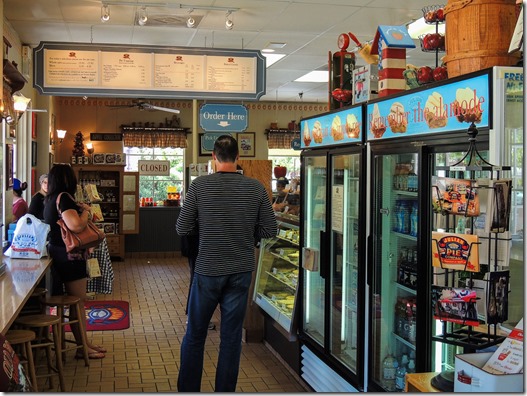
We reached the town of Santa Ysabel around 10:00 am and the first this we did was head for the Apple Country Restaurant for a hardy breakfast at a very reasonable cost. After breakfast we walked about 20 yards to the Julian Pie Bakery just north of the restaurant.

The Julian Pie Company became a reality for Liz Smothers in September of 1986. It all started when she and a neighbor began peeling apples for a local pie shop where she was soon employed to bake and sell pies. Tim, her son worked after school rolling dough. Liz’s husband Keith had a full-time job at the time working for AT&T. That would soon change as be began the study the art of orcharding. It should be noted that Julian, California is famous for its apple orchards and its apple cider.

Recognizing her expertise, two other pie shops hired her to bake for them. While Liz enjoyed the activity and baking for the pie shops, she had a desire to be creative on her own and not merely bake someone else's pie. With the assistance of a friend and emphasis on quality control and clean, neat surroundings, the Julian Pie Company began.

In 1989, Keith and Liz purchased an apple farm and with the help of son Dan, 17,000 trees were planted to supply fresh apples for the pie shop. While the orchard occupied much of Keith’s time, Liz’s expertise was in the kitchen ensuring quality control. Her goal was to produce a pie that would capture the essence of the small mountain town of Julian.

Being the youngest of eight children, Liz attributes the love of pie making to her mother. "One of my fondest memories is standing on a box beside my mother putting leftover pie dough in a metal jar lid to make a pie." Today she attributes the success of the pie shop to her dedicated team of bakers and staff.

On any given day you will find Dave, the oldest son, managing the Julian shop while Tim, the youngest son, heads up operations at the Santa Ysabel location. Daughter-in-law Brandi assists with the bookkeeping. Eldest daughter Joni and son Dan, while still supportive of the business enjoy other levels of success as an author and an electrical engineer.

Liz, while still participating in her love of pie making, leaves much of the overall operations to son Tim. Today she continues to oversee quality control and customer satisfaction and in addition serves as a consultant and primary resource for start-up businesses.

With a growing demand for Julian pies in local markets, the need to expand the production resulted in the opening of the Santa Ysabel facility in 1992. Keith was instrumental in helping Liz open this second location for the Julian Pie Company. Together they designed and purchased equipment for this new facility. In those early days Liz would bake the pies and Keith would deliver them. Julian Pies now delivers pies to San Diego and Riverside counties as well as shipping pies throughout the United States via their Internet site.

The Pie Companies busiest time of the year for Liz and her 45 employees is Thanksgiving. Ten days prior to Thanksgiving the “Thanksgiving Bake” as Liz calls it begins. During this period an average of 35,000 pies are baked and shipped and the bakery in Santa Ysabel

The Pie Company runs 24/7 during this period. Hundreds of pies are baking in the ovens while dozens of employees, each with a very specific job, work on an assembly line basis to get these pies out the door and to the Thanksgiving Day table. The vast majority of these pies are shipped via Federal Express to the on-line customers and the 79 retail outlets across the country with the Albertsons’ supermarket chain being their largest retail customer.

It starts at the “18-wheeler peeler”, a huge machine where apples are put in two at a time and the machine peels and cores them. The apples must be 2-5/8 inches in diameter for the machine to work properly and the staff makes sure that no seeds or peels are left. People don’t like seeds or peels in heir pies.

When possible, The Julian Pie Company use locally grown apples but there aren’t nearly enough apples to meet the demand, so most of the apples come from other parts of the country. Also different apples are used for different pies.

In 2007 the company invested in four massive ovens, each of which can bake 120 pies at a time. The pies rotate in the ovens as air circulates, ensuring that each pie is browned exactly the same way.

Each pie weighs 2.85 pounds or very close. He pies are made by hand, which means their weight might be off by a slice or two. A mixture of apple cider and egg whites is bushed on the tops of many of the pies to give the crust a golden brown color when baked. But it’s the crumb-toped pies that are the big sellers by a ratio of 2:1. According to Liz Smothers it’s the crumb-toped pies that keep them in business

Everything is made in units of ten for quality control. Ten pie crusts at a time — a bowl of crumb topping for ten pies.

The company does very little advertising, but it has been written up in many food and travel magazines and the Food Network cable channel did a documentary about the company in 2001.

The Julian Pie Company sells approximately 400,000 pies each year and at $14 dollars per pie that’s a gross revenue of $5.6 million dollars per year. They use 175,000 pounds of flour, 127,000 pounds of sugar, and 800,000 apples each year. And all of this comes from this approximately 5.200 square foot facility located on the little town of Santa Ysabel (33 6 35,-116 40 28)

I had been to the Julian Pies shops in Julian and Santa Ysabel before but this time I wanted to learn more about the pie baking business so I took some time to question the sales girl while Kathy and Gwen were seeking out the pies they wanted to purchase. Kathy wanted a pie to take home and eat (I suggested the apple/peach crumb) and Gwen wanted a frozen apple pie to take to her friend in Albuquerque on Monday. (Yes, they sell frozen unbaked pies that you can bake at home with instructions packed with the pie). She also purchased a dozen of their scrumptious apple doughnuts.

The sales girl was very knowledgeable of the company’s history and business practices. As the sales room was not too busy at this time she was able to spend some time giving me the information I was asking for.

Almost all their pies contain apples. Their pie menu includes:

The original traditional apple pie like grandma used to make with Granny Smith apples. This is their legacy apple pie.

Dutch, same as original apple pie, but has a sweet crumb top.

Natural, made with sweet apples and sweet apple cider. No preservatives, artificial flavors or sugar added. Tastes like a sweet apple cooked in its own juice.

Boysenberry Apple, a layer of boysenberries, topped with apples, has a crumb top.

Pecan pie with fresh pecans in a rich flavorful filling.

Strawberry Rhubarb, old fashioned favorite with sweet strawberries and tart rhubarb, has a flavor all its own.

Pumpkin Pie, a holiday favorite, has a rich spicy flavor.

Peach Apple, sweet sliced peaches layered with apples, has a crumb top. This is one of my favorites.

Apple Mountain Berry, Raspberries, strawberries and boysenberries tossed with apples and has a crumb top. This one is really good.

Raspberry Apple, whole raspberries layered with apples. Has a crumb top.

Cherry Apple, with tart Michigan cherries layered with apples and has a crumb top.

Blueberry Apple Crumb, whole blueberries mixed with tart apples with a sweet crumb top.

Blueberry, a pie packed full of blueberries to satisfy your blueberry craving with a crust top.

Blackberry, a country favorite bursting with flavor with a crust top.

To view a full on-line menu of their pies with clickable thumbnail images click here.

If you want to take the time to visit one of the Julian Pies stores here are the addresses.

Julian

Julian Pie Company 2225 Main Street, Julian, California (760) 765-2449

Santa Ysabel

Julian Pie Company 21976 Hwy. 79, Santa Ysabel, California (760) 765-2400

You don’t have to buy a whole pie as they sell slices that can be eaten with a cup of their various coffees at counter or on the patio of the Julian store. However, I think after tasting a slice of a Julian Pie you will want to take one (or two) home. A trip to Julian for a breakfast or lunch and a pie makes a relaxing day to get away from all of the hustle and bustle in life.

Photo Gallery

DSCN0094

The Apple Country Restaurant

DSCN0089

The Julian Pie Company – Santa Ysabel

DSCN0099

Some of the pies

DSCN0101

Caramel Apples

DSCN0103

The sales office and counter

DSCN0105-Edit

The friendly sales girl

For a complete gallery of photos click here

Monday, October 15, 2012

Ending Union Dominance In The Golden State

"When plunder becomes a way of life for a group of men living together in society, they create for themselves, in the course of time, a legal system that authorizes it and a moral code that glorifies it." — Frederic Bastiat, The Law, 1849.

There is no doubt that California is broke. California’s GDP once ranked 5th in world ranking has now slipped to 9th behind Brazil. Once ranking first in average income California has fallen to 17th ($43,647 per year) behind North Dakota, ranked at 7th.with $47,236 per year and Wyoming at 6th with $46, 898 per year. (Connecticut ranks 1st with $57,902 per year.) But, California has the largest budget deficit in the nation at $10 billion and this does not include the unfunded liabilities for government worker’s pensions and life-time healthcare.

Keep in mind that these numbers are for the state at large and do not include counties, cities, and school districts — and in California that number is astronomical. In fact is so bad that three major cities; San Diego; and San Jose have passed ballot measures reducing the impact of civil service workers on their budget and Stockton has declared bankruptcy.

One of the reasons California is in the mess that is in today is the tremendous amount on influence the unions have on Sacramento. The unions with the most influence are the public sector unions, teachers unions, and SEIU. Without the money and voting numbers these unions are able to bring to the polls each election California would be a red state and Jerry (“Moonbeam”) Brown would not be governor. In 2010 Brown won by more than 1.3 million votes (53.8%) and there are an estimated 900,000 SEIU members in the state, including nurses and hotel workers.

From the outside looking in, you have to admit that something is a little "off"Jerry Brown in California politics. In the year 2010, while voters nationwide swept Republicans into office high and low, voters in California kept Democrats in office, with the numbers in the California House delegation remaining exactly the same. Not only did Californians re-elect far-left U.S. Senator Barbara Boxer, but California voters also dusted off and voted back in as governor a relic from the 1970's, Jerry "Moonbeam" Brown. Californians preserved a Democrat majority in the California Senate and even added to a Democratic majority in the Assembly. And I am sure Obama will carry the golden state by the same margin.

When my wife and I arrived in California in 1962 the political climate was much different. California was a “fair and balanced” state. Pat Brown, a Democrat, was governor and the state was moving forward with water and transportation projects. People, by the thousands, were migrating to California to find opportunities for a better life and to enjoy the favorable climate.

When my wife and I arrived in California I took a job with the California Division of Highways (now Caltrans) as a surveyor and highway engineer. During my 10 year tenure with Caltrans I served under Pat Brown and Ronald Reagan and I did well, advancing in my profession and providing for my expanding family.

After 10-years I had had enough of civil service as I became disenchanted with the culture and the desire to begin my own consulting civil engineering and surveying business, which I did along with two partners. Things went well for my partners and me as we grew the business to 100 employees by 1980. Then with the election of Jimmy Carter and his disastrous economic policies and mortgage interest rising to 22% our business began a rapid decline as most of our clients were land developers and home builders. By 1982 we had declined to ten employees and one of my partners had decided to look for other opportunities. I had to look for another form to merge with.

In 1982 I was able to strike a deal with another firm suffering from the same effects of the Carter economy and for the next 22 years I served as a principal and director of our combined forms and by the time I retired we had grown to over 800 employees with offices throughout California and in Arizona, Nevada, and Colorado. I was responsible for developing business in the public and corporate sector due to my experience and knowledge in the transportation sector and my disdain for working in the land development sector of the business. My clients were now federal agencies, state and local governments, utility companies, and large A&E firms such as Bechtel and Parsons Brinkerhoff.

Jerry (Moon-Beam) Brown, Pat Brown’s son was inaugurated as the 34th governor of the State of California on January 6, 1975 and things in California began to go downhill. There is a saying, when talking about the similarities between a father and a son that states “the apple does not fall far from the tree.” In Jerry Brown’s case the apple fell or rolled miles away. Jerry Brown was anti-transportation and pro-government. He cancelled many of the proposed freeway projects and supported something called the Dill’s Act. In 1978, he signed the "Dill’s Act," which gave California public employees the right to collective bargaining. Not only did the Dill’s act allow public employee collective bargaining it laid the foundation for an economic disaster in California, defined public employee pension programs. It also insured the dominance of the Power of the Democrat Party in California.

In normal collective bargaining, say between a private sector union and a group of employers, the union negotiates with the employer on the basis of what will be financially beneficial for both parties. This means that the union knows it cannot ask for more than the employer can afford without going out of business and ending the jobs for the union employees. This was the case in the 70’s when the auto workers kept pushing the American auto makers and the auto makers kept giving into the unions and increasing the prices of their cars. As the prices rose the door opened for foreign auto makers to move in with less expensive and more reliable cars. As the Japanese auto makers began to erode the market for the American car makers they began opening plants in the United States, and these plants were non-union shops. To this day these Japanese (now Korean and German) auto plants remain non-union and their employees have resisted all attempts by the UAW to organize them into the union.

This is not the case with public sector unions. Here the union representative negotiates with the employer in the same manner as the private sector. The one big difference is the employers are the politicians who are supported with union money, money that is coerced from the employees whether they like it or not and then donated to the same politicians that will determine their wages and benefits. It’s a closed loop.

The public service and teachers unions also pose a monopoly on the work they perform. As two examples are the teachers unions and in A&E services. The teachers unions, through their massive political donations to the Democrat Party have been able to stifle school vouchers and the establishment of charter schools where non-union teachers are hired. This has been done to the detriment of our K-12 education system.

Architect and Engineering services are a more egregious abuse of the public service unions. Federal, state, and local governments need A&E services to design and construct buildings, highways, dams, subways and other civil works. As these projects vary in intensity and number it makes no sense to for government to maintain high level of workforce. This is why these agencies will outsource his work to the private sector where they can obtain qualified professionals. State highway departments outsource and average of 50% of these services to the private sector to avoid staffing for peak levels and then maintain these civil servants for twenty-five to thirty years and paying them for doing nothing. This also greatly adds to the liabilities for defined pension programs that are breaking the budgets of state and local governments. (See the Tale of Two Cities)

California's governor Schwarzenegger commissioned a study by Stanford University, which has found that California's three public employee pension funds (The California Public Employees' Retirement System [CalPERS], California State Teachers' Retirement System [CalSTRS], and University of California Retirement System [UCRS]) lost $109.7 billion in portfolio value in one year (June '08 to June '09) and are currently in shortfall of "more than half a trillion dollars."

By law, California taxpayers are required to pay the public employees' pensions shortfalls that may occur. Local governments cannot "print money" as the federal government does to cover budget deficits.

In the State of California less than 10% of these A&E services are outsourced to the private sector. This is due to the power of the PECG (Professional Engineers in California Government), the public service union representing architects, engineers, surveyors, and mappers. Due to PECG’s money and power Caltrans is over-staffed by at least 30%-40%. The currently have a workforce of about 22,000, a workforce that should be somewhere around 14,000 or less. While this does not sound like a big deal you should consider that these 8,000 employees with be there for 25 to 30 years and then draw a defined pension and health care benefits for the remainder of their lives. Currently one-third of the Caltrans $11 billion dollar budget is devoted to salaries of civil service employees. As for the monies owed for pensions and health care you need to look at CalPERS, California’s combined pension program.

I had a very personal experience with the power of PECG in 1997 when the California Supreme Court upheld a 1990 decision by a Sacramento Superior Court, Eugene T. Gualco. The court found that since the 1986-1987 fiscal year, Caltrans has unlawfully contracted privately for engineering projects that the civil service has traditionally done;  that by hiring more civil service employees, Caltrans could have the work at issue performed in a timely manner, and that Caltrans failed to justify private contracting on a cost-effectiveness or other valid basis.

The trial court also found that Caltrans undertook private contracting as a direct result of “gubernatorial/executive branch policy against the expansion of state government,” which required Caltrans to “balance and temper” its requests for funding for additional staff by contracting with private entities, without regard to whether qualified persons were actually available for civil service employment or whether Caltrans could assimilate and train them in a timely manner. The court found insufficient evidence to support Caltrans's contentions that (1) its increased project workload involved short-term or temporary work that private contractors could perform most economically and efficiently, or (2) private contracting would allow Caltrans to perform its work in a more timely and effective manner than hiring new civil service staff.

Thus, on April 17, 1990, the court issued a permanent injunction prohibiting Caltrans from (1) contracting privately for engineering and inspection services for highway projects unless the work was to be performed in compliance with the then existing criteria set forth in section 14101 and former section 14130 et seq.;  (2) entering into cooperative agreements with local entities when private entities were to perform part or all of the work;  and (3) awarding contracts to private entities for construction survey staking.

As I mentioned above I was developing a book of business with public agencies and in one court decision I had $7 million dollars in contract value wiped off my desk — work I and my firm were well qualified to perform and a lesser cost than the public sector.

This did not sit well with the California voters and in 2000 they approved Proposition 35 by 55.2% to 44.8). Prop 35 amended the California Constitution by eliminating several restrictions that had previously prevented the state government and local governments throughout the state from contracting with private entities for engineering and architectural services. Under the terms of Proposition 35, at any time that a California government agency awards a contract to a private entity, the government agency first has to go through a competitive selection process.

Still, to this day PECG fights any efforts of Caltrans to outsource more than 10% of its work. According to the American Council of Engineering Companies of California, both the bipartisan Legislative Analyst’s Office (LAO) and the State Auditor have previously recommended that the state can make meaningful savings at Caltrans — money that the state could put to better use in actually rebuilding its crumbling infrastructure. The LAO, for example, has concluded that Caltrans is way overstaffed and recommended cutting Caltrans staff by 1,500 positions for a savings of approximately $200 million per year. That proposed reduction would be more than 4.5 times the size of the governor’s proposal.

The ACEC says that Caltrans management itself has also recognized that the department needs to shift more of its engineering work to the private sector in order to better manage project and personnel workload. Management last year asked to be able to contract up to 20% of its workload to the private sector instead of the 10% historically contracted out. Gov. Brown’s proposal will result in Caltrans being able to contract out just 11% of its work, according to the ACEC.

Caltrans today is actually an anomaly, says Paul Meyer, executive director at ACECC. “Nationwide, state departments of transportation use private engineering firms on average for more than 50% of their workload,” he says. DOTs realize, he adds, that with a private firm after a project is satisfactorily finished, the state has no further financial obligations, such as public employee pensions and lifetime health care.

In addition, the LAO and State Auditor have also pointed to systemic inefficiencies in Caltrans’ operations. Until addressed with meaningful reforms, these will continue to hamper the department’s ability to accurately account for project costs and limit its efficient operation, the ACECC says.

Meanwhile, the California Transportation Commission is taking up the challenge of raising public awareness with its first “Needs Report” since 1999. The 191-page report covers roads, highways, bridges, airports, seaports, railways, border crossings, and public transit infrastructure, warning that further decay and a deterioration of these transportation systems “may take many years to recover.” The reality is that, in the aftermath of the “Great Recession,” the public has lost its focus on big picture issues like the transportation system, says the CTC.

“California’s transportation system is the largest and most complex in the nation. Historical investments in freeways, roads, bridges, rail systems, airports, public transit, and other transportation infrastructure have fueled the state’s phenomenal economic growth in recent decades. But times have changed,” the CTC notes.

“Today, California’s transportation system is in jeopardy,” the report continues. “Investments to preserve transportation systems simply have not kept pace with the demands on them, and this underfunding — decade after decade – has led to the decay of one of the state’s greatest assets.”

The State Auditor recently released a lengthy, highly critical report on Caltrans’ spending on project “support” costs, which is primarily spending on Caltrans’ own employees. This spending is important. When “support” spending is too high, that takes money away from actually constructing new projects and creating new jobs.

Here are some findings along with comments:

“Caltrans exceeded their own budgets for project support on 62 percent of their projects. [Editor’s note: This is your gasoline tax money they are wasting]

The legislature's annual arbitrary imposition of a 10% cap on the use of outside consultants actually ends up reducing Caltrans' flexibility. [Note: That may be why Caltrans has hired an excessive number of full-time, long-term employees — and thereby taken on the huge liability of their long-term pension costs. The 49 other state departments of transportation know well how inflexible and expensive the Caltrans model is, and so they regularly use consultants for 50 to 60 per cent of their workload.]

Caltrans' time-reporting system lacks strong internal controls — and consequently no one really knows to what extent Caltrans’ employees are correctly charging their time to projects.

Caltrans also failed — in each of the last three fiscal years — to meet its own goal: a maximum of 32 per cent in the ratio of support costs to total project costs. That is a strong sign that Caltrans is overstaffed. [Note: Last year the Legislative Analyst’s Office (LAO) found that Caltrans was overstaffed by at least 1,500 personnel years (PYs), the equivalent of approximately $300 million/year.]

Another problem with support costs is that Caltrans may be comparing apples to oranges. The State Auditor found that from year-to-year Caltrans fails to use a consistent method to calculate the ratio of support to total costs.

The State Auditor made a series of recommendations to address these findings, including that Caltrans should not hire permanent staff beyond its long-term need for such staff.

The report further states that the Legislature should give Caltrans the leeway to hire consultants to meet its temporary workload increases — a recommendation with which Caltrans to its credit agrees. Now it is up to the California Legislature to act on it.

The report also recommends that the state commission an independent study of the costs and benefits of using consultants. Although Caltrans was not thrilled with that idea, Caltrans does note that “consultants pay for and bring their own tools, equipment and office space to the job — all of which are cost items for the taxpayer to support staff positions. Outside consultants also take care of their own healthcare costs and pension obligations; both “big ticket” items and something the report reminds us are also not included in Caltrans’ staff cost estimates.”

To download a copy of the State Auditor's report, which was released on April 28, click here.

As Joel Kotkin writes in his excellent article in the City Journal:

“California has long been a destination for those seeking a better place to live. For most of its history, the state enacted sensible policies that created one of the wealthiest and most innovative economies in human history. California realized the American dream but better, fostering a huge middle class that, for the most part, owned their homes, sent their kids to public schools, and found meaningful work connected to the state’s amazingly diverse, innovative economy.

Recently, though, the dream has been evaporating. Between 2003 and 2007, California state and local government spending grew 31 percent, even as the state’s population grew just 5 percent. The overall tax burden as a percentage of state income, once middling among the states, has risen to the sixth-highest in the nation, says the Tax Foundation. Since 1990, according to an analysis by California Lutheran University, the state’s share of overall U.S. employment has dropped a remarkable 10 percent. When the state economy has done well, it has usually been the result of asset inflation—first during the dot-com bubble of the late 1990s, and then during the housing boom, which was responsible for nearly half of all jobs created earlier in this decade.

….

What went so wrong? The answer lies in a change in the nature of progressive politics in California. During the second half of the twentieth century, the state shifted from an older progressivism, which emphasized infrastructure investment and business growth, to a newer version, which views the private sector much the way the Huns viewed a city—as something to be sacked and plundered. The result is two separate California realities: a lucrative one for the wealthy and for government workers, who are largely insulated from economic decline; and a grim one for the private-sector middle and working classes, who are fleeing the state.”

Much of this malaise in California is due to the passage of the Dill’s act and the power of the public service unions.

There are 13 initiatives on the California ballot this year. I do not usually note for these ballot measures as they end up being “not as advertised” and have numerous unintended consequences. However, there is one ballot measure I will surely vote for —Proposition 32. Prop 32 goes as far as the Constitution allows by severing the money tie between special interests and career politicians by:

  • Prohibiting unions and corporations from giving to candidates
  • Prohibiting unions and corporations from deducting money from employee paychecks for political purposes without permission, making all political contributions truly voluntary
  • Prohibiting contractors from contributing to politicians who approve their contracts

The disconnect between the demands of the unions and those of California voters is what backers of Proposition 32 hope to remedy with their proposal to end all union and corporate donations to candidates, and to end automatic union and corporate deductions in paychecks for political contributions.

If this all sounds familiar, it should. Similar California ballot measures have been proposed and have lost in the past. Both Proposition 226 in 1998 and Proposition 75 in 2005 went down to defeat, thanks to unions outspending the proponents 4 to 1 in the case of Proposition 226 and 10 to 1 in the case of Proposition 75.

So what is different this time? For one is the momentum gained from Wisconsin's battle with unions. A similar measure passed in Wisconsin under Gov. Scott Walker, and Wisconsin Republicans who favored the measure survived a recall. The knowledge that this measure may actually pass may inspire supporters to actually cast their votes for Proposition 32.

Also, unlike with prior measures, in addition to paycheck protection, Proposition 32 also prohibits corporations and unions from contributing to candidate campaigns, so this measure is more even-handed. Proposition 32 also prohibits contractors from contributing money to the politicians who will award contracts.

Another difference this time is Gloria Romero, former Democrat state senator and major supporter of Prop. 32. As California's Senate Democratic majority leader from 2001-2009, she saw first-hand the public-sector union corruption in Sacramento. "There is no other way to say it politely," she recently told the Wall Street Journal. "It's owned." Both in office and later as head of the California chapter of Democrats for Education Reform, Romero has fought for education reform in California, including the ability of parents to take their kids out of failing schools, but has butted heads with the CTA (California Teachers Association) and other public-sector unions many times. The CTA "has killed or hijacked nearly every reform bill that has popped up in the legislature," she told the Journal. CTA officials "walk around the capitol "like they're God."

Romero has been featured in a very effective ad supporting Prop. 32, in which she challenges the voter: "if you want to take back California from the special interests, if you want to get big money out of California politics, if you want elected officials to answer to the people again join me in voting yes on Proposition 32." It is almost enough to make non-Californians move to California so they can vote for Prop. 32.

Romero's ad is the only Prop. 32 ad that directly takes on the teachers' unions. Other Prop. 32 ads target the prison guards union and the large corporate campaign donors, and they are all very effective.

This time around, California also has some home-grown momentum. Earlier this summer San Diego and deep-blue San Jose, California passed ballot measures that kept union pensions from swallowing up their city budgets. In the case of San Jose, the results were not even close: 70% voted in favor of limiting union pensions. Suddenly the old union demagoguery didn't work in cities that wanted to keep their same city services along with manageable union pensions, and not raise taxes to pay for it all.

So far, Prop. 32 is still polling even with Californians. But the unions are putting up a fight. While Proposition 32 proponents have raised a meager $5 million, opponents to Prop. 32 have amassed $36 million to use in campaigning the issue, with millions more in union dues to come. That is a lot of money to pay for TV commercials with worried-looking teachers and nurses groveling before Californians, begging the citizenry not to cut their pay.

There is a saying in California: "as California goes, so goes the country." Well, admittedly, that phrase may have itself spread across the country more than actual California policies. But you have to admit that California's 1978 victory with Proposition 13 in 1978 spread some tax-cutting frenzy, culminating in tax cuts that were passed under President Reagan in 1981. It could be that passing Proposition 32 in California could be the next step in regaining control of America's states from out-of-control unions.

Thursday, June 28, 2012

The Tale of Two Cities

"Most bad government has grown out of too much government.” — Thomas Jefferson

A Tale of Two Cities is a novel by Charles Dickens, published in 1859, set in London and Paris before and during the French Revolution. With well over 200 million copies sold, it ranks among the most famous works in the history of fictional literature.

The novel depicts the plight of the French peasantry demoralized by the French aristocracy in the years leading up to the revolution, the corresponding brutality demonstrated by the revolutionaries toward the former aristocrats in the early years of the revolution, and many unflattering social parallels with life in London during the same time period. It follows the lives of several protagonists through these events. The most notable are Charles Darnay and Sydney Carton. Darnay is a French once-aristocrat who falls victim to the indiscriminate wrath of the revolution despite his virtuous nature, and Carton is a dissipated British barrister who endeavors to redeem his ill-spent life out of his unrequited love for Darnay's wife. The 45-chapter novel was published in 31 weekly installments in Dickens' new literary periodical titled All the Year Round. From April 1859 to November 1859, Dickens also republished the chapters as eight monthly sections in green covers. Dickens' previous novels had appeared only as monthly installments. The first weekly installment of A Tale of Two Cities ran in the first issue of All the Year Round on 30 April 1859. The last ran thirty weeks later, on 26 November.

My tale of two cities is not about the French Revolution, Robespierre or goutiness. It is, however, about aristocrats and peasants. Think of the aristocrats as the statist, utopians, and masterminds and the peasants as the taxpayers. As in Dickens’ novel the aristocrats are forcing tyranny upon the citizens and the citizens’ only recourse is at the ballot box. This is not working very well.

The cities I refer to are not London and Paris, but Stockton, California and Sandy Springs, Georgia, cities almost 2,000 miles apart. I will begin with Stockton. Once a thriving community located at the north end of California’s Central Valley and a virtual suburb of Sacramento Stockton, as city of 290,000 people is declaring bankruptcy. It is out of money and can longer meet its debts or obligations. Fox News reports:

“Officials in Stockton said Tuesday that mediation with creditors has failed, meaning the city is set to become the largest American city ever to declare bankruptcy.

City Manager Bob Deis said officials were unable to reach a deal to restructure hundreds of millions of dollars of debt under a new state law designed to help municipalities avoid bankruptcy.

Monday marked the three-month deadline for negotiations.

"Unfortunately we have no comprehensive set of agreements with our creditors that would eliminate the deficit and avoid insolvency," Deis said at a City Council meeting. He said, however, that the city was still negotiating with some creditors and could reach deals with as many as one-third of them.

"We think Chapter 9 protection is the only choice left. If we get any agreements, those will be honored in Chapter 9," Deis said.

The Council was expected to vote later on a special bankruptcy budget to plug next year's anticipated $26 million deficit.

The budget is expected to suspend debt payments, reduce payments for retiree medical benefits and increase revenue through code enforcement and parking citations, among other steps.

City lawyers could file for Chapter 9 protection in court as soon as Wednesday.

The river port city of 290,000 in Central California has seen its property taxes and other revenues decline, while expensive investments and generous retiree benefits drained city coffers.

In the past three years, officials in the city that was slammed by the collapse of the housing market dealt with $90 million in deficits through a series of drastic cuts.

They eliminated one-fourth of the city's police officers, one-third of the fire staff, and 40 percent of all other employees. They also cut wages and medical benefits.

To plug next year's anticipated $26 million budget shortfall, a proposed budget to be considered Tuesday night would suspend payments for debts and legal claims, reduce payments for retiree medical benefits, further cut some pay and benefits, and increase revenue through code enforcement and parking citations.

The proposed budget includes no major service reductions, Deis said earlier.

"The whole purpose of filing Chapter 9 is to avoid an uncontrolled chaotic situation," he said. "Bankruptcy provides the equivalent of a pause button. It retains services and provides structure so you don't have a bunch of lawsuits."

City officials say the city has run out of options. In recent years, thousands of new homes mushroomed in Stockton, part of a suburban housing boom that attracted buyers from the San Francisco Bay area and beyond.

When the economy crashed and the construction bubble burst, Stockton was battered by foreclosures and lost income from property taxes and other fees.

Multi-year labor contracts for city workers carrying escalating costs and generous retirement plans added to the burden.

In addition, expensive city investments -- a promenade, sports arena and hotel -- failed to produce an economic boon.

The city also has high crime and unemployment rates. It has twice topped Forbes magazine's list of "America's most miserable cities."

Under a bankruptcy filing, officials would retain power over day-to-day city operations and staffing, but a judge would take over all decisions concerning the city's debts, said Robert Benedetti, professor of political science at the University of the Pacific in Stockton.

The judge would decide which creditors should be paid, how much and in what order. He would make allowances for expenditures needed by the city to function, and it would be up to city officials to decide how to spend that money.

"One of the reasons a city might want to go the bankruptcy route is that they don't want a situation where they have to pay out debts and have to close the police or fire department," Benedetti said. "Filing for Chapter 9 means you're asking the court to protect you against lawsuits from people who hold your debt."

Stockton's bankruptcy would make it the largest city by population to file for Chapter 9 protection, according to Jim Spiotto, a Chicago bankruptcy lawyer who tracks such cases. He said Bridgeport, Conn., was the largest city to file for bankruptcy, which it did in 1991, followed by Vallejo, Calif., which filed in 2008.”

For years Stockton, like many cities in California and the nation, has been run by utopians and masterminds who have spent like drunken sailors and passed out entitlements like Chinese fortune cookies, with the biggest entitlement of all being the defined benefit and pension programs given their public union employees. All went well while the spending spree was going on, but when the recession hit in 2008 the city went into a tailspin.

As mortgages defaulted the tax base shrunk and the entitlements continued to escalate, especially for the unemployed and welfare class. As the State of California is also broke Stockton could and not expect any help for the state, nor should they. They made their bed with the public service and teachers unions and now they can lay in it.

2,000 miles away lays the town of Sandy Springs, Georgia located just to the north of Atlanta. The left-leaning Huffington Post reports:

"In 2005, decades after Sandy Springs first attempted annexation to Atlanta, the Republican-dominated Georgia state legislature allowed the city, located adjacent to Atlanta, to break off and become a largely autonomous, self-governing entity.

Scrambling to ready themselves for the division, Sandy Springs effectively privatized the large majority of the municipal services by entering into a public-private partnership with CH2M HILL, a full-service operations company that now controls nearly all of the once-public sector, from road maintenance to cleaning up trash in the park.

"Nobody likes change," Sandy Springs Mayor and former economist Eva Galambos told Reason, a libertarian magazine. "But, if your city is fiscally bankrupt, there may have to be some change."

The city, sixth-largest in the state with a 2010 population of 93,853, wanted to separate itself from what it saw as wasteful government spending in surrounding communities. The city benefits greatly, though, from the number of Fortune 500 companies headquartered there, boasting an extremely high per capita income, with the median family household income, according to a 2008 census estimate, approximated at $129,810, and the average family income $169,815.

Comparatively, the surrounding Fulton County has a median family income of only $58,573. The median national income is $49,777.

Adding to that, only 3.1 percent of families — 7.9 percent of the entire population — live below the poverty line in Sandy Springs. The percentage of Fulton County families living in poverty, in comparison, is nearly four times higher at 11.5 percent. Without needing to provide to as many poverty-stricken families, who typically use more public services, Sandy Springs can more easily keep taxes at a lower, sustainable level.

Not all of Sandy Spring's public services have been privatized, however. Public safety continues to be handled by government police officers and firefighters, and the Fulton County School System still operates public schools within the city, something not noted in the below video by Reason magazine. Mayor Galambos also notes the city "made a clear decision" to not hand out "defined benefits" of any sort to police officers and firefighters, in order to keep taxes low and avoid future obligations.

In light of municipal budget crises wreaking havoc across the country, the fiscally-conservative Sandy Springs government is proud of their radical decision, which they say has left them with no long-term liabilities. The $25 million they paid to CH2M HILL for one year's work, Reason argues, is less than half what they would pay in a typical, government-run scenario.

Since 2005, four surrounding Georgia cities have adopted the model.”

I have written about Sandy Springs in the past so I will not give much time to how this Georgia city is fighting against the public sector unions by just not having any public sector employees of the city’s payroll, they outsource most all of the city’s services with the exception of police and fire. You can read that blog by clicking here.

For years government including federal, state, county, and municipal outsourced most of its needed public service needs to private contractors. This included public works, legal, accounting, maintenance, and construction. It usually excluded fire and law enforcement except for municipalities having volunteer fire departments. Even law enforcement was outsourced by some smaller towns and cities to county sheriffs’ or to an adjacent city’s police department.

I recall a close friend of mine who was the mayor of a small city in Orange County, California. The town did not have its own police department and was not in a financial position to form one. She was approached by the Orange County Sheriffs’ Department with an offer to contract for the town’s law enforcement. She was not happy with the OCSD’s offer so she put the contract out to bid to several adjacent cities. She selected one of the adjacent cities as their offer posed the best for cost and service and subsequently gave the contract to them. The OCSD was not too pleased with her action, but she obtained the best deal for the city. This is the way it used to work and still does in many parts of the country.

With the growth of the public service unions, in power and numbers, across the county since the early 1980’s cities, counties, and states have been sliding down a deep abyss into higher costs for public service and the real millstone of the liabilities for their unfunded defined benefit programs of pensions and lifetime health care.

Lately states such as Wisconsin and Indiana have begun to reverse this trend much to the hew and cry of union leaders and progressives who garner much of their political support from these unions.

On the same day the people of Wisconsin voted to support Governor Scott Walker in his battle against the public service unions the people of San Diego and San Jose voted by an overwhelming majority to curtail the influence and cost these unions are imposing on the cities. Too bad Stockton did not take this action years ago, but they were just too close to Sacramento – the home of public service unions and Jerry Brown.

Many cities and towns outsource most of their public service needs. When I was in business running a consulting engineering and land surveying firm we worked for some of these cities by providing civil engineering and land surveying. It was their belief that if you could buy something through the Yellow Pages, especially from a local business, there was no need to provide those services by in-house, permanent staff – a staff they would have to support until the day they died.

In years past government outsourced almost everything to qualified contractors from Jefferson giving Lewis and Clark a contract to explore and map the lands he purchased from Napoleon in the Louisiana Purchase to the surveying the lands for incorporation into the United States Rectangular Survey System, building of the Transcontinental Railroad, Hoover Dam, the Interstate Highway System, and thousands of other public works including your local post office. Government provided the funds for these projects, but not the public service employees. The planning, design, engineering, and construction was carried out by the private sector.

Consider the interstate highway system as a classic example of how this system worked and should work. In 1956 Congress passed the Interstate Highway Act and it was signed into law by President Eisenhower. The law imposed a federal tax on fuel and trucks. This tax would be collected by the federal government and placed in a Highway Trust Fund. This money was then apportioned out to the states to construct modern, four lane divided highways. The apportioning was done on the need for the highway and the and the state’s ability to pay for the highway. In this case some states were considered donor states, while others were deemed recipient states. As example the larger, more populous states like California, New York, and Illinois were donor states and states with small population such as Montana, Wyoming and Nevada were considered recipient states. This was considered fair and necessary as you could not have a true interstate highway system if the roads were not connected through the lesser populated states and if you did not purchase fuel you did not contribute to the Fund.

The monies from the Fund were usually apportioned back to the states on a 90-10 basis – 90% federal and 10% state or local. The states then provided all of the design, engineering, and construction services to build the roads. Fiducial and design standards oversight were provided by the federal government through the Bureau of Public Roads (now the Federal Highway Administration). The BPR and various state highway officials through the American Association of State Highway and Transportation Officials (AASHTO) set the design and construction specifications and standards for building the system. Items such as; lane and shoulder widths, percentage of grades, sight distances, curve radiuses, design speeds, bridge clearance heights, pavement types and structural sections, signage, and minimum median widths. These specifications and standards were incorporated into the design of any highway qualifying for federal funding under the Interstate Highway Act.

As the design, engineering and construction management were left to the states he door was opened to the public employees to move in. Some states, mainly in the south, outsourced most of this work to the private sector. Other states such as California, New York, and New Jersey brought this work in-house and began to build massive bureaucracies. As an example when I worked for the California Division of Highways (now Caltrans) from 1962 to 1972 the agency had about 9,000 employees and all design, engineering, and maintenance work was done in-house. Today Caltrans has 22,000 employees and a budget of $12.8 billion dollars and the Interstate System was completed years ago. Today they outsource about 10% of their design and engineering services, and that took a court decision and referendum (Proposition 35) to accomplish that.

Throughout the ensuing years The Professional Engineers in California Government (PECG), a public service union representing 13,000 state-employed engineers and related professionals responsible for designing and inspecting California’s highways and bridges, has held Caltrans hostage by constantly fighting against and outsourcing of these services to the private sector. They claim that state employees are better qualified and will do the work for less cost is fallacious and ridiculous. The average Caltrans employee earns $100,000 including benefits, benefits that will be paid for life. Also, Caltrans has no way to reduce their in-house staff due to civil service rules, even if there is no current work for them.

While Sandy Springs is not the only municipality to outsource most of its public services it is certainly one of the best. Other towns, cities, counties, and states are beginning to see the light and eliminate their public service staff, thus reducing their costs and unfunded liabilities.