"When plunder becomes a way of life for a group of men living together in society, they create for themselves, in the course of time, a legal system that authorizes it and a moral code that glorifies it." — Frederic Bastiat
For the past two years I have been writing about the myth of high speed passenger rail. (See my blog from May 12, 2012 — “The Train to Nowhere, Part Deux”) In my May 12th blog I addressed the history of rail in the United States and talked about the proposed $7 billion dollar high speed rail from Victorville, California to Las Vegas, California. Since that time the name of the project has changed from DesertXpress to XpressWest and the United States Department of Transportation’s Federal Railroad Administration has nixed the requested $5.5 billion dollar loan.
On July 17th the Washington Post reported:
“WE’VE SEEN some bad policy ideas but not many more awful than the proposal to extend a $5.5 billion low-interest, 35-year federal loan to a West Coast start-up for a high-speed rail connection between Southern California and Las Vegas. This time, though, we are happy to report, common sense has prevailed: The Obama administration has stopped the project.
Backed by wealthy casino moguls, who in turn enjoyed the support of Senate Majority Leader Harry Reid (D-Nev.), a company called XpressWest wanted to lay tracks between Vegas and lonely Victorville, Calif., some 81 miles east of downtown Los Angeles. Several times larger than the largest amount ever loaned under the obscure federal Railroad Rehabilitation and Improvement Financing Program, the federal money would cover 80 percent of the project’s costs. The supposed public benefits were reduced carbon emissions, less auto traffic and, of course, more jobs.
What XpressWest struggled to explain was why taxpayers should bet on a proposition that private investors apparently found too risky: hordes of travelers driving to Victorville, parking their cars and then boarding the train for an 80-minute ride to Vegas — as opposed to driving the whole way, flying or taking “My Party Ride,” a limo-like bus trip for up to 30 passengers at $99 each, including food and drinks.
The whole thing had the makings of a boondoggle, for which taxpayers would eventually end up paying. Yet multiple federal and state agencies had given environmental and regulatory approvals, leaving the crucial matter of the loan up to the Transportation Department. Given the project’s political connections, DOT’s thumbs-up seemed inevitable — until June 28, when then-Secretary Ray LaHood, as one of his final acts in office, sent XpressWest Chairman Anthony Marnell II a letter saying that the department had decided to “suspend further consideration” of the loan.”
LaHood, in his June 28 letter to the company, cited "serious issues" with the application in the decision to cut the project off. He suggested the company was having difficulty ensuring that the project would be built with enough American products like U.S-made steel and iron.
Some of the letter was redacted, but LaHood also suggested concerns about the sheer size of the loan and the risk, and the company's apparent failure to submit additional documentation on other participants in the project.
"After several years of engagement with no resolution to the threshold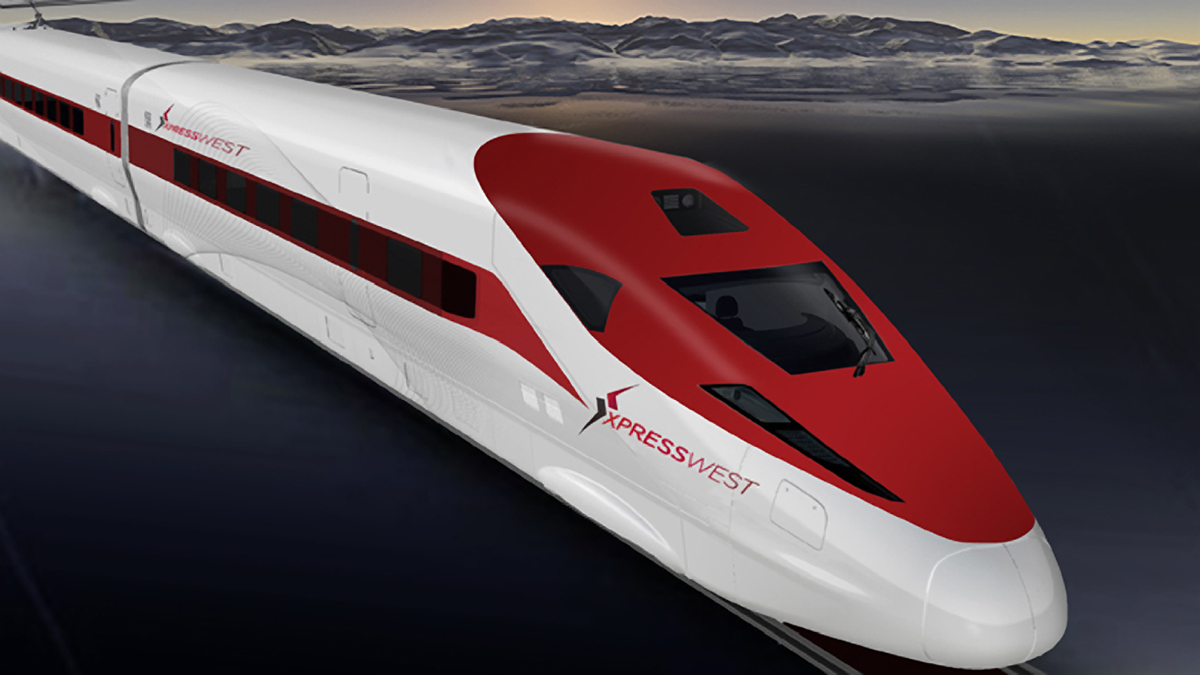
The decision is a major blow to the project, as the federal loan was expected to make up the bulk of funding for the $6.9 billion rail line.
The 185-mile line was billed as the most advanced and fastest in the U.S. According to the company, it would connect Southern California and Vegas with an 80-minute train ride.
Yet critics warned that costs could spiral and ridership projections might be too rosy, and that such a massive federal investment was not wise.
The XpressWest line is running into a wall after another project — a proposed magnetic levitation (Maglev) train with a similar route — also ran into recent problems, as state planners backed away from that project and federal funding ran dry.
Sen. Jeff Sessions, (R-Alabama), top Republican on the Senate Budget Committee, and Rep. Paul Ryan, (R-Wisconsin)., chairman of the House Budget Committee, had earlier revealed they'd been told about the department's decision on XpressWest. The two lawmakers had been among the toughest critics of the project and loan, calling it "costly, wasteful and risky."
On February 12, 2013 Laura Carroll Reported in the Las Vegas Review Journal:
“At best, it could be another 18 months before any ground is broken on the XpressWest project - the same time frame backers gave the Las Vegas Review-Journal in 2009.
The reality of a high-speed train shuttling travelers between Victorville, Calif., and Las Vegas hinges on funding of $5.5 billion from the Railroad Rehabilitation and Improvement Financing, which is administered by the Federal Railroad Administration. XpressWest's first loan application was submitted in December 2010 and is still under review.
The nearly $7 billion project will largely be financed from this loan, if approved, and the rest in private equity investment.
At Tuesday's meeting of the Las Vegas Convention and Visitors Authority board of directors, XpressWest Chief Operating Officer Andrew Mack, said it could be six months before a decision is made on the application. If approved, it would be still another year before ground is broken.
"It's really dependent on the RRIF pay," Mack said. "That's really driving the schedule.
The train would be built adjacent to Interstate 15 with service every 20 minutes and one-ways taking about 80 minutes. The average fare is less than $100, Mack said. Each train would seat between 500 and 600 passengers.
If construction eventually starts, XpressWest estimates that 80,000 direct and indirect construction jobs will be created, with a third of those going to Southern Nevadans. The estimated economic output of the rail line during its lifetime is $7.8 billion.
In Las Vegas, two potential sites have been chosen for train stations: one across from the Rio and the other across from Mandalay Bay.”
The Transportation Department later said in a statement that "XpressWest has the ability to revive its application by significantly revising its request."
The project still has a powerful supporter in Congress — Senate Majority Leader Reid, as well as Republican Nevada Sen. Dean Heller.
According to the Las Vegas Review-Journal, Reid claims the administration has not "permanently foreclosed" the possibility of an investment. He stressed Friday that he plans to keep pushing for "this vital investment." Obviously this decision is a death blow to Reid and the backers of the project — a decision I totally agree with. (See the Fox News report from March 13, 2013)
According to an August 2012 tax risk assessment by the libertarian Reason Foundation should the Victorville to Las Vegas train commercial revenues fail to pay operating costs and debt service, the project would not have enough money to repay the federal loan, resulting in a default that would make Solyndra look like small change. Taxpayers would lose up to $6.5 billion in principal and any unpaid interest, an amount that could climb to more than $7.5 billion if a full six-year deferment of repayment is granted. The Taxpayer Risk Assessment identifies a number of concerns that could result in taxpayer losses.
This Taxpayer Risk Assessment examines the financial risks to taxpayers of the proposed XpressWest high-speed rail project from Victorville to Las Vegas. There would be no need for a Taxpayer Risk Analysis without government (taxpayer) involvement. For example, if a bus company were to establish a new service between Victorville and Las Vegas, there would be no taxpayer financial exposure under normal circumstances. The company would either succeed or fail depending on its ability to cover its costs through various commercial activities. As with private loans, the ability to secure the loan depends on the bank’s assessment of its successfully pay off — a natural inhibitor of risky propositions. XpressWest is intended to be self-supporting, with the construction and financing expenses and operating expenses covered by commercial revenues, principally passenger fares. Tellingly, the project sponsors are apparently unable to arrange conventional private sector financing and seek a federal loan with a subsidized interest rate, which would pass the risks on to taxpayers if the forecasted ridership should fail to materialize. Moreover, in the event of financial difficulty, state and local taxpayers could face significant pressure to provide funding to complete the system or to subsidize its operations. Thus, a Taxpayer Risk Assessment is necessary.
This Taxpayer Risk Analysis reviews ridership, revenue and capital cost forecasts to the extent that they are available. The principal focus is on ridership, since the repayment of the proposed federal loan from taxpayers is entirely dependent upon commercial revenues, principally the fares that will be paid by riders and ancillary revenues, such as advertising.
1. A Speculative Consumer Market: The greatest risk is that the potential consumer market for the train is far smaller, in geographical terms, than is assumed in the project documentation. There is no parallel for large numbers of drivers and airline passengers to travel well outside the urban areas in which they live to connect to a train (or plane) to any destination, much less one so close to Southern California as Las Vegas. As a result, common sense finds ridership and revenue likely to be a mere fraction of forecast. This would likely make repayment of the federal loan impossible. This risk to taxpayers of an exaggerated market is “unknown, but potentially severe.”
2. Materially Changed Circumstances: Even if the consumer market were geographically as large as assumed, growth in the Las Vegas tourist market has been far below forecasts in recent years. As a result, the base ridership figures are implausibly exaggerated and need to be revised downward. The ridership and revenue risk to XpressWest from this factor is high and risks make paying the federal debt impossible, calling for a taxpayer bailout.
3. Ridership and Revenue Forecast Model Concerns: The international record indicates that rail projects tend to average approximately 39% less in ridership than forecast. Specific factors of the ridership forecast for the Victorville to Las Vegas train indicate that actual ridership is likely to be 39% to 70% less than forecasted, even after adjustment for the materially changed circumstances. These factors include an optimistic estimate of the base year market, a market growth rate greater than in pre-recession years, an optimistic assumption of attraction from cars and an optimistic bus attraction assumption. Such rosy predictions increase the likelihood that the federal loan would not be repaid.
4. Capital Cost Escalation: Capital cost escalation for rail projects has been pervasive in similar projects, suggesting that capital cost escalation is likely to occur on the Victorville to Las Vegas train, leaving the project impossible to complete and triggering a default on the federal loan. Governments (federal, state and local) would be faced with difficult decisions about whether to complete the project, at elevated costs, with public funding or to fund dismantlement of a partially completed system.
5. Likely Commercial Losses: Even if there is no capital cost escalation, it is unlikely that the business plan for this project is flexible enough to deal with all the variations discussed above without suffering either higher costs or commercial revenue shortfalls. This inflexibility could lead to a default on the federal loan with the loss paid by taxpayers. Further, political pressure to keep the train operating could lead to a federal Amtrak-style takeover with subsidies, or the train could be operated with state and/or local subsidies. The risk of taxpayer loss from this factor is evaluated at “high.”
6. Higher Cost for Highway Expansion: Use of the median of I-15 for the Victorville to Las Vegas train could preclude the most cost-effective options to expand highway capacity. This would increase costs to taxpayers and highway users. The risk of higher expansion costs on I-15 is evaluated as “moderate.”
In 1991 I was involved with the proposed Maglev line from Anaheim to Las Vegas. This was to be a cooperative venture between Transrapid (the German consortium pushing their Maglev technology), The California High Speed Rail Corporation, and Bechtel to design, build and operate a Maglev train from Disneyland to Las Vegas. The technology seemed sound but there were two major problems. One is that they could not get a permit from Caltrans to use any right of way along the I-15 corridor and two; they could not find any investors. Eventually the right of way issue was solved by an act of the California Legislature, but there still was no money coming forth.
The majority of high-speed rail lines require large government subsidies from both general taxpayers and drivers. Even with generous subsidies, traveling by high-speed rail is still more expensive than flying for 12 of the 23 most popular high-speed rail routes in the world. Evidence suggests it can only be competitive on routes that are 200 to 500 miles in length.
High-speed rail is also very expensive to build. Most new routes cost at least $10 million per mile to construct. The cheapest European rail line costs more than $50,000 per seat to operate annually. A U.S. high-speed rail line would need ridership of 6 million to 9 million people per year to break even. The high-speed Acela service, despite operating in the busy Northeast Corridor, averages only 3.4 million passengers per year.
Advocates cite other advantages for high-speed rail, but most fall apart under close examination:
Environment: High-speed rail creates more pollution than it prevents because building a high-speed rail line is very energy-intensive.
Economic development: High-speed rail does not create much new development; it merely redirects development from one area to another.
Mobility: High-speed rail is unlikely to improve mobility since most of its potential passengers already travel by air.
Choice: Customers can already choose between a low-cost bus, a fast plane or a personalized car trip.
Most countries have built high-speed rail to relieve passenger overcrowding on their existing lines. The U.S. lacks this overcrowding, which suggests consumer demand for high-speed rail may not be there. Furthermore, freight rail dominates track usage, and railroad companies are reluctant to relinquish capacity, as is evident in the discussions surrounding the proposed multimodal passenger terminal in downtown Atlanta.
Any U.S. rail operator will have to compete on the same terms that cause Amtrak to lose large amounts of money each year. Railways are subject to outdated labor laws that were enacted when railroads did not face competition. Operating a passenger railroad in the existing regulatory environment is not a profitable proposition.
Our core cities, where people are most likely to board high-speed trains, are much less dense than European or Asian cities, which also limits the potential market.
The U.S. has far higher rates of car ownership than most other countries. Gas taxes are lower, road tolls are less common, and many cities — especially in the South and West — have grown up around the automobile.
As a result, high-speed rail is best regarded as a luxury toy this country cannot afford. For far less money, we could create a world-class highway and aviation system with first-rate bus and airplane service and far more flexibility.
We’d like to think that cost and feasibility concerns ultimately derailed this crazy train, but that is not what Mr. LaHood emphasized in his letter. Rather, he faulted XpressWest for not guaranteeing that it would get steel and other manufactured goods from U.S. suppliers. We disagree with protectionist “Buy America” thinking; still, in this case it at least shows that the project’s job-creation potential was always limited by the fact that no U.S. manufacturer makes high-speed rail cars or the needed heavy steel rails and electrification systems. However imperfect his rationale, Mr. LaHood reached the right result, and that’s cause for celebration.

