Search This Blog

Thursday, July 4, 2013

What Makes The United States Exceptional

“Society in every state is a blessing, but government even in its best state is but a necessary evil; in its worst state an intolerable one; for when we suffer, or are exposed to the same miseries by a government, which we might expect in a country without government, our calamity is heightened by reflecting that we furnish the means by which we suffer. Government, like dress, is the badge of lost innocence; the palaces of kings are built on the ruins of the bowers of paradise. For were the impulses of conscience clear, uniform, and irresistibly obeyed, man would need no other lawgiver; but that not being the case, he finds it necessary to surrender up a part of his property to furnish means for the protection of the rest; and this he is induced to do by the same prudence which in every other case advises him out of two evils to choose the least. Wherefore, security being the true design and end of government, it unanswerably follows that whatever form thereof appears most likely to ensure it to us, with the least expense and greatest benefit, is preferable to all others” — Thomas Paine, Common Sense, 1776

Yesterday we learned that President Mohammed Morsi was removed from office, placed under house arrest, and the new constitution suspended by the Egyptian military. After rioting in the streets two years ago great hope was had for Egypt when the dictator president Mubarak was removed. This was labeled the “Arab Spring” by our government and media. Soon afterward a new constitution was adopted and a new president elected — Mohammed Morsi — with the support of the military and the Muslim Brotherhood.

As things worsened in Egypt with unemployment approaching 25% and foodEGYPT INAUGURATION ANNIVERSARY PROTESTS riots in Cairo and villages across the country people began becoming dissatisfied with the Arab Spring. Also the Muslim Brotherhood, which controls over 50% of the government, began to impose Sharia Law it became evident that radical Islamics were taking over the government. This caused the recent spate of riots in Cairo and forced the military to remove Morsi and suspend the constitution.

For Islamists, however, the idea of Morsi stepping down is an inconceivable infringement on the repeated elections they won since Mubarak's fall, giving them not only a longtime Brotherhood leader as president but majorities in parliament.

Like most revolutions that begin in the streets or that are influenced by outside forces the Arab Spring failed and will continue to fail. This is because these revolutions are usually based and focused on things people want not on the principles of liberty. They are dissatisfied with the rulers they have, usually because of tyrannical polices and economic conditions. The ruling class is concerned about the tyranny and the poor are concerned about bread.

If there is one extremely deceptive aspect of the American Revolution, it is that the Founding Fathers made revolution look easy. Since that fateful day, over two centuries ago, revolutions have ruffled across the globe, many claiming to follow in the ideals of the American Founders, or claiming to take their principles to a higher level. Almost none of them succeeded. None succeeded as fully. Quite often the result was a tyranny darker than the one overthrow.

Four things are necessary for a successful revolution:

1) The old order must be rotten

2) The revolutionary cause must offer improvement

3) Circumstances must be providential

4) The revolutionaries must be worthy

The first requirement is quite often easy to meet. As a general rule, governments are rotten. Some more than others; but it is the rare nation that is blessed with good government. The question is: Is the government rotten enough to merit a struggle, particularly an armed one?

In the case of the American Revolution, the British government was rotten and corrupt to the core. Our school books dumb down the cause to mere taxes, but it is more than that. British laws had put a stranglehold on the American economy, with the intent of making America nothing more than a dumping ground for British manufactures. Trade with the French or Spanish was forbidden.

To the untutored this may seem like nothing more than a protectionist policy; but in the seventeenth century this policy had reduced Scotland to poverty and Ireland to a slavish, starving state of destitution; all by design. The rest of the Empire existed only to make London rich. On top of all of this, the colonists had no representation in the Parliament to correct the matter. Not that it would have mattered much with such a corrupt legislature.

Franklin, who had spent some time in the British Isles, had seen the devastation wrought by these policies.

Franklin toured Ireland in 1771 and was astounded and moved by the level of poverty he saw there. Ireland was under the trade regulations and laws of England, which affected the Irish economy, and Franklin feared that America could suffer the same plight if Britain's exploitation of the colonies continued.

More than anything else, Franklin saw how London Bankers, through the Currency Act, forced American colonies to stop issuing their own currency; and required them to take loans at interest. This caused an immediate depression in the colonies.

Franklin saw corruption and influence peddling that sickened him. He knew that America was slated to become nothing more than England's useful doormat. Franklin had gone to England in 1757 as a cheerleader for the British Empire. He would return to the colonies in 1775 as a revolutionary.

The American Revolution met the first requirement. The old order was rotten.

The second requirement is to offer improvement.

One would be surprised how many revolutions do not. Quite often governments can be overthrown merely to exchange power, not improve the situation. This or that tribe feels oppressed, and overthrows the ruling tribe; but no improvement is sought. The underclass and ruling class have merely exchanged places. This is quite typical in the Arab and African world. The present Syrian Civil War between Sunni and Shia is just such a struggle. No matter who wins, the object is to oppress the other side.

In other cases, governments can be overthrown to prevent improvement. This is quite common in Latin America where right or left wing groups have been known to overthrow governments rather than have them proceed with reform. In such cases, the maintenance of tyranny is sought.

In Europe, governments were overthrown to institute murderous totalitarian regimes far worse than the previous order; often in the name of class or ethnic struggle.

In all these cases, these countries would have been better without such revolutions, if only to prevent unnecessary bloodshed, and quite often to prevent a genuine horror.

The second requirement of improvement is rarely met. The Belgians met it inmarieantoinetteexecute-a8b7aa02f3a17f0904724853bbfc83dc2b9c738a-s6-c30 1830, but just barely. The French Revolution met this requirement initially, but then descended into the Reign of Terror — perhaps as a reaction against foreign interference. But the French Revolution became a bloodbath. Its initially high principles were trashed.

In America, however, the colonists had a clear vision of liberty; and what it meant. They had enough experience with self-government to know that they could indeed run things better than the British. They had been schooled in the writings of Locke to know how a good government should be framed.

The third requirement is circumstance. There are many fine worthy peoples who have never achieved independence and liberty for lack of providential circumstance.

The Basque come to mind. They are an industrious people who greatly outperform Spain proper. Their per capita output is equal to Germany's. In the Middle Ages, they had a wrested a degree of local autonomy from Spanish kings and ran their provinces like republics guided by the fueros (laws). Moreover, they were amazingly egalitarian with their women; always a sign of high civilization. Devoutly Christian, the Basque — mostly part of the forces fighting Franco — refused to embrace the communist atheism rampant in the Spanish Republican ranks; but remained proudly Catholic.

After Franco's victory, it was the Basque country which regularly protested against his fascist rule. The General Strike of 1947 being a famous example.

Yet, this noble people is stuck between France and Spain. They will almost certainly never rise above autonomy, though they certainly deserve more. Likewise, can anyone doubt that if it were not the circumstance of adjacent geography, all of Ireland would be free of British rule by now?

Americans of the Revolution were blessed with natural wealth, a century and a half of practice in colonial self-government, and a history of self-reliance when Britain ignored them, as it did during their Cromwellian Civil War. Most of all, the three thousand miles between America and Britain was a game-changer.

America's circumstances were providentially blessed.

The fourth, and most important requirement, is the quality of men. Most revolutions are run by thugs or benighted intellectuals. Mussolini, Stalin, Castro, the Assads of Syria, etc. Worse yet, they often depend on illiterate masses following them.

The Americans of the Revolution were the most unique people in world history. Literate, self-reliant, and moral at levels that is hard for us to conceive of today. They were probably the most biblically educated people in world history. Even the unbelieving Tom Paine would frame his pamphlet, Common Sense, arguing for revolution based on the Old Testament passages.

Contrary to popular belief, America was not one-third revolutionary, one-third neutral, and one-third Tory. In actuality, ninety percent of the population was in favor on Independence, to some degree or another. The American people were of a rare caliber of excellence, unity, and character.

When one looks at other revolutions in history, no one other people comes close.

Cromwell, who claimed to be setting up a Christian Commonwealth in 17th century Britain, dismissed the Parliament, and assumed the mantle of Lord Protector; which is a fancy name for dictator — a Protestant Ayatollah.

Washington, on the other hand refused a similar prospect when Army officers at Newburgh offered to deliver the new American government into his hands. He would not take the path of Caesar, Cromwell, or the subsequent Napoleon. The Europeans were so astounded by Washington's character that he would be honored by all as a giant of history, even in his lifetime; even by the British. Upon news of his death, Napoleon had the French navy fire volleys in his honor.

This year, Americans will again gather on the public square not just to celebrate and recite, but to seriously reflect on the founders' hallowed words. Millions today fear the nation is heading in the wrong direction, if not rushing headlong toward calamity. Sensing the urgent need for a dramatic "mid-course" correction, citizens should search for guidance in the doctrines that have served so many, so well, for so

Founding principles are fundamental. They allow us to reach the root of our difficulties rather than just deal in mere policy details. They make possible deep-seated, encompassing political reform. Unfortunately, no number of readings of the founding documents will furnish any satisfactory answers to the basic queries. Neither Jefferson's Declaration nor the Framers' Constitution sufficiently spells out the strict bounds of public power, the exact extent and limit of the law. The basic questions are these: What should government do for the governed? And what must the governed be expected to do for themselves? When can, when must, a people say to their political leaders this far, and no farther? How limited must limited government be? When did the country first go off course? And how did we get from that day to this?

Nothing so illustrates the point as much as the 2013 State of the Union Address. "What makes us exceptional," President. Obama asserted, "is our allegiance to an idea articulated in a declaration made more than two centuries ago: 'We hold these truths to be self-evident, that all men are created equal, that they are endowed by their Creator with certain unalienable rights, that among these are Life, Liberty, and the pursuit of Happiness.'"

Precisely how is this abstract principle to be applied? It's anybody's guess. For, "when times change, so must we," Why is that? Because "fidelity to our founding principles will require new responses to new challenges; because preserving our individual freedoms ultimately requires collective action?" Mr. Obama once pledged to effect a fundamental transformation of our political order. And so, in the Union he envisions, the state would "harness new ideas and technology to remake our government that is what will give real meaning to our creed." Just how much change can a founding creed carry before it shatters into thousands of unmanageable policy pieces?

Hearing the president, one might conclude that the Declaration of Independence says whatever anyone wants it to say. But that isn't so. Jefferson's revolutionary manifesto clearly enunciates the precise limit of government's "lawful" power. The needed guidance is there, but to grasp it fully one must learn to read between the lines. Etched into the revolutionary parchment, if only in invisible ink, is a grander, more comprehensive political vision. For, all other influences notwithstanding, the patriots of the Revolution, the Framers of the Constitution, the Federalists who supported, and the Antifederalists who opposed its ratification, were all committed to a set of principles nowhere more fully enunciated than in the writings of John Locke.

What kept Locke's memory alive some 70 years after his passing? Writing during the turbulent years leading up to England's Glorious Revolution, Locke220px-JohnLocke spoke for the part of England that prized liberty and government of, by, and for the people, and opposed the Stuart Monarchs who would rather rule by and for themselves. By 1760, a large part of that population had already settled in thirteen far-off British colonies. And many believed their liberties were again in jeopardy. Locke's Second Treatise of Government defended the idea of armed resistance against a state rife with corruption, just what the King's colonial subjects were contemplating. Compare Locke's language to Jefferson's. Rebellion should not be started for "light and transient causes," said Jefferson. For, as Locke explained, "Great mistakes in the ruling part, many wrong and inconvenient laws, and all the slips of human frailty, will be borne by the people." But here's Jefferson, "when a long train of abuses and usurpations,” and, Locke’s, "should a long train of abuses, prevarications and artifices" reveal, in Jefferson's words, a design to reduce the people under absolute despotism, “it is their right, it is their duty to throw off such government and to provide new guards for their future security."

But with what should the old guards be replaced? Here, too, Locke mentored the Americans. Locke imagined a time without government, a "state of nature." But he really was describing "the state all men are naturally in, and that is, a state of perfect freedom to order their actions, and dispose of their possessions and persons, as they think fit without asking leave or depending upon the will of any other man (II, §4)." Why is that? Because of certain basic commitments Locke and Jefferson shared. The Declaration thus declares, "We hold these truths to be self-evident, that all men are created equal." For Locke, "there is nothing more evident than that creatures of the same species and rank, promiscuously born to all the same advantages of nature, and the use of the same faculties, should also be equal one amongst another without subordination or subjection" (II, §6).

You see, "the state of nature has a law of nature to govern it, which obliges everyone, and reason which is that law, teaches all mankind who will but consult it, that being all equal and independent, no one ought to harm another in his life, health, liberty, or possessions." (II, §6). As men are created equal, so they are "endowed with certain "unalienable" rights. Locke designated these "Life, Liberty and Property." Jefferson replaced property with "the Pursuit of Happiness." All understood that happiness is not possible where there is no right to gain, keep, use, and dispose of material possessions.

What comes next is pivotal. Jefferson explains that it is "to secure theseThomas_Jefferson_rev rights that government is instituted among men, deriving its just powers from the consent of the governed." Consider all that this implies. Since the powers of government are derived from the consent of the governed, it behooves us to discern precisely what range of rights the governed possess, and so may cede to government. This means that no government may claim the power to do what the citizens did not have the right to do, in the first place. So just which of man's rights will men willingly confer on their political institutions?

The answer will be found in exposing one additional right Locke finds in the natural make-up of man: the right of self-defense. If men could not defend their persons and possessions from being violated, in the prepolitical state of nature, in reality, they would have no rights at all. Upon establishing civil government, then, individuals do not surrender their fundamental rights. It is to better protect their lives, liberties, and possessions that they grant government the right to rule over them. The original right of self-defense is transformed into government's power to defend all the rights of every single citizen. Citizens pledge not to take the law into their own hands, not to become vigilantes, but to rely on the rule of law and the institutions of government to prevent or justly punish any assault on men's liberties from all threats foreign and domestic. For its part, government erects effective military, intelligence, police, judicial and correctional institutions to assure individuals the enjoyment of what is already theirs. And that it is all political leadership is authorized to do. Locke himself was plain as daylight on the point:

“For nobody can transfer to another more power than he has in himself; and no Body has an absolute Arbitrary Power over any other, to take away the Life or Property of another and having in the State of Nature no Arbitrary Power over the Life, Liberty or Possessions of another, but only so much as the Law of Nature gives him to the preservation of himself; this is all he doth, or can give up to the Commonwealth so that the Legislative can have no more than this. (XI, § 135).”

No one had the right to restrain another from doing as he or she pleased or to abscond with what another earned by the sweat of his brow. Having no such right, in the state of nature, no number of organized special interests or humanitarian pleaders can affect such a transfer. Government was designed to serve as a Protector. The moment it begins acting not to protect (the interests of all), but rather to assist (some, and always at the expense of others), government transforms itself from Protector to Provider. And what it provides, might as well be called welfare (whether offered to rich or poor, young or old, healthy or sick, family farmer or "fat-cat" financier).

The Social/Corporate welfare complex and the Lockean/Jeffersonian conception of ordered liberty/laissez faire form two mutually exclusive social visions. From the founders' perspective, the wide range of social services, business subsidies, and sundry other privileges doled out over the past two centuries constitute no lawful exercise of political power. (The ObamaCare mandate, compelling every American to purchase a health insurance policy deemed "acceptable" by Washington hardly counts as the first "unprecedented" assault on individual liberty suffered by the people.)

To champion the nation's founding principles is to commit to a downsizing of government the likes of which can barely be imagined, in today's climate. Who in America is prepared to handle the whole truth and nothing but or commit to so radical a cause? Who on talk radio would dare hint of mounting a righteous crusade of abolition against the welfare principle, as such? Which Tea Party candidate will run for office pledging to slash his constituents' benefits and put the civil servants in his district or state out to pasture?

It's an open question whether any lesser course will spare the nation the calamitous consequences that eventually catch up to ill-begotten causes. But this little exercise allows the July 4th revelers to more clearly appreciate: (1) just when the country first veered off the founding course; and (2) how she got from that day to this.

By Locke's reckoning, the fateful shift came with the second bill signed into law by the nation's first president. The Tariff Act of 1789, in addition to raising revenue, something certainly sanctioned by the Constitution, authorized Congress to "encourage domestic manufactures." It could impose a "protective" tariff, raising the price of goods coming from Europe, inviting retaliatory measures and curtailing the trans-Atlantic trade, but not without raising consumer prices for farmers and planters and depriving many of those who made their living in the seafaring trades of their livelihoods. How did the country get from that day to this? Consider this principle:

Once a nation decides that some of its citizens have a right not to go out and get, but to sit still and be given, it finds itself torn by two questions: Just who should be given and exactly how much should they get? There's only one answer: Politics. As the demands for benefits and privileges grow, so must the supply. There's no limit to what citizens, in the crucible of time, may consider themselves "entitled" to. After that, it's politics all the way down.

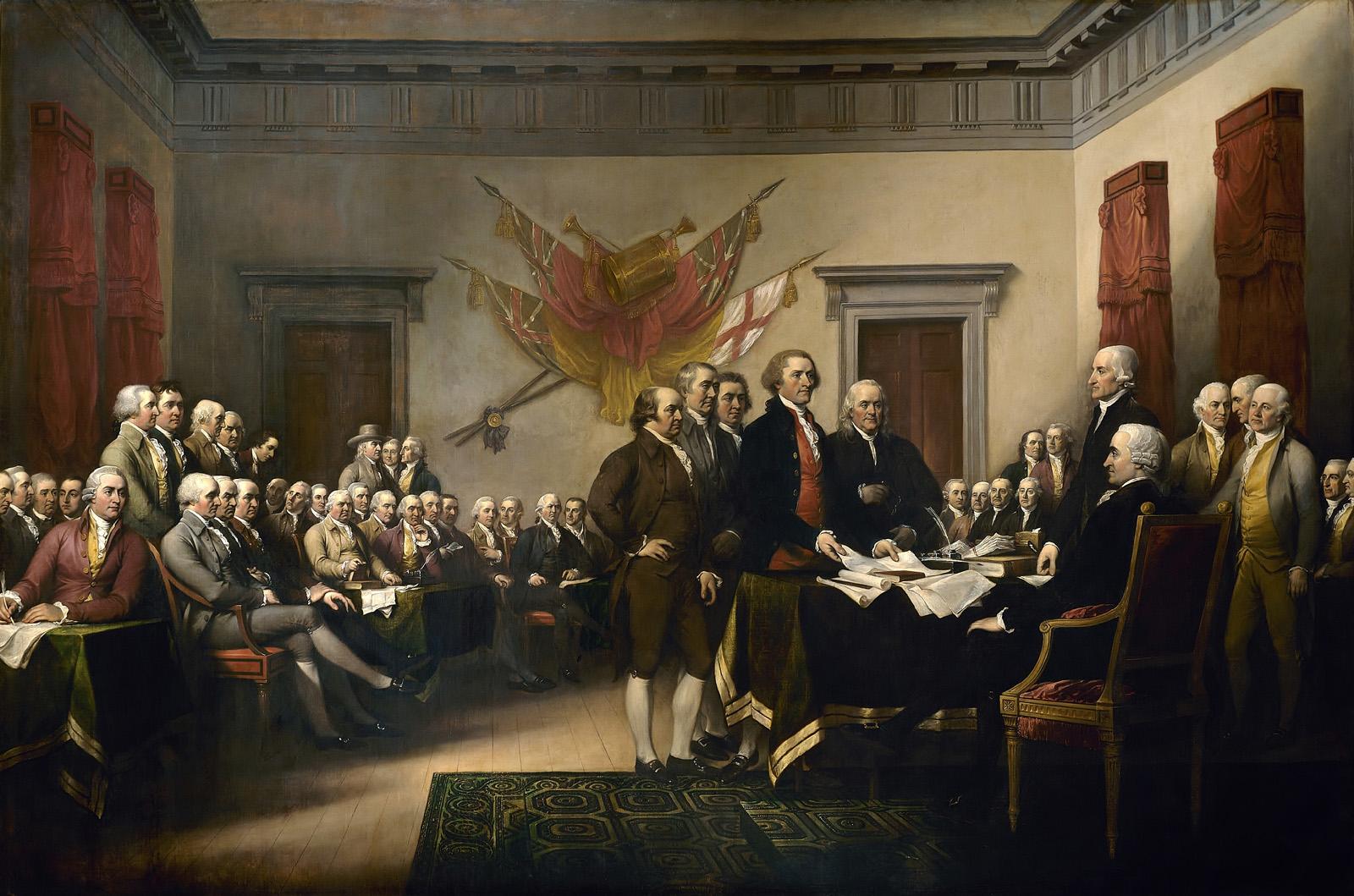
Two hundred thirty seven years ago, our forefathers sat in a hot room with closed windows arguing over the future of the thirteen colonies they represented. For a while they had thought of reconciliation with their motherland. But over time it became clear that neither King nor Parliament were interested in anything other than submission.

These fifty-six men did what had not been done before them.

They outlined their grievances on paper, declared their independence, and signed their names so both King and Parliament would know who the traitors were. The act was treason punishable by death. Some of them did die. Some were bankrupted. Many lost their homes and property. Some saw their wives and children taken and abused. But none recanted. All held firm.

237 years later we view the unanimous Declaration of the thirteen united States of America in the abstract. The grievances are distant if not surreal. But it was very real to them.

The United States of America today stands 69 years removed from D-Day.

D-Day was 79 years from the end of the Civil War, and 81 years removed from Gettysburg, which we are now 150 years separated from in time and history.

The beginning of the Civil War was 85 years from 1776 and only 72 years from the constitution being enacted.

The Revolution was only 88 years from the Glorious Revolution — a revolution from which we are separated by a chasm of 325 years.

It was the Glorious Revolution that so influenced our John Locke and our Founders. It was not abstract to them. It was not far removed. It was an event in the lifetimes of some of their grandparents. Parliament’s supremacy was asserted. The British subjects became citizens and acquired certain rights under the Bill of Rights of 1689 while others from the Magna Carta were reinforced. Among the rights derived from the Glorious Revolution were prohibitions on taxation without representation in Parliament, prohibitions on a standing army, the right to petition the King without prosecution, the prohibition on dispensing with Acts of Parliament, and the prohibition of fines and forfeitures before convictions of crimes.

The American colonists saw themselves as British citizens, not just subjects. They saw themselves as heirs to a Glorious Revolution and the Bill of Rights that sprang therefrom. These events were not even a century beyond them. They wanted their rights and when King and Parliament would not grant them those rights they rebelled. As Jefferson stated in the Declaration:

“That to secure these rights, Governments are instituted among Men, deriving their just powers from the consent of the governed, that whenever any Form of Government becomes destructive of these ends, it is the Right of the People to alter or to abolish it, and to institute new Government, laying its foundation on such principles and organizing its powers in such form, as to them shall seem most likely to effect [sic] their Safety and Happiness. Prudence, indeed, will dictate that Governments long established should not be changed for light and transient causes; and accordingly all experience hath shewn [sic], that mankind are more disposed to suffer, while evils are sufferable, than to right themselves by abolishing the forms to which they are accustomed.

But when a long train of abuses and usurpations, pursuing invariably the same Object evinces a design to reduce them under absolute Despotism, it is their right, it is their duty, to throw off such Government, and to provide new Guards for their future security. Such has been the patient sufferance of these Colonies; and such is now the necessity which constrains them to alter their former Systems of Government. The history of the present King of Great Britain is a history of repeated injuries and usurpations, all having in direct object the establishment of an absolute Tyranny over these States. To prove this, let Facts be submitted to a candid world.”

The colonists — the revolutionaries — did not want something new, but something old. By 1776, eighty-eight years after their Glorious Revolution, the colonists realized they would have to throw off the old form of government for something new in order to gain back those rights they realized neither Crown nor Government acknowledged they had. To King George and the men of the British Parliament, these were colonists, a class of men and women not heirs to the Glorious Revolution and most certainly not true British citizens.

The colonists engaged in a conservative revolution — a revolution not for something wholly new, but for something 88 years old. They only rebelled for “new Guards for their future security” when neither King nor Parliament would grant them what they thought they already had: life, liberty, and the pursuit of happiness.

What we find today to be so abstract — gun rights written into our Constitution prohibition on quartering soldiers, checks and balances and clear limits on power drawn up by men deeply skeptical of themselves and others with power — were not abstract notions to our Founders. They were real. They were present. Most importantly, they were worth fighting for and, if need be, dying for.

More than two centuries now separate us from our Founding Fathers. The liberties they fought for were liberties to thrive absent the heavy hand of government. These days now most often the recitation of liberties from the people are those things they can do so long as government provides a safety net to ensure a soft landing in the event of failure.

Failure to our Founders meant hanging. Would you this day pledge your life and be willing to die for your cause? Would you?

Those fifty-six men were willing to.

In the heat of July in room full of flies with no circulating air those men debated the future of the colonies. On July 2nd, by unanimous declaration, they proclaimed the colonies the United States of America, setting the date of adoption of the declaration as July 4, 1776. The unity then was one of purpose at the time, not unity as one nation. But that would come.

In even hotter August those men would go to Philadelphia to sign their names and make public the declaration of their treason.

“And for the support of this Declaration, with a firm reliance on the protection of divine Providence, we mutually pledge to each other our Lives, our Fortunes and our sacred Honor.”

What they were prepared to lose remains to this very day our gain. We are 237 years removed from that time, but we should all pray we never remove ourselves so far from the spirit of 1776.

“..appealing to the Supreme Judge of the world for the rectitude of our intentions, do, in the Name, and by Authority of the good People of these Colonies, solemnly publish and declare, That these United Colonies are, and of Right ought to be Free and Independent States.”

All revolutions throughout history, with the exception of the American Revolution, turned out badly within a few years due to the lack of Lockean/Jeffersonian principles. The French Revolution turned into a reign of terror as the people began to indulge in class warfare. It became a war of the have-nots against the haves. The Russian Revolution was doomed from the beginning as it was based on the principles of Karl Marx — principles of class warfare and the supremacy of the collective. Stalin killed millions as displaced the kulaks from their farms and turned kulak against kulak. All rights came from Moscow, not God.

The numerous revolutions in Mexico, Latin and South America were based on bread, land, and jobs. Even the great Simon Bolivar was no Jefferson. These countries were steeped in Spanish culture where the monarchy was absolute. There were no Lockes, Montesquieus, Smith in Spain’s history for people to draw on. They attempted to copy parts of our Declaration and Constitution but they had no real deep understanding of the words and their meanings. What the people (peasants and farmers) wanted was land and bread. When a leader arose who would promise this he became the next dictator until he was deposed by the next revolution or the ruling oligarchies.

The American Revolution was different. It was promulgated by men were educated in the rights of the British sine the Glorious Revolution. They were farmers, merchants, planters, businessmen, doctors, lawyers, and everyday folks who had land and bread. Many were wealthy and some not. The one common thread was that they all wanted the rights proclaimed by John Locke. They were not interested in obtaining or increasing power. They wanted to be left alone to pursue their dreams without stomping the dreams of their neighbor. They wanted nothing from their neighbor except an appreciation of their rights. They believed government’s only role was to protect those rights from foreign and domestic threats. They realized that would cost everyone so they agreed to pay for that government. They also adopted a Constitution based on the principles of the Declaration that would enumerate and limit the power of the central government while giving all powers not so enumerated to the people.

Today we, as a people, have drifted away from those founding principles as we look to the central government for property and sustenance. As we demand more free stuff at the expense of others we trample of their rights, but we also abdicate some our rights along the way. This happens as we give more and more power to the central government and we become a nation ruled by men, not by our laws as enacted to preserve our founding principles.

When Thomas Jefferson wrote the Declaration of Independence, he used language that has become iconic.

He wrote that we are endowed by our Creator with certain inalienable rights,AP10080209946-620x430 and among them are life, liberty and the pursuit of happiness.

Not only did he write those words, but the first Congress adopted them unanimously, and they are still the law of the land today.

By acknowledging that our rights are inalienable, Jefferson’s words and the first federal statute recognize that our rights come from our humanity — from within us — and not from the government.

The government the Framers gave us was not one that had the power and ability to decide how much freedom each of us should have, but rather one in which we individually and then collectively decided how much power the government should have. That, of course, is also recognized in the Declaration, wherein Jefferson wrote that the government derives its powers from the consent of the governed.

To what governmental powers may the governed morally consent in a free society? We can consent to the powers necessary to protect us from force and fraud, and to the means of revenue to pay for a government to exercise those powers. But no one can consent to the diminution of anyone else’s natural rights, because, as Jefferson wrote and the Congress enacted, they are inalienable.

Just as I cannot morally consent to give the government the power to take your freedom of speech or travel or privacy, you cannot consent to give the government the power to take mine.

This is the principle of the natural law: We all have areas of human behavior in which each of us is sovereign and for the exercise of which we do not need the government’s permission. Those areas are immune from government interference.

That is at least the theory of the Declaration of Independence, and that is the basis for our 237-year-old American experiment in limited government, and it is the system to which everyone who works for the government today pledges fidelity.

Regrettably, today we have the opposite of what the Framers gave us. Today we have a government that alone decides how much wealth we can retain, how much free expression we can exercise, how much privacy we can enjoy. And since the Fourth of July 2012, freedom has been diminished.

In the past year, all branches of the federal government have combined to diminish personal freedoms, in obvious and in subtle ways.

In the case of privacy, we now know that the federal government has the ability to read all of our texts and emails and listen to all of our telephone calls — mobile and landline — and can do so without complying with the Constitution’s requirements for a search warrant (Fourth Amendment).

We now know that President Obama authorized this, federal judges signed off on this, and select members of Congress knew of this, but all were sworn to secrecy, and so none could discuss it. And we only learned of this because a young whistleblower risked his life, liberty and property to reveal it.

In the past year, Obama admitted that he ordered the CIA in Virginia to use a drone to kill two Americans in Yemen, one of whom was a 16-year-old boy. He did so because the boy’s father, who was with him at the time of the murders, was encouraging militants to wage war against the U.S.

He wasn’t waging war, according to the president; he was encouraging it.

Simultaneously with this, the president claimed he can use a drone to kill whomever he wants, so long as the person is posing an active threat to the U.S., is difficult to arrest and fits within guidelines that the president himself has secretly written to govern himself.

In the past year, the Supreme Court has ruled that if you are in police custody and fail to assert your right to remain silent, the police at the time of trial can ask the jury to infer that you are guilty. This may seem like a technical ruling about who can say what to whom in a courtroom, but it is in truth a radical break from the past.

Everyone knows that we all have the natural and constitutionally guaranteed right to silence. And anyone in the legal community knows that judges for generations have told jurors that they may construe nothing with respect to guilt or innocence from the exercise of that right. (Fifth Amendment)

No longer. Today, you remain silent at your peril.

In the past year, the same Supreme Court has ruled that not only can you be punished for silence, but you can literally be forced to open your mouth. The court held that upon arrest -- not conviction, but arrest — the police can force you to open your mouth so they can swab the inside of it and gather DNA material from you.

Put aside the legal truism that an arrest is evidence of nothing and can and does come about for flimsy reasons; DNA is the gateway to personal data about us all. Its involuntary extraction has been insulated by the Fourth Amendment’s requirements of relevance and probable cause of crime.

No longer. Today, if you cross the street outside of a crosswalk, get ready to open your mouth for the police.

The litany of the loss of freedom is sad and unconstitutional and irreversible. The government does whatever it can to retain its power, and it continues so long as it can get away with it. It can listen to your phone calls, read your emails, seize your DNA and challenge your silence, all in violation of the Constitution.

Bitterly and ironically, the government Jefferson wrought is proving the accuracy of Jefferson’s prediction that in the long march of history, government grows and liberty shrinks. Somewhere Jefferson is weeping.

We have strayed from the path our Founders forged 237 years ago. Under the Constitutional Republic they created after the Revolutionary War, the United States has prospered over the centuries beyond the founding generation’s wildest dreams; however, we are wandering further from those very Constitutional principles that enabled us to thrive.

Our Founders developed an ingenious system of checks and balances, which900_george_washington George Washington described as, “though not absolutely perfect, it is one of the best in the world.” This government “by the people, for the people,” empowered the citizenry to select representatives that would unite the nation’s factions while protecting those liberties so many died to defend.

But over the years, power has shifted from the local level to the federal government, where bitter partisanship clogs the mechanisms of that ingenious system by which we might begin to repair.

If history is a guide, Washington would not give up on our Constitutional Republic now — he would fight to return it to its proper functioning. And he would begin by rallying the electorate. As he did during his time, he would extol us to replace wayward politicians with leaders who will act in the best interests of the country instead of their party.

The evils of modern politics were foreshadowed by the prescient words of the founding generation.

Washington, our nation’s first and only president with no declared party allegiance, was perhaps the most weary of the harms caused by uncompromising political factions.

With the ink on the Constitution barely dry, the nation fractured into competitive political parties.

President Washington derided these factions as “a fire not to be quenched, demanding a uniform vigilance to prevent its bursting into a flame, lest, instead of warming, it should consume.” He believed that they “agitated the community with ill-founded jealousies and false alarms, kindling]the animosity of one part against another.”

Fortuitously, Washington prescribed how we might fight that fire: “by force of public opinion.”

James Madison echoed this sentiment in Federalist 10, where he suggestedJames_Madison we might cure our partisan ills via an engaged electorate who diligently watch their leaders.

Our Founders charged us, the public, with the responsibility to elect those representatives that will rightfully uphold our Constitution — and reject those who place their own power and parties over the good of the nation. And what if we cannot find any good candidates? Run for office. It is our civic duty.

On this July Fourth, we find ourselves in a great country that is mired by politicians who seem to expend more resources fighting one another than adhering to our Constitution.

The United States government was never meant to be a “team sport” of Democrats vs. Republicans.

Our forward thinking Founders have gifted us with advice from the grave: we must beat back the partisanship with our votes and civic involvement, and install principled leaders, as our Founders were.

If we are to lead our nation towards those core Constitutional principles that have enabled us to prosper, we do so “by force of public opinion.”

“The foundation of our Republic was not laid in the gloomy age of Ignorance and Superstition, but in an era when the rights of mankind were better understood and more clearly defined,” Washington wrote in 1783, “At this auspicious period, the United States came into existence as a Nation, and if their Citizens should not be completely free and happy, the fault will be entirely their own.”

In 237 years we have journeyed many steps backwards on the path to life, liberty, property. With that said it is still possible to reverse this course if we and our fellow citizens can educate ourselves in those sacred principles and begin to restore self-government. This will require sacrifice and hard work. The question one must ask is; are we willing to sacrifice our lives, our fortunes, and our sacred honor to so?

In the meantime we should celebrate our Declaration and revolution in the manner prescribed by John Adams in his famous letter of July 3, 1776, in which he wrote to his wife Abigail what his thoughts were about celebrating the Fourth of July:

“The Second Day of July 1776, will be the most memorable Epocha, in the History of America. I am apt to believe that it will be celebrated, by succeeding Generations, as the great anniversary Festival. It ought to be commemorated, as the Day of Deliverance by solemn Acts of Devotion to God Almighty. It ought to be solemnized with Pomp and Parade, with Shews [sic], Games, Sports, Guns, Bells, Bonfires and Illuminations from one End of this Continent to the other from this Time forward forever more. You will think me transported with Enthusiasm but I am not. I am well aware of the Toil and Blood and Treasure, that it will cost Us to maintain this Declaration, and support and defend these States. Yet through all the Gloom I can see the Rays of ravishing Light and Glory. I can see that the End is more than worth all the Means. And that Posterity will triumph [sic] in that Days Transaction, even altho [sic] We should rue it, which I trust in God We shall not.”

Tuesday, July 2, 2013

Gettysburg Remembered

“..that we here highly resolve that these dead shall not have died in vain, that this nation under God shall have a new birth of freedom, and that government of the people, by the people, for the people shall not perish from the earth." — Abraham Lincoln, Dedication of the military cemetery at Gettysburg, Pennsylvania, November 19, 1863.

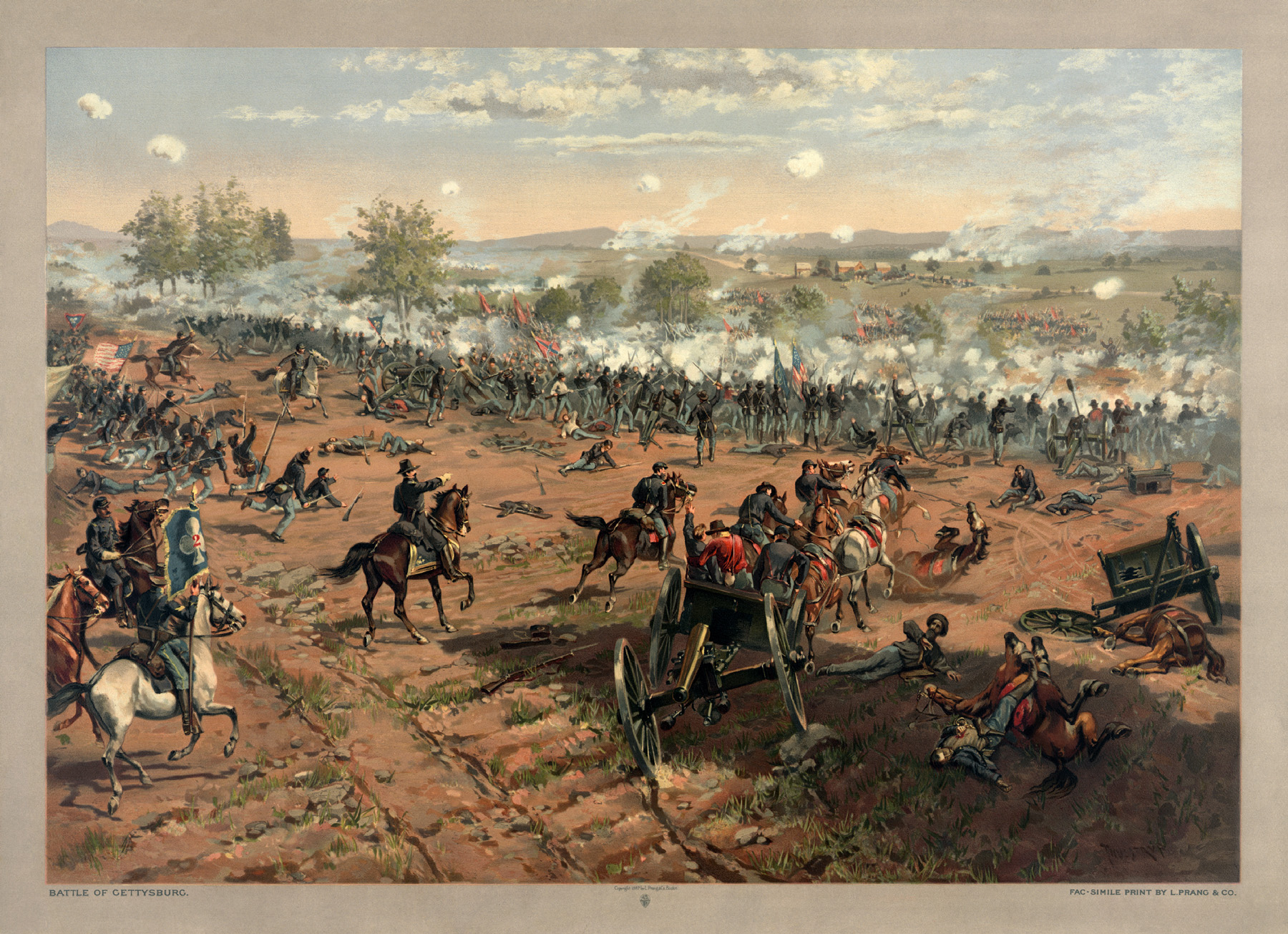
The Battle of Gettysburg, fought from July 1 to July 3, 1863, is considered the most important engagement of the American Civil War. After a greatThure_de_Thulstrup_-_L._Prang_and_Co._-_Battle_of_Gettysburg_-_Restoration_by_Adam_Cuerden victory over Union forces at Chancellorsville, General Robert E. Lee marched his Army of Northern Virginia into Pennsylvania in late June 1863. On July 1, the advancing Confederates clashed with the Union's Army of the Potomac, commanded by General George G. Meade, at the crossroads town of Gettysburg. The next day saw even heavier fighting, as the Confederates attacked the Federals on both left and right. On July 3, Lee ordered an attack by fewer than 15,000 troops on the enemy's center at Cemetery Ridge. The assault, known as "Pickett's Charge," managed to pierce the Union lines but eventually failed, at the cost of thousands of rebel casualties, and Lee was forced to withdraw his battered army toward Virginia on July 4.

In May 1863, Robert E. Lee's Confederate Army of Northern Virginia had scored a smashing victory over the Army of the Potomac at Chancellorsville. Brimming with confidence, Lee decided to go on the offensive and invade the North for a second time (the first invasion had ended at Antietam the previous fall). In addition to bringing the conflict out of Virginia and diverting northern troops from Vicksburg, where the Confederates were under siege, Lee hoped to gain recognition of the Confederacy by Britain and France and strengthen the cause of northern "Copperheads" who favored peace.

On the Union side, President Abraham Lincoln had lost confidence in theGeorge_G._Meade_Standing Army of the Potomac's commander, Joseph Hooker, who seemed reluctant to confront Lee's army after the defeat at Chancellorsville. On June 28, Lincoln named Major General George Gordon Meade to succeed Hooker. Meade immediately ordered the pursuit of Lee's army of 75,000, which by then had crossed the Potomac River into Maryland and marched on into southern Pennsylvania.

Battle of Gettysburg Begins: July 1

Upon learning that the Army of the Potomac was on its way, Lee planned to assemble his army in the prosperous crossroads town of Gettysburg, 35 miles southwest of Harrisburg, Pennsylvania. One of the Confederate divisions in A.P. Hill's command approached the town in search of supplies early on July 1, only to find that two Union cavalry brigades had arrived the previous day. As the bulk of both armies headed toward Gettysburg, Confederate forces (led by Hill and Richard Ewell) were able to drive the outnumbered Federal defenders back through town to Cemetery Hill, located a half mile to the south.

Seeking to press his advantage before more Union troops could arrive, Lee gave discretionary orders to attack Cemetery Hill to Ewell, who had taken command of the Army of Northern Virginia's Second Corps after Lee's most trusted general, Thomas J. "Stonewall" Jackson, was mortally wounded at Chancellorsville. Ewell declined to order the attack, considering the Federal position too strong; his reticence would earn him many unfavorable comparisons to the great Stonewall. By dusk, a Union corps under Winfield Scott Hancock had arrived and extended the defensive line along Cemetery Ridge to the hill known as Little Round Top; three more Union corps arrived overnight to strengthen its defenses.

Gettysburg_Battle_Map_Day1

Battle of Gettysburg, Day 2: July 2

As the next day dawned, the Union Army had established strong positions from Culp's Hill to Cemetery Ridge. Lee assessed his enemy's positions and determined — against the advice of his defensively minded second-in-command, James Longstreet — to attack the Federals where they stood. He ordered Longstreet to lead an attack on the Union left, while Ewell's corps would strike the right, near Culp's Hill. Though his orders were to attack as early in the day as possible, Longstreet didn't get his men into position until 4 pm, when they opened fire on the Union corps commanded by Daniel Sickles.

Over the next several hours, bloody fighting raged along Sickles' line, which stretched from the nest of boulders known as Devil's Den into a peach orchard, as well as in a nearby wheat field and on the slopes of Little Round Top. Thanks to fierce fighting by one Minnesota regiment, the Federals were able to hold Little Round Top, but lost the orchard, field and Devil's Den; Sickles himself was seriously wounded. Ewell's men had advanced on the Union forces at Culp's Hill and East Cemetery Hill in coordination with Longstreet's 4 pm attack, but Union forces had stalled their attack by dusk. Both armies suffered extremely heavy losses on July 2, with 9,000 or more casualties on each side. The combined casualty total from two days of fighting came to nearly 35,000, the largest two-day toll of the war.

529px-Gettysburg_Day2_Plan

Battle of Gettysburg, Day 3: July 3

Early on the morning of July 3, Union forces of the Twelfth Army Corps pushed back a Confederate threat against Culp's Hill after a seven-hourGeorgePickett firefight and regained their strong position. Believing his men had been on the brink of victory the day before, Lee decided to send three divisions (preceded by an artillery barrage) against the Union center on Cemetery Ridge. Fewer than 15,000 troops, led by a division under George Pickett, would be tasked with marching some three-quarters of a mile across open fields to attack dug-in Union infantry positions.

Despite Longstreet's protests, Lee was determined, and the attack — later known as "Pickett's Charge" — went forward around 3 pm, after an artillery bombardment by some 150 Confederate guns. Union infantry opened fire on the advancing rebels from behind stone walls, while regiments from Vermont, New York and Ohio hit both of the enemy's flanks. Caught from all sides, barely half of the Confederates survived, and Pickett's division lost two-thirds of its men. As the survivors stumbled back to their opening position, Lee and Longstreet scrambled to shore up their defensive line after the failed assault.

529px-Gettysburg_Battle_Map_Day3

Pickett's-Charge

Battle of Gettysburg: Aftermath and Impact

His hopes of a victorious invasion of the North dashed, Lee waited for a Union counterattack on July 4, but it never came. That night, in heavy rain, the Confederate general withdrew his decimated army toward Virginia. Though the cautious Meade would be criticized for not pursuing the enemy after Gettysburg, the battle was a crushing defeat for the Confederacy. Union casualties in the battle numbered 23,000, while the Confederates had lost some 28,000 men — more than a third of Lee's army. The North rejoiced while the South mourned its hopes for foreign recognition of the Confederacy erased.

In November 1863, President Abraham Lincoln was invited to deliver remarks, which later became known as the Gettysburg Address, at the official dedication ceremony for the National Cemetery of Gettysburg in Pennsylvania, on the site of one of the bloodiest and most decisive battles of the Civil War. Though he was not the featured orator that day, Lincoln's 273-word address would be remembered as one of the most important speeches in American history. In it, he invoked the principles of human equality contained in the Declaration of Independence and connected the sacrifices of the Civil War with the desire for "a new birth of freedom," as well as the all-important preservation of the Union created in 1776 and its ideal of self-government.

Demoralized by the defeat at Gettysburg, Lee offered his resignation to President Jefferson Davis, but was refused. Though the great Confederate general would go on to win other victories, the Battle of Gettysburg (combined with Ulysses S. Grant's victory at Vicksburg, also on July 4) irrevocably turned the tide of the Civil War in the Union’s favor.

As after previous battles, thousands of Union soldiers killed at Gettysburg were quickly buried, many in poorly marked graves. In the months thatHD-SN-99-01912 followed, however, local attorney David Wills spearheaded efforts to create a national cemetery at Gettysburg. Wills and the Gettysburg Cemetery Commission originally set October 23 as the date for the cemetery's dedication, but delayed it to mid-November after their choice for speaker, Edward Everett, said he needed more time to prepare. Everett, the former president of Harvard College, former U.S. senator and former secretary of state, was at the time one of the country's leading orators. On November 2, just weeks before the event, Wills extended an invitation to President Lincoln, asking him "formally [to] set apart these grounds to their sacred use by a few appropriate remarks."

Though Lincoln was extremely frustrated with Meade and the Army of the Potomac for failing to pursue Lee's forces in their retreat, he was cautiously optimistic as the year 1863 drew to a close. He also considered it significant that the Union victories at Gettysburg and at Vicksburg, under General Ulysses S. Grant, had both occurred on the same day: July 4, the anniversary of the signing of the Declaration of Independence.

When he received the invitation to make the remarks at Gettysburg, Lincoln saw an opportunity to make a broad statement to the American people on the enormous significance of the war, and he prepared carefully. Though long-running popular legend holds that he wrote the speech on the train while traveling to Pennsylvania, he probably wrote about half of it before leaving the White House on November 18, and completed writing and revising it that night, after talking with Secretary of State William H. Seward, who had accompanied him to Gettysburg.

On the morning of November 19, Everett delivered his two-hour oration (from memory) on the Battle of Gettysburg and its significance, and the orchestra played a hymn composed for the occasion by B.B. French. Lincoln then rose to the podium and addressed the crowd of some 15,000 people. He spoke for less than two minutes, and the entire speech was only 270 words long. Beginning by invoking the image of the founding fathers and the new nation, Lincoln eloquently expressed his conviction that the Civil War was the ultimate test of whether the Union created in 1776 would survive, or whether it would "perish from the earth." The dead at Gettysburg had laid down their lives for this noble cause, he said, and it was up to the living to confront the "great task" before them: ensuring that "government of the people, by the people, for the people, shall not perish from the earth."

The essential themes and even some of the language of the Gettysburg Address were not new; Lincoln himself, in his July 1861 message to Congress, had referred to the United States as "a democracy–a government of the people, by the same people." The radical aspect of the speech, however, began with Lincoln's assertion that the Declaration of Independence–and not the Constitution–was the true expression of the founding fathers' intentions for their new nation. At that time, many white slave owners had declared themselves to be "true" Americans, pointing to the fact that the Constitution did not prohibit slavery; according to Lincoln, the nation formed in 1776 was "dedicated to the proposition that all men are created equal." In an interpretation that was radical at the time–but is now taken for granted — Lincoln's historic address redefined the Civil War as a struggle not just for the Union, but also for the principle of human equality.

On the day following the dedication ceremony, newspapers all over the country reprinted Lincoln's speech along with Everett's. Opinion was generally divided along political lines, with Republican journalists praising the speech as a heartfelt, classic piece of oratory and Democratic ones deriding it as inadequate and inappropriate for the momentous occasion.

In the years to come, the Gettysburg Address would endure as arguably the most-quoted, most-memorized piece of oratory in American history. After Lincoln's assassination in April 1865, Senator Charles Sumner of Massachusetts wrote of the address, "That speech, uttered at the field of Gettysburg and now sanctified by the martyrdom of its author, is a monumental act. In the modesty of his nature he said 'the world will little note, nor long remember what we say here; but it can never forget what they did here.' He was mistaken. The world at once noted what he said, and will never cease to remember it."

In just 270 words Lincoln gave one of the most famous speeches in American History:

"Fourscore and seven years ago our fathers brought forth on this continent a new nation, conceived in liberty and dedicated to the proposition that all men are created equal. Now we are engaged in a great civil war, testing whether that nation or any nation so conceived and so dedicated can long endure. We are met on a great battlefield of that war. We have come to dedicate a portion of that field as a final resting-place for those who here gave their lives that that nation might live. It is altogether fitting and proper that we should do this. But in a larger sense, we cannot dedicate, we cannot consecrate, we cannot hallow this ground. The brave men, living and dead who struggled here have consecrated it far above our poor power to add or detract. The world will little note nor long remember what we say here, but it can never forget what they did here. It is for us the living rather to be dedicated here to the unfinished work which they who fought here have thus far so nobly advanced. It is rather for us to be here dedicated to the great task remaining before us--that from these honored dead we take increased devotion to that cause for which they gave the last full measure of devotion--that "Fourscore and seven years ago our fathers brought forth on this continent a new nation, conceived in liberty and dedicated to the proposition that all men are created equal. Now we are engaged in a great civil war, testing whether that nation or any nation so conceived and so dedicated can long endure. We are met on a great battlefield of that war. We have come to dedicate a portion of that field as a final resting-place for those who here gave their lives that that nation might live. It is altogether fitting and proper that we should do this. But in a larger sense, we cannot dedicate, we cannot consecrate, we cannot hallow this ground. The brave men, living and dead who struggled here have consecrated it far above our poor power to add or detract. The world will little note nor long remember what we say here, but it can never forget what they did here. It is for us the living rather to be dedicated here to the unfinished work which they who fought here have thus far so nobly advanced. It is rather for us to be here dedicated to the great task remaining before us--that from these honored dead we take increased devotion to that cause for which they gave the last full measure of devotion--that we here highly resolve that these dead shall not have died in vain, that this nation under God shall have a new birth of freedom, and that government of the people, by the people, for the people shall not perish from the earth."

No doubt the finest theatrical film made about the Civil War is the 1993 film “Gettysburg.” The 4-1/2 hour film, directed by Ronald F. Maxwell and staring Martin Sheen and Tom Berenger, is a depiction of the historical and personal events surrounding and including the decisive American civil war battle. It features thousands of civil war re-enactors marching over the exact ground that the federal army and the army of North Virginia fought on. The defense of the Little Round Top and Pickett's Charge are highlighted in the actual three day battle which is surrounded by the speeches of the commanding officers and the personal reflections of the fighting men. It is based upon Michael Shaara’s novel “The Killer Angels.”

I have included a few scenes from the film below.

The first scene is of Union Colonel Joshua Lawrence Chamberlain where deliver’s a speech to 120 mutineers of the 20th Maine Division.

This scene depicts Chamberlain’s bayonet charge on Little Round Top where his decision was instrumental in holding the left flank of the Union line against a full assault by Confederate troops.

This scene depicts the infamous and disastrous Pickett’s charge against the massed Union infantry and artillery on Cemetery Ridge

In this scene you see the aftermath of Pickett’s charge and Lee and Longstreet’s realization that the battle had been lost and they needed to regroup the Army of Virginia and retreat.

This final scene is of a Gettysburg tour guide giving a detailed account of Pickett’s charge

I have visited the Gettysburg National Battlefield site three times once with my wife, once with my brother and his wife, and recently during my Lincoln Highway road trip. The Lincoln Highway (U.S. Route 30) runs along the north side of the battlefield and is dotted with plaques and monuments memorializing the battles and the generals who were involved. The route also runs through the center of Gettysburg and the hamlet of Cash Town where Confederate General Hill’s Corps assembled for the battle making his headquarters in the inn that still stands and is serving customers to this day.

The Gettysburg Battle was a turning point in the Civil War. After suffering loss after loss and seeing horrendous causality figures the Union states were growing weary of the war. The Copperheads were pushing for negotiated peace and a return to the Union prior to the beginning of hostilities. Every family in the North was affected by the war so far. There was a sense of dread in the North that the Lincoln could not win this war and he was taking the Union into an abyss.

Gettysburg changed all of this. It gave new hope and energy to the North. It silenced the Copperheads and brought new vigor to recruitment. It dashed any hopes of foreign recognition of the Confederate States as a sovereign nation. It gave Lincoln a second term and the ability to get the 13th Amendment passed and ratified abolishing slavery and involuntary servitude. No one will ever know what would have happened had Lee defeated the Union forces at Gettysburg and marched unopposed into Washington D.C. Historians can only conjecture, based on newspaper reports and comments from politicians of the time, what the outcome would have been. However, one thing we know for sure is that like the Battle of Trenton during the Revolutionary War in 1777 where Washington crossed a frozen river on Christmas night and surprised a bunch of Hessen Mercenaries supporting the British and turned the tide of our revolution The Battle of Gettysburg accomplished a similar feat and gave the Republic a new birth in freedom.

Monday, July 1, 2013

Remembrance of the Fourth of July

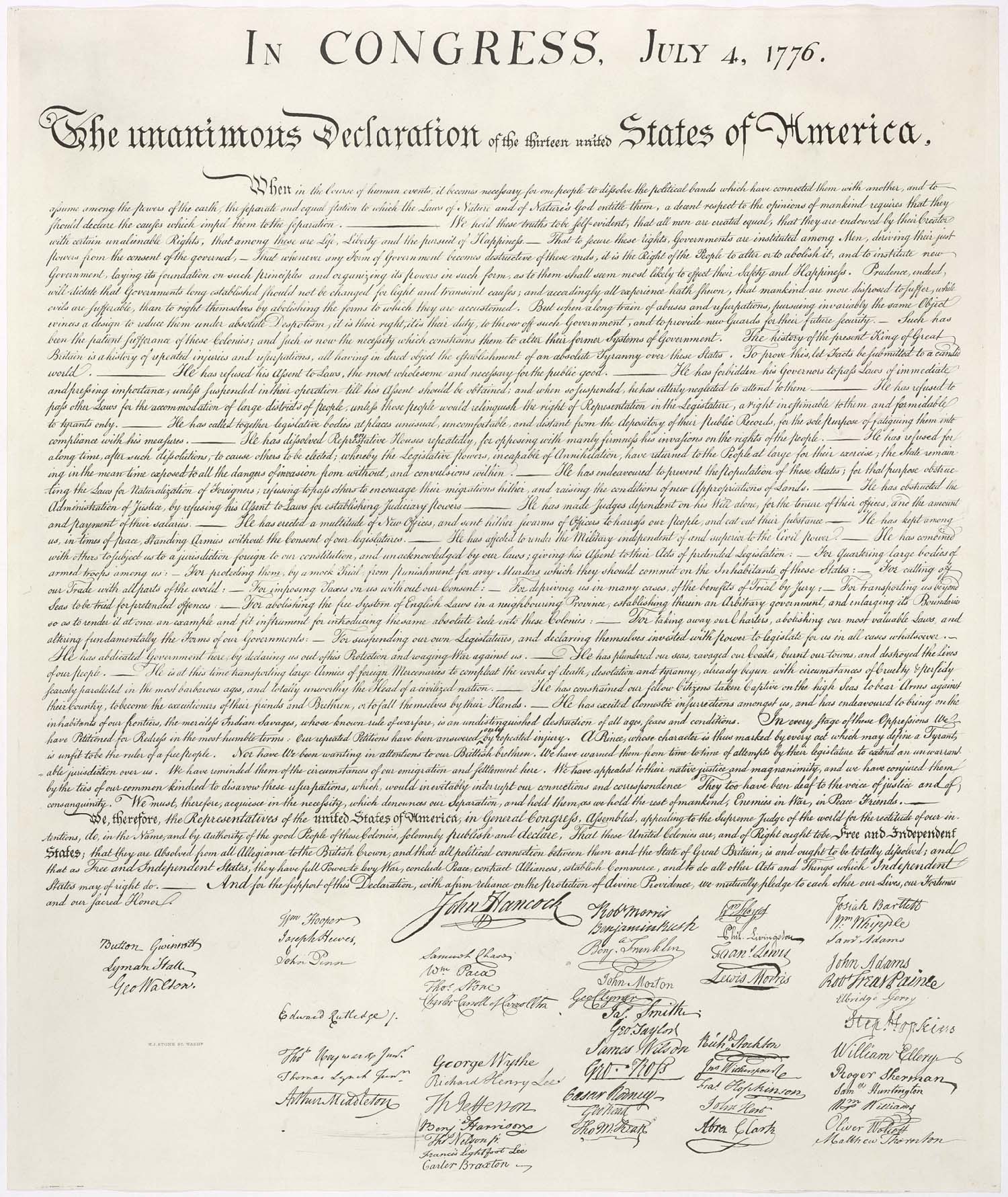
“We hold these truths to be self-evident, that all men are created equal, that they are endowed by their Creator with certain unalienable Rights, that among these are Life, Liberty and the pursuit of Happiness.” — The unanimous Declaration of the thirteen united States of America, July 4, 1776.

This coming Thursday will mark the 237th anniversary of the signing of our Declaration of Independence from Great Britain.

When armed conflict between bands of American colonists and British soldiers began in April 1775, the Americans were ostensibly fighting only for their rights as subjects of the British crown. By the following summer, with the Revolutionary War in full swing, the movement for independence from Britain had grown, and delegates of the Continental Congress were faced with a vote on the issue. In mid-June 1776, a five-man committee including Thomas Jefferson, John Adams and Benjamin Franklin was tasked with drafting a formal statement of the colonies' intentions. The Congress formally adopted the Declaration of Independence — written largely by Jefferson — in Philadelphia on July 4, a date now celebrated as the birth of American independence.

Even after the initial battles in the Revolutionary War broke out, few colonists desired complete independence from Great Britain, and those who did — like John Adams — were considered radical. Things changed over the course of the next year, however, as Britain attempted to crush the rebels with all the force of its great army. In his message to Parliament in October 1775, King George III railed against the rebellious colonies and ordered the enlargement of the royal army and navy. News of his words reached America in January 1776, strengthening the radicals’ cause and leading many conservatives to abandon their hopes of reconciliation. That same month, the recent British immigrant Thomas Paine published "Common Sense," in which he argued that independence was a "natural right" and the only possible course for the colonies; the pamphlet sold more than 150,000 copies in its first few weeks in publication.

In March 1776, North Carolina's revolutionary convention became the first to vote in favor of independence; seven other colonies had followed suit by mid-May. On June 7, the Virginia delegate Richard Henry Lee introduced a motionWriting_the_Declaration_of_Independence_1776_cph.3g09904 calling for the colonies' independence before the Continental Congress when it met at the Pennsylvania State House (later Independence Hall) in Philadelphia. Amid heated debate, Congress postponed the vote on Lee's resolution and called a recess for several weeks. Before departing, however, the delegates also appointed a five-man committee — including Thomas Jefferson of Virginia, John Adams of Massachusetts, Roger Sherman of Connecticut, Benjamin Franklin of Pennsylvania and Robert R. Livingston of New York — to draft a formal statement justifying the break with Great Britain. That document would become known as the Declaration of Independence.

Jefferson had earned a reputation as an eloquent voice for the patriotic cause after his 1774 publication of "A Summary View of the Rights of British America," and he was given the task of producing a draft of what would become the Declaration of Independence. As he wrote in 1823, the other members of the committee:

"unanimously pressed on myself alone to undertake the draught [sic]. I consented; I drew it; but before I reported it to the committee I communicated it separately to Dr. Franklin and Mr. Adams requesting their corrections. I then wrote a fair copy, reported it to the committee, and from them, unaltered to the Congress."

As Jefferson drafted it, the Declaration of Independence was divided into five sections, including an introduction, a preamble, a body (divided into two sections) and a conclusion. In general terms, the introduction effectively stated that seeking independence from Britain had become "necessary" for the colonies. While the body of the document outlined a list of grievances against the British crown, the preamble includes its most famous passage:

"We hold these truths to be self-evident; that all men are created equal; that they are endowed by their Creator with certain inalienable rights; that among these are life, liberty and the pursuit of happiness; that to secure these rights, governments are instituted among men, deriving their just powers from the consent of the governed."

The Continental Congress reconvened on July 1, and the following day 12 ofstone.tif the 13 colonies adopted Lee's resolution for independence. The process of consideration and revision of Jefferson's declaration (including Adams' and Franklin's corrections) continued on July 3 and into the late morning of July 4, during which Congress deleted and revised some one-fifth of its text. The delegates made no changes to that key preamble, however, and the basic document remained Jefferson's words. Congress officially adopted the Declaration of Independence later on July 4 (though most historians now accept that the document was not signed until August 2).

As the first formal statement by a nation's people asserting their right to choose their own government, the Declaration of Independence became a significant landmark in the history of democracy. In addition to its importance in the fate of the fledgling American nation, it also exerted a tremendous influence outside the United States, most memorably in France during the French Revolution. Together with the Northwest Ordinance, the Constitution (including the Bill of Rights), the Declaration of Independence can be counted as one of the three essential founding documents and the organic laws of the United States.

Abraham Lincoln was dedicated so much the Declaration that he called it “an apple of gold set in the silver frame of the Constitution.” He believed that the Declaration embodied all of the basic principles of the United States and that the Constitution was designed to codify those principles as a part of our organic law.

Today not many people have read the Declaration. I would venture that less than 30% of our high school or college graduates have ever read the entire document. My estimate is not based on any scientific evidence, but it is based on empirical data obtained from personal observation. Unless a student is enrolled in a very good college prep school or studying law or political science in college I doubt very much that they have had any exposure to the entire document. This includes most of the talking heads on TV.

One of the things you can do this Fourth of July when you have friends and family gathered for the barbeque of burgers, hot dogs, and ribs is to print out the Declaration and have you family members and friends each read aloud a portion of the document. I did this at my annual birthday party over the weekend and it was not only informative and educational, but was a fun experience — especially when they got to the part containing the grievances against the King George III.

After reading the grievances some discussion evolved on the listed grievances and how these same grievances can be adapted to what the government is doing to its citizens today. Here are a few examples.

Before citing the examples lets preface then with the remaining section of the preamble:

“That to secure these rights, Governments are instituted among Men, deriving their just powers from the consent of the governed, that whenever any Form of Government becomes destructive of these ends, it is the Right of the People to alter or to abolish it, and to institute new Government, laying its foundation on such principles and organizing its powers in such form, as to them shall seem most likely to effect [sic] their Safety and Happiness. Prudence, indeed, will dictate that Governments long established should not be changed for light and transient causes; and accordingly all experience hath shewn [sic], that mankind are more disposed to suffer, while evils are sufferable, than to right themselves by abolishing the forms to which they are accustomed.

But when a long train of abuses and usurpations, pursuing invariably the same Object evinces a design to reduce them under absolute Despotism, it is their right, it is their duty, to throw off such Government, and to provide new Guards for their future security. Such has been the patient sufferance of these Colonies; and such is now the necessity which constrains them to alter their former Systems of Government. The history of the present King of Great Britain is a history of repeated injuries and usurpations, all having in direct object the establishment of an absolute Tyranny over these States. To prove this, let Facts be submitted to a candid world.”

“He has refused his Assent to Laws, the most wholesome and necessary for the public good.”

Look at how the present administration refuses to enforce laws such as our current immigration laws and how the Justice Department refused to enforce the legally enacted Defense of Marriage Act (DOMA) signed into law by Bill Clinton.

“He has forbidden his Governors to pass Laws of immediate and pressing importance, unless suspended in their operation till his Assent should be obtained; and when so suspended, he has utterly neglected to attend to them.”

Just look at what the federal government is doing to states with the passage of ObamaCare and how governors are being pressed to pay for more and more towards Medicaid. Also how the federal government is attempting to force states to accept federal gun and drug laws.

“He has endeavoured [sic] to prevent the population of these States; for that purpose obstructing the Laws for Naturalization of Foreigners; refusing to pass others to encourage their migrations hither, and raising the conditions of new Appropriations of Lands.”

Just look at how the federal government has opposed the states enforcement of our immigration laws through the actions of the Justice Department using the power of the federal courts and Homeland Security by refusing to put forth the resources to control illegal immigration. Article IV, Section 4 of the Constitution states:

“The United States shall guarantee to every state in this union a republican form of government, and shall protect each of them against invasion; and on application of the legislature, or of the executive (when the legislature cannot be convened) against domestic violence.”

Millions of illegals have and are crossing our southern border as they invade the states of California, Texas, Arizona, and New Mexico while the executive branch does little to prevent this as the Democrats are looking for adding these illegals to their voting bloc.

“He has erected a multitude of New Offices, and sent hither swarms of Officers to harass [sic] our people, and eat out their substance.”

Over the past decades the administrative state has created hundreds of new czars and regulators to hassle, badger, and bully citizens. The EPA, Department of Agriculture, Department of Education, NSA, IRS, and Homeland Security have put forth thousands of regulations without the consent of Congress. They have mandated regulations for K-12 public schools overriding the will of states and local school boards. They have told us what light bulbs and toilets we can use. The NSA is collecting your personal data on your phone calls and e-mails. The IRS imposes illegal regulation of political opponents of the Obama administration. The Obama administration is waging a war against Christians who do not approve of gay marriage, abortion or the requirements for birth control and abortifacient pharmaceutical drugs for girls as young as 13-years of age without parental consent as mandated in ObamaCare. It has even reached the point of absurdity where the Department of Agriculture is demanding a children’s magician to submit a disaster plan for his rabbit. The new regulation became effective Jan. 30, 2012 without the consent of Congress.

“He has combined with others to subject us to a jurisdiction foreign to our constitution, and unacknowledged by our laws; giving his Assent to their Acts of pretended Legislation.”

The current administration and certain members of the U.S. Supreme Court are now referring to foreign laws to interpret our Constitution and Bill of Rights. As Associate Justice Antonin Scalia stated in his dissent to the recent DOMA decision

“The majority must have in mind one of the foreign constitutions that pronounces such primacy for its constitutional court and allows that primacy to be exercised in contexts other than a lawsuit.”

“For imposing Taxes on us without our Consent”

Today our tax code is so complex it obfuscates many of the taxes we pay the federal government. Also the administration through its regulatory agencies imposes thousands of fees on unsuspecting citizens. How about the carbon taxes and the taxes on your telephone and cable TV? Or the taxes on your electric bill to pay for those who do not have enough money to afford electricity?

I am sure you can find many examples of current actions of the federal government that pertain to the grievances I have cited.

Jefferson’s conclusion to the Declaration states:

“We, therefore, the Representatives of the united States of America, in General Congress, Assembled, appealing to the Supreme Judge of the world for the rectitude of our intentions, do, in the Name, and by Authority of the good People of theseThomas_Jefferson_rev Colonies, solemnly publish and declare, That these United Colonies are, and of Right ought to be Free and Independent States; that they are Absolved from all Allegiance to the British Crown, and that all political connection between them and the State of Great Britain, is and ought to be totally dissolved; and that as Free and Independent States, they have full Power to levy War, conclude Peace, contract Alliances, establish Commerce, and to do all other Acts and Things which Independent States may of right do. And for the support of this Declaration, with a firm reliance on the protection of divine Providence, we mutually pledge to each other our Lives, our Fortunes and our sacred Honor.”

I wonder how many of today’s crop of politicians are willing to pledge their lives, fortunes, and sacred honor in the cause of liberty.

When and if you do decide to have a communal reading of the Declaration at your Fourth of July BBQ here are nine things you may not know about our Declaration of Independence — things that will no doubt impress your family and friends:

1. The Declaration of Independence wasn’t signed on July 4, 1776.

On July 1, 1776, the Second Continental Congress met in Philadelphia, and on the following day 12 of the 13 colonies voted in favor of Richard Henry Lee’s motion for independence. The delegates then spent the next two days debating and revising the language of a statement drafted by Thomas Jefferson. On July 4, Congress officially adopted the Declaration of Independence, and as a result the date is celebrated as Independence Day. Nearly a month would go by, however, before the actual signing of the document took place. First, New York’s delegates didn’t officially give their support until July 9 because their home assembly hadn’t yet authorized them to vote in favor of independence. Next, it took two weeks for the Declaration to be “engrossed”—written on parchment in a clear hand. Most of the delegates signed on August 2, but several—Elbridge Gerry, Oliver Wolcott, Lewis Morris, Thomas McKean and Matthew Thornton—signed on a later date. (Two others, John Dickinson and Robert R. Livingston, never signed at all.) The signed parchment copy now resides at the National Archives in the Rotunda for the Charters of Freedom, alongside the Constitution and the Bill of Rights.

2. More than one copy exists.

After the adoption of the Declaration of Independence, the “Committee of Five”—Thomas Jefferson, John Adams, Benjamin Franklin, Roger Sherman and Robert R. Livingston—was charged with overseeing the reproduction of the approved text. This was completed at the shop of Philadelphia printer John Dunlap. On July 5, Dunlap’s copies were dispatched across the 13 colonies to newspapers, local officials and the commanders of the Continental troops. These rare documents, known as “Dunlap broadsides,” predate the engrossed version signed by the delegates. Of the hundreds thought to have been printed on the night of July 4, only 26 copies survive. Most are held in museum and library collections, but three are privately owned.

3. When news of the Declaration of Independence reached New York City, it started a riot.

By July 9, 1776, a copy of the Declaration of Independence had reached New York City. With hundreds of British naval ships occupying New York Harbor, revolutionary spirit and military tensions were running high. George Washington, commander of the Continental forces in New York, read the document aloud in front of City Hall. A raucous crowd cheered the inspiring words, and later that day tore down a nearby statue of George III. The statue was subsequently melted down and shaped into more than 42,000 musket balls for the fledgling American army.

4. Eight of the 56 signers of the Declaration of Independence were born in Britain.

While the majority of the members of the Second Continental Congress wereDeclaration_independence native-born Americans, eight of the men voting for independence from Britain were born there. Gwinnett Button and Robert Morris were born in England, Francis Lewis was born in Wales, James Wilson and John Witherspoon were born in Scotland, George Taylor and Matthew Thornton were born in Ireland and James Smith hailed from Northern Ireland.

5. One signer later recanted.

Richard Stockton, a lawyer from Princeton, New Jersey, became the only downloadsigner of the Declaration of Independence to recant his support of the revolution. On November 30, 1776, the hapless delegate was captured by the British and thrown in jail. After months of harsh treatment and meager rations, Stockton repudiated his signature on the Declaration of Independence and swore his allegiance to King George III. A broken man when he regained his freedom, he took a new oath of loyalty to the state of New Jersey in December 1777.

6. There was a 44-year age difference between the youngest and oldest signers.

The oldest signer was Benjamin Franklin, 70 years old when he scrawled his name on the parchment. The youngest was Edward Rutledge, a lawyer from South Carolina who was only 26 at the time. Rutledge narrowly beat out fellow South Carolinian Thomas Lynch Jr., just four months his senior, for the title.

7. Two additional copies have been found in the last 25 years.

In 1989, a Philadelphia man found an original Dunlap Broadside hidden in the back of a picture frame he bought at a flea market for $4. One of the few surviving copies from the official first printing of the Declaration, it was in excellent condition and sold for $8.1 million in 2000. A 26th known Dunlap broadside emerged at the British National Archives in 2009, hidden for centuries in a box of papers captured from American colonists during the Revolutionary War. One of three Dunlap broadsides at the National Archives, the copy remains there to this day.

8. The Declaration of Independence spent World War II in Fort Knox.

On December 23, 1941, just over two weeks after the Japanese attack on Pearl Harbor, the signed Declaration, together with the Constitution, was removed from public display and prepared for evacuation out of Washington, D.C. Under the supervision of armed guards, the founding document was packed in a specially designed container, latched with padlocks, sealed with lead and placed in a larger box. All told, 150 pounds of protective gear surrounded the parchment. On December 26 and 27, accompanied by Secret Service agents, it traveled by train to Louisville, Kentucky, where a cavalry troop of the 13th Armored Division escorted it to Fort Knox. The Declaration was returned to Washington, D.C., in 1944.

9. There is something written on the back of the Declaration of Independence.

In the movie “National Treasure,” Nicholas Cage’s character claims that the back of the Declaration contains a treasure map with encrypted instructions from the founding fathers, written in invisible ink. Unfortunately, this is not the case. There is, however, a simpler message, written upside-down across the bottom of the signed document: “Original Declaration of Independence dated 4th July 1776.” No one knows who exactly wrote this or when, but during the Revolutionary War years the parchment was frequently rolled up for transport. It’s thought that the text was added as a label.