Search This Blog

Showing posts with label Abraham Lincoln. Show all posts

Tuesday, July 2, 2013

Gettysburg Remembered

“..that we here highly resolve that these dead shall not have died in vain, that this nation under God shall have a new birth of freedom, and that government of the people, by the people, for the people shall not perish from the earth." — Abraham Lincoln, Dedication of the military cemetery at Gettysburg, Pennsylvania, November 19, 1863.

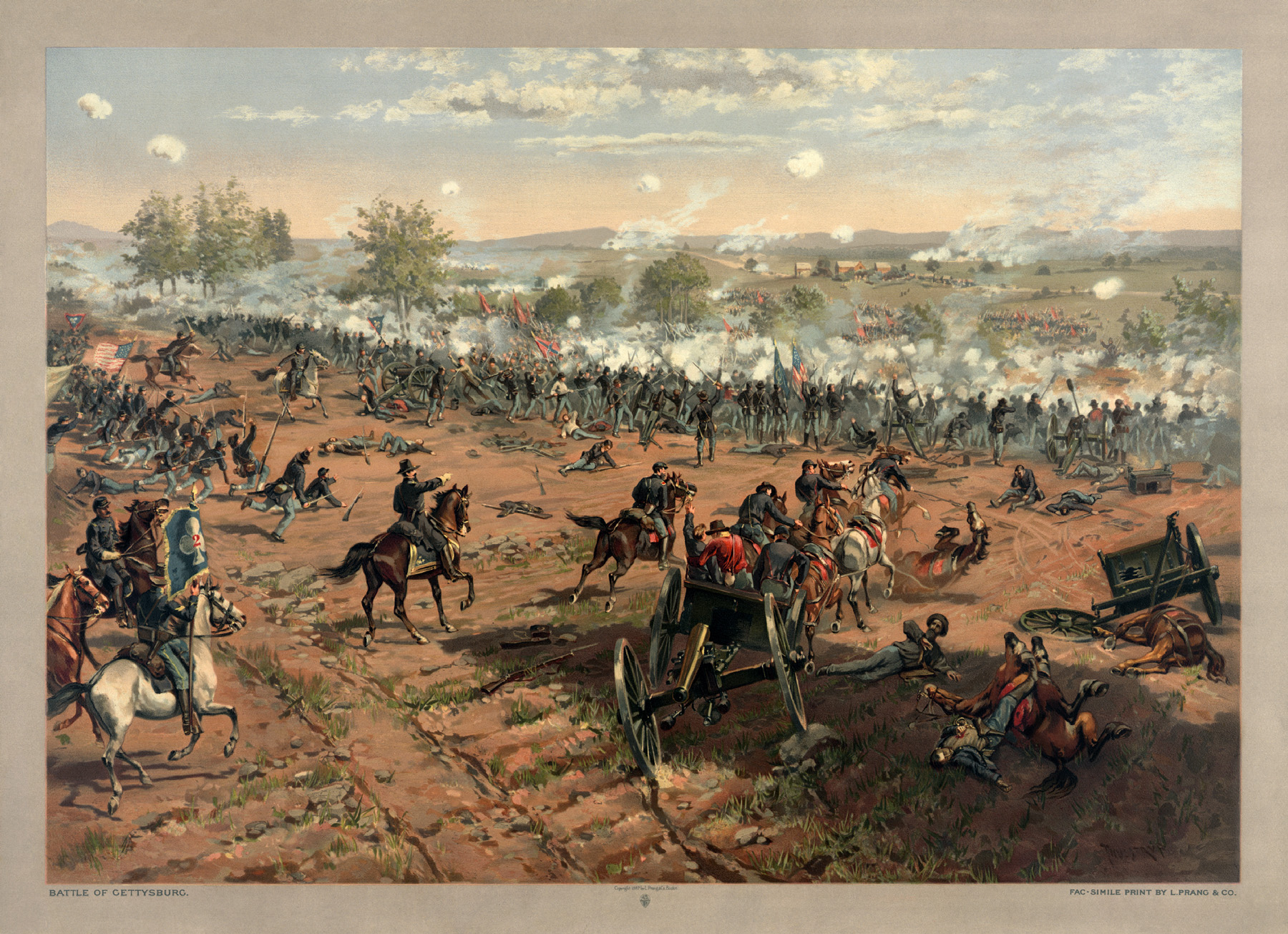
The Battle of Gettysburg, fought from July 1 to July 3, 1863, is considered the most important engagement of the American Civil War. After a greatThure_de_Thulstrup_-_L._Prang_and_Co._-_Battle_of_Gettysburg_-_Restoration_by_Adam_Cuerden victory over Union forces at Chancellorsville, General Robert E. Lee marched his Army of Northern Virginia into Pennsylvania in late June 1863. On July 1, the advancing Confederates clashed with the Union's Army of the Potomac, commanded by General George G. Meade, at the crossroads town of Gettysburg. The next day saw even heavier fighting, as the Confederates attacked the Federals on both left and right. On July 3, Lee ordered an attack by fewer than 15,000 troops on the enemy's center at Cemetery Ridge. The assault, known as "Pickett's Charge," managed to pierce the Union lines but eventually failed, at the cost of thousands of rebel casualties, and Lee was forced to withdraw his battered army toward Virginia on July 4.

In May 1863, Robert E. Lee's Confederate Army of Northern Virginia had scored a smashing victory over the Army of the Potomac at Chancellorsville. Brimming with confidence, Lee decided to go on the offensive and invade the North for a second time (the first invasion had ended at Antietam the previous fall). In addition to bringing the conflict out of Virginia and diverting northern troops from Vicksburg, where the Confederates were under siege, Lee hoped to gain recognition of the Confederacy by Britain and France and strengthen the cause of northern "Copperheads" who favored peace.

On the Union side, President Abraham Lincoln had lost confidence in theGeorge_G._Meade_Standing Army of the Potomac's commander, Joseph Hooker, who seemed reluctant to confront Lee's army after the defeat at Chancellorsville. On June 28, Lincoln named Major General George Gordon Meade to succeed Hooker. Meade immediately ordered the pursuit of Lee's army of 75,000, which by then had crossed the Potomac River into Maryland and marched on into southern Pennsylvania.

Battle of Gettysburg Begins: July 1

Upon learning that the Army of the Potomac was on its way, Lee planned to assemble his army in the prosperous crossroads town of Gettysburg, 35 miles southwest of Harrisburg, Pennsylvania. One of the Confederate divisions in A.P. Hill's command approached the town in search of supplies early on July 1, only to find that two Union cavalry brigades had arrived the previous day. As the bulk of both armies headed toward Gettysburg, Confederate forces (led by Hill and Richard Ewell) were able to drive the outnumbered Federal defenders back through town to Cemetery Hill, located a half mile to the south.

Seeking to press his advantage before more Union troops could arrive, Lee gave discretionary orders to attack Cemetery Hill to Ewell, who had taken command of the Army of Northern Virginia's Second Corps after Lee's most trusted general, Thomas J. "Stonewall" Jackson, was mortally wounded at Chancellorsville. Ewell declined to order the attack, considering the Federal position too strong; his reticence would earn him many unfavorable comparisons to the great Stonewall. By dusk, a Union corps under Winfield Scott Hancock had arrived and extended the defensive line along Cemetery Ridge to the hill known as Little Round Top; three more Union corps arrived overnight to strengthen its defenses.

Gettysburg_Battle_Map_Day1

Battle of Gettysburg, Day 2: July 2

As the next day dawned, the Union Army had established strong positions from Culp's Hill to Cemetery Ridge. Lee assessed his enemy's positions and determined — against the advice of his defensively minded second-in-command, James Longstreet — to attack the Federals where they stood. He ordered Longstreet to lead an attack on the Union left, while Ewell's corps would strike the right, near Culp's Hill. Though his orders were to attack as early in the day as possible, Longstreet didn't get his men into position until 4 pm, when they opened fire on the Union corps commanded by Daniel Sickles.

Over the next several hours, bloody fighting raged along Sickles' line, which stretched from the nest of boulders known as Devil's Den into a peach orchard, as well as in a nearby wheat field and on the slopes of Little Round Top. Thanks to fierce fighting by one Minnesota regiment, the Federals were able to hold Little Round Top, but lost the orchard, field and Devil's Den; Sickles himself was seriously wounded. Ewell's men had advanced on the Union forces at Culp's Hill and East Cemetery Hill in coordination with Longstreet's 4 pm attack, but Union forces had stalled their attack by dusk. Both armies suffered extremely heavy losses on July 2, with 9,000 or more casualties on each side. The combined casualty total from two days of fighting came to nearly 35,000, the largest two-day toll of the war.

529px-Gettysburg_Day2_Plan

Battle of Gettysburg, Day 3: July 3

Early on the morning of July 3, Union forces of the Twelfth Army Corps pushed back a Confederate threat against Culp's Hill after a seven-hourGeorgePickett firefight and regained their strong position. Believing his men had been on the brink of victory the day before, Lee decided to send three divisions (preceded by an artillery barrage) against the Union center on Cemetery Ridge. Fewer than 15,000 troops, led by a division under George Pickett, would be tasked with marching some three-quarters of a mile across open fields to attack dug-in Union infantry positions.

Despite Longstreet's protests, Lee was determined, and the attack — later known as "Pickett's Charge" — went forward around 3 pm, after an artillery bombardment by some 150 Confederate guns. Union infantry opened fire on the advancing rebels from behind stone walls, while regiments from Vermont, New York and Ohio hit both of the enemy's flanks. Caught from all sides, barely half of the Confederates survived, and Pickett's division lost two-thirds of its men. As the survivors stumbled back to their opening position, Lee and Longstreet scrambled to shore up their defensive line after the failed assault.

529px-Gettysburg_Battle_Map_Day3

Pickett's-Charge

Battle of Gettysburg: Aftermath and Impact

His hopes of a victorious invasion of the North dashed, Lee waited for a Union counterattack on July 4, but it never came. That night, in heavy rain, the Confederate general withdrew his decimated army toward Virginia. Though the cautious Meade would be criticized for not pursuing the enemy after Gettysburg, the battle was a crushing defeat for the Confederacy. Union casualties in the battle numbered 23,000, while the Confederates had lost some 28,000 men — more than a third of Lee's army. The North rejoiced while the South mourned its hopes for foreign recognition of the Confederacy erased.

In November 1863, President Abraham Lincoln was invited to deliver remarks, which later became known as the Gettysburg Address, at the official dedication ceremony for the National Cemetery of Gettysburg in Pennsylvania, on the site of one of the bloodiest and most decisive battles of the Civil War. Though he was not the featured orator that day, Lincoln's 273-word address would be remembered as one of the most important speeches in American history. In it, he invoked the principles of human equality contained in the Declaration of Independence and connected the sacrifices of the Civil War with the desire for "a new birth of freedom," as well as the all-important preservation of the Union created in 1776 and its ideal of self-government.

Demoralized by the defeat at Gettysburg, Lee offered his resignation to President Jefferson Davis, but was refused. Though the great Confederate general would go on to win other victories, the Battle of Gettysburg (combined with Ulysses S. Grant's victory at Vicksburg, also on July 4) irrevocably turned the tide of the Civil War in the Union’s favor.

As after previous battles, thousands of Union soldiers killed at Gettysburg were quickly buried, many in poorly marked graves. In the months thatHD-SN-99-01912 followed, however, local attorney David Wills spearheaded efforts to create a national cemetery at Gettysburg. Wills and the Gettysburg Cemetery Commission originally set October 23 as the date for the cemetery's dedication, but delayed it to mid-November after their choice for speaker, Edward Everett, said he needed more time to prepare. Everett, the former president of Harvard College, former U.S. senator and former secretary of state, was at the time one of the country's leading orators. On November 2, just weeks before the event, Wills extended an invitation to President Lincoln, asking him "formally [to] set apart these grounds to their sacred use by a few appropriate remarks."

Though Lincoln was extremely frustrated with Meade and the Army of the Potomac for failing to pursue Lee's forces in their retreat, he was cautiously optimistic as the year 1863 drew to a close. He also considered it significant that the Union victories at Gettysburg and at Vicksburg, under General Ulysses S. Grant, had both occurred on the same day: July 4, the anniversary of the signing of the Declaration of Independence.

When he received the invitation to make the remarks at Gettysburg, Lincoln saw an opportunity to make a broad statement to the American people on the enormous significance of the war, and he prepared carefully. Though long-running popular legend holds that he wrote the speech on the train while traveling to Pennsylvania, he probably wrote about half of it before leaving the White House on November 18, and completed writing and revising it that night, after talking with Secretary of State William H. Seward, who had accompanied him to Gettysburg.

On the morning of November 19, Everett delivered his two-hour oration (from memory) on the Battle of Gettysburg and its significance, and the orchestra played a hymn composed for the occasion by B.B. French. Lincoln then rose to the podium and addressed the crowd of some 15,000 people. He spoke for less than two minutes, and the entire speech was only 270 words long. Beginning by invoking the image of the founding fathers and the new nation, Lincoln eloquently expressed his conviction that the Civil War was the ultimate test of whether the Union created in 1776 would survive, or whether it would "perish from the earth." The dead at Gettysburg had laid down their lives for this noble cause, he said, and it was up to the living to confront the "great task" before them: ensuring that "government of the people, by the people, for the people, shall not perish from the earth."

The essential themes and even some of the language of the Gettysburg Address were not new; Lincoln himself, in his July 1861 message to Congress, had referred to the United States as "a democracy–a government of the people, by the same people." The radical aspect of the speech, however, began with Lincoln's assertion that the Declaration of Independence–and not the Constitution–was the true expression of the founding fathers' intentions for their new nation. At that time, many white slave owners had declared themselves to be "true" Americans, pointing to the fact that the Constitution did not prohibit slavery; according to Lincoln, the nation formed in 1776 was "dedicated to the proposition that all men are created equal." In an interpretation that was radical at the time–but is now taken for granted — Lincoln's historic address redefined the Civil War as a struggle not just for the Union, but also for the principle of human equality.

On the day following the dedication ceremony, newspapers all over the country reprinted Lincoln's speech along with Everett's. Opinion was generally divided along political lines, with Republican journalists praising the speech as a heartfelt, classic piece of oratory and Democratic ones deriding it as inadequate and inappropriate for the momentous occasion.

In the years to come, the Gettysburg Address would endure as arguably the most-quoted, most-memorized piece of oratory in American history. After Lincoln's assassination in April 1865, Senator Charles Sumner of Massachusetts wrote of the address, "That speech, uttered at the field of Gettysburg and now sanctified by the martyrdom of its author, is a monumental act. In the modesty of his nature he said 'the world will little note, nor long remember what we say here; but it can never forget what they did here.' He was mistaken. The world at once noted what he said, and will never cease to remember it."

In just 270 words Lincoln gave one of the most famous speeches in American History:

"Fourscore and seven years ago our fathers brought forth on this continent a new nation, conceived in liberty and dedicated to the proposition that all men are created equal. Now we are engaged in a great civil war, testing whether that nation or any nation so conceived and so dedicated can long endure. We are met on a great battlefield of that war. We have come to dedicate a portion of that field as a final resting-place for those who here gave their lives that that nation might live. It is altogether fitting and proper that we should do this. But in a larger sense, we cannot dedicate, we cannot consecrate, we cannot hallow this ground. The brave men, living and dead who struggled here have consecrated it far above our poor power to add or detract. The world will little note nor long remember what we say here, but it can never forget what they did here. It is for us the living rather to be dedicated here to the unfinished work which they who fought here have thus far so nobly advanced. It is rather for us to be here dedicated to the great task remaining before us--that from these honored dead we take increased devotion to that cause for which they gave the last full measure of devotion--that "Fourscore and seven years ago our fathers brought forth on this continent a new nation, conceived in liberty and dedicated to the proposition that all men are created equal. Now we are engaged in a great civil war, testing whether that nation or any nation so conceived and so dedicated can long endure. We are met on a great battlefield of that war. We have come to dedicate a portion of that field as a final resting-place for those who here gave their lives that that nation might live. It is altogether fitting and proper that we should do this. But in a larger sense, we cannot dedicate, we cannot consecrate, we cannot hallow this ground. The brave men, living and dead who struggled here have consecrated it far above our poor power to add or detract. The world will little note nor long remember what we say here, but it can never forget what they did here. It is for us the living rather to be dedicated here to the unfinished work which they who fought here have thus far so nobly advanced. It is rather for us to be here dedicated to the great task remaining before us--that from these honored dead we take increased devotion to that cause for which they gave the last full measure of devotion--that we here highly resolve that these dead shall not have died in vain, that this nation under God shall have a new birth of freedom, and that government of the people, by the people, for the people shall not perish from the earth."

No doubt the finest theatrical film made about the Civil War is the 1993 film “Gettysburg.” The 4-1/2 hour film, directed by Ronald F. Maxwell and staring Martin Sheen and Tom Berenger, is a depiction of the historical and personal events surrounding and including the decisive American civil war battle. It features thousands of civil war re-enactors marching over the exact ground that the federal army and the army of North Virginia fought on. The defense of the Little Round Top and Pickett's Charge are highlighted in the actual three day battle which is surrounded by the speeches of the commanding officers and the personal reflections of the fighting men. It is based upon Michael Shaara’s novel “The Killer Angels.”

I have included a few scenes from the film below.

The first scene is of Union Colonel Joshua Lawrence Chamberlain where deliver’s a speech to 120 mutineers of the 20th Maine Division.

This scene depicts Chamberlain’s bayonet charge on Little Round Top where his decision was instrumental in holding the left flank of the Union line against a full assault by Confederate troops.

This scene depicts the infamous and disastrous Pickett’s charge against the massed Union infantry and artillery on Cemetery Ridge

In this scene you see the aftermath of Pickett’s charge and Lee and Longstreet’s realization that the battle had been lost and they needed to regroup the Army of Virginia and retreat.

This final scene is of a Gettysburg tour guide giving a detailed account of Pickett’s charge

I have visited the Gettysburg National Battlefield site three times once with my wife, once with my brother and his wife, and recently during my Lincoln Highway road trip. The Lincoln Highway (U.S. Route 30) runs along the north side of the battlefield and is dotted with plaques and monuments memorializing the battles and the generals who were involved. The route also runs through the center of Gettysburg and the hamlet of Cash Town where Confederate General Hill’s Corps assembled for the battle making his headquarters in the inn that still stands and is serving customers to this day.

The Gettysburg Battle was a turning point in the Civil War. After suffering loss after loss and seeing horrendous causality figures the Union states were growing weary of the war. The Copperheads were pushing for negotiated peace and a return to the Union prior to the beginning of hostilities. Every family in the North was affected by the war so far. There was a sense of dread in the North that the Lincoln could not win this war and he was taking the Union into an abyss.

Gettysburg changed all of this. It gave new hope and energy to the North. It silenced the Copperheads and brought new vigor to recruitment. It dashed any hopes of foreign recognition of the Confederate States as a sovereign nation. It gave Lincoln a second term and the ability to get the 13th Amendment passed and ratified abolishing slavery and involuntary servitude. No one will ever know what would have happened had Lee defeated the Union forces at Gettysburg and marched unopposed into Washington D.C. Historians can only conjecture, based on newspaper reports and comments from politicians of the time, what the outcome would have been. However, one thing we know for sure is that like the Battle of Trenton during the Revolutionary War in 1777 where Washington crossed a frozen river on Christmas night and surprised a bunch of Hessen Mercenaries supporting the British and turned the tide of our revolution The Battle of Gettysburg accomplished a similar feat and gave the Republic a new birth in freedom.

Tuesday, April 2, 2013

The Crisis of the Union

“I have no purpose, directly or indirectly, to interfere with the institution of slavery in the states where it exists. I believe I have no lawful right to do so, and I have no inclination to do so.” — Abraham Lincoln, First Inaugural Address, March 4, 1861.

Over the Easter weekend I viewed the film “Lincoln” via my local cable provider’s pay-per-view service. While probably not as good as watching it on the big screen in a theater I was satisfied seeing it on a 55-inch LED television set.

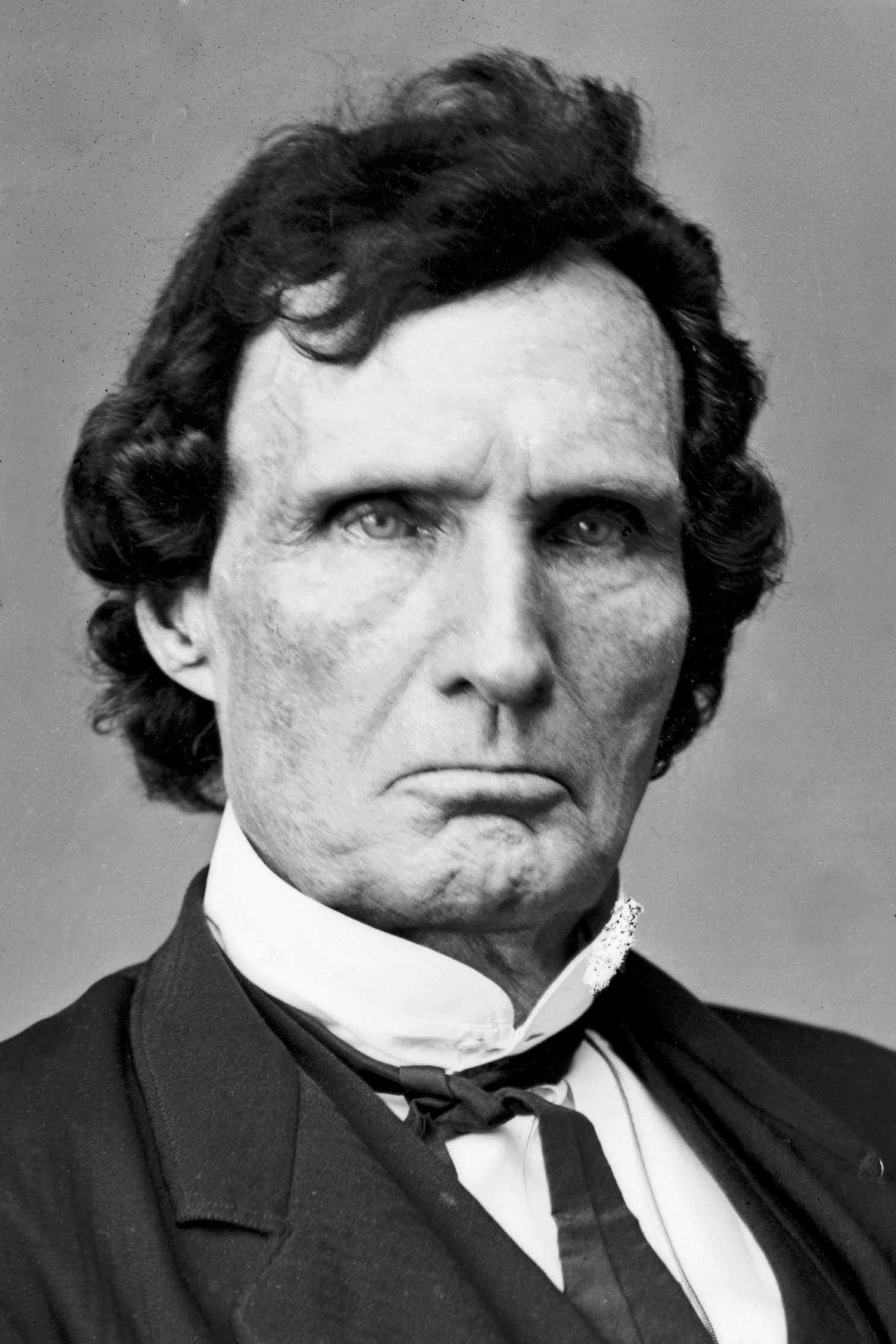
Before giving my brief critique of the film have must say that I was very impressed with Daniel Day Lewis’ portrayal of Abraham Lincoln and equallyThaddeus_Stevens_-_Brady-Handy-crop so with Sally Fields’ playing Lincoln’s manic-depressive wife, Mary Todd Lincoln. Tommy Lee Jones’s portrayal of the firebrand radical Republican Pennsylvania Representative Thaddeus Stevens was as good as it could be allowing for the flawed script he was given by director Spielberg and writers Tony Kushner and Doris Kearns Goodwin whose book “Team of Rivals: The Political Genius of Abraham Lincoln” the film was loosely based upon. Both writers and the director are ardent Progressives and their ideology was evident in the film.

As example the film opens with a scene of Lincoln being confronted by two Black soldiers complaining of their unequal pay in a very belligerent manner. The first words of the film are spoken to Lincoln by one of the black soldiers:

“Some of us was in the 2nd Kansas Colored. We fought the Rebs at Jenkins Ferry last April just after they killed every Negro they captured at Poison Springs. So at Jenkins Ferry we decided we weren't taking no Reb prisoners, and we didn't leave a one of them alive.”

Only a liberal (or maybe a white supremacist) would begin a story about Abraham Lincoln and the ending of slavery with a black racial atrocity. Obviously, Spielberg and Kushner don't believe it was an atrocity. They see it as something a soldier would be so proud of that he would immediately boast of it when happening upon the President of the United States nine months later. And Lincoln in turn would find it commendable, as confirmed by the response the filmmakers have him utter: "The 2nd Kansas Colored infantry, they fought bravely at Jenkins Ferry.

They did. But some of them — certainly not all, as Kushner infers — brutally slaughtered wounded and captured men and mutilated the dead. The exact details are lost to history, but the record of the Kansas National Guard doesn't appear to confirm Kushner's allegations that the killing was premeditated or that the soldiers "didn't leave a one of them alive."

According to the Gay, Progressive Kushner what the Confederates did to the black soldiers at Poison Springs was a moral crime. What the blacks did to the Confederates was rightful social justice, of which a soldier could be proud. A black soldier, that is. No one can imagine a white soldier bragging to the commander in chief that he had slaughtered wounded and captured prisoners and then mutilated their corpses.

As this first soldier finishes his boast, the other begins to harangue Lincoln about the unequal treatment of black soldiers, beginning with their lesser pay. This is Kushner memorializing another liberal trope: the eternal grievance. While it was true that black pay was lower during the Battle of Jenkins Ferry (April 30, 1864), Congress corrected the injustice almost immediately thereafter, equalizing black pay and making the increase retroactive.

Because that injustice was remedied nearly a year earlier, no black soldier would have ranted about it to Lincoln that night. In fact, no Black soldier would have spoken to the president in the manner and tone Kushner employs here. First he deprives blacks of a moral compass, and then he takes away their social probity. Interestingly, we actually have a first-hand account of a meeting between Lincoln and black troops occurring almost at this time:

"The black troops received him most enthusiastically, grinning from ear to ear, and displaying an amount of ivory terrible to behold," remarked Gen. U.S. Grant's aide, Horace Porter. "They cheered wildly, crowding around Lincoln, kissing his hand, brushing his coat or his horse so that they could tell others that they had touched the president. And Lincoln was touched. His eyes brimming with tears, his voice broke as he talked with the men; the encounter reminded everyone what was at stake."

It is highly unlikely that two enlisted soldiers — Black or white — would address the President of the United States in such a disrespectful manner, especially in public.

Once this opening scene was over the film settled down to its real theme — the battle over the 13th Amendment.

In my opinion the good points of the film were:

  • Lewis’ portrayal of Lincoln and his debates within his own Cabinet on the rational of pushing for the passage of the 13th Amendment before the war was over. Lincoln believed that once the war ended there would be no support for its passage.
  • A scene where Stevens (Tommy Lee Jones) is confronted by Mary Todd Lincoln over Congress’ disapproval of her lavish spending in the White House and the hearings they conducted to curb it. Unlike today’s imperial first family Congress in those days took a serious posture on public spending and held to their Constitutional duty of controlling the federal purse.
  • The raucous and passionate debate in the House of Representatives between the Free-Soilers, Conservative Republicans, Radical Republicans, and Democrats over the proposed amendment. This debate synthesized most of the arguments of the day over slavery and the war. The position of the Radical Republicans was expressed by Thaddeus Stevens who eventually was part of the House Managers in the impeachment of Andrew Johnson and fought for the money to allow Secretary of State William Henry Seward to purchase Alaska.
  • Lincoln’s use of paid “consultants”, under the supervision of Seward, to “convince” House Members to support the Amendment.
  • I will pass on the relationship portrayed in the film between Stevens’ Negro housekeeper, Lydia Hamilton Smith, who was involved with Mary Todd Lincoln’s Negro dressmaker Elizabeth Keckley.

All in all I would give the film 5 stars for the portrayal of Lincoln, Mary Todd Lincoln, Thaddeus Stevens, William Seward, and Congress. I would give it another 5 stars for the lighting, costuming, and sets. However, I would give it a mere two and a half stars for Kushner’s script. Now to reality!

The sectional divide that led to the outbreak of the Civil War was rooted in fundamentally opposing interpretations of the principles of the Declaration of Independence in addition to diverging perceptions of the institution of slavery. Slaveholders and non-slaveholders alike at the time of the Founding generally agreed that slavery was unjust and an evil that ran counter to the ethos of the Founding, even while countenancing it in practice. By the 1850s, prominent men such as John C. Calhoun and Alexander Stevens argued that slavery was a positive good, and that liberty and equality, far from being natural rights belonging to every human being, were privileges to be earned.

As showcased by the writings and life of Thomas Jefferson, at the time of the Founding there existed the wide-spread belief that slavery-while an institutional denial of natural rights and an inherently unjust practice, in addition to being an evil for the character of slave and owner alike-was a necessary evil without an immediately viable alternative. Various states took measures to eliminate slavery gradually within their borders, while organizations formed (The American Colonization Society) with the purpose of aiding emancipated slaves through a variety of ways (such as establishing the colony of Liberia in West Africa). This was a program based on “Compensated Emancipation.”

Compensated Emancipation was a method of ending slavery in countries where slavery was legal. This involved the person who was recognized as the owner of a slave being compensated monetarily or by a period of labor (an 'apprenticeship') for releasing the slave.

The latter was chosen as a compromise between slavery and outright emancipation, the former slaves receiving a nominal salary, while still being bound in their labors for a period of time. This proved unpopular, as for the slaves it amounted to little more than continued mandatory servitude, while it placed an added burden of wages on the former owners. Due to resistance in both the North and the South compensated emancipation

Only in the District of Columbia, which fell under direct Federal auspices, was compensated emancipation enacted. On April 16, 1862, President Lincoln signed the District of Columbia Compensated Emancipation Act. This law prohibited slavery in the District, forcing its 900-odd slaveholders to free their slaves, with the government paying owners an average of about $300 for each. In 1863 state legislation towards compensated emancipation in Maryland failed to pass, as did an attempt to include it in a newly-written Missouri constitution.

On the other hand the Free-Soilers wanted Congress to prohibit slavery in the new states and territories based on Article IV, Section 3 of the Constitution that stated:

“New states may be admitted by the Congress into this union; but no new states shall be formed or erected within the jurisdiction of any other state; nor any state be formed by the junction of two or more states, or parts of states, without the consent of the legislatures of the states concerned as well as of the Congress.

The Congress shall have power to dispose of and make all needful rules and regulations respecting the territory or other property belonging to the United States; and nothing in this Constitution shall be so construed as to prejudice any claims of the United States, or of any particular state.”

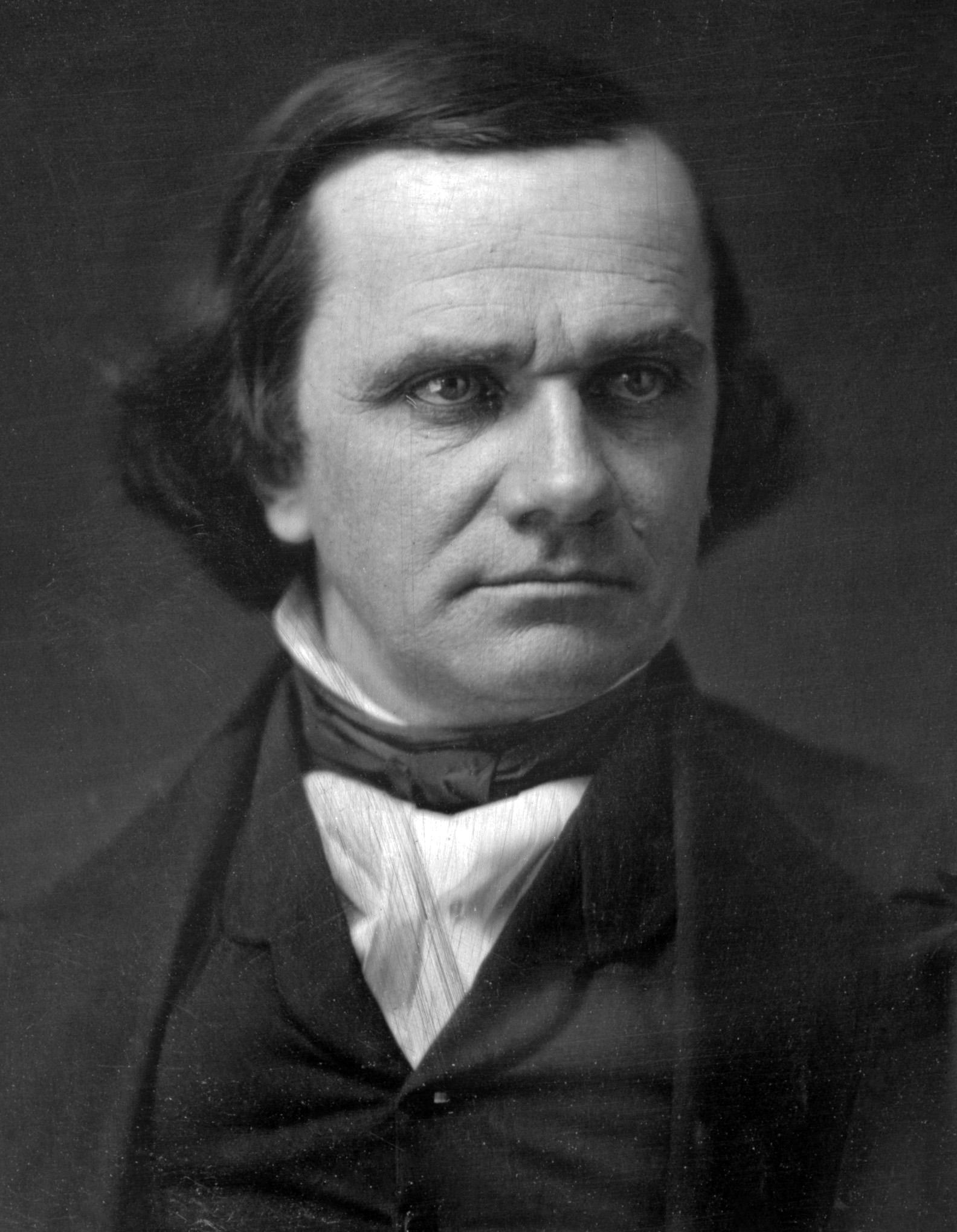
But, it was Stephen Douglas’, Lincoln’s opponent in the 1858 Illinois senatorial race, “popular sovereignty” that had carried the debate and was responsible for the notorious Kansas-Nebraska Act that Lincoln had so much disdain for.

Stephen A. Douglas, in a joint debate with Abraham Lincoln in Ottawa, Illinois on August 21, 1858 stated:

"Now, I hold that Illinois had a right to abolish and prohibit slavery465px-Stephen_A_Douglas_-_headshot as she did, and I hold that Kentucky has the same right to continue and protect slavery that Illinois had to abolish it. I hold that New York had as much right to abolish slavery as Virginia has to continue it, and that each and every state of this union is a sovereign power, with the right to do as it pleases upon this question of slavery, and upon all its domestic institutions. Slavery is not the only question which comes up in this controversy."
"Now, my friends, if we will only act conscientiously and rigidly upon this great principle of popular sovereignty, which guarantees to each state and territory the right to do as it pleases on all things, local and domestic, instead of Congress interfering, we will continue at peace one with another. Why should Illinois be at war with Missouri, or Kentucky with Ohio, or Virginia with New York, merely because their institutions differ? Our fathers intended that our institutions should differ. They knew that the North and the South, having different climates, productions and interests, required different institutions. This doctrine of Mr. Lincoln, of uniformity among the institutions of the different states, is a new doctrine, never dreamed of by Washington, Madison, or the framers of this government."

Lincoln’s response was:

"This declared indifference, but, as I must think, covert real zeal for the spread of slavery, I cannot but hate. I hate it because of the monstrous injustice of slavery itself. I hate it because it deprives our republican example of its just influence in the world-enables the enemies of free institutions, with plausibility, to taunt us as hypocrites-causes the real friends of freedom to doubt our sincerity, and especially because it forces so many really good men amongst ourselves into an open war with the very fundamental principles of civil liberty-criticizing the Declaration of Independence, and insisting that there is no right principle of action but self-interest."

Lincoln lost the election to Douglas, but attained a greater prize in 1860 — the presidency of the United States.

No American president has faced a national crisis of the magnitude Abraham

Lincoln confronted upon assuming office. To most observers of the time, Lincoln seemed ill-prepared for the momentous challenges that lay ahead. Born in a log cabin in Kentucky, he later moved with his family to Indiana and then to Illinois, receiving little formal education along the way. Nonetheless, Lincoln possessed a prodigious intelligence, and while in New Salem, Illinois, he began to study law on his own. In 1834 he was elected to the first of several terms in the Illinois legislature, and he gravitated toward the Whig party and its prominent leader, Henry Clay. Lincoln became a staunch proponent of law and order, an attribute that guided his thinking during the secession crisis of 1860–1861.

In 1846 Lincoln was elected to the U.S. House of Representatives from Springfield, Illinois, and while serving a single term in that body he became a vocal critic of President James K. Polk’s decision to lead the United States into war with Mexico. During and after the Mexican War, Lincoln asserted that any people “sufficiently numerous for national independence” possessed the right to “revolutionize” or throw off their existing government and to replace it with a government of their choosing. In later years, Lincoln was careful to insist that the right to revolution was a moral, not a legal, right—a right that could be exercised only on behalf of “a morally justifiable cause.” During the secession crisis, Lincoln maintained that secession was not revolution and was thus illegitimate and illegal—a point that he made clear in his first inaugural address. Lincoln aimed his speech at Unionists throughout the South, whom he believed had been tempted to embrace secession by a vocal minority of Southern nationalists. Lincoln believed most Southerners, even those in the states that had claimed to secede, were loyal to the Union and would, with proper encouragement, wrest political power from the rebels. Thus, his address contained a care

While a fierce opponent of slavery Lincoln did not believe he had the Constitutional authority to do anything about it in the existing states. He believed it would take amending the Constitution to that. In his first inaugural address on March 4, 1861 he stated:

“I have no purpose, directly or indirectly, to interfere with the institution of slavery in the states where it exists. I believe I have no lawful right to do so, and I have no inclination to do so.”

On the contrary Alexander H. Stephens, a friend of Lincoln’s and the eventual Vice President of the Confederacy stated regarding slavery in his Cornerstone Speech:

“But not to be tedious in enumerating the numerous changes for the better, allow me to allude to one other though last, not least. The new constitution has put at rest, forever, all the agitating questions relating to our peculiar institution African slavery as it exists amongst us the proper status of the negro in our form of civilization. This was the immediate cause of the late rupture and present revolution. Jefferson in his forecast, had anticipated this, as the "rock upon which the old Union would split." He was right. What was conjecture with him, is now a realized fact. But whether he fully comprehended the great truth upon which that rock stood and stands, may be doubted. The prevailing ideas entertained by him and most of the leading statesmen at the time of the formation of the old constitution were that the enslavement of the African was in violation of the laws of nature; that it was wrong in principle, socially, morally, and politically. It was an evil they knew not well how to deal with, but the general opinion of the men of that day was that, somehow or other in the order of Providence, the institution would be evanescent and pass away. This idea, though not incorporated in the constitution, was the prevailing idea at that time. The constitution, it is true, secured every essential guarantee to the institution while it should last, and hence no argument can be justly urged against the constitutional guarantees thus secured, because of the common sentiment of the day. Those ideas, however, were fundamentally wrong. They rested upon the assumption of the equality of races. This was an error. It was a sandy foundation, and the government built upon it fell when the "storm came and the wind blew."

Our new government is founded upon exactly the opposite idea; its foundations are laid, its cornerstone rests, upon the great truth that the negro is not equal to the white man; that slavery subordination to the superior race is his natural and normal condition. This, our new government, is the first, in the history of the world, based upon this great physical, philosophical, and moral truth. This truth has been slow in the process of its development, like all other truths in the various departments of science. It has been so even amongst us. Many who hear me, perhaps, can recollect well, that this truth was not generally admitted, even within their day. The errors of the past generation still clung to many as late as twenty years ago. Those at the North, who still cling to these errors, with a zeal above knowledge, we justly denominate fanatics…”

Lincoln, a firm believer in the Declaration of Independence and the Constitution, especially the Ninth and Tenth Amendments, believed the federal government had no warrant to war with existing states over the issue of slavery, but did have the power to squelch any form of rebellion by those states against the United States. This was Lincoln’s view of the Civil War until the Battle of Antietam on September 17, 1862.

This was the first major battle in the American Civil War to take place on Union soil. It was the bloodiest single-day battle in American history, with 22,717 dead, wounded and missing on both sides combined. 25% of the Federal Army were casualties and the public in the North and Congress were horrified. They began to question the purpose of the war and recruiting was waning.

To this effect Lincoln, under the war powers granted him as Commander-In-Chief in Article II, Section 2.1 issued his first Emancipation Proclamation. In this proclamation issued on September 22, 1862 gave the rebellious Southern States until January 1, 1863 to abolish slavery and rejoin the union:

That it is my purpose, upon the next meeting of Congress to again recommend the adoption of a practical measure tendering pecuniary aid to the free acceptance or rejection of all slave-states, so called, the people whereof may not then be in rebellion against the United States, and which states, may then have voluntarily adopted, or thereafter may voluntarily adopt, immediate, or gradual abolishment of slavery within their respective limits; and that the effort to colonize persons of African descent, with their consent, upon this continent, or elsewhere, with the previously obtained consent of the Governments existing there, will be continued.

That on the first day of January in the year of our Lord, one thousand eight hundred and sixty three, all persons held as slaves within any state, or designated part of a state, the people whereof shall then be in rebellion against the United States shall be then, thence forward, and forever free; and the executive government of the United States, including the military and naval authority thereof, will recognize and maintain the freedom of such persons, and will do no act or acts to repress such persons, or any of them, in any efforts they may make for their actual freedom.”

The rebellious states did not take Lincoln’s proclamation to heart and on January 1, 1863 Lincoln issued the Final Emancipation Proclamation, the one we know today:

Now, therefore I, Abraham Lincoln, President of the United States, by virtue of the power in me vested as Commander-in-Chief, of the Army and Navy of the United States in time of actual armed rebellion against authority and government of the United States, and as a fit and necessary war measure for suppressing said rebellion, do, on this first day of January, in the year of our Lord one thousand eight hundred and sixty three, and in accordance with my purpose so to do publicly proclaimed for the full period of one hundred days, from the day first above mentioned, order and designate as the States and parts of States wherein the people thereof respectively, are this day in rebellion against the United States, the following, to wit:

Arkansas, Texas, Louisiana, (except the Parishes of St. Bernard, Plaquemines, Jefferson, St. Johns, St. Charles, St. James, Ascension, Assumption, Terrebonne, Lafourche, St. Mary, St. Martin, and Orleans, including the City of New-Orleans) Mississippi, Alabama, Florida, Georgia, South-Carolina, North-Carolina, and Virginia, (except the forty-eight counties designated as West Virginia, and also the counties of Berkley, Accomac, Northampton, Elizabeth-City, York, Princess Ann, and Norfolk, including the cities of Norfolk & Portsmouth); and which excepted parts are, for the present, left precisely as if this proclamation were not issued.

And by virtue of the power, and for the purpose aforesaid, I do order and declare that all persons held as slaves within said designated States, and parts of States, are, and henceforward shall be free; and that the Executive government of the United States, including the military and naval authorities thereof, will recognize and maintain the freedom of said persons.”

In essence his proclamation abolished slavery in all of the rebellious states, but did not affect the Border States loyal to the Union or any of the Northern States. Lincoln had changed the mission of the war against rebellion to a two-fold mission of a Civil War — one to end the rebellion and the second to abolish slavery. This placated the abolitionists in the North but motivated the South to fight harder for their right to keep slaves.

Lincoln knew that when the war ended this proclamation would become void and to end slavery he would need to amend the Constitution. The Constitution had not been amended for 60 years with the 12th Amendment — the Amendment dictating the process for electing a President and establishing the Electoral College was ratified by the states on June 15, 1804. It is not an easy process as to amend the Constitution requires a vote of two-thirds of both Houses and then a ratification of three-fourths of the States Legislatures.

The 13th Amendment had been passed by the Senate on April 8, 1864, but the House of Representatives was another matter. Lincoln and his aides had to work and cajole the House Members either against the Amendment or on the fence.

The Senate passed the Amendment, by a vote of 38 to 6. However, just over two months later on June 15, the House failed to get the necessary two-thirds vote for passage, with 93 in favor and 65 against. Representative Ashley was instrumental in its eventual passage. An ardent Free-Soiler before becoming a Republican, he was the House floor manager and persuaded a number of Democrats to support it. President Lincoln took an active role in working for its passage through the House by ensuring the amendment was added to the Republican Party platform for the 1864 presidential election and using his powers adroitly. Finally, after seven months of debate and promises of patronage, the House narrowly reached the two-thirds majority needed to pass the bill on January 31, 1865, by a vote of 119 to 56. The Thirteenth Amendment's archival copy bears an apparent Presidential signature, under the usual ones of the Speaker of the House and the President of the Senate, after the words "Approved February 1, 1865"

The amendment was sent to the state legislatures. The Northern states quickly ratified it. On December 18, 1865, Secretary of State Seward proclaimed the amendment to have been adopted as of December 6, 1865, when Georgia's ratification brought the total number of ratifying states to 27, of the then 36 states in the union (75%). Florida ratified it on December 28, 1865; New Jersey in 1866; Texas in 1870; Delaware in 1901; and Kentucky in 1976. Mississippi, whose legislature voted in 1995 to do so, belatedly notified the Office of the Federal Register in February 2013 of that legislative action, completing the legal process for the state.

On March 4, 1865 Lincoln gave his famous Second Inaugural Address where he mentioned the horrible cost of the war in blood and treasure, the abolishen of slavery, and his thoughts on reconstruction where he stated:

“With malice toward none; with charity for all; with firmness in the right, as God gives us to see the right, let us strive on to finish the work we are in; to bind up the nation’s wounds; to care for him who shall have borne the battle, and for his widow, and his orphan—to do all which may achieve and cherish a just and a lasting peace, among ourselves, and with all nations.”

On April 9, 1865 Robert E. Lee, commander of the Confederate Army of Northern Virginia surrender to Lieutenant General Ulysses S. Grant and the Union Army of the Potomac at Appomattox Court House, Virginia, thus ending for all intents and purposes the Civil War. Five days later Lincoln would meet his death at the hands of the assassin John Wilkes Booth and Secretary Seward would be seriously wounded by Wilkes’ co-conspirator Lewis Powell.

It would take another Amendment — the 14th to give the freed slaves the rights of full citizenship.

On July 5, 1852 Frederick Douglass in his “What to the Slave is the Fourth of July” speech had this to say about the Declaration, the Constitution, and the United States:

“Pride and patriotism, not less than gratitude, prompt you to celebrate and to hold it in perpetual remembrance. I have said that the Declaration of Independence is the ring-bolt to the chain of your nation’s destiny; so, indeed, I regard it. The principles contained in that instrument are saving principles. Stand by those principles, be true to them on all occasions, in all places, against all foes, and at whatever cost.

Your fathers staked their lives, their fortunes, and their sacred honor, on the cause of their country. In their admiration of liberty, they lost sight of all other interests. They were peace men; but they preferred revolution to peaceful submission to bondage. They were quiet men; but they did not shrink from agitating against oppression. They showed forbearance; but that they knew its limits. They believed in order; but not in the order of tyranny. With them, nothing was "settled" that was not right. With them, justice, liberty and humanity were "final;" not slavery and oppression. You may well cherish the memory of such men. They were great in their day and generation. Their solid manhood stands out the more as we contrast it with these degenerate times.

How circumspect, exact and proportionate were all their movements! How unlike the politicians of an hour! Their statesmanship looked beyond the passing moment, and stretched away in strength into the distant future. They seized upon eternal principles, and set a glorious example in their defense. Mark them!

Fellow-citizens! there is no matter in respect to which, the people of the North have allowed themselves to be so ruinously imposed upon, as that of the pro-slavery character of the Constitution. In that instrument I hold there is neither warrant, license, nor sanction of the hateful thing; but, interpreted as it ought to be interpreted, the Constitution is a GLORIOUS LIBERTY DOCUMENT. Read its preamble, consider its purposes. Is slavery among them? Is it at the gateway? or is it in the temple? It is neither. While I do not intend to argue this question on the present occasion, let me ask, if it be not somewhat singular that, if the Constitution were intended to be, by its framers and adopters, a slave-holding instrument, why neither slavery, slaveholding, nor slave can anywhere be found in it. What would be thought of an instrument, drawn up, legally drawn up, for the purpose of entitling the city of Rochester to a track of land, in which no mention of land was made? Now, there are certain rules of interpretation, for the proper understanding of all legal instruments. These rules are well established. They are plain, common-sense rules, such as you and I, and all of us, can understand and apply, without having passed years in the study of law. I scout the idea that the question of the constitutionality or unconstitutionality of slavery is not a question for the people. I hold that every American citizen has a fight to form an opinion of the constitution, and to propagate that opinion, and to use all honorable means to make his opinion the prevailing one.

It’s too bad that Kutcher and Spielberg could not have opened their film with a quote from Frederick Douglass rather than two fictional, disgruntled Black soldiers.

The Oscar for Best Actor went to Daniel Day-Lewis, and deservedly so. This Welshman brought the Great Emancipator to the screen in a remarkably lifelike portrayal. He captured the Hoosier accent, the awkward gestures, even the pained walk of a man whose feet hurt him. The only thing amiss in this amazing rendition was that Day-Lewis's Lincoln looked like the incoming president, the man of 1861, not the withered, ravaged commander-in-chief. The Abraham Lincoln of 1865 had visibly aged twenty-five years in four.

Still, Daniel Day-Lewis's Lincoln comes closer to the real man than some of the caricatures that are, unfortunately, being offered by some conservatives. Some of them say Lincoln is a hypocrite because he approves of the right of revolution spelled out in the Declaration of Independence but disapproves of secession.

Secession was no revolution it was rebellion. We have Jefferson Davis's own Inaugural Address to prove that:

“The declared purpose of the compact of Union from which we have withdrawn was "to establish justice, insure domestic tranquility, provide for the common defense, promote the general welfare, and secure the blessing of liberty to ourselves and our posterity;" and when, in the judgment of the sovereign States now composing this Confederacy, it had been perverted from the purposes for which it was ordained, and had ceased to answer the ends for which it was established, a peaceful appeal to the ballot-box declared that so far as they were concerned, the government created by that compact should cease to exist. In this they merely asserted a right which the Declaration of Independence of 1776 had defined to be inalienable; of the time and occasion for its exercise, they, as sovereigns, were the final judges, each for itself. The impartial and enlightened verdict of mankind will vindicate the rectitude of our conduct, and He who knows the hearts of men will judge of the sincerity with which we labored to preserve the Government of our fathers in its spirit. The right solemnly proclaimed at the birth of the States, and which has been affirmed and reaffirmed in the bills of rights of States subsequently admitted into the Union of 1789, undeniably recognize in the people the power to resume the authority delegated for the purposes of government. Thus the sovereign States here represented proceeded to form this Confederacy, and it is by abuse of language that their act has been denominated a revolution. They formed a new alliance, but within each State its government has remained, the rights of person and property have not been disturbed. The agent through whom they communicated with foreign nations is changed, but this does not necessarily interrupt their international relations.”

The reason Mr. Davis denied his Confederate States were making a revolution was simple: If he had a human right to revolution, then so did his slaves. Also, Jefferson Davis wanted the aid of England and France, then both monarchies. They would be unlikely to assist a Southern revolution that might give ideas to their own disenfranchised masses.

Jefferson Davis's vice president, Alexander Hamilton Stephens, was a personal friend to Abraham Lincoln. But Vice President Stephens gave a famous "Cornerstone Speech," in which he openly avowed that the new Confederate constitution was based on slavery.

When President Lincoln wrote to editor Horace Greeley, he famously said he would free all the slaves or none, or free some and leave others alone if by so doing he could save the Union. Recall, this letter was written while Lincoln had the draft of the Emancipation Proclamation in his desk drawer.

This is taken to be proof that he didn't care about slavery. Not in the least. Let's remember how he was elected. It was to stop the extension of slavery into the territories.

Saving the Union would stop the spread of human bondage over the continent. There was no inconsistency in this. Saving the Union meant "putting slavery on the path to ultimate extinction." That was the Founders' policy; that was Lincoln's policy.

The leaders in those states that seceded were not confused about Lincoln's views on slavery. They took the election of Lincoln on an anti-slavery platform as their signal to leave the Union. Each of those states sent commissioners to other slaveholding states, urging them to leave the Union, too. Would they have done that if they thought Lincoln was insincere about stopping the spread of slavery?

To say Lincoln didn't free anyone by his Emancipation Proclamation is similarly misguided. It is true he didn't free the slaves of loyal Union citizens in the Border States (or in those regions occupied by the Union army). That's because he knew that his war powers extended only to suppressing the rebellion. If an American citizen was obeying the laws, Lincoln had no right to interfere with their slaves — until the Thirteenth Amendment was ratified.

From that date —January 1, 1863 — until the ratification of the Thirteenth Amendment, however, the Union armies and navy became forces of liberation. Slaves swarmed into Union camps crying for joy and blessing the Lord for their freedom. If those freedmen and women — many of whom were kept illiterate by law — could understand so clearly what Lincoln's Emancipation Proclamation meant, how can we get it so wrong?

Some folks say the Civil War was not about slavery, but about states' rights. We strongly support states’ rights — especially when it comes protecting our essential liberties from the dangers of ObamaCare. But in 1861, the secessionists' new constitution prohibited any free state from joining the Confederacy. It forbade the people of any Confederate state from voluntarily freeing their slaves. And the framers of that constitution even debated — and soundly defeated — a provision that would have allowed states to secede from the Confederacy. Clearly, the war was not just about states' rights.

Some think Abraham Lincoln gave us the Big Government we all deplore today. He did give us the Trans-Continental Railroad, to be sure, but that was privately built and owned. And the Homestead Act turned over millions of acres of public lands to private owners who would farm and improve them. Even the military — which had mushroomed to over a million men in wartime (including some 200,000 free men of color) — quickly shrank after the war. By 1870, it was little larger than before the war. Even the income tax imposed during the Civil War was quickly repealed and not enacted again until the Progressive Era of the 20th century and the 16th Amendment.

Today, the people of the South are leading the country in respect for life and in defending marriage. The South cares deeply about religious freedom. We thank God for our Southern friends and fellow believers. This is true conservatism.

But if conservatives today surrender Lincoln to the Hollywood left and Barack Obama, we will be giving up a vitally important cultural icon and one of our two greatest presidents. Conservatives believe in the Founding principles of this nation, including the inalienable right to life. Lincoln said that in the Founders' enlightened belief, "nothing stamped in the divine image was sent into the world to be trod upon." We know he meant the slaves. But we challenge President Obama: "Are not unborn children so stamped?" Let's not abandon Lincoln and allow liberals to "blow out the moral lights around us."
Monday, February 18, 2013

The Day of the Mattress Sale

“Perhaps the strongest feature in his character was prudence, never acting until every circumstance, every consideration, was maturely weighed; refraining if he saw a doubt, but, when once decided, going through with his purpose, whatever obstacles opposed.” — Thomas Jefferson on George Washington in a letter to Dr. Walter Jones — 1814

Across the land today is considered Presidents Day and a legal government holiday for government, postal, and many private sector employees. Government offices, post offices, banks, public schools, and many private businesses are closed.

Titled George Washington's Birthday, a federal holiday honoring George Washington was originally implemented by an Act of Congress in 1879 forGilbert_Stuart_Williamstown_Portrait_of_George_Washington government offices in the District of Columbia (20 Stat. 277) and expanded in 1885 to include all federal offices. As the first federal holiday to honor American citizens, the holiday was celebrated on Washington's actual birthday, February 22. On January 1, 1971, the federal holiday was shifted to the third Monday in February by the Uniform Monday Holiday Act. This date places it between February 15 and 21, which makes the name "Washington's Birthday" in some sense a misnomer, since it never occurs on Washington's actual birthday, either February 11 (Old Style), or February 22 (New Style).

The first attempt to create a generic Presidents Day occurred in 1951 when the "President's Day National Committee" was formed by Harold Stonebridge Fischer of Compton, California, who became its National Executive Director for the next two decades. The purpose was not to honor any particular President, but to honor the office of the Presidency. It was first thought that March 4, the original inauguration day, should be deemed Presidents Day. However, the bill recognizing the March 4 date was stalled in the Senate Judiciary Committee (which had authority over federal holidays). That committee felt that, because of its proximity to Lincoln's and Washington's Birthdays, three holidays so close together would be unduly burdensome. During this time, however, the Governors of a majority of the individual states issued proclamations declaring March 4 to be Presidents' Day in their respective jurisdictions.

An early draft of the Uniform Monday Holiday Act would have renamed the holiday to "Presidents' Day" to honor the birthdays of both Washington and Lincoln, which would explain why the chosen date falls between the two, but this proposal failed in committee and the bill as voted on and signed into law on June 28, 1968, kept the name Washington's Birthday.

By the mid-1980s, with a push from advertisers, the term "Presidents' Day" began its public appearance. Although Lincoln's birthday, February 12, was never a federal holiday, approximately a dozen state governments have officially renamed their Washington's Birthday observances as "Presidents' Day", "Washington and Lincoln Day", or other such designations. However, "Presidents' Day" is not always an all-inclusive term.

Today, the February holiday has become well known for being a day in which many stores, especially car dealers, hold sales. Until the late 1980s, corporate businesses generally closed on this day, similar to present corporate practices on Memorial Day or Christmas Day. With the late 1980s advertising push to rename the holiday, more and more businesses are staying open on the holiday each year, and, as on Veterans Day and Columbus Day, most delivery services outside of the U.S. Postal Service now offer regular service on the day as well. Some public transit systems have also gone to regular schedules on the day. Many colleges and universities hold regular classes and operations on Presidents Day. Various theories exist for this, one accepted reason being to make up for the growing trend of corporations to close in observance of the Birthday of Martin Luther King, Jr. However, when reviewing the Uniform Monday Holiday Bill debate of 1968 in the Congressional Record, one notes that supporters of the Bill were intent on moving federal holidays to Mondays to promote business.

So what we have today is a holiday where the biggest event is the mattress and furniture sales we see and hear advertised on the TV and radio. Nothing much is said about George Washington, the true father of our country — not Barak Obama as proclaimed by Chris Rock.

Much is said about Abraham Lincoln, especially since Bill O’Reilly’s book “Killing Lincoln” became a best seller. Last night I watched the National Geographic Channel’s 2 hour movie (minus 25 minutes for commercials). If you have not read O’Reilly’s book I recommend the film — if you have read the book don’t waste your time. The film is a docudrama narrated by Tom Hanks that glosses over the salient points of the book. It is well acted, especially the character of John Wilkes Booth, and provided the NatGeo channel with its highest ever ratings.

Today not much is known about George Washington except school children are told the tale of his confessing to chopping down the cherry tree in his father’s yard. While this tale in unconfirmed it does tell of Washington’s honor and truthfulness.

However, as the Washington Examiner notes, we don’t dedicate this day to Washington because he is the greatest U.S. general (he isn’t) or even the greatest president (the case can certainly be made for others). No, though Washington’s performance in both categories is deserving of high praise, we honor him for the precedent and example he set.

“He held the proverbial ring of power, and he gave it up of his own accord,” the Washington Examiner notes.

“Washington’s selflessness separates him from lesser men who won much greater military victories but were vanquished by the temptation of power — Julius Caesar before him and Napoleon Bonaparte afterward.”

He refused this power because he believed in the cause of the republic.

Understanding the pitfalls of organized government, Washington in his 1796 farewell address to Congress urged U.S. lawmakers to guard against unnecessary wars and racking up unsustainable public debt, among other things.

Considering the fact that the nation’s capital has in recent years become a spectacle more deserving of mockery than praise, perhaps it’s worth revisiting some of his warnings to Congress.

On The Constitution:

“This government, the offspring of our own choice uninfluenced and unawed, adopted upon full investigation and mature deliberation, completely free in its principles, in the distribution of its powers, uniting security with energy, and containing within itself a provision for its own amendment, has a just claim to your confidence and your support. Respect for its authority, compliance with its Laws, acquiescence in its measures, are duties enjoined by the fundamental maxims of true Liberty. The basis of our political systems is the right of the people to make and to alter their Constitutions of Government. But the constitution which at any time exists, ’till changed by an explicit and authentic act of the whole People, is sacredly obligatory upon all. The very idea of the power and the right of the People to establish Government presupposes the duty of every Individual to obey the established Government.”

On ‘Progressive’ Ideas:

“Towards the preservation of your Government and the permanency of your present happy state, it is requisite, not only that you steadily discountenance irregular oppositions to its acknowledged authority, but also that you resist with care the spirit of innovation upon its principles, however specious the pretexts. One method of assault may be to effect, in the forms of the Constitution, alterations which will impair the energy of the system, and thus to undermine what cannot be directly overthrown. In all the changes to which you may be invited, remember that time and habit are at least as necessary to fix the true character of Governments, as of other human institutions; that experience is the surest standard by which to test the real tendency of the existing Constitution of a country; that facility in changes upon the credit of mere hypotheses and opinion exposes to perpetual change, from the endless variety of hypotheses and opinion: and remember, especially, that for the efficient management of your common interests, in a country so extensive as ours, a Government of as much vigour as is consistent with the perfect security of Liberty is indispensable. Liberty itself will find in such a Government, with powers properly distributed and adjusted, its surest Guardian. It is indeed little else than a name, where the Government is too feeble to withstand the enterprises of faction, to confine each member of the Society within the limits prescribed by the laws and to maintain all in the secure and tranquil enjoyment of the rights of person and property.”

On Political Parties:

“I have already intimated to you the danger of Parties in the State, with particular reference to the founding of them on Geographical discriminations. Let me now take a more comprehensive view, and warn you in the most solemn manner against the baneful effects of the Spirit of Party, generally.

This spirit, unfortunately, is inseparable from our nature, having its root in the strongest passions of the human Mind. It exists under different shapes in all Governments, more or less stifled, controlled, or repressed; but, in those of the popular form it is seen in its greatest rankness and is truly their worst enemy.

The alternate domination of one faction over another, sharpened by the spirit of revenge natural to party dissention, which in different ages and countries has perpetrated the most horrid enormities, is itself a frightful despotism. But this leads at length to a more formal and permanent despotism. The disorders and miseries, which result, gradually incline the minds of men to seek security and repose in the absolute power of an Individual: and sooner or later the chief of some prevailing faction more able or more fortunate than his competitors, turns this disposition to the purposes of his own elevation, on the ruins of Public Liberty.

Without looking forward to an extremity of this kind (which nevertheless ought not to be entirely out of sight) the common and continual mischiefs of the spirit of Party are sufficient to make it the interest and duty of a wise People to discourage and restrain it.

It serves always to distract the Public Councils and enfeeble the Public administration. It agitates the Community with ill-founded jealousies and false alarms, kindles the animosity of one part against another; foments occasionally riot and insurrection. It opens the door to foreign influence and corruption, which find a facilitated access to the government itself through the channels of party passions. Thus the policy and the will of one country are subjected to the policy and will of another.”

(Editor’s note: If this isn’t a warning against class warfare nothing is)

On War:

“Observe good faith and justice towards all Nations. Cultivate peace and harmony with all. Religion and morality enjoin this conduct; and can it be that good policy does not equally enjoin it? It will be worthy of a free, enlightened, and, at no distant period, a great Nation, to give to mankind the magnanimous and too novel example of a People always guided by an exalted justice and benevolence. Who can doubt that in the course of time and things the fruits of such a plan would richly repay any temporary advantages which. might be lost by a steady adherence to it? Can it be, that Providence has not connected the permanent felicity of a Nation with its virtue? The experiment, at least, is recommended by every sentiment which ennobles human Nature.

Alas! is it rendered impossible by its vices?

In the execution of such a plan nothing is more essential than that permanent, inveterate antipathies against particular Nations and passionate attachments for others should be excluded; and that in place of them just and amicable feelings towards all should be cultivated. The Nation, which indulges towards another an habitual hatred, or an habitual fondness, is in some degree a slave. It is a slave to its animosity or to its affection, either of which is sufficient to lead it astray from its duty and its interest. Antipathy in one Nation against another, disposes each more readily to offer insult and injury, to lay hold of slight causes of umbrage, and to be haughty and intractable, when accidental or trifling occasions of dispute occur. Hence frequent collisions, obstinate envenomed, and bloody contests. The Nation, prompted by ill will and resentment sometimes impels to War the Government, contrary to the best calculations of policy. The government sometimes participates in the national propensity, and adopts through passion what reason would reject; at other times, it makes the animosity of the Nation subservient to projects of hostility instigated by pride, ambition and other sinister and pernicious motives. The peace often, sometimes perhaps the Liberty, of Nations has been the victim.

On Public Debt:

“As a very important source of strength and security, cherish public credit. One method of preserving it is to use it as sparingly as possible: avoiding occasions of expense by cultivating peace, but remembering also that timely disbursements to prepare for danger frequently prevent much greater disbursements to repel it; avoiding likewise the accumulation of debt, not only by shunning occasions of expense, but by vigorous exertions in time of Peace to discharge the Debts which unavoidable wars may have occasioned, not ungenerously throwing upon posterity the burthen which we ourselves ought to bear. The execution of these maxims belongs to your Representatives; but it is necessary that public opinion should cooperate. To facilitate to them the performance of their duty it is essential that you should practically bear in mind, that towards the payment of debts there must be Revenue; that to have Revenue there must be taxes; that no taxes can be devised which are not more or less inconvenient and unpleasant; that the intrinsic embarrassment inseparable from the selection of the proper objects (which is always a choice of difficulties) ought to be a decisive motive for a candid construction of the Conduct of the Government in making it, and for a spirit of acquiescence in the measures for obtaining Revenue which the public exigencies may at any time dictate.”

Today’s celebration of George Washington stands as a mockery of presidents who start wars unilaterally. It is a rebuke to presidents who falsely believe their own agenda so important that it cannot wait for the processes set forth in the Constitution.

This is why “Presidents’ Day” should instead be referred to by its proper name – “Washington’s Birthday.” Today is not about the presidency, whose modern glorification would have horrified Washington. It is, rather, a celebration of the kind of selfless restraint that is so rarely exercised in that office.

Sunday, May 27, 2012

Another Memorial Day

“All this is not the result of accident. It has a philosophical cause. Without the Constitution and the Union, we could not have attained the result; but even these, are not the primary cause of our great prosperity. There is something back of these, entwining itself more closely about the human heart. That something, is the principle of "Liberty to all"--the principle that clears the path for all--gives hope to all--and, by consequence, enterprise, and industry to all.” Abraham Lincoln, Unpublished Fragment on the Constitution, 1861.

During this Memorial Day weekend much of the TV coverage has been focused on our veterans — veterans of the Second World War, Vietnam, Iraq and Afghanistan, and rightfully so. I would like to step back a few years to the bloodiest war in our nation’s history — a war that finalized lofty purpose of our Declaration of Independence — the Civil War. For the purpose of this blog I will use the term “Civil War”, although it is synonymous with “War Between The States” of as Lincoln called it “Insurrection.”

Lincoln stated in in first Inaugural Address on March 4, 1861:

“All profess to be content in the Union, if all constitutional rights can be maintained. Is it true, then, that any right, plainly written in the Constitution, has been denied? I think not. Happily the human mind is so constituted, that no party can reach to the audacity of doing this. Think, if you can, of a single instance in which a plainly written provision of the Constitution has ever been denied. If, by the mere force of numbers, a majority should deprive a minority of any clearly written constitutional right, it might, in a moral point of view, justify revolution—certainly would, if such right were a vital one. But such is not our case. All the vital rights of minorities, and of individuals, are so plainly assured to them, by affirmations and negations, guaranties and prohibitions, in the Constitution, that controversies never arise concerning them. But no organic law can ever be framed with a provision specifically applicable to every question which may occur in practical administration. No foresight can anticipate, nor any document of reasonable length contain express provisions for all possible questions. Shall fugitives from labor be surrendered by national or by State authority? The Constitution does not expressly say. May Congress prohibit slavery in the territories? The Constitution does not expressly say. Must Congress protect slavery in the territories? The Constitution does not expressly say.”

Lincoln believed that there was no Constitution right or right so expressed in the Declaration for the southern states to rebel against or succeed from the Union. There was a Constitutional means for these sates to continue with slavery — the amendment process. The southern states knew that such an amendment would not carry the 75% of the states needed for passage so they elected to rebel and succeed from the Union — a totally unconstitutional act.

The causes of the Civil War were complex, and have been controversial since the war began. The issue has been further complicated by historical revisionists, who have tried to improve the image of the South by lessening the role of slavery. Slavery was the central source of escalating political tension in the 1850s. The Republican Party was determined to prevent any spread of slavery, and many Southern leaders had threatened secession if the Republican candidate, Lincoln, won the 1860 election. Following Lincoln's victory, many Southern whites felt that disunion had become their only option.

While not all Southerners saw themselves as fighting to preserve slavery, most of the officers and over a third of the rank and file in Lee's army had close family ties to slavery. To Northerners, in contrast, the motivation was primarily to preserve the Union, not to abolish slavery. Abraham Lincoln consistently made preserving the Union the central goal of the war, though he increasingly saw slavery as a crucial issue and made ending it an additional goal. Lincoln's decision, after the Battle of Antietam, to issue the Emancipation Proclamation angered both Peace Democrats ("Copperheads") and War Democrats, but energized most Republicans. By warning that free blacks would flood the North, Democrats made gains in the 1862 elections, but they did not gain control of Congress. The Republicans' counterargument that slavery was the mainstay of the enemy steadily gained support, with the Democrats crushed at the 1863 elections in Ohio when they tried to resurrect anti-black sentiment.

In the presidential election of 1860, the Republican Party, led by Abraham Lincoln, had campaigned against expanding slavery beyond the states in which it already existed. The Republicans strongly advocated nationalism, and in their 1860 platform they denounced threats of disunion as avowals of treason. After a Republican victory, but before the new administration took office on March 4, 1861, seven cotton states declared their secession and joined to form the Confederate States of America. Both the outgoing administration of President James Buchanan and the incoming administration rejected the legality of secession, considering it rebellion. The other eight slave states rejected calls for secession at this point. No country in the world recognized the Confederacy.

Hostilities began on April 12, 1861, when Confederate forces attacked a U.S800px-Battle_of_Gettysburg,_by_Currier_and_Ives. military installation at Fort Sumter in South Carolina. Lincoln responded by calling for a volunteer army from each state to recapture federal property, which led to declarations of secession by four more slave states. Both sides raised armies as the Union seized control of the border states early in the war and established a naval blockade. Land warfare in the East was inconclusive in 1861–62, as the Confederacy beat back Union efforts to capture its capital, Richmond, Virginia, notably during the Peninsular Campaign. In September 1862, the Confederate campaign in Maryland ended in defeat at the Battle of Antietam, which dissuaded the British from intervening.[2] Days after that battle, Lincoln issued the Emancipation Proclamation, which made ending slavery a war goal.

In 1863, Confederate general Robert E. Lee's northward advance ended in defeat at the Battle of Gettysburg. To the west, the Union gained control of the Mississippi River after the Battle of Shiloh and Siege of Vicksburg, splitting the Confederacy in two and destroying much of their western army. Due to his western successes, Ulysses S. Grant was given command of the eastern army in 1864, and organized the armies of William Tecumseh Sherman, Philip Sheridan and others to attack the Confederacy from all directions, increasing the North's advantage in manpower. Grant restructured the union army, and put other generals in command of divisions of the army that were to support his push into Virginia. He fought several battles of attrition against Lee through the Overland Campaign to seize Richmond, though in the face of fierce resistance he altered his plans and led the Siege of Petersburg which nearly finished off the rest of Lee's army. Meanwhile, Sherman captured Atlanta and marched to the sea, destroying Confederate infrastructure along the way. When the Confederate attempt to defend Petersburg failed, the Confederate army retreated but was pursued and defeated, which resulted in Lee's surrender to Grant at Appomattox Court House on April 9, 1865.

The Union lost 365,000 and the Confederacy 260,000 for a total 625,000 with a total 412,000 wounded and maimed. The population of the Northern StatesBattle_of_Gettysburg was about 22 million while the South had about nine million persons. That doesn't say it all, because there were almost 3.5 million slaves included in the South's population count which were a liability. The slave population required guarding and supervision. They were unavailable as troops, because if they were ever given access to arms a slave revolt was certain. This meant that total causalities amounted to about 3.5% of the entire population. Compare this to WWII when the population was 133 million and our total casualties in WWII were 416,000 or 0.31% of the population.

Most historians believe, as I do, that the turning point in the Civil War was the three day Battle of Gettysburg (July 1-4, 1863) fought around the town of Gettysburg, Pennsylvania sitting astride US 30 (the Lincoln Highway). The fighting was fierce at places named the Peach Orchard, Devils Den, and Round Top where the Col. Joshua Chamberlain led the 20th Maine in a bayonet charge against advancing Confederate forces. But the action that finally broke Lee’s back was Picket’s charge from the Confederate position near Seminary Ridge across an open field to the Union guns positioned on the higher ground to the east on Cemetery Hill.

The third day began when the Confederate artillery under the command of 28-year old Colonel Alexander began the bombardment of the Union positions. Lee had given General Longstreet the order to advance toward the Union position on Cemetery Hill. Longstreet would command Pickett's Virginia division of his own First Corps, plus six brigades from A.P. Hill's Corps, in an attack on the Federal II Corps position at the right center of the Union line on Cemetery Ridge. Prior to the attack, all the artillery the Confederacy could bring to bear on the Federal positions would bombard and weaken the enemy's line.

Around 1 p.m., from 150 to 170 Confederate guns began an artillery bombardment that was probably the largest of the war. In order to save valuable ammunition for the infantry attack that they knew would follow, the Union Army of the Potomac's artillery, under the command of Brig. Gen. Henry Jackson Hunt, at first did not return the enemy's fire. After waiting about 15 minutes, about 80 Federal cannons added to the din. The Army of Northern Virginia was critically low on artillery ammunition, and the cannonade did not significantly affect the Union position.

It was at this time Colonel Alexander pleaded with Pickett, for God’s sake,  to attack now otherwise he would not be able to support him as he was running low on ammunition. Pickett rushed to Longstreet asking for permission to begin the attack. So despondent over the attack, which he knew would fail, Longstreet could do nothing more than simply nod his head and wave his hand to give the order to Pickett. Now was the moment that over 12,500 rebel troops emerged from the tree line and lined up in formation for the fateful long march. Their main focus was a little clump of trees behind the Federal lines.

Around 3 p.m., the cannon fire subsided, and 12,500 Southern soldiers stepped from the ridgeline and advanced the three-quarters of a mile to Cemetery Ridge in what is known to history as "Pickett's Charge". As the Confederates approached, there was fierce flanking artillery fire from Union positions on Cemetery Hill and north of Little Round Top, and musket and canister fire from Hancock's II Corps. In the Union center, the commander of artillery had held fire during the Confederate bombardment, leading Southern commanders to believe the Northern cannon batteries had been knocked out. However, they opened fire on the Confederate infantry during their approach with devastating results. Nearly one half of the attackers did not return to their own lines. Although the Federal line wavered and broke temporarily at a jog called the "Angle" in a low stone fence, just north of a patch of vegetation called the Copse of Trees, reinforcements rushed into the breach, and the Confederate attack was repulsed. The farthest advance of Brig. Gen. Lewis A. Armistead's brigade of Maj. Gen. George Pickett's division at the Angle is referred to as the "High-water mark of the Confederacy", arguably representing the closest the South ever came to its goal of achieving independence from the Union via military victory.

What Lee and Longstreet did not factor in to their plans was the fence alongDscn0960 the Emmitsburg Road, a wooden post and rail fence that sat about two feet above the sunken road. As Picket’s troops began climbing the fence they were decimated by Union artillery fire, mainly canister and grapeshot that was used for anti-personnel fire. Many of Picket’s were killed or wounded as they attempted to climb the fence while others simply turned and ran.

It is estimated that over 1,700 Confederate soldiers died in this futile charge. One might say that Union was saved by a rail fence.

After news of the victory at Gettysburg a crowd assembled outside of the White House clamoring for Lincoln to say a few words about the victory. Lincoln responded to the crowds request with these words:

“Fellow-citizens:

I am very glad indeed to see you to-night, and yet I will not say I thank you for this call, but I do most sincerely thank Almighty God for the occasion on which you have called. How long ago is it -- eighty odd years -- since on the Fourth of July for the first time in the history of the world a nation by its representatives, assembled and declared as a self-evident truth that "all men are created equal." That was the birthday of the United States of America. Since then the Fourth of July has had several peculiar recognitions. The two most distinguished men in the framing and support of the Declaration were Thomas Jefferson and John Adams -- the one having penned it and the other sustained it the most forcibly in debate -- the only two of the fifty-five who sustained it being elected President of the United States. Precisely fifty years after they put their hands to the paper it pleased Almighty God to take both from the stage of action. This was indeed an extraordinary and remarkable event in our history. Another President, five years after, was called from this stage of existence on the same day and month of the year; and now, on this last Fourth of July just passed, when we have a gigantic Rebellion, at the bottom of which is an effort to overthrow the principle that all men are created equal, we have the surrender of a most powerful position and army on that very day, and not only so, but in a succession of battles in Pennsylvania, near to us, through three days, so rapidly fought that they might be called one great battle on the 1st, 2d, and 3d of the month of July; and on the 4th the cohorts of those who opposed the declaration that all men are created equal, "turned tail" and ran. Gentlemen, this is a glorious theme, and the occasion for a speech, but I am not prepared to make one worthy of the occasion. I would like to speak in terms of praise due to the many brave officers and soldiers who have fought in the cause of the war. There are trying occasions, not only in success, but for the want of success. I dislike to mention the name of one single officer, lest I might do wrong to those I might forget. Recent events bring up glorious names, and particularly prominent ones, but these I will not mention. Having said this much, I will now take the music.”

On November 19, 1863 on the occasion of the dedication of the Gettysburg National Cemetery two speakers were invited to address the assembled throng. One was the renowned politician and orator Edward Everett and the other Abraham Lincoln. Everett, a Whig, served as U.S. Representative, U.S. Senator, the 15th Governor of Massachusetts, Minister to Great Britain, and United States Secretary of State. He also taught at Harvard University and served as president of Harvard. Everett spoke for nearly two hours preceding Lincoln and not many remembered what he had to say.

On the other hand Lincoln gave his short, 271 words, address, probably one of the finest and most memorable speeches ever given to the American People and the world — The Gettysburg Address:

“Four score and seven years ago our fathers brought forth, on this continent, a new nation, conceived in Liberty, and dedicated to the proposition that all men are created equal.

Now we are engaged in a great civil war, testing whether that nation, or any nation so conceived, and so dedicated, can long endure. We are met on a great battle-field of that war. We have come to dedicate a portion of that field, as a final resting-place for those who here gave their lives, that that nation might live. It is altogether fitting and proper that we should do this.

But, in a larger sense, we can not dedicate—we can not consecrate—we can not hallow—this ground. The brave men, living and dead, who struggled here, have consecrated it far above our poor power to add or detract. The world will little note, nor long remember what we say here, but it can never forget what they did here. It is for us the living, rather, to be dedicated here to the unfinished work which they who fought here have thus far so nobly advanced. It is rather for us to be here dedicated to the great task remaining before us—that from these honored dead we take increased devotion to that cause for which they here gave the last full measure of devotion—that we here highly resolve that these dead shall not have died in vain—that this nation, under God, shall have a new birth of freedom—and that government of the people, by the people, for the people, shall not perish from the earth.”

If you notice in Lincoln’s opening paragraph he deferred to the Declaration of Independence, something he was deeply committed to. Lincoln believed the Declaration was the “Apple of Gold set in the silver frame of the Constitution.”

Over the years the libertarian right has branded Lincoln and a statist and a tyrant while the progressive left has attempted to highjack Lincoln as one of theirs. Neither is true. Lincoln firmly believed in the Declaration and Constitution. He did not violate the 9th and 10th Amendments to the Constitution by branding succession as an insurrection. It was not, as Libertarians claim, and act against state’s rights. There was no clause in the Constitution allowing a right for slavery or rebellion; therefore there was no warrant in the Declaration for revolt against the national government.

On the other hand the progressive left has attempted to highjack Lincoln as one of their own. Lincoln, unlike Wilson and Roosevelt believed all unalienable rights came from God and were not granted by government as the progressives believed.

Lincoln was neither. He believed in the precepts the Declaration and the law of the Constitution. He also believed that states had the powers not expressly granted Congress in the Constitution and that slavery was not one of those rights. Lincoln believed:

“We hold these truths to be self-evident, that all men are created equal, that they are endowed by their Creator with certain unalienable Rights, that among these are Life, Liberty and the pursuit of Happiness.—That to secure these rights, Governments are instituted among Men, deriving their just powers from the consent of the governed,—That whenever any Form of Government becomes destructive of these ends, it is the Right of the People to alter or to abolish it, and to institute new Government, laying its foundation on such principles and organizing its powers in such form, as to them shall seem most likely to effect their Safety and Happiness. Prudence, indeed, will dictate that Governments long established should not be changed for light and transient causes; and accordingly all experience hath shown, that mankind are more disposed to suffer, while evils are sufferable, than to right themselves by abolishing the forms to which they are accustomed.”

No unalienable rights of the southern states were violated. The simple fact is that the southern states were violating the unalienable rights of 3.5 million slaves.

In his second Inaugural Address given on March 4, 1865 Lincoln stated:

“On the occasion corresponding to this four years ago, all thoughts were anxiously directed to an impending civil-war. All dreaded it—all sought to avert it. While the inaugural address was being delivered from this place, devoted altogether to saving the Union without war, insurgent agents were in the city seeking to destroy it without war—seeking to dissolve the Union, and divide effects, by negotiation. Both parties deprecated war; but one of them would make war rather than let the nation survive; and the other would accept war rather than let it perish. And the war came.

One eighth of the whole population were colored slaves, not distributed generally over the Union, but localized in the Southern part of it. These slaves constituted a peculiar and powerful interest. All knew that this interest was, somehow, the cause of the war. To strengthen, perpetuate, and extend this interest was the object for which the insurgents would rend the Union, even by war; while the government claimed no right to do more than to restrict the territorial enlargement of it. Neither party expected for the war, the magnitude, or the duration, which it has already attained. Neither anticipated that the cause of the conflict might cease with, or even before, the conflict itself should cease. Each looked for an easier triumph, and a result less fundamental and astounding. Both read the same Bible, and pray to the same God; and each invokes His aid against the other. It may seem strange that any men should dare to ask a just God’s assistance in wringing their bread from the sweat of other men’s faces; but let us judge not that we be not judged. The prayers of both could not be answered; that of neither has been answered fully. The Almighty has His own purposes. “Woe unto the world because of offenses! for it must needs be that offenses come; but woe to that man by whom the offense cometh!” If we shall suppose that American Slavery is one of those offenses which, in the providence of God, must needs come, but which, having continued through His appointed time, He now wills to remove, and that He gives to both North and South, this terrible war, as the woe due to those by whom the offense came, shall we discern therein any departure from those divine attributes which the believers in a Living God always ascribe to Him? Fondly do we hope—fervently do we pray—that this mighty scourge of war may speedily pass away. Yet, if God wills that it continue, until all the wealth piled by the bond-man’s two hundred and fifty years of unrequited toil shall be sunk, and until every drop of blood drawn with the lash, shall be paid by another drawn with the sword, as was said three thousand years ago, so still it must be said “the judgments of the Lord, are true and righteous altogether.”

With malice toward none; with charity for all; with firmness in the right, as God gives us to see the right, let us strive on to finish the work we are in; to bind up the nation’s wounds; to care for him who shall have borne the battle, and for his widow, and his orphan—to do all which may achieve and cherish a just, and a lasting peace, among ourselves, and with all nations.”

365 thousand died for the Union cause many believing they were fighting for the unalienable rights of all men to be free while 260 thousand died for the Confederacy believing they were fighting for state’s rights. Both were partially right. The union cause was based on the preservation of the union and the liberation of the slaves. The Confederate cause was based on an erroneous interpretation of the Constitution as there was no right for slavery expressed.

I have visited the Gettysburg Battlefield three times and each time I amDscn0964a amazed at what happened here in 1863 and how perilously close the Union came to losing this battle and the war. I have walked the hallowed were Buford’s Calvary attacked and along the Cashtown Road. I have seen the wood and rail fence along Emmitsburg Road and looked over the site of Picket’s charge from Cemetery Hill. Each time I have thought of all of those brave and sometimes foolish men who perished here. It is a sobering site to behold

This Memorial Day take some time from your BBQ, burgers, and hot dogs to give some thought to the men who gave their lives at Gettysburg to preserve the Union and insure liberty for all men. Also if you have a chance rent the great 1993 Turner film Gettysburg. It’s well worth 271 minutes of your time. Most of the filming took place in and around the Gettysburg Battlefield and the dialog and costuming is as authentic as it can get. It also has a haunting musical score. While the film is long it does a good job of accurately depicting the events of July 1-4, 1863.

If the Union had lost this battle would live in a much different nation today. States would have been split off from states and then other states would have split from those states. Our nation would look more like the Balkans then the Union of States under one Constitution as it does today.