Search This Blog

Showing posts with label Lincoln Highway. Show all posts

Tuesday, July 2, 2013

Gettysburg Remembered

“..that we here highly resolve that these dead shall not have died in vain, that this nation under God shall have a new birth of freedom, and that government of the people, by the people, for the people shall not perish from the earth." — Abraham Lincoln, Dedication of the military cemetery at Gettysburg, Pennsylvania, November 19, 1863.

The Battle of Gettysburg, fought from July 1 to July 3, 1863, is considered the most important engagement of the American Civil War. After a greatThure_de_Thulstrup_-_L._Prang_and_Co._-_Battle_of_Gettysburg_-_Restoration_by_Adam_Cuerden victory over Union forces at Chancellorsville, General Robert E. Lee marched his Army of Northern Virginia into Pennsylvania in late June 1863. On July 1, the advancing Confederates clashed with the Union's Army of the Potomac, commanded by General George G. Meade, at the crossroads town of Gettysburg. The next day saw even heavier fighting, as the Confederates attacked the Federals on both left and right. On July 3, Lee ordered an attack by fewer than 15,000 troops on the enemy's center at Cemetery Ridge. The assault, known as "Pickett's Charge," managed to pierce the Union lines but eventually failed, at the cost of thousands of rebel casualties, and Lee was forced to withdraw his battered army toward Virginia on July 4.
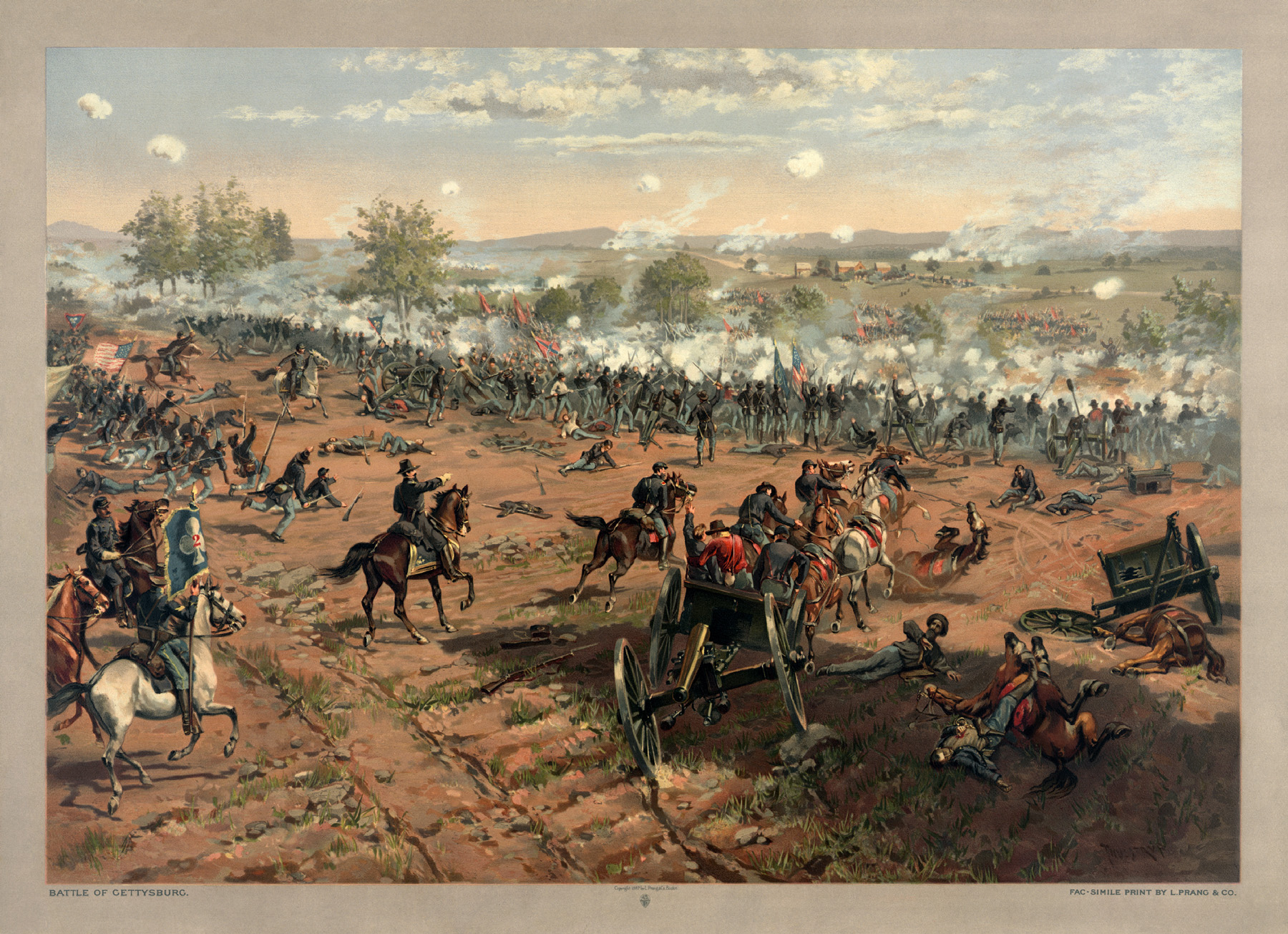
In May 1863, Robert E. Lee's Confederate Army of Northern Virginia had scored a smashing victory over the Army of the Potomac at Chancellorsville. Brimming with confidence, Lee decided to go on the offensive and invade the North for a second time (the first invasion had ended at Antietam the previous fall). In addition to bringing the conflict out of Virginia and diverting northern troops from Vicksburg, where the Confederates were under siege, Lee hoped to gain recognition of the Confederacy by Britain and France and strengthen the cause of northern "Copperheads" who favored peace.

On the Union side, President Abraham Lincoln had lost confidence in theGeorge_G._Meade_Standing Army of the Potomac's commander, Joseph Hooker, who seemed reluctant to confront Lee's army after the defeat at Chancellorsville. On June 28, Lincoln named Major General George Gordon Meade to succeed Hooker. Meade immediately ordered the pursuit of Lee's army of 75,000, which by then had crossed the Potomac River into Maryland and marched on into southern Pennsylvania.

Battle of Gettysburg Begins: July 1

Upon learning that the Army of the Potomac was on its way, Lee planned to assemble his army in the prosperous crossroads town of Gettysburg, 35 miles southwest of Harrisburg, Pennsylvania. One of the Confederate divisions in A.P. Hill's command approached the town in search of supplies early on July 1, only to find that two Union cavalry brigades had arrived the previous day. As the bulk of both armies headed toward Gettysburg, Confederate forces (led by Hill and Richard Ewell) were able to drive the outnumbered Federal defenders back through town to Cemetery Hill, located a half mile to the south.

Seeking to press his advantage before more Union troops could arrive, Lee gave discretionary orders to attack Cemetery Hill to Ewell, who had taken command of the Army of Northern Virginia's Second Corps after Lee's most trusted general, Thomas J. "Stonewall" Jackson, was mortally wounded at Chancellorsville. Ewell declined to order the attack, considering the Federal position too strong; his reticence would earn him many unfavorable comparisons to the great Stonewall. By dusk, a Union corps under Winfield Scott Hancock had arrived and extended the defensive line along Cemetery Ridge to the hill known as Little Round Top; three more Union corps arrived overnight to strengthen its defenses.

Gettysburg_Battle_Map_Day1

Battle of Gettysburg, Day 2: July 2

As the next day dawned, the Union Army had established strong positions from Culp's Hill to Cemetery Ridge. Lee assessed his enemy's positions and determined — against the advice of his defensively minded second-in-command, James Longstreet — to attack the Federals where they stood. He ordered Longstreet to lead an attack on the Union left, while Ewell's corps would strike the right, near Culp's Hill. Though his orders were to attack as early in the day as possible, Longstreet didn't get his men into position until 4 pm, when they opened fire on the Union corps commanded by Daniel Sickles.

Over the next several hours, bloody fighting raged along Sickles' line, which stretched from the nest of boulders known as Devil's Den into a peach orchard, as well as in a nearby wheat field and on the slopes of Little Round Top. Thanks to fierce fighting by one Minnesota regiment, the Federals were able to hold Little Round Top, but lost the orchard, field and Devil's Den; Sickles himself was seriously wounded. Ewell's men had advanced on the Union forces at Culp's Hill and East Cemetery Hill in coordination with Longstreet's 4 pm attack, but Union forces had stalled their attack by dusk. Both armies suffered extremely heavy losses on July 2, with 9,000 or more casualties on each side. The combined casualty total from two days of fighting came to nearly 35,000, the largest two-day toll of the war.

529px-Gettysburg_Day2_Plan

Battle of Gettysburg, Day 3: July 3

Early on the morning of July 3, Union forces of the Twelfth Army Corps pushed back a Confederate threat against Culp's Hill after a seven-hourGeorgePickett firefight and regained their strong position. Believing his men had been on the brink of victory the day before, Lee decided to send three divisions (preceded by an artillery barrage) against the Union center on Cemetery Ridge. Fewer than 15,000 troops, led by a division under George Pickett, would be tasked with marching some three-quarters of a mile across open fields to attack dug-in Union infantry positions.

Despite Longstreet's protests, Lee was determined, and the attack — later known as "Pickett's Charge" — went forward around 3 pm, after an artillery bombardment by some 150 Confederate guns. Union infantry opened fire on the advancing rebels from behind stone walls, while regiments from Vermont, New York and Ohio hit both of the enemy's flanks. Caught from all sides, barely half of the Confederates survived, and Pickett's division lost two-thirds of its men. As the survivors stumbled back to their opening position, Lee and Longstreet scrambled to shore up their defensive line after the failed assault.

529px-Gettysburg_Battle_Map_Day3

Pickett's-Charge

Battle of Gettysburg: Aftermath and Impact

His hopes of a victorious invasion of the North dashed, Lee waited for a Union counterattack on July 4, but it never came. That night, in heavy rain, the Confederate general withdrew his decimated army toward Virginia. Though the cautious Meade would be criticized for not pursuing the enemy after Gettysburg, the battle was a crushing defeat for the Confederacy. Union casualties in the battle numbered 23,000, while the Confederates had lost some 28,000 men — more than a third of Lee's army. The North rejoiced while the South mourned its hopes for foreign recognition of the Confederacy erased.

In November 1863, President Abraham Lincoln was invited to deliver remarks, which later became known as the Gettysburg Address, at the official dedication ceremony for the National Cemetery of Gettysburg in Pennsylvania, on the site of one of the bloodiest and most decisive battles of the Civil War. Though he was not the featured orator that day, Lincoln's 273-word address would be remembered as one of the most important speeches in American history. In it, he invoked the principles of human equality contained in the Declaration of Independence and connected the sacrifices of the Civil War with the desire for "a new birth of freedom," as well as the all-important preservation of the Union created in 1776 and its ideal of self-government.

Demoralized by the defeat at Gettysburg, Lee offered his resignation to President Jefferson Davis, but was refused. Though the great Confederate general would go on to win other victories, the Battle of Gettysburg (combined with Ulysses S. Grant's victory at Vicksburg, also on July 4) irrevocably turned the tide of the Civil War in the Union’s favor.

As after previous battles, thousands of Union soldiers killed at Gettysburg were quickly buried, many in poorly marked graves. In the months thatHD-SN-99-01912 followed, however, local attorney David Wills spearheaded efforts to create a national cemetery at Gettysburg. Wills and the Gettysburg Cemetery Commission originally set October 23 as the date for the cemetery's dedication, but delayed it to mid-November after their choice for speaker, Edward Everett, said he needed more time to prepare. Everett, the former president of Harvard College, former U.S. senator and former secretary of state, was at the time one of the country's leading orators. On November 2, just weeks before the event, Wills extended an invitation to President Lincoln, asking him "formally [to] set apart these grounds to their sacred use by a few appropriate remarks."

Though Lincoln was extremely frustrated with Meade and the Army of the Potomac for failing to pursue Lee's forces in their retreat, he was cautiously optimistic as the year 1863 drew to a close. He also considered it significant that the Union victories at Gettysburg and at Vicksburg, under General Ulysses S. Grant, had both occurred on the same day: July 4, the anniversary of the signing of the Declaration of Independence.

When he received the invitation to make the remarks at Gettysburg, Lincoln saw an opportunity to make a broad statement to the American people on the enormous significance of the war, and he prepared carefully. Though long-running popular legend holds that he wrote the speech on the train while traveling to Pennsylvania, he probably wrote about half of it before leaving the White House on November 18, and completed writing and revising it that night, after talking with Secretary of State William H. Seward, who had accompanied him to Gettysburg.

On the morning of November 19, Everett delivered his two-hour oration (from memory) on the Battle of Gettysburg and its significance, and the orchestra played a hymn composed for the occasion by B.B. French. Lincoln then rose to the podium and addressed the crowd of some 15,000 people. He spoke for less than two minutes, and the entire speech was only 270 words long. Beginning by invoking the image of the founding fathers and the new nation, Lincoln eloquently expressed his conviction that the Civil War was the ultimate test of whether the Union created in 1776 would survive, or whether it would "perish from the earth." The dead at Gettysburg had laid down their lives for this noble cause, he said, and it was up to the living to confront the "great task" before them: ensuring that "government of the people, by the people, for the people, shall not perish from the earth."

The essential themes and even some of the language of the Gettysburg Address were not new; Lincoln himself, in his July 1861 message to Congress, had referred to the United States as "a democracy–a government of the people, by the same people." The radical aspect of the speech, however, began with Lincoln's assertion that the Declaration of Independence–and not the Constitution–was the true expression of the founding fathers' intentions for their new nation. At that time, many white slave owners had declared themselves to be "true" Americans, pointing to the fact that the Constitution did not prohibit slavery; according to Lincoln, the nation formed in 1776 was "dedicated to the proposition that all men are created equal." In an interpretation that was radical at the time–but is now taken for granted — Lincoln's historic address redefined the Civil War as a struggle not just for the Union, but also for the principle of human equality.

On the day following the dedication ceremony, newspapers all over the country reprinted Lincoln's speech along with Everett's. Opinion was generally divided along political lines, with Republican journalists praising the speech as a heartfelt, classic piece of oratory and Democratic ones deriding it as inadequate and inappropriate for the momentous occasion.

In the years to come, the Gettysburg Address would endure as arguably the most-quoted, most-memorized piece of oratory in American history. After Lincoln's assassination in April 1865, Senator Charles Sumner of Massachusetts wrote of the address, "That speech, uttered at the field of Gettysburg and now sanctified by the martyrdom of its author, is a monumental act. In the modesty of his nature he said 'the world will little note, nor long remember what we say here; but it can never forget what they did here.' He was mistaken. The world at once noted what he said, and will never cease to remember it."

In just 270 words Lincoln gave one of the most famous speeches in American History:

"Fourscore and seven years ago our fathers brought forth on this continent a new nation, conceived in liberty and dedicated to the proposition that all men are created equal. Now we are engaged in a great civil war, testing whether that nation or any nation so conceived and so dedicated can long endure. We are met on a great battlefield of that war. We have come to dedicate a portion of that field as a final resting-place for those who here gave their lives that that nation might live. It is altogether fitting and proper that we should do this. But in a larger sense, we cannot dedicate, we cannot consecrate, we cannot hallow this ground. The brave men, living and dead who struggled here have consecrated it far above our poor power to add or detract. The world will little note nor long remember what we say here, but it can never forget what they did here. It is for us the living rather to be dedicated here to the unfinished work which they who fought here have thus far so nobly advanced. It is rather for us to be here dedicated to the great task remaining before us--that from these honored dead we take increased devotion to that cause for which they gave the last full measure of devotion--that "Fourscore and seven years ago our fathers brought forth on this continent a new nation, conceived in liberty and dedicated to the proposition that all men are created equal. Now we are engaged in a great civil war, testing whether that nation or any nation so conceived and so dedicated can long endure. We are met on a great battlefield of that war. We have come to dedicate a portion of that field as a final resting-place for those who here gave their lives that that nation might live. It is altogether fitting and proper that we should do this. But in a larger sense, we cannot dedicate, we cannot consecrate, we cannot hallow this ground. The brave men, living and dead who struggled here have consecrated it far above our poor power to add or detract. The world will little note nor long remember what we say here, but it can never forget what they did here. It is for us the living rather to be dedicated here to the unfinished work which they who fought here have thus far so nobly advanced. It is rather for us to be here dedicated to the great task remaining before us--that from these honored dead we take increased devotion to that cause for which they gave the last full measure of devotion--that we here highly resolve that these dead shall not have died in vain, that this nation under God shall have a new birth of freedom, and that government of the people, by the people, for the people shall not perish from the earth."

No doubt the finest theatrical film made about the Civil War is the 1993 film “Gettysburg.” The 4-1/2 hour film, directed by Ronald F. Maxwell and staring Martin Sheen and Tom Berenger, is a depiction of the historical and personal events surrounding and including the decisive American civil war battle. It features thousands of civil war re-enactors marching over the exact ground that the federal army and the army of North Virginia fought on. The defense of the Little Round Top and Pickett's Charge are highlighted in the actual three day battle which is surrounded by the speeches of the commanding officers and the personal reflections of the fighting men. It is based upon Michael Shaara’s novel “The Killer Angels.”

I have included a few scenes from the film below.

The first scene is of Union Colonel Joshua Lawrence Chamberlain where deliver’s a speech to 120 mutineers of the 20th Maine Division.

This scene depicts Chamberlain’s bayonet charge on Little Round Top where his decision was instrumental in holding the left flank of the Union line against a full assault by Confederate troops.

This scene depicts the infamous and disastrous Pickett’s charge against the massed Union infantry and artillery on Cemetery Ridge

In this scene you see the aftermath of Pickett’s charge and Lee and Longstreet’s realization that the battle had been lost and they needed to regroup the Army of Virginia and retreat.

This final scene is of a Gettysburg tour guide giving a detailed account of Pickett’s charge

I have visited the Gettysburg National Battlefield site three times once with my wife, once with my brother and his wife, and recently during my Lincoln Highway road trip. The Lincoln Highway (U.S. Route 30) runs along the north side of the battlefield and is dotted with plaques and monuments memorializing the battles and the generals who were involved. The route also runs through the center of Gettysburg and the hamlet of Cash Town where Confederate General Hill’s Corps assembled for the battle making his headquarters in the inn that still stands and is serving customers to this day.

The Gettysburg Battle was a turning point in the Civil War. After suffering loss after loss and seeing horrendous causality figures the Union states were growing weary of the war. The Copperheads were pushing for negotiated peace and a return to the Union prior to the beginning of hostilities. Every family in the North was affected by the war so far. There was a sense of dread in the North that the Lincoln could not win this war and he was taking the Union into an abyss.

Gettysburg changed all of this. It gave new hope and energy to the North. It silenced the Copperheads and brought new vigor to recruitment. It dashed any hopes of foreign recognition of the Confederate States as a sovereign nation. It gave Lincoln a second term and the ability to get the 13th Amendment passed and ratified abolishing slavery and involuntary servitude. No one will ever know what would have happened had Lee defeated the Union forces at Gettysburg and marched unopposed into Washington D.C. Historians can only conjecture, based on newspaper reports and comments from politicians of the time, what the outcome would have been. However, one thing we know for sure is that like the Battle of Trenton during the Revolutionary War in 1777 where Washington crossed a frozen river on Christmas night and surprised a bunch of Hessen Mercenaries supporting the British and turned the tide of our revolution The Battle of Gettysburg accomplished a similar feat and gave the Republic a new birth in freedom.

Tuesday, October 25, 2011

Two Americas

"Growing old is mandatory, growing up is optional" — Roadside sign along the Lincoln Highway in Nebraska.

Yesterday President Obama spent time in Los Angeles raising money for his 2012 election campaign. He visited a Mexican restaurant to gain favor with Hispanic voters. After tasting some spicy chicken wings he was off to the home of Melanie Griffith to attend a fund raising dinner hosted by her and actor Antonio Banderas along with other Hollywood moguls.

In New York City the Occupying Wall Street gang continues to camp out on private property with the support of New York’s liberal mayor, Michael Bloomberg. The welfare lovers, Marxists academics, and college students have been camping out for almost a month demanding an end to capitalism, free college, forgiveness of student loans, and a grocery list of socialist programs.

In Madison Wisconsin we have seen teachers along with public sector union thugs and college students rioting against minor cuts in pension and health care contributions proposed and enacted by Governor Scott Walker and the state legislators. These protestors caused over one million dollars in damage to the state capitol building while demanding more benefits.

These are just three examples of what had been happening on the east and west coasts and major urban centers where union, academics, welfare recipients, teachers, and college students are demanding more and more from the American taxpayer. These are the protests and rallies that draw the attention of the media, celebrates and talking heads.

There is another America we do not hear much about unless there is a flood, tornado or other natural disaster. This is the America where people go to work every day to support their families, tend to their farms, and run their small business. It is the county of Wal-Mart, Target, and Home Depot. It is a part of the country we refer to as “Fly-over County.”

I have recently completed a road trip along the historic Lincoln Highway from Pennsylvania to California. My wife and I spent fourteen days driving through Pennsylvania, West Virginia, Ohio, Indiana, Illinois, Iowa, Nebraska, Wyoming, Utah, Nevada and California driving the Lincoln Highway andFXP_9092 exploring the small towns along the route. We ate at local cafes. We saw the vast farm lands of Ohio, Indiana, Illinois, Iowa, and Nebraska. We saw the cattle county of Wyoming and Utah. We passed through the fall foliage in the mountains of Pennsylvania and West Virginia. We saw the vast agriculture of California’s central valley where the environmentalist in San Francisco have cut off the water supply for the farms and almond orchards to protect a tiny fish they believe is being harmed in San Francisco Bay. We saw farm equipment and truck dealers that were much more prevalent than BMW, Mercedes, and Lexus showrooms. We saw acres and acres of corn and beans in Iowa and Nebraska where farmers work from dusk to dawn seven days a week tending their crops while being good custodians of the land they farm.

These are the people the elites call hayseeds and boobs. They grow our food, raise our meat, mine our minerals, and drill for our oil. They pay billions is taxes and obey the law. They are for the most part conservative and patriotic because they believe in the word “conserve.” They conserve the traditions, values and land of America. They fly American flags on their houses and buildings. They construct memorials to their ancestors, sons and daughters that have sacrificed their lives at Saratoga, Gettysburg, Belleau Wood, Iwo Jima, The Chosen Reservoir, Khe Sanh, Fallujah, and Kandahar. They invest in their farms and businesses. They spend a quarter of a million dollars for harvesting machines and tractors that rival a Mercedes in comfort and technology.

The people in this fly-over county drive pickup trucks and SUVs not Priuses and Chevy Volts. They invest in enormous grain storage silos, irrigation equipment, road maintenance, and their local schools. Their schools and public buildings fly the American Flag, not the Mexican Flag. They preserve their historic buildings, traditions, and culture.

FXP_9358This is the America the media pays little attention. It’s the America many of us grew up in where political correctness was never heard off. It’s the America where owning a gun is considered a right not to be tampered with and Washington, D.C. is not high on their list of concerns, except when the EPA begins to pile on regulations that affect their ability to make a living.

If you remove the influence of the big urban centers like Philadelphia, Cleveland, Chicago, Des Moines, and Omaha these states would be listed as red states. Red states in the context of voting Republican and conservative, not in the context of Marxism or socialism.

It would be good to see those freaks and parasites demanding an end to capitalism and government handouts who our protesting in New York, Los Angeles and other big cities to pay a visit to this fly-over country and work a few weeks on a farm of in a small business so they could complete their expensive, elite education by getting their hands soiled producing something rather than rhetoric. Perhaps they would develop a love of country and the values that have endured in Middle America for these many years.

Wednesday, October 19, 2011

Day Nineteen of Our Lincoln Highway Road Trip

Today was our last day of our Lincoln Highway adventure. So far we have traveled 7,219 miles and with our trip home from Sacramento tomorrow we should end up with a total distance traveled of 7,700 miles in nineteen days.

This morning we were up at 6:00 am again and we decided not to partake in the lousy continental breakfast offered by the Days Inn we were staying at. Instead we loaded the car and went around the corner to Carrows for a real American breakfast of bacon, eggs, hash browns and toast. This was the first time we did not eat the breakfast offered by the hotel. The breakfast offered by the hotels we stayed at ranked with Comfort Inn as number 1, Super-8 at number 2, and Days Inn as last.

Our first stop was at Idlewild Park, in Reno, where there was supposed to be a monument to the Lincoln Highway and the transcontinental railroad. We did not find the monument, but the scenery in the park was great, especially the reflections of the trees in the calm water.

We then traveled west on I-80 to the little hamlet of Verdi to search for theDSCN3202 iron monument marking the boundary of California and Nevada. We had to do some exploring to locate the monument and we found it surrounded by a chain link fence to protect it from vandals and souvenir hunters. The drive up to the state line passed through some very scenic countryside and the old iron bridge over the Truckee River was a terrific photo spot.

After spending time at the Truckee River and state line we made our way to Truckee, California to look for some markers for the Lincoln Highway which now was designated as US 40 in California. The railroad station, where the marker was located, was having its parking area renovated and there was no evidence of any marker. We stopped in the California Information Center and asked the girl behind the counter where the marker was. She told us it was in storage until the construction was completed. There was, however, a restored Flying A service station.

Truckee is a quaint little town with boutique shops and cafes. As were not hungry we took our pictures and got back on Historic US 40 heading for Donner Summit.

As we drove west on US 40 (Donner Summit Road) we stopped at the site of the infamous Donner Party and the tragedy that befell them in 1846 as they traveled to California. Only 48 of the 87 member party survived the snow and cold where they became stranded in the Sierra Nevada Mountains on their way to Sacramento. There were numerous reports of cannibalisms among those who survived the ordeal.

Once again we encountered construction as the park’s entrance and parking area was being renovated. The museum was opened and the exhibits told the story of the Donner Party and other pioneers braving the hardships of the Emigrant Trail to California.

We hiked some of the trails around the museum and once again the scenery was great especially around the river.

Our final stop before we headed for Sacramento was at Donner SummitFXP_9841 where we stopped at the Rainbow Bridge and saw evidence of where the original Lincoln Highway passed over the summit and through the Sierra Nevada Mountains. It must have been some task for those cars in the 1920s and 30s to traverse this highway on their way to San Francisco. There was even the remnant of a wrecked car that could not negotiate the curves and tumbled down the mountain. The scenery on this portion of US 40 was magnificent.

After we climbed to the summit and began our downward passage we rejoined I-80 and headed for Sacramento. Our Lincoln Highway adventure had come to an end and we would be going home on Interstate 5.

You can see all of my pictures by clicking here. Don’t forget to click the “Slideshow” button at the upper right to view the largest image.

In the coming weeks watch for my newsletter articles about the Lincoln Highway. I will discuss its history and significance to the United States

Tuesday, October 18, 2011

Day Eighteen of Our Lincoln Highway Road Trip

Today marked the beginning of the home stretch for our 395, Trans-Canada, and Lincoln Highway road trip. So far we have travelled about 6,800 miles and coved a lot of road. We have seen prairies, mountains, fall foliage, and grain silos. We have had an accident with our 2001 Toyota Van and completed the trip with a new Ford Expedition from Enterprise Car Rental. To date I have posted 937 photos — about 40% of the total I have taken. For the most part the weather has been clear and mild.

On this 18th day we travelled on US 50 from Wendover, Utah to Reno,DSCN3114 Nevada. US 50 follows the trace of the Lincoln Highway and is known as the loneliest highway in the United States, and believe me it is. It goes southwesterly from Wendover to Reno and crosses some of the most desolate lands in Nevada. The road is good and mostly straight. It goes through a few towns like Ely, Eureka and Austin before reaching Fallon, Nevada. We were lucky to find a café in Austin that offered good, inexpensive food.

Outside of these few towns and an old pony express station it was a very boring, uneventful drive. We arrived in Reno at 5:00 pm, checked into our hotel, and jelled out for the night.

Tomorrow we will climb the Sierras on I-80 to Sacramento and then on Thursday we will head for home on I-5. Kathy and I are now looking forward to getting home. We have a lot to do including swapping our rental car for a more economical vehicle and buying another van. We will have a busy weekend.

You can see all of my pictures by clicking here. Don’t forget to click the “Slideshow” button at the upper right to view the largest image.

Till Wednesday night.

Saturday, October 15, 2011

Day Fourteen and Fifteen of Our Lincoln Highway Road Trip

After a good night’s sleep at the Comfort Inn in Dixon, Illinois we were on the road by 7:00 am and heading for Iowa. The two things I had to do today were to forget about the accident with our van and get used to driving the behemoth Ford Expedition. The toughest thing to get used to was getting in and out. You need a step ladder to climb into the driver’s seat. Once on the road it is not too bad to drive, especially on the Interstates. You also have to get used to parking it. Another annoying thins is pulling up to the gas pumps. The vehicle is longer than you think and I have to pull past the pump farther than I am used to get the hose into the filler spout, which does not have a cap. It is designed for the new nozzles and you just insert the gas nozzle into the filler spout.

Iowa is flat and devoid of many trees. There is, however, a lot of corn. As we drove along the Lincoln Highway, Route 30, we saw fields and fields of corn. Some fields were being harvested while others were still waiting for the harvesting machines.

We only had a few miles left in Illinois until we reached the Mississippi River and crossed over into Iowa. But before we crossed we stopped at the Dutch windmill on the banks of the river. This windmill is there because a Dutch fellow with a love of windmills built it. It is a working windmill and one of the workers opened it up and gave us a tour of the interior of the mill. We saw the workings and how it ground the grain into flour. Due to the mills height above the river I was able to get some good shots of the river.

The Iowa DOT does a good job of marking the Lincoln Highway. It was veryDSCN2921 easy to follow the route with the numerous signs along the road. There was nothing really spectacular in Iowa except the section of the original brick paving on the Lincoln Highway and the numerous grain silos.

We reached Carter Lake, Iowa and ended our day of travel across Iowa at the Nebraska border at Omaha and the Missouri River. Much to our chagrin our motel was by the airport and there was a marked lack of restaurants so we went to the local Subway for dinner.

Today we were up early and ready to meet Nebraska. The Lincoln Highway in Nebraska pretty much follows Route 30. The day was clear and warm with a high of 85 degrees. Nebraska has more corn fields than you can imagine. All along the route there are fields of corn, farms and grain silos. It is amazing how much corn is grown here. We were also following the route of the Union Pacific Railroad and we saw at least twenty trains of 80 cars or more containing tank cars loaded with ethanol, corn and coal. Where the coal was coming from I don’t know, but there was plenty of it.

Along the way I stopped by a dealer selling farm machinery and talked with a young man who was fixing a harvesting machine. Los Angeles has their BMW and Mercedes dealers. Nebraska has their John Deere, Case, Massey Ferguson, GMC, and Ford dealers. Almost everyone drives a big pickup truck and I found out that most of the farmers own their farm machinery.

These harvesting machines are like luxury cars. The cabs are air conditionedFXP_9356 and equipped with radios, GPS and other comfort items. A Gleaner harvesting machine runs about $250,000. This is quite a pop for a corn farmer as he also has a $100,000 tractor and several other expensive pieces of equipment. The farms also have a complex of silos to store the grain.

People, especially the elite, laugh at these farmers. Because they do not have a degree from Princeton, Harvard, Yale, or Columbia those who do look down their noses at the people who feed us. These farmers work dawn to dusk seven days a week to plant, fertilize, care for and harvest the grains and beans we buy at the supermarket at the lowest prices in the world. They fight the government, taxes and the weather to give us our daily bread. They are generally conservative, patriotic and good care takers of the land God gave them.

The corn we saw looked like it was dead, but upon closer inspection it wasFXP_9364 not. Most of the corn we saw is used either for cattle feed, corn syrup or ethanol. Corn leads all other crops in value and volume of production. Here are some more interesting facts about corn:

  • Iowa, Illinois, Nebraska and Minnesota account for over 50 percent of the corn grown in the U.S.
  • Corn is a major component in many food items like cereals, peanut butter, snack foods and soft drinks.
  • Each year, a single U.S. farmer provides food and fiber for 129 people - 97 in the U.S. and 32 overseas.
  • In the U.S., corn production measures more than 2 times that of any other crop.
  • Over 55% of Iowa's corn goes to foreign markets. The rest is used in other parts of the United States
  • The United States produces 333 million tons of corn each year and the closest competitor is China at 163 million.

As you can see corn is a very important crop in the United States and the farmers of Iowa and Nebraska make a major contribution

Our last stop on the Lincoln Highway was Buffalo Bill’s house in North Platte, NE. Unfortunately the house was closed and we did not get to go inside. The house was built in 1886 and is quite ornate and picturesque.

Our stop for the night was at the Super-8 motel in Ogallala, Nebraska. Tomorrow we will head west through Nebraska and enter into Wyoming.

You can see all of my pictures by clicking here. Don’t forget to click the “Slideshow” button at the upper right to view the largest image.

Till Saturday night.

Wednesday, October 12, 2011

Day Twelve of Our Lincoln Highway Road Trip

Today up at 06:00 at our hotel in Mansfield, Ohio and we were greeted by rain. It began raining during the night and by the time we finished breakfast, checked our maps and loaded the car it was still raining. Ugh! I think we are in for some rain the next few days. Oh, well we will just have tough it.

As we drove through Mansfield, not a pretty town, we passed the abandonedFXP_9080 Westinghouse appliance factory, a plant that once employed 7,000 people. Now the plant is being torn down and all of the jobs are gone, probably to China or Korea. So much for all of those union jobs.

After we got out of Mansfield we picked up the Lincoln Highway and began rolling though Ohio farm country. The Ohio DOT has done a good job of marking the highway. Around 10:00 am the rain quit and it began to clear. This was good.

I forgot how pretty the central and western Ohio farm country is. The farms are neat and the fields are well manicured. The smell of freshly cut hay and grass was terrific. These farmers are prosperous and conservative. I can remember hearing about the reactionary, conservative farmers in southern Ohio when I lived in Cleveland. I did not realize then how correct these farmers and citizens of the small towns are. They are patriotic as demonstrated by the American flags on their houses and the monuments in the town squares. The town of Delphos on the old Lincoln Highway had an impressive memorial to the fallen heroes of the town dating to the Civil War. There was also a terrific mural painted on the wall of a Firestone garage depicting the Lincoln Highway of bygone days.

We had to make a quick stop at a Rite Aid in Ontario, Ohio pick up some supplies for the trip. We needed ice, paper towel, crackers and a few other items. The store was neat and clean and the checkout clerk was friendly and helpful. Of course Kathy had to tell her all the details of the trip as she does everyone she meets.

We found several of the historic markers for the highway along with someFXP_9092 great fall colors along the way. It almost makes me want to move back to Ohio where there are sensible people who believe in America. You just have to stay away from Cleveland and Toledo.

Around lunch time we crossed into Indiana where the Lincoln Highway is not marked as well as Ohio. We had lunch at a truck stop at the junction of Route 30 and I-69 on the outskirts of Fort Wayne, Indiana. We bypassed Fort Wayne as here was not much of the historical Lincoln Highway to see there and we wanted to make some time to get to our send destination of Joliet, Illinois and the Texas Road House for a great steak dinner.

We discovered the cheapest gas prices in Ohio at $3.19 per gallon. I don’t know why gas is so cheap. Another thing we like to do is stop at a McDonalds for a coffee and a pit stop.

When I went to use the restroom at the restaurant there was a black guy hanging about and he asked me for some money to buy a sandwich as his “comp” check had not come in. I ignored him and walked out. It’s a good thing he did not have a knife or some other weapon.

We had a good lunch and then were back on the road again. Now the sun was out and the farm lands of Indiana were as nice as those of Ohio. There were not many points of interest related to the Lincoln Highway in this part of Indiana so we jumped on the expressway and Interstate 94 for Chicago and Joliet.

We arrived at our Super-8 motel in Joliet very near the Hampton Inn where we stayed the first night of our Route 66 road trip. This is the location where the Lincoln Highway crosses historic Route 66. The Texas Road House where we had a great steak is the same restaurant we ate at the first night of our Route 66 trip.

Tomorrow is supposed to be partly sunny with a chance of showers as we make our way across Illinois and on to Cedar Rapids, Iowa. I hope the showers hold and the sun is predominant. I think we will see many historic points and some more lush farm lands.

You can see all of my pictures by clicking here. Don’t forget to click the “Slideshow” button at the upper right to view the largest image.

Till Thursday night.

Tuesday, October 11, 2011

Day Ten of Our Lincoln Highway Road Trip

Today we were on the road by 07:00 to explore the historic Lincoln Highway through Pennsylvania. We had our map books organized and the main points of interest identified. It was fairly easy to follow the track of the Lincoln Highway as it mainly followed US 30 with exceptions where US 30 was realigned. The Pennsylvanian Department of Transpiration (PennDOT) has done a great job of marking the Lincoln Highway with highway shields.

The weather was not as great as it had been for the past nine days. The skies were overcast but bright. No blue skies until midafternoon. Traffic was heavy because it was a holiday today (Columbus Day)

Interruption! I had to quit as I lost the Internet connection and could not upload any photos.

I am resuming on Day Eleven so I will combine the two day.

Day Ten Resumed.

Our journey along the historic Lincoln Highway took us along US 30 through New Oxford and Gettysburg where we got some great photos. We had no problems following the route as it was marked well by PennDOT.

The day was one of those partially sunny days with a hazy sun andDSCN2502 sometimes breaks of blue. There were several murals painted on buildings and barns along the way and the autumn colors varied from town to town. There were some really neat colored trees along the country roads.

We stopped at a roadside fruit stand in St. Thomas, PA. They had some great farm grown tomatoes so I bought one and ate it on the spot. It was the best tomato I have had for years, ripened on the vine and fresh from the farm. Kathy bought some apples and gourds to take home to Gwen for decorating the house for Halloween and Thanksgiving.

About 2:00 pm we arrived at the memorial for United Flight 93. This is the new memorial that is still under construction and I did not care for it. First you have to take a bus to the actual memorial and then hike about a half a mile to the wall with the names of the victims. I felt this new memorial was too cold. The old memorial was constructed by people and had more passion and warmth connected to it. This memorial was designed and built by engineers and architects and it looked like they were more concerned with their achievements than the victims of the terrorists. Also there were not enough restrooms.

We spent about two hours at the memorial; most of the time spent hikingFXP_8912 back to the wall of names and then back to the bus stop. It was good exercise. Also, unless you are a family member you cannot walk out to the large rock that serves of a headstone for the mass grave of the victims. Perhaps in a few years when the National Park Service gets some more money it will be a better memorial — I hope so.

Day Eleven: Greensburg, PA to Mansfield, Ohio.

We started out again at 07:30 am along US 30 towards Pittsburg and the Ohio River. I decided to take the Interstate in order to avoid going through Pittsburg during the morning rush hour. Even using the Interstate the traffic was heavy and there were the usual orange barrels blocking lanes for construction. I don’t think they ever stop fixing the roads in Pennsylvania.

We crossed into a small portion of West Virginia where we got fuel and the visited the world’s largest tea pot at Chester, West Virginia. We then crossed of the Ohio River into the buckeye state and then made our way east along the river to the survey marker marking the boundary of Ohio and Pennsylvania and the beginning of Jefferson rectangular land scheme for the United States.

Once the Land Ordinance of 1785 was passed by Congress surveyors needed DSCN2661to establish the boundary of Pennsylvania and Ohio to implement the first seven ranges of the rectangular land scheme of townships and sections. This sectionalized land scheme, after being refined, became the basis of land in the United States, with the exception of the Mexican ranchos, west of this boundary marker. It was the basis for transferring land to soldiers in payment for their service in the revolutionary war, the homesteads of the mid-west, and building of the transcontinental railroad. It is also why the United States is the wealthiest land in the world. (See my article on “What Separates the Rich From the Poor.”) After practicing land surveying for 55 years I was quite excited to see the monument where the sectionalized land system began.

After leaving the boundary between Ohio and Pennsylvania we made our way west along US 30 and the Lincoln Highway. The Ohio Department of Transportation, like PennDOT, has done a great job of marking the historic Lincoln Highway. We meandered on and off US 30 to the old alignment of the Lincoln Highway and were able to locate one of the first test sections of the roadway. The test section was a one mile section of roadway where they engineers developed a standardized lane width and cross fall. This test section would be used as a standard for all subsequent constructions.

Abound noon we made it to Canton, Ohio and The Professional Football Hall of Fame. If you are a pro football fan this is a “must” visit. There are 267 busts of the hall of famers enshrined to this date. The exhibits are great and they tell the history of pro football from its founding days to the present. There are video displays, movies and of course a gift shop. The gift shop is great as you can buy everything from mouse pads and cups to jerseys of your favorite team.

We spent about two hours at the hall of fame and then got some lunch and visited the McKinley Memorial in Canton. Then it was time to head for Mansfield and our hotel. It was a great day with lots of fall colors and good Ohio scenery. Tomorrow we will travel through the remainder of Ohio and Indiana to Joliet, Illinois.

You can see all of my pictures by clicking here. Don’t forget to click the “Slideshow” button at the upper right to view the largest image.

Till Wednesday night.

Sunday, October 9, 2011

Day Eight and Nine of Our Lincoln Highway Road Trip

These would be two days of visiting my niece Cindy and her husband Vic and son Paul at their home in Cicero, New York. We had been looking forward to this visit for the last five days and were anxious to spend time with them and catch up on family issues.

Before we arrived at their home we made two stops. The first was to visit the 1812 battlefield of Sackets Harbor just east of Watertown and the second stop was at an urgent care center. I’ll begin with the visit to Sackets Harbor.

This day was day was another gorgeous day with clear blue skies and mildFXP_8736 temperatures. Sackets Harbor sits on the southern shore of Lake Ontario and was the site of a land and naval battle between the U.S, Navy and the British and Canadian forces in the war of 1812. Sackets Harbor is also the site of some beautiful homes, pleasant streets and a marina.

Kathy and I spent about an hour walking the entire state park and taking photos of the historic homes, monuments, informational plaques, and the burgeoning fall colors. The red barn set against the blue sky and lush green grass was especially impressive.

After leaving Sackets Harbor we wandered the back roads of Jefferson County past the farms and neat homes along the country roads. The fresh air and smells of freshly cut grass brought back memories of living in the outskirts of Cleveland and wandering the roads of Cuyahoga County in the autumn. It was a great experience.

Returning to Watertown we stopped at a Target store to see if the pharmacist could give Kathy something for her eye that was irritated and red. The Pharmacist told her eye was infected and she needed to see a physician. But, before leaving the store I picked up a calculator so Kathy did not have to long hand division to calculate our gas mileage and one of those magic window cleaners to keep our windshield sparkling.

Thanks to the GPS we located an urgent care facility in Watertown and after navigating the meandering city streets we found the urgent care facility. WeFXP_8750 walked in and were greeted by a helpful receptionist who took down all of Kathy’s information and medical insurance information. We had no problems with the medical insurance and after about a 20 minute wait we saw a physician’s assistant named Kerri who immediately diagnosed the problem as an eye infection (red eye) and prescribed some antibiotic eye drops which we purchased at the local Walgreens pharmacy for $40.00. Kathy has to use one drop in each eye three times each day for eight days and make sure she keeps her hands clean with antiseptic hand cleaner. After one day I can already see an improvement in her eye.

We left Watertown and drove for just over an hour to Vic and Cindy’s home in Cicero, NY. They have a great home on 12 acres right off State Route 31. The home is set back about 100 yards off the road and is surrounded by big trees.

Vic, Cindy and Paul greeted us with enthusiasm and made us feel right at home. When we arrived Vic and Paul were building their hot tub enclosure at the rear of the house. Vis is a military engineer who works on defense projects for Navy, but he finds time to serve as a Boy Scout Leader, volunteer fireman, carpenter, brick mason, tile layer, and general all around handyman. He has boundless energy and, along with Cindy and Paul, he has built most of his house. I envy him his talent and energy.

Vic is not only a great builder he also does a lot of the cooking and baking.FXP_8768 He made us delicious lasagna on Saturday night along with an apple pie from scratch. This morning he got up early and whipped up some omelets for us. I always knew Cindy married well.

Paul is an Eagle Scout and a senior in high school. He hopes to get into Ohio State to study aerospace engineering. I am sure he will do well in whatever he does. He is a great young man who is well grounded thanks to the great parenting of Vic and Cindy. I wanted to mention he should look into civil engineering due to his love of building stuff and Ohio State has a good CE program. That will be up to Paul to figure out and I am sure he will choose his passion.

After a very hospitable stay with Vic, Cindy and Paul (oh I almost forgot Midnight, their black Lab) we departed for York, Pennsylvania at 10:00 am. Our first stop was a car wash to get all of those Canadian bugs off of the car. Then Dunkin Donuts for a coffee for the road. We took I-81 south and headed for York, PA. The drive was easy, but the traffic was heavy, it looked as though everyone was on the road this Sunday, Perhaps it was the weather and the thought that this might be the last good weekend of the year. On our drive south on I-81 we passed two Tim Hortons in New York, I thought we saw the last of them in Canada, but obviously the Canadians have invaded New York once again. No, we did not stop at Tim Hortons, we had enough of them. Instead we stopped at a Subway for a meatball sandwich for lunch. Fortunately I had loaded up with antacids for the trip. The sandwich was good, but it lasted for a long time.

The fall colors are just now coming into full bloom and we are finally seeing the reds of the oaks. When we crossed in Pennsylvania we began to encounter the usual construction zones with their forest of orange barrels. If you want to make some good investments look for companies that make those barrels. You will not go wrong. When we got around Harrisburg it got squirrely with the construction, detours and constant turnoffs. Vic warned me that road work in Pennsylvania was never done and he was right on.

We arrived at our Super-8 in York PA at 16:30 and got settled in before looking for a dinner spot. The Indian desk clerk recommended the Round the Clock Diner just up the road from the hotel. The food was good and the prices very reasonable. After returning to the hotel we watched the Cardinals and Jets lose and now I am watching the Packers and Falcons. I think the Falcons will win, but you will know if I was correct when you read this blog. Since this was a bye week for the Rams I did not have to get frustrated today.

Tomorrow (Monday) we will begin our trek along the Historic Lincoln Highway. I hope we have the same weather we have had so far and I have good luck finding the historic places I have marked on my maps.

You can see all of my pictures by clicking here. Don’t forget to click the “Slideshow” button at the upper right to view the largest image.

Till Monday night.