“In the wars of the European powers in matters relating to themselves we have never taken any part, not does it comport with our policy so to do. It is only when our rights are invaded or seriously menaced that we resent injuries or make preparation for our defense.” — James Monroe
We have not had a rational foreign policy dedicated to our self-interest since the Monroe Doctrine. The Monroe Doctrine was a policy of the United States introduced on December 2, 1823. It stated that further efforts by European nations to colonize land or interfere with states in North or South America would be viewed as acts of aggression, requiring U.S. intervention. At the same time, the Doctrine noted that the United States would neither interfere with existing European colonies nor meddle in the internal concerns of European countries. The Doctrine was issued at a time when nearly all Latin American colonies of Spain and Portugal had achieved independence from the Spanish Empire (except Cuba and Puerto Rico) and the Portuguese Empire. The United States, working in agreement with Britain, wanted to guarantee no European power would move in.[2]
President James Monroe first stated the doctrine during his seventh annual State of the Union Address to Congress. It became a defining moment in the foreign policy of the United States and one of its longest-standing tenets, and would be invoked by many U.S. statesmen and several U.S. presidents, including Theodore Roosevelt, John F. Kennedy, Lyndon B. Johnson, Ronald Reagan and many others.
The intent and impact of the Monroe Doctrine persisted with only minor variations for more than a century. Its primary objective was to free the newly independent colonies of Latin America from European intervention and avoid situations which could make the New World a battleground for the Old World powers. The doctrine asserted that the New World and the Old World were to remain distinctly separate spheres of influence, for they were composed of entirely separate and independent nations.
 The full document of the Monroe Doctrine is long and couched in diplomatic language as it was presumed to be the work of John Quincy Adams Monroe’s Secretary of State, but its essence is expressed in two key passages; the first is the introductory statement:
“The occasion has been judged proper for asserting, as a principle in which the rights and interests of the United States are involved, that the American continents, by the free and independent condition which they have assumed and maintain, are henceforth not to be considered as subjects for future colonization by any European powers.”
The second key passage, a fuller statement of the Doctrine, is addressed to the "allied powers" of Europe (that is, the Holy Alliance); it clarifies that the United States remains neutral on existing European colonies in the Americas but is opposed to "interpositions" that would create new colonies among the newly independent Spanish American republics:
“We owe it, therefore, to candor and to the amicable relations existing between the United States and those powers to declare that we should consider any attempt on their part to extend their system to any portion of this hemisphere as dangerous to our peace and safety. With the existing colonies or dependencies of any European power we have not interfered and shall not interfere. But with the Governments who have declared their independence and maintained it, and whose independence we have, on great consideration and on just principles, acknowledged, we could not view any interposition for the purpose of oppressing them, or controlling in any other manner their destiny, by any European power in any other light than as the manifestation of an unfriendly disposition toward the United States.”
The Monroe Doctrine served as our fundamental basis for our foreign policy until the introduction of the Truman Doctrine in 1947.
With the Truman Doctrine, President Harry S. Truman established that the United States would provide political, military and economic assistance to all democratic nations under threat from external or internal authoritarian forces. The Truman Doctrine effectively reoriented U.S. foreign policy, away from its usual stance of withdrawal from regional conflicts not directly involving the United States, to one of possible intervention in distant conflicts.
The Truman Doctrine arose from a speech delivered by President Truman before a joint session of Congress on March 12, 1947. The immediate cause for the speech was a recent announcement by the British Government that, as of March 31, it would no longer provide military and economic assistance to the Greek Government in its civil war against the Greek Communist Party. Truman asked Congress to support the Greek Government against the Communists. He also asked Congress to provide assistance for Turkey, since that nation, too, had previously been dependent on British aid.
At the time, the U.S. Government believed that the Soviet Union supported the Greek Communist war effort and worried that if the Communists prevailed in the Greek civil war, the Soviets would ultimately influence Greek policy. In fact, Soviet leader Joseph Stalin had deliberately refrained from providing any support to the Greek Communists and had forced Yugoslav Prime Minister Josip Tito to follow suit, much to the detriment of Soviet-Yugoslav relations. However, a number of other foreign policy problems also influenced President Truman's decision to actively aid Greece and Turkey. In 1946, four setbacks, in particular, had served to effectively torpedo any chance of achieving a durable post-war rapprochement with the Soviet Union: the Soviets' failure to withdraw their troops from northern Iran in early 1946 (as per the terms of the Tehran Declaration of 1943); Soviet attempts to pressure the Iranian Government into granting them oil concessions while supposedly fomenting irredentism by Azerbaijani separatists in northern Iran; Soviet efforts to force the Turkish Government into granting them base and transit rights through the Turkish Straits; and, the Soviet Government's rejection of the Baruch plan for international control over nuclear energy and weapons in June 1946.
In light of the deteriorating relationship with the Soviet Union and the appearance of Soviet meddling in Greek and Turkish affairs, the withdrawal of British assistance to Greece provided the necessary catalyst for the Truman Administration to reorient American foreign policy. Accordingly, in his speech, President Truman requested that Congress provide $400,000,000 worth of aid to both the Greek and Turkish Governments and support the dispatch of American civilian and military personnel and equipment to the region.
Truman justified his request on two grounds. He argued that a Communist victory in the Greek Civil War would endanger the political stability of Turkey, which would undermine the political stability of the Middle East. This could not be allowed in light of the region's immense strategic importance to U.S. national security. Truman also argued that the United States was compelled to assist "free peoples" in their struggles against "totalitarian regimes," because the spread of authoritarianism would "undermine the foundations of international peace and hence the security of the United States." In the words of the Truman Doctrine, it became "the policy of the United States to support free peoples who are resisting attempted subjugation by armed minorities or by outside pressures."
Truman argued that the United States could no longer stand by and allow the forcible expansion of Soviet totalitarianism into free, independent nations, because American national security now depended upon more than just the physical security of American territory. Rather, in a sharp break with its traditional avoidance of extensive foreign commitments beyond the Western Hemisphere during peacetime, the Truman Doctrine committed the United States to actively offering assistance to preserve the political integrity of democratic nations when such an offer was deemed to be in the best interest of the United States.
The Truman Doctrine of intervention lasted throughout the Cold War and has been modified since our intervention in Bosnia-Herzegovina, Kosovo, Iraq, and Afghanistan. Now we have no stated rational foreign policy that is dedicated to our self-interest as John Quincy Adams advocated in the Monroe Doctrine.
Today we have a mish-mash of a foreign policy ranging from establishing democratic regimes around the world to the war on terror. To accomplish these aims we spend our treasure and our blood on foreign aid and military interventions. The latest example of military intervention was Obama’s bombing of Libya and our monetary aid has been recently targeted at Syria and Egypt — nations where we have no compelling self-interests.
What is the Obama administration’s foreign policy? Is it to lead from behind? Is it to vacillate on making decisions like he did in Benghazi? Is it to support any Islamic regime that fit’s his personal ideology? Is it to change from day to day like a chameleon? Or is it simply to play golf?
However, the one thing Obama has is the support of the mainstream media. No matter what he does he can be assured that the MSM will either support what he does or keep mum.
Millions protesting in the streets. Another leader deposed. Dozens killed in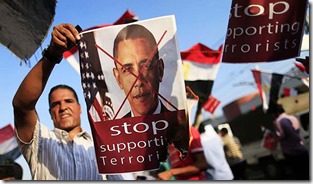 violent clashes, including at least 51 people slain on Monday. Obama’s Mideast policy is in shambles. Nowhere is that more obvious that Egypt, which just held its second revolution in as many years.
Egypt isn’t just a problem. It’s a full-fledged disaster, hand-delivered to us by President Obama. He sabotaged our ally Hosni Mubarak more than a year ago, then defended that strategy during his reelection campaign.
According to Dan Gainor of Fox News:
“All of this is essential context to the collapse of the Morsi-government. Yet network journalists aren’t saying any of it. In 51 stories and briefs on the morning and evening news shows since the latest unrest began, ABC, CBS and NBC never mentioned Obama’s complicity in Mubarak’s fall.
If Obama wants our Egyptian policy to be one that rejects our friends and supports our enemies, then he’s doing an excellent job.
Heck, they barely mentioned Obama, citing the president by name in just 28 percent of the stories, even though America’s $1.5 billion in aid, our relationship with the Egyptian military and more are at stake.
Network reports were happy to quote Obama’s generic comment: “Our commitment to Egypt has never been around any particular individual or party. Our commitment has been to a process.” But context and the history of the last revolution were sorely lacking.
During NBC’s third July 3 “Nightly News” report on Egypt, correspondent Andrea Mitchell brought up Obama’s past support of Mubarak. She actually criticized Obama for waiting too long, not for abandoning a key American ally. “The irony is, after being accused of sticking too long with Hosni Mubarak two years ago, once again, the U.S. is being tagged as being on the wrong side of history in Egypt,” she argued.
That didn’t exactly go well. By September 2012, Obama even admitted it. According to CBS News, “President Obama says the U.S. would not consider Egypt an ally, ‘but we don't consider them an enemy.’”
When asked during the presidential debates in October if he regretted abandoning Mubarak, Obama was clear: “I don't because I think that America has to stand with democracy.” He then listed several areas that he expected the new government to push including taking “responsibility for protecting religious minorities,” recognizing “the rights of women,” abiding “by their treaty with Israel,” and “developing their own economy.”
In 2011, President Obama quickly called on President Mubarak to acquiesce to demonstrators’ demands and leave office.
With Mubarak out of the way, Obama proceeded to support the outlawed Muslim Brotherhood, who succeeded in stealing the revolution.
Obama’s support extended to an ex-con named Mohammad Morsi. When Morsi ran for the presidency, the president continued to support him, even when it was clear that the close election was rigged by dubious tactics.
With Obama’s full-fledged support of Morsi, you would think that Egyptians would be in love with him. But the deeply troubled Egyptian public is in no way enamored with this White House.
Quite the contrary. Here’s why: More than 40 percent of Egyptian citizens currently must survive on about $2 per day. Lines to purchase gasoline stretch on for hours. The lines for a tank of propane — needed for cooking and other necessities of life — extend for up to nine hours. Electricity is cut off from 2-3 hours per night.
When the Egyptian masses finally couldn’t take it anymore, 22 million people signed a petition to recall Morsi’s election—more than twice the number of people than originally voted for him.
Then something totally unprecedented happened: 30 million people took to the streets. The largest mass demonstration in human history.
 The Egyptian Army had tried on many previous occasions to mediate between President Morsi and the opposition. But Morsi autocratically and arrogantly refused to talk to anyone other than his masters in the Muslim Brotherhood headquarters.
In order to avoid the stigma of a coup, the military leaders met with a cross-section of the Egyptian population and religious leaders, including Islamists. As a result, they produced a wise plan calling for an election and appointing the chief justice of the Supreme Court as the interim president.
But here is the irony: while millions of Egyptians responded to Morsi’s ouster by joyfully dancing in the streets, the Muslim Brotherhood advisers in the White House helped Obama produce a non-descript statement. With his wishy-washy message about those who are democratically elected, Obama confirmed in Egyptian minds that he is in the pocket of the Muslim Brotherhood.
It is downright depressing to see the leader of the free world unable to comprehend the Islamic understanding of democracy. To the Islamist, democracy means “one man, one vote, one time.” Once they have their power, there’s no reason to ever have another election.
The latest news from Egypt is grim. Fifty-one people are now said to have been killed yesterday when Army units guarding a military barracks opened fire on protestors loyal to deposed President Mohamed Morsi. The military says that the protestors were trying to storm the building. The Muslim Brotherhood insists that its supporters were behaving peacefully, saying that they were just completing their prayers as the firing began. Of those killed, only one was a soldier. The rest were Morsi supporters — and most of them appear to have been unarmed.
The following report is from Evan Hill for Foreign Policy Magazine
It was around 3:30 a.m. in Cairo on Monday morning and time for Fajr, the first of the day's five Muslim prayers. In an hour and a half, the sun would rise. Now, it was still dark. On a wide boulevard running in front of the heavily guarded gates of the Republican Guard club, a few hundred protesters were entering the fourth day of a sit-in demanding the reinstatement of ousted President Mohamed Morsi. They had been waiting, sleeping in sparse shade through the hot days, believing their president was held inside the compound. On Monday morning, they formed into lines with their backs turned to the soldiers guarding the gate, and began to pray.
Less than two thousand feet away, in a high-rise apartment on the other side of the sprawling club, Salah and his family awoke. They prepared for Fajr. Then they heard gunshots.
Salah rushed to the window, turned on his phone and began to film. The shots cracked through the pre-dawn darkness, followed by more — a rapid series of single blasts that sounded like they came from rifles. There was distant and incoherent shouting. Something that look liked black smoke drifted upward, and then more shots. Down below, inside the club, Salah watched soldiers throw on flak jackets, jump into vehicles and drive toward the commotion.
On the streets in front of the club, something terrible was happening. How it began, too, is shrouded in darkness. But how it ended was clear: at least 51 dead protesters, a dead soldier and a dead policeman. It was the worst act of state violence since the 2011 uprising, a "massacre" that threatened to push the huge but temporarily defeated Muslim Brotherhood even further from reconciliation with a new government they view as completely illegitimate.
"The killing isn't random or individual or against thugs like before. The killing is systematic and programmed, instructed and ordered by the military," Mohamed el-Beltagy, a leading member of the Brotherhood's Freedom and Justice Party, told reporters later on Monday. "This is a crime that threatens all Egyptians, that this is the regime that awaits Egypt if they allow the continuation of this military coup."
The two narratives of what occurred on Monday morning are as polarized as Egypt's politics, where belief now seems to hinge on affiliation over logic. The Brotherhood, castigated by many as an insular, clannish and reactionary religious militia, find themselves out of power and bereft of non-Islamist allies. They're framed by popular, privately-owned media as thuggish criminals undeserving of sympathy — even in death. "Against terrorism," reads a banner permanently appended to the on-screen broadcast of the CBC network, unsubtly aimed at the Brotherhood.
The military offered up its own press conference on Monday afternoon to explain why 51 citizens lay dead in the street. The spokesman said Morsi's supporters had attempted to storm the guards' compound using shotguns and Molotov cocktails. Others threw rocks and debris on the guards from above, he explained, and soldiers had no choice but to respond with lethal force.
 The story was problematic. Dozens of witnesses, including some not associated with the protesters, told reporters that violence began when soldiers and riot police fired tear gas to break up the sit-in and quickly began firing birdshot and bullets. Those who had been praying said the attack began suddenly, without provocation. Various survivors gave consistent statements. Doctors and journalists said the majority of the fatal gunshot wounds struck their victims from behind, as if they had been praying or fleeing. The military failed to produce any photographs or videos showing the initial alleged attack. The few they did provide showed two Morsi supporters responding later, during street battles after sunrise, with homemade pistols. The New York Times reported that the policeman who died was a local officer who had likely been shot by the military while hiding in his car, as they fired at protesters.
There was clear evidence that soldiers had pursued the protesters far beyond the sit-in. By midday, troops had erected a barbed-wire barricade some thousand feet up a road leading to the primary pro-Morsi protest at the Rabaa el-Adaweya Mosque. Far beyond the barricade, protesters showed reporters blood stains on the street. A car and food kiosk in a nearby intersection were both pocked with bullet holes, as were lamp posts even farther up the road. Video circulated by the Freedom and Justice Party showed a police officer, in daylight, firing a shotgun at protesters as military riot police with batons advanced, as well as what appeared to be a soldier atop a nearby Defense Ministry building firing shots from an assault rifle down at the crowd.
Mostafa Sharawy, a doctor who had arrived shortly after 5 a.m. to assist in a field hospital, said he had only come in time to see one casualty -- a man shot in the back. A bespectacled, thickly bearded young man who gave his name only as Mustafa and whose t-shirt and pants were covered in dried blood said he had been at the prayer, participating peacefully, when the sit-in was attacked.
But the bloodshed seemed to sway few opinions in an environment where both sides have become unbending and entrenched. After citing a raft of problems they faced securing the country after the 2011 uprising, neither the military or Interior Ministry's spokesmen mentioned how many of Morsi's supporters had been killed or wounded on Monday. (According to the Health Ministry, at least 51 died and more than 300 were wounded. The Brotherhood claimed the death count had reached 70.) No member of the Egyptian press corps challenged the military's narrative of the violence. When he adjourned the press conference, he was applauded.
On Monday afternoon, in a side street near the ongoing face-off between Morsi supporters and the military, a lawyer who gave his name only as Mahmoud and said he worked in the neighborhood and watched as an eighth-floor office was slowly eaten by flames. Protesters claimed thugs had set it alight after seeing military personnel filming or firing from its windows. Other video suggested that Morsi supporters may have taken a position on top of the building, raising the possibility that a tear gas canister had started the fire. As Mahmoud looked on, four employees of the company that occupied the office space sat on a bench, observing the fire forlornly.
Mahmoud said he felt no sadness for the dozens of Morsy supporters who had died that morning.
"They started this. I wish the army would come and clear them all out," he said.
Mahmoud claimed that a friend who lived in a nearby street overlooking the Rabaa el-Adaweya sit in had seen a minibus full of weapons being stockpiled by the Brotherhood. He didn't have a picture to support the claim.
"They came and attacked the military with shotguns and Molotovs. What do you expect the army to do? They responded with automatic weapons," Mahmoud said. "They wanted to provoke a response. The only thing they have left is international sympathy."
The fallout has been swift. The Al Nour Party, the sole Islamist group to back Morsi's ouster by the military last week, announced that it was withdrawing its support. The Muslim Brotherhood promptly called for an uprising against the new interim government, which is currently headed by a novice president with zero political experience. (The announced appointment of liberal technocrat Mohammed ElBaradei had already run into problems over the weekend — and the massacre may have ruined his chances for good.) And all this happens as Egypt's ailing economy is falling off a cliff. The White House may now be forced to cut assistance to the Egyptian military, and pending talks between Cairo and the International Monetary Fund about desperately needed loans will probably be put on hold.

Small wonder that one Western newspaper came up with this headline: "After massacre, has Egypt become ungovernable?" Many in Cairo and elsewhere are undoubtedly wondering whether the government of newly appointed President Adly Mansour can survive this atrocity.
Such questions are logical. Killing a bunch of apparently unarmed protestors does not seem like a good way for a newly installed government to endear itself to its people. The polarization of Egyptian political life was already well under way before the massacre, and it's sure to exacerbate the divides. It's worth remembering that 51.73 percent of Egyptians voted for Morsi in the country's first democratic elections a year ago. Surely his supporters aren't going to give up so easily. Now they'll have an added incentive to push back hard against the generals — perhaps even to the point of civil war.
Yet history doesn't automatically support the notion that massacres undermine the governments that launch them. Yes, the indiscriminate use of force can stiffen resistance and erode the legitimacy of the powers-that-be. Yet the recent past is also full of examples when security forces fired on defenseless protestors (or otherwise massacred the innocent) without causing major problems for the governments that gave the orders. In some cases, indeed, the slaughter might even help to keep the authorities in power (at least for a while).
Perhaps the best recent case of a massacre that ignited popular resentment and led straight to a government's overthrow was the Black Friday shooting in Iran in September 1978, when forces loyal to Shah Mohammed Reza Pahlavi opened fire on a big group of anti-government demonstrators in Jaleh Square in central Tehran. To this day, no one knows for sure how many were killed; the estimates range from around 70 to several thousand. What's clear, though, is that the massacre essentially poured accelerant on the flames of the Iranian Revolution, ruling out any sort of negotiated solution between the Shah and his opponents. After Black Friday, the quantity, intensity, and violence of revolutionary demonstrations soared, and the government never regained the initiative. Five months later, the Shah was gone.
It remains to be seen whether Morsi's supporters can prove as skilled as those of Iran's revolutionary leader Ayatollah Khomeini at exploiting the deaths of "revolutionary martyrs." There's no question that the Brotherhood is well-organized, but, as Morsi's stint in office demonstrated, they're also shockingly oblivious to political dynamics outside of their own movement. And while Morsi certainly commands the support of a considerable bloc of sympathizers, their political weight is probably equaled or neutralized by that of the Egyptian armed forces.
In the past, even opposition movements that have overwhelming majorities behind them have found it hard to bounce back from attacks by ruthless governments. The 1960 Sharpeville massacre in South Africa, when police killed 69 demonstrators, undercut the legitimacy of the white-minority regime, dramatically deepened South Africa's international isolation, and prompted the opposition movement to found its first armed guerrilla organizations. Even so, non-white South Africans had to wait another 34 years until apartheid finally gave way.
That was in a country where the rulers accounted for less than 10 percent of the population. But what about British-ruled India? In 1919, a unit of the British Indian army opened fire on unarmed protestors in a public garden in the city of Amritsar, killing up to 1,000 people — including many women and children. (This was at a time when a little more than 100,000 Britons on the subcontinent were lording it over a population of 250 million.) The news of the Jallianwal Bagh massacre (this incident was portrayed in the 1982 film Gandhi) prompted a surge of anger around the Raj, giving a big boost to the Indian nationalist movement. Yet there was no nationwide uprising. British guns and organization, combined with a deeply fragmented Indian opposition, enabled London to maintain its grip until 1947.
One might argue that this is because there are so many entrenched business interests who have an interest in glossing over bad behavior. But there are also many other reasons for official forgetfulness. The White House scolded Uzbekistan's dictator Islam Karimov for the massacre of hundreds of demonstrators in the city of Andijan in 2005 — but that moral impulse was soon overridden by the need to maintain supply lines to U.S. troops in Afghanistan that run through Karimov's Central Asian homeland. (It's striking, indeed, that reporters were unable to extract an unambiguous condemnation of the Cairo killings from the State Department today, where a spokeswoman was only willing "to call on the military to use maximum restraint responding to protesters, just as we urge all of those demonstrating to do so peacefully." Protestors in Egypt can hardly be blamed for suspecting that the White House is bending over backwards to maintain its good relations with the Egyptian military.)
Russian revolutionaries rebounded from the Bloody Sunday killings in 1905 to bring down czarist rule 12 years later. (The Bolsheviks then heaved themselves into power seven months after that.) Still, even these two struggles show just how hard it can be to fight back against a government that's has little compunction about killing its opponents. No one knows that better than the Syrian rebels, whose war against Bashar al-Assad started after his troops viciously crushed peaceful protests in 2011.
Perhaps there is some source of hope to be found in the realization that many of these governments did fall in the end. Of course, every situation is unique, and the "lessons of history" can hardly be considered binding. Egypt faces a period of unparalleled volatility — and any pundit who claims to know what will happen next is lying. But if history is any guide, we shouldn't expect today's bloodshed to weaken the military's hold any time soon.
Barack Obama's administration is the best American friend the global caliphate movement has ever had. Obama, a notorious backstabber of accomplices who have outlived their usefulness, is now demonstrating that he is capable of steadfast comradeship when his heart is in it, responding to the mass uprising and military coup that has toppled Egypt's Muslim Brotherhood regime by demanding that the Brotherhood be allowed to participate in whatever form of government comes next.
From Bloomberg News, we get this:
“While President Barack Obama's administration has stopped short of condemning the July 3 military takeover, it has called on Egyptian leaders to pursue "a transparent political process that is inclusive of all parties and groups," including "avoiding any arbitrary arrests of Morsi and his supporters," Bernadette Meehan, a spokeswoman for the National Security Council, said July 4 in a statement.”
Let us leave aside the obvious hilarity of the Obama administration demanding "a transparent political process" from anyone else — while secretly collecting personal communications and financial data on all of its citizens, using federal agencies to target political opponents, concocting elaborate lies to cover for the gravest moral misdeeds, and arbitrarily micromanaging the implementation of destructive laws to shield its party from election fallout. The more important consideration here is what exactly this call for an "inclusive" process in Egypt is intended to achieve.
With his demands that today's Egyptian leaders pursue transparency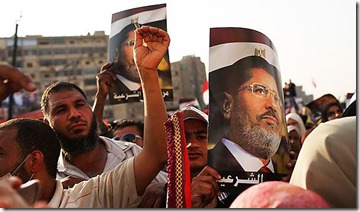 and "avoid any arbitrary arrests," Obama is suggesting that the new leaders need to be pushed into behaving with restraint, thus implicitly painting the Morsi government as the victim in this struggle. Further, the Obama administration has implied, though they have "stopped short of" declaring, that the ouster of Morsi was illegitimate; why else would they demand that the faction just removed from government in a popular uprising must be allowed right back in as quickly as possible?
The Obama administration is "concerned" that Egypt's military leadership may wish to instigate an all-out fight with the Muslim Brotherhood support base, with the intention of wiping out the movement. As an alternative, they are urging that the MB be allowed to participate equally in a new democratic political process — exactly what they were urging a year ago. And what happened a year ago? Mohamed Morsi, a Brotherhood leader, was elected with the support of the large faction of Egyptian Sunnis who advocate political rule by Sharia law, support Hamas, and would eliminate all alternative voices within the Egyptian press and political community.
Notice how the administration's reasoning also buys into the "root causes" talk that is typically favored by jihadist sympathizers. Muslims are radicalized by feeling excluded from the political process, we are told; and remember that in this case we are not even talking about Muslims in general, but rather a particular faction of Sunni Muslims that openly supports terrorist groups and hopes to eliminate all religious competitors within and without Islam. A group that would "probably" "shift to al-Qaeda type terrorist tactics" if they didn't get their way is already radicalized. If al-Qaeda itself wished to be granted official party status, would Obama go out of his way to demand it? (Sadly, the answer is probably yes; following the thinking of his Chicago friend Rashid Khalidi, he would accept the premise that it is only a sense of disenfranchisement — ultimately caused by the Jews — that has radicalized the terrorists.)
The question the Obama administration, like all progressive organizations, wishes to ignore is whether demanding that an extremely intolerant, tyrannical faction be allowed to participate as an equal partner in a "democratic political process" is not a recipe for a speedy drift into tyranny. In fact, arguments for compromise with tyranny made in the name of "peace" and "justice" are the progressives' stock-in-trade in both domestic and foreign policy, as these have been pursued throughout the late modern world.
The League of Nations and the United Nations were progressive ideas, grand moral equivalency schemes foisted upon the West by men who wished to achieve gradually what the world's tyrants wished to achieve immediately, namely "global governance" in the name of collectivist peace. The abolition of property rights, the dilution of national sovereignty, and the establishment of an international technocratic elite that would supersede elected governments and seek peace through compromise of the fundamental principles of individualism and freedom — these progressive goals lulled the West into a sleepwalk through fascism, and finally built an entire culture of apologetics for the spread of communism.
The tyrannical men and regimes of the world must be included in any legitimate political process, the West was repeatedly told by its leaders — they must "have a voice" — lest they become militant and unmanageable. The worst thing we could do, the progressives continually warned, would be to exclude the totalitarians from the discussion, for this might "provoke" them into a more radical and threatening position.
The present case could not demonstrate the folly (let's be generous) of such a position any more clearly. The Muslim Brotherhood is an international organization bent on achieving world Islamic rule. And their notion of Islamic rule is in no way morally or politically equivalent to what defenders of Israel mean when they speak of a "Jewish state." For one thing, the state they seek is global — there would be no alternative homeland for those who do not wish to live in this "Islamic state." And for another, the society they envision, and toward which they strive, is not a pluralistic, open society, but the most monolithic, closed society imaginable — outside of the communist totalitarian world, toward which Western progressives also urged tolerance, inclusion, and understanding.
The Talibanization of the Earth would, in practice, differ from the dream of world communism primarily in that the chains would come down most heavily on women and infidels first, rather than on everyone at once. In the end, a global approximation of Taliban Afghanistan would be the result in either case; whether the murdered and re-educated are called "infidels" or "capitalists" makes very little difference. The only significant difference would be perceptual: we wouldn't actually be able to see the women's starving faces.
The Morsi government was supposed to be the "friendly" face of this global caliphate fantasy. Within a year of the election of these "moderates," they had begun in earnest the process of reconfiguring Egypt to destroy secular politics, and to eliminate modern (non-jihadist) culture. This is the faction that the Obama administration is offering its tacit moral backing, by demanding that it be included in the political machinery that evolves out of the latest crisis.
Consider, once again, the standard progressive argument for appeasement, as promoted by anonymous Obama administration officials. Marginalizing and excluding the MB from the political process would "probably prompt a shift to al-Qaeda type terrorist tactics by extremists in the Islamist movement in Egypt and elsewhere." In other words, their goals are coercive and authoritarian, so the best course of action is to allow them to achieve those goals gradually and peacefully rather than forcing them to resort to violence. To restate: "Give them what they want, and nobody gets hurt." (Case in point Czechoslovakia 1938) You might hand over your wallet to an armed thief on such terms; but would you deliver millions of people into Taliban-like servitude on the same terms?
The current predicament in Egypt is more evidence — as if we needed it — for the principle that broadly "democratic" political arrangements cannot be superimposed on a society that does not have a populace morally and intellectually prepared for self-governance. A population that votes itself into tyranny for bread and land is like a free man who sells himself into slavery — he is not spiritually mature enough for self-determination. And the nations of the West are hardly in a position to look smugly at the unfitness of the Arab world for self-government, given that we have had all the historical preparation and civilizational establishment one could hope for, and are nevertheless well along in the process of doing the same thing Egypt did last year, and will likely do again this year.
The fact that the Obama administration's instinct, when secular tyrants were being ousted in favor of Islamic rule, was to encourage this shift as evidence of "hope and change," while, when the developing Islamic tyranny is ousted, the administration's instinct is to admonish Egyptians and make demands on behalf of political Islam, is both telling and revolting. I cannot pretend to understand what is happening in Egypt, or to predict what will happen next. The horror stories of dozens of rapes during the recent protests, and recent reports about the character of the general leading the coup, indicate that this mass movement is threatened from the inside, probably by the involvement of radical Muslims who happen to oppose the MB's methods. It is likely, however, that there are also a good number of people who genuinely desire a new start for their country, on a footing of reasonable, pluralistic government. No population votes itself into tyranny unanimously: rather, the majority uses its own submission to authority to strip away the freedoms of any minority faction that might have preferred a more civil order. (Sound familiar?) Given the history of Egypt and the region, the well-intentioned minority's chances don't look good. But they could not look much worse than they did under the quickly tightening authority of the MB regime.
Given the turmoil this decent minority is going through now, nothing, I imagine, could be more disheartening than the thought that after all this, they will simply end up in another "democratic process" that brings some version of the global caliphate movement back into power. And yet the likelihood of that miserable outcome is being enhanced, and even promoted, by the Obama administration's demands that "democracy" be restored quickly, and that this "democracy" include the Muslim Brotherhood. What we are witnessing, among other things, is the vindication of everyone who ever warned that democracy without limiting principles quickly devolves into the tyranny of the majority.
It is usually best to avoid overused comparisons, but this time the obvious seems inevitable: Had Hitler survived his defeat in WWII, would the Allies have demanded, as a condition of Germany's restoration, that he be reinstated as a candidate for chancellor immediately? Imagine seeing those campaign posters on your ride home from Auschwitz.
What should happen next in Egypt is hardly clear. And it is almost a given that this is not what will happen. Is it not unseemly, however, for a U.S. administration to declare that a "democratic process" cannot be judged legitimate unless it includes the advocates of global tyranny? On the other hand, if ever there were a U.S. administration well-positioned to make such a declaration, it would be this one.


