Search This Blog

Showing posts with label Private Sector. Show all posts

Monday, June 10, 2013

Fairness vs. Liberty and Entrepreneurship

“The champions of socialism call themselves progressives, but they recommend a system which is characterized by rigid observance of routine and by a resistance to every kind of improvement. They call themselves liberals, but they are intent upon abolishing liberty. They call themselves democrats, but they yearn for dictatorship. They call themselves revolutionaries, but they want to make the government omnipotent." — Economist Ludwig von Mises (1881-1973)

We have an administration that is dedicated to something called “fairness.” Obama’s call for this form of class warfare is not new. It dates back to the beginning of the Progressive movement at the turn of the twentieth century. It ebbed and flowed with various administrations. Grover Cleveland was not a fan and neither were Warren Harding, Calvin Coolidge, and Ronald Reagan. Woodrow Wilson, while an ardent progressive in his later years, was lukewarm on the issue. Franklin Roosevelt and Lyndon Johnson were no doubt its biggest advocates both in words and policies.

Our economy is lousy, the labor force participation rate is the lowest in 31 years, we’ve had 50 consecutive months with real unemployment over 8 percent, and a record 47 million people are on food stamps, so one might expect President Obama would welcome as much help as he could get. Surely he would want private sector job creators — investors and entrepreneurs — to have the strongest possible incentives for turning around this Obama “recovery” where household incomes are falling faster than they fell in the Bush recession.

But Obama’s priority is class warfare. That’s why he relentlessly denounces job creators as “millionaires and billionaires.” That’s why he demands that they be punished with higher tax rates.

Recently New York Senator Charles Schumer, one of Obama’s comrades, vowed that there would be no bipartisan budget deal without higher taxes on the rich.

What is it that drives class warriors? “Fairness,” of course, is the familiar battle cry, but according to the IRS the top 1 percent of taxpayers pay about 36 percent of federal income taxes. Before the financial meltdown when the rich were richer, the top 1 percent paid over 40 percent. By any standard, that’s a lot — especially considering that as we have heard, 47 percent of taxpayers don’t pay any income tax.

We need to understand that class warfare is a mortal enemy of economic growth and jobs. At the very least, class warfare means “progressive” taxation — higher tax rates on investors and entrepreneurs, eventually reaching confiscatory levels. In many places, class warfare has gone much farther with suffocating regulations, exchange controls, asset seizures, arbitrary imprisonment and other measures that suppress private property rights and throttle a market economy.

Confiscatory tax rates cannot be justified as revenue-generators, because they don’t raise much money. They discourage work, they drive away investors and entrepreneurs to lower-tax jurisdictions, and there aren’t enough rich people to keep the government going very long, even if all their assets were expropriated. If assets were expropriated this year that would be a one-time event, and next year government would have no choice but to plunder the middle class and the poor.

Whatever tax revenue is realized means less money available for private employers to hire people and less money for consumers to buy things. This offsets any possible benefits from government spending — the theoretical “stimulus” effect is zero.

Actually, the economy suffers when money is taxed away from private individuals and spent by government. In part, this is because regardless how smart politicians and bureaucrats might be, they have only a miniscule fraction of the total knowledge in a society. Politicians and bureaucrats tend to have book learning that’s related to academic credentials, whereas specific, practical knowledge needed to make an economy work is dispersed among multitudes of ordinary people. This includes knowledge about the best locations for a particular business, individuals most likely to be good employees, changing consumer preferences, the most suitable business models, and technologies and so on.

Private individuals not only have such knowledge, they have stronger incentives than politicians or bureaucrats to use the knowledge effectively. It’s well-known that people tend not to be as careful with other people’s money as they are with their own money.

It’s hard to argue, as class warriors do, that the rich have “too much,” meaning compared to average pay or some other arbitrary standard. Pay is a matter of supply and demand. Many people can do good yard work, but it’s tough to find individuals capable of turning around a troubled computer company — particularly when large amounts of money and large numbers of jobs are at stake.

In any event, as Henry Ford once said employees aren’t really paid by bosses. They’re paid by consumers who voluntarily buy a company’s goods or services among many possible choices available in the marketplace. Newspapers aren’t able to pay as many people or pay as much money like they used to, because more consumers are reading news online for free.

Some people earn large amounts of money by taking risks that other people don’t want. Commodities speculators assume the risk that prices of various commodities might go up or down. Insurance companies assume the risk that various adverse events might happen. If confiscatory taxation limits the gains needed to offset losses, fewer people will be willing to help others avoid risks.

Is it fair that some people get rich because they’re lucky? No, but government didn’t earn the money, either, and it’s hard to think of any moral justification for seizing it. If government did seize the money, undoubtedly politicians and bureaucrats with the most clout would make sure it was spent to help enhance their power, and why would that be wonderful? When lawfully-acquired private property is secure, people have incentives to make the most of their luck, by investing some of the money which would make more equity capital available, by saving some of the money which would make more lending possible and/or by spending it which would mean more revenue for private businesses.

Quite apart from incentive effects, progressive taxation has contributed to hideous complexity in the tax code. This is because the higher tax rates go, the stronger the incentives various interest groups have to lobby for special treatment, and since politicians always need more campaign contributions, they’re eager to oblige lobbyists. The more complex the tax code, the more arbitrary and capricious enforcement is sure to be. With high top rates, progressive taxation promotes an illusion of “fairness,” while causing considerable unfairness.

Lindy L. Paull, who served as chief of staff for the Joint Committee on Taxation, reported:

“The Internal Revenue Code consists of nearly 1.4 million words and includes 693 separate sections that impact individual taxpayers. The Treasury Department has issued some 20,000 pages of regulations containing over 8 million words. Individual taxpayers who file an annual Form 1040 must deal with its 79 lines, 144 pages of instructions and 11 schedules totaling 443 lines plus instructions to go with them. There are 19 separate worksheets imbedded in the Form 1040 instructions, and the possibility of filing numerous other forms, depending on the circumstances.”

Despite these problems with class warfare, Obama has led America along the class warfare road. He has made it clear he’ll try to escalate class warfare now that he’s elected for a second term.

Argentina’s progressive president Christina Kirchner has gone farther and shows what we might expect. Several years ago, she seized private pensions supposedly to help cover government budget deficits. Government spending subsequently soared 40 percent! Frightened Argentines fled the country, carrying suitcases stuffed with cash. The government retaliated by organizing teams of dogs trained to sniff vehicles and luggage for the scent of flight capital.

Class warfare tends to intensify, because people don’t like to be pushed around. If government threatens their property or their lives, they’re likely to push back. Dedicated class warriors could be counted on to assert their power with more force. Class warfare attracts people who like to use force, which is why class warfare is associated with so many thugs.

During the French Revolution, the Jacobin class warrior Maximilien Robespierre believed in “equality of wealth,” and he enforced confiscatory taxes with the guillotine.

Other much-admired class warriors like Lenin, Stalin and Mao were strong believers in executing class enemies.

During the Bolshevik Revolution, Lenin declared class war against wicked capitalists, seizing privately-owned land, banks, wholesale and retail businesses. He triggered a famine in which an estimated 5 million Russians starved to death in the breadbasket of the USSR — the Ukraine. Lenin was famously reported to have remarked that “You can’t make an omelet without breaking eggs.”

Lenin’s successor Stalin pursued class war against “kulaks” — supposedly rich peasants who might have had several cows. Kulaks were demonized as “bloodsuckers, vampires and profiteers.” In 1929, Stalin ordered their property seized, and some 7 million people subsequently starved to death.

Mao denounced “capitalist-roaders,” “counter-revolutionaries” and other class enemies. He promoted the “Great Leap Forward” in which as many as 45 million Chinese people were worked, starved or beaten to death between 1958 and 1962.

Where did all this class warfare come from?

According to tax historian E.R.A. Seligman, progressive taxation goes back to Athens during the sixth century B.C.E., but it disappeared in the Roman republic and empire. In some parts of Italy after about 1000 C.E., town populations embraced the idea of taxing people differently, but they persuaded assessors that poor people should pay higher rates than the rich.

The history of taxation abounds with struggles among interest groups, each of which has tried to push tax burdens on somebody else. For example, the Medici family that controlled Renaissance Florence manipulated progressive tax rates to ruin their rivals. As Seligman explained, “Individuals were frequently reduced to beggary, and forced sales of property to pay taxes were a common occurrence.” Ruthless tax collectors provoked much political turmoil during the 1400s.

In 1795, the revolutionary French government (the Directorate) imposed a 100 percent tax on income above modest exemptions. Not surprisingly, people subject to the tax scrambled to transfer assets out of harm’s way, and the tax yielded only about a fifth of what officials had anticipated. Martin-Michel-Charles Gaudin, the French finance minister at the time, observed that the 100 percent tax caused much resentment, but “no real revenue was to be expected.”

The first U.S. income tax was enacted in 1862, during the Civil War, and there were two brackets (three percent of incomes from $600 to $10,000 and five percent for incomes above that). That tax ended in 1871. The Confederacy had a progressive income tax, too.

Progressive taxation didn’t become widespread until after 1900. Self-styled “progressives” promoted higher tax rates for the rich. Ironically, though, peacetime progressive tax rates were very low by our standards. High — progressive — tax rates were mainly a consequence of war, notably World War I and World War II. During World War II, FDR issued an executive order that outlawed annual pay exceeding $25,000 (the equivalent of perhaps $200,000 today). High income tax rates persisted into the 1960s, because of the Cold War. Since then, progressives, who claim to love peace, have worked hard to revive high wartime rates. They opposed the Kennedy, Reagan and Bush across-the-board tax cuts of the 1960s, 1980s and 2000s respectively.

Progressive taxation has survived as a dogma that the rich should pay higher tax rates simply because they have more money. Like Obama, Schumer and so many others, today’s defenders of class warfare don’t feel they need to provide a moral, philosophical or economic justification for it. The case for class warfare boils down to nothing more than envy and resentment.

The last extended discussion about progressive taxation in the United States — on property, personal incomes, corporate incomes and inheritance — was more than a century ago. Farmers were having a hard time, because the number of farms quadrupled between 1850 and 1900, and total cultivated acreage nearly tripled to more than 840 million acres. Soaring food production generated downward pressure on prices for agricultural commodities, and farmers struggled to cut their costs. Farmers resented having to pay higher prices for imported goods, because of high tariffs that were the principal source of federal revenue. The farmers had a point.

Farmers in the South and West wanted an income tax from which they could be exempt, an income tax that would push the tax burden onto the rich who lived in the East. An income tax bill was introduced in nearly every session of Congress during the 1870s and 1880s. “Most of the agitation was by those active in the ‘share-the-wealth’ and ‘soak-the-rich’ campaigns,” reported historians Roy G. Blakey and Gladys C. Blakey. Those income tax bills were buried by the Republican-controlled House Ways & Means Committee.

More and more people spoke out for a progressive income tax. Felix Adler, who founded the popular Ethical Culture movement, demanded an income tax with rates up to 100 percent. A publication called The Progressive Taxpayer urged higher tax rates on the rich to “maintain among men a certain real equality.” Joseph Pulitzer, the New York newspaper publisher, beat the drums for special taxes on high incomes, luxuries and inheritances.

The main political opponents of the income tax were Republicans who defended high tariffs, but there were principled opponents without conflicting interests, too. Economist David A. Wells, who had previously supported an income tax, became a critic. He called graduated rates the beginning of “unmasked confiscation.” Tax historian Randolph Paul pointed out that many Democratic newspapers like the New York Times, Brooklyn Eagle and Boston Globe opposed an income tax because it could authorize inquisitorial power to pry into people’s private lives. The higher the rates and the more aggressively an income tax was enforced, the more it would promote evasion and capital flight. The Milwaukee Journal warned about “a tax of tyrants.” Such critics had a point.

Paradoxically, in 1894, an income tax bill was passed as an amendment to the Wilson-Gorman tariff bill. President Grover Cleveland, a low-tax, freeGorman trade Democrat, didn’t want an income tax or high tariffs. He refused to sign the final bill, but Congress had enough votes to make it law. The income tax provision was subsequently overturned by the Supreme Court due to its violation of Article 9, Section 4 of the Constitution.

As it turned out, most of the arguments offered on behalf of progressive taxation were satisfied by proportional taxation where everybody pays the same rates — in modern lingo, a flat tax. The same rate applied to a higher income yields more tax revenue.

The traditional justification for proportional rates is the idea that people should pay for the most fundamental benefit of government — namely, national defense. The more property people own, the greater their presumed benefit, and the more they should pay. To be sure, governments often start wars and imperil their citizens. Many governments also become tyrannical and seize their citizens’ property or worse. There’s no precise formula in the taxing business.

Ultimately, the progressive income tax became law, in 1913, because about 98 percent of the people were exempted, and perhaps they anticipated sharing some of the loot. It’s not hard to see why that was a formula for legislative success.

But Milton Friedman warned people to “always look a gift horse in the mouth.” The presumed “fairness” of our progressive income tax was illusory, even after President Franklin Delano Roosevelt hiked income tax rates during the Great Depression. FDR’s New Deal programs, intended to help the middle class and the poor, were funded mainly by the middle class and the poor, because the biggest source of federal revenue during the 1930s was the federal excise tax. It applied to beer, cigarettes, soda, chewing gum and other cheap pleasures enjoyed disproportionately by the middle class and the poor. Under FDR, depression era excise taxes more than doubled. Until 1936, the federal excise tax generated more revenue than the federal personal income tax and the federal corporate income tax combined.

During World War II, the federal income tax became a people’s tax. Millions of previously-exempt citizens had to pay it. In 1942, for instance, the IRS received some 28 million tax returns — 1,300 percent more than a decade earlier.

While progressive taxation can make the rich poorer, it makes the poor poorer, too. If the aim is to foster economic growth and jobs, then one needs to forget about class warfare.

Economists in the French Enlightenment (like Jacques Turgot) and the Scottish Enlightenment (like Adam Smith) recognized that essential humanimages institutions such as language, culture, legal customs, mutual aid societies and markets develop spontaneously when governments get out of the way. In The Wealth of Nations, for instance, Smith, who supported proportional taxation, observed that “Little else is requisite to carry a state to the highest degree of opulence from the lowest barbarism but peace, easy taxes, and a tolerable administration of justice.”

Government power is exercised only in the absence of liberty. If you are legally compelled to do something, you are not free to refuse. The government does spend a good deal of time making “suggestions” and offering optional “benefits” these days, but all of this activity is funded by the compulsory seizure of wealth.

Power takes many forms. Money is power. Everything the government does requires funding. The ability to take money unevenly from the populace, assigning different tax rates and exemptions to people, conveys tremendous power. The tax code can be used to reward favored constituents, and punish behavior the government disapproves of.

Taxation is really a form of command, even under a relatively flat and simple system, because after all, time is money. As the calculation of Tax Freedom Day each year demonstrates, when the government takes a percentage of your income, it is commanding a certain percentage of your labor; you work for the State until April or May each year to pay off your tax burden. Paying taxes in currency is a much less painless way of surrendering time to the government than impressing people into servitude on some governmentb90229924ecd4c78a980abd8e4b44329-e1369158211929 project for a couple of days a week, or a few months each year. Paying taxes through invisible paycheck deductions is even more painless. But the essential nature of the transaction, as a form of command, remains the same. That’s why it was grotesque to hear a top IRS official under Congressional interrogation in the recent scandal describe it as “poor customer service.” We are not the government’s customers; there is nothing voluntary about the transaction. Shulman seemed not to realize that he worked for us, not the reverse. This is the effect of power on the mentality of the bureaucrats and masterminds in Washington, D.C.

Spending money without taxation — in other words, deficit spending — is also an expression of power. It is the rejection of a limit upon the State, namely that it should spend only the money it has been given. Rather than presenting the people with a set of proposals and asking if they are willing to cover the estimated costs, the government does what it pleases, and hands the invoices to a generation of children that never had a chance to say no. In this way, authority is taken from people who cannot refuse, rather than being requested from respected citizens by their humble officials.

Information is also a form of power. It can be very valuable, both in terms of how it is used, and the expense involved in accumulating it. Bureaucracies are eager to gather all sorts of information about the people they regulate. The people, in turn, believe they exercise power over government by demanding transparency. What they learn about the conduct of government officials influences their votes.

When the flow of information becomes unequal, the party with more data assumes a position of power and dominance over the less well-informed. If you spent a few hours locked in a room with someone who asked you a barrage of intrusive questions under penalty of perjury, while answering none about himself, you’d have no illusions about whether he was more powerful than you.

We find ourselves looking at a particularly painful imbalance of power between American citizens and their central government. The Administration is not willing to disclose much about itself. Its high officials are impervious to consequences for their action — they’re more likely to be promoted than punished after a scandal. But they are gathering enormous amounts of information about us, and improperly disclosing it for their own benefit.

Even leaving scandals aside, we have before us a system of government that requires a very deep sea of power beneath it to stay afloat. It cannot function without monitoring the public in countless ways, and exerting a high201212_teaparty level of compulsive control. It has to take a vast amount of money from the public, and it grows extremely upset at the suggestion that it should make do with any less. It spends a fantastic amount of money it doesn’t actually have, periodically using its own insolvency as a weapon against the public, twisting concern about the national debt into an irresistible demand for higher taxes. Growing amounts of behavior are forbidden, regulated, or even mandated. More and more of what the government does is not even subject to the political process any more — for example, we are told we’ll never even have a chance to vote on reclaiming control of our health care. Many decisions have been swept off the table and there’s an awful lot going on underneath the table.

This means the old understanding of “privacy” has become obsolete. You’re not allowed to conduct your life away from the unblinking gaze of the government any more. Everything is taxed, monitored, and controlled. All business is the government’s business. They have to know what we’re up to, before they can tell us what to do.

As it grows, the government becomes less concerned with the strict performance of carefully outlined duties. It has its own interests, and it looks out for them. It treats its allies much differently than its perceived adversaries, as any conservative group seeking a tax exemption, or information from the Environmental Protection Agency, can testify.

As the French economist Frederic Bastiat stated some 150 years ago when talking about the creep of socialism into the French economy:

"These socialist writers look upon people in the same manner that the gardener views his trees. Just as the gardener capriciously shapes the trees into pyramids, parasols, cubes, vases, fans, and other forms, just so does the socialist writer whimsically shape human beings into groups, series, centers, sub-centers, honeycombs, labor-corps, and other variations. And just as the gardener needs axes, pruning hooks, saws, and shears to shape his trees, just so does the socialist writer need the force that he can find only in law to shape human beings. For this purpose, he devises tariff laws, relief laws, and school laws."

This is the nature of government power. Of course it seems arrogant, for its great works are justified as moral crusades when they are actually moral hazards. How can a few selfish dissenters be allowed to stand in the way of almighty Progress? Who are you, to doubt the judgment of top officials? Social justice must be dispensed, wealth must be re-distributed to the deserving, discourse must be purified, and the Earth itself must be saved. You little people aren’t really qualified to ask questions about it, much less refuse to participate. And if you want a government that asks fewer questions of you, insist on making it smaller. The big ones are always pushy.

Wednesday, March 27, 2013

The Men Who Built America

“It is not the employer who pays the wages. Employers only handle the money. It is the customer who pays the wages.” — Henry Ford

In recent years there has been an increasing scorn for capitalism in this country and around the world. Movements like Occupy caught a great deal attention last year as they staged protests and occupied parks in New York City and Oakland. Their beef was with the greed of capitalists and bankers. They wanted government to provide more and more assistance for those who could not find satisfying jobs.

There is a great series playing on the History Channel about the Men Who Built America. The series profiles John D. Rockefeller, Cornelius Vanderbilt, Andrew Carnegie, Henry Ford, and J.P. Morgan and shows how they turned ideas into millions of dollars and in the process they built this nation.

mwba2_480x250

John D. Rockefeller, Cornelius Vanderbilt, Andrew Carnegie, Henry Ford and J.P. Morgan rose from obscurity and in the process built modern America. Their names hang on street signs, are etched into buildings and are a part of the fabric of history. These men created the American Dream and were the engine of capitalism as they transformed everything they touched in building the oil, rail, steel, shipping, automobile, and finance industries. Their paths crossed repeatedly as they elected presidents, set economic policies and influenced major events of the 50 most formative years this country has ever known. From the Civil War to the Great Depression and World War I, they led the way.

Using state of the art computer generated imagery that incorporates 12 million historical negatives, many made available for the first time by the Library of Congress, this series brings back to life the world they knew and the one they created. The event series shows how these men created the greatest superpower the world has ever seen. In the series we see how their historic achievements came to create the America of today.

The series begins with the life and achievements of Cornelius Vanderbilt. Shipping and railroad tycoon Cornelius Vanderbilt (1794-1877) was a self-made multi-millionaire who became one of the wealthiest Americans of the 19th century. As a boy, he worked with his father, who operated a boat that ferried cargo between Staten Island, New York, where they lived, and Manhattan. After working as a steamship captain, Vanderbilt went into business for himself in the late 1820s, and eventually became one of the country’s largest steamship operators. In the process, the Commodore, as he was publicly nicknamed, gained a reputation for being fiercely competitive and ruthless. In the 1860s, he shifted his focus to the railroad industry, where he built another empire and helped make railroad transportation more efficient. When Vanderbilt died, he was worth more than $100 million ($2.6 billion in today’s dollars).

In the early 1850s, during the California Gold Rush, a time before449px-Cornelius_Vanderbilt_Daguerrotype2 transcontinental railroads, Vanderbilt launched a steamship service that transported prospectors from New York to San Francisco via a route across Nicaragua. His route was faster than an established route across Panama, and much speedier than the other alternative, around Cape Horn at the southern tip of South America, which could take months. Vanderbilt’s new line was an instant success, earning more than $1 million (about $26 million in today’s money) a year.

In the 1860s, Vanderbilt shifted his focus from shipping to the railroad industry, which was entering a period of great expansion. He gained control of a number of railway lines operating between Chicago and New York and established an interregional railroad system. According to T.J. Styles, author of “The First Tycoon: The Epic Life of Cornelius Vanderbilt”: “This was a major transformation of the railroad network, which previously had been fragmented into numerous short railroads, each with its own procedures, timetables, and rolling stock. The creation of a coherent system spanning several states lowered costs, increased efficiency, and sped up travel and shipment times.”

Unlike the Gilded Age titans who followed him, such as steel magnate Andrew Carnegie (1835-1919) and oil mogul John Rockefeller (1839-1937), Vanderbilt did not own grand homes or give away much of his vast wealth to charitable causes. In fact, the only substantial philanthropic donation he made was in 1873, toward the end of his life, when he gave $1 million to build and endow Vanderbilt University in Nashville, Tennessee. (In a nod to its founder’s nickname, the school’s athletic teams are called the Commodores.)

John D. Rockefeller (1839-1937), founder of the Standard Oil Company, became one of the world’s wealthiest men and a major philanthropist. BornJohn_D._Rockefeller_1885 into modest circumstances in upstate New York, he entered the then-fledgling oil business in 1863 by investing in a Cleveland, Ohio, refinery. In 1870, he established Standard Oil, which by the early 1880s controlled some 90 percent of U.S. refineries and pipelines. Critics accused Rockefeller of engaging in unethical practices, such as predatory pricing and colluding with railroads to eliminate his competitors, in order to gain a monopoly in the industry. In 1911, the U.S. Supreme Court found Standard Oil in violation of anti-trust laws and ordered it to dissolve. During his life Rockefeller donated more than $500 million to various philanthropic causes

In 1865, Rockefeller borrowed money to buy out some of his partners and take control of the refinery, which had become the largest in Cleveland. Over the next few years, he acquired new partners and expanded his business interests in the growing oil industry. At the time, kerosene, derived from petroleum and used in lamps, was becoming an economic staple. In 1870, Rockefeller formed the Standard Oil Company of Ohio, along with his younger brother William (1841-1922), Henry Flagler (1830-1913) and a group of other men. John Rockefeller was its president and largest shareholder.

Standard Oil gained a monopoly in the oil industry by buying rival refineries and developing companies for distributing and marketing its products around the globe. In 1882, these various companies were combined into the Standard Oil Trust, which would control some 90 percent of the nation’s refineries and pipelines. In order to exploit economies of scale, Standard Oil did everything from build its own oil barrels to employ scientists to figure out new uses for petroleum by-products.

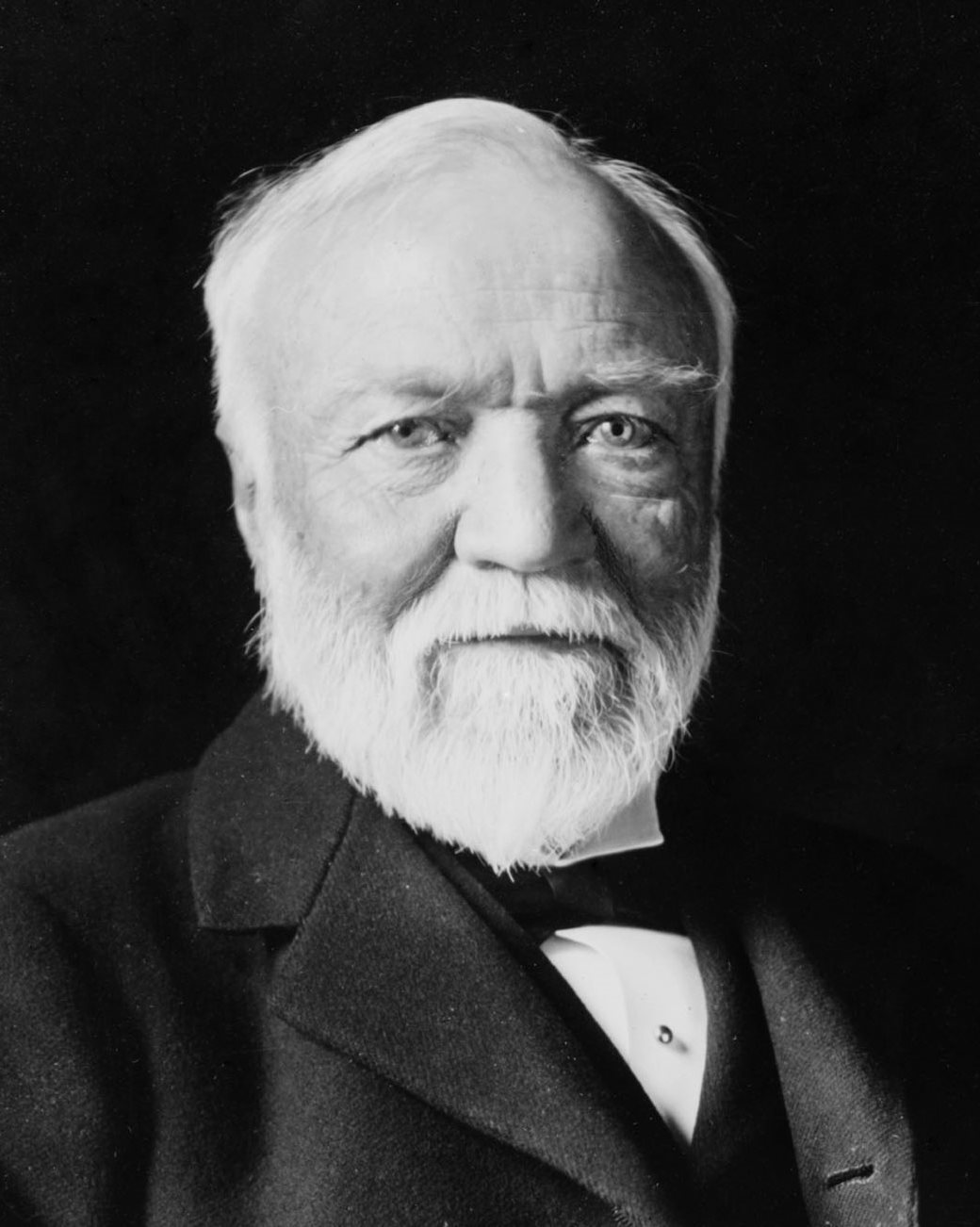
Scottish-born Andrew Carnegie (1835-1919) was an American industrialist who amassed a fortune in the steel industry then became a major philanthropist. Carnegie worked in a Pittsburgh cotton factory as a boy before rising to the position of division superintendent of the Pennsylvania Railroad in 1859. While working for the railroad, he invested in various ventures, including iron and oil companies, and made his first fortune by the time he was in his early 30s. In the early 1870s, he entered the steel business, and over the next two decades became a dominant force in the industry. In 1901, he sold the Carnegie Steel Company to banker John Pierpont Morgan for $480 million. Carnegie then devoted himself to philanthropy, eventually giving away more than $350 million.

Ambitious and hard-working, he went on to hold a series of jobs, including479px-Andrew_Carnegie,_three-quarter_length_portrait,_seated,_facing_slightly_left,_1913-crop messenger in a telegraph office and secretary and telegraph operator for the superintendent of the Pittsburgh division of the Pennsylvania Railroad In 1859, Carnegie succeeded his boss as railroad division superintendent. While in this position, he made profitable investments in a variety of businesses, including coal, iron and oil companies and a manufacturer of railroad sleeping cars.

After leaving his post with the railroad in 1865, Carnegie continued his ascent in the business world. With the U.S. railroad industry then entering a period of rapid growth, he expanded his railroad-related investments and founded such ventures as an iron bridge building company and a telegraph firm, often using his connections to win insider contracts. By the time he was in his early 30s, Carnegie had become a very wealthy man.

In the early 1870s, Carnegie co-founded his first steel company, near Pittsburgh. Over the next few decades, he created a steel empire, maximizing profits and minimizing inefficiencies through ownership of factories, raw materials and transportation infrastructure involved in steel-making. In 1892, his primary holdings were consolidated to form Carnegie Steel Company.

The steel magnate considered himself a champion of the working man; however, his reputation was marred by a violent labor strike in 1892 at his Homestead, Pennsylvania, steel mill. After union workers protested wage cuts, Carnegie Steel general manager Henry Clay Frick (1848-1919), who was determined to break the union, locked the workers out of the plant. Andrew Carnegie was on vacation in Scotland during the strike, but put his support in Frick, who called in some 300 Pinkerton armed guards to protect the plant. A bloody battle broke out between the striking workers and the Pinkertons, leaving at least 10 men dead. The state militia then was brought in to take control of the town, union leaders were arrested and Frick hired replacement workers for the plant. After five months, the strike ended with the union’s defeat. Additionally, the labor movement at Pittsburgh-area steel mills was crippled for the next four decades.

In 1901, banker John Pierpont Morgan (1837-1913) purchased Carnegie Steel for some $480 million, making Andrew Carnegie one of the world’s richest men. That same year, Morgan merged Carnegie Steel with a group of other steel businesses to form U.S. Steel, the world’s first billion-dollar corporation.

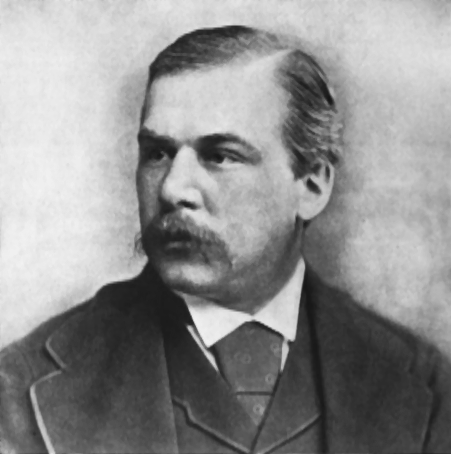
One of the most powerful bankers of his era, J.P. (John Pierpont) MorganJPMorgan-Young (1837-1913) financed railroads and helped organize U.S. Steel, General Electric and other major corporations. The Connecticut native followed his wealthy father into the banking business in the late 1850s, and in 1871 formed a partnership with Philadelphia banker Anthony Drexel. In 1895, their firm was reorganized as J.P. Morgan & Company, a predecessor of the modern-day financial giant JPMorgan Chase. Morgan used his influence to help stabilize American financial markets during several economic crises, including the panic of 1907. However, he faced criticism that he had too much power and was accused of manipulating the nation’s financial system for his own gain. The Gilded Age titan spent a significant portion of his wealth amassing a vast art collection.

During the late 19th century, a period when the U.S. railroad industry experienced rapid overexpansion and heated competition (the nation’s first transcontinental rail line was completed in 1869), Morgan was heavily involved in reorganizing and consolidating a number of financially troubled railroads. In the process, he gained control of significant portions of these railroads’ stock and eventually controlled an estimated one-sixth of America’s rail lines.

By the start of the 20th century, Morgan’s focus had shifted from railroads to other industries. In 1901, he bought the Carnegie Steel Company from Andrew Carnegie (1835-1919) for some $480 million then merged it with a group of other steel companies to create U.S. Steel, the world’s first billion-dollar corporation. Morgan also helped engineer the deals that established General Electric, International Harvester, American Telephone & Telegraph and other industrial giants. In 1902, he was instrumental in the formation of International Mercantile Marine (IMM), a conglomeration of transatlantic shipping companies. A decade later, the Titanic, owned by one of the IMM companies, White Star, sank on its maiden voyage after hitting an iceberg. Morgan, who attended the ship’s christening in 1911, was booked on the ill-fated April 1912 voyage but had to cancel.

During Morgan’s era, the United States had no central bank so he used his influence to help save the nation from disaster during several economic crises. In 1895, Morgan assisted in rescuing America’s gold standard when he headed a banking syndicate that loaned the federal government more than $60 million. In another instance, the financial panic of 1907, Morgan held a meeting of the country’s top financiers at his New York City home and convinced them to bail out various faltering financial institutions in order to stabilize the markets.

While working as an engineer for the Edison Illuminating Company in Detroit,Henry_ford_1919 Henry Ford (1863-1947) built his first gasoline-powered horseless carriage, the Quadricycle, in the shed behind his home. In 1903, he established the Ford Motor Company, and five years later the company rolled out the first Model T. In order to meet overwhelming demand for the revolutionary vehicle, Ford introduced revolutionary new mass-production methods, including large production plants, the use of standardized, interchangeable parts and, in 1913, the world's first moving assembly line for cars. Enormously influential in the industrial world, Ford was also outspoken in the political realm. Ford drew controversy for his pacifist stance during the early years of World War I and earned widespread criticism for his anti-Semitic views and writings.

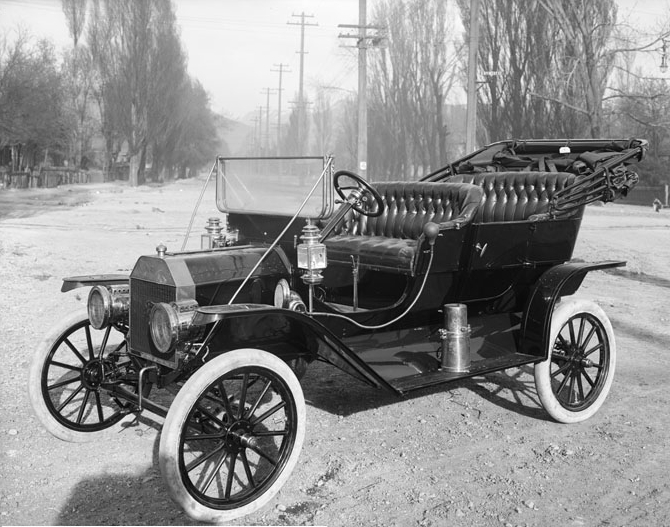
A month after the Ford Motor Company was established, the first Ford car—the two-cylinder, eight-horsepower Model A—was assembled at a plant on Mack Avenue in Detroit. At the time, only a few cars were assembled per day, and groups of two or three workers built them by hand from parts that were ordered from other companies. Ford was dedicated to the production of an efficient and reliable automobile that would be affordable for everyone; the result was the Model T, which made its debut in October 1908.

The "Tin Lizzie," as the Model T was known, was an immediate success, and1910Ford-T Ford soon had more orders than the company could satisfy. As a result, he put into practice techniques of mass production that would revolutionize American industry, including the use of large production plants; standardized, interchangeable parts; and the moving assembly line. Mass production significantly cut down on the time required to produce an automobile, which allowed costs to stay low. In 1914, Ford also increased the daily wage for an eight-hour day for his workers to $5 (up from $2.34 for nine hours), setting a standard for the industry. The mass production techniques Henry Ford championed allowed the Ford Motor Company to turn out one Model T every 24 seconds.

So during this great age of industrial expansion from the end of the Civil War to the end of the First World War what bound these giants of industry together? Firstly these men had fierce completive and entrepreneurial spirits. With the exception of J.P. Morgan they came from modest working-class roots and were not high-born. Second is that they wanted to win and would not take no for an answer. They hated competition and would take whatever measures needed to defeat that competition. Thirdly they all had a vision of what their efforts could achieve. Fourth is that they were not afraid of long hours and hard work and expected such from those around them. Fifth is that when they saw an opportunity they were quick to take action and if that opportunity did not pan out they were equally as quick to move on to other opportunities that would arise, especially from the work of others. And sixth, and perhaps the most important is that they realized the needs and wants of their customers and did all they could to keep them well feed.

In 1862, the Pacific Railroad Act chartered the Central Pacific and the Union Pacific Railroad Companies, and tasked them with building a transcontinental railroad that would link the United States from east to west. Over the next seven years, the two companies would race toward each other from Sacramento, California on the one side and Omaha, Nebraska on the other, struggling against great risks before they met at Promontory, Utah, on May 10, 1869.

By the 1880s the nation was overbuilt of railroads and many were losing money — including those owned by Vanderbilt. He was looking for new customers willing to ship goods on his lines. At the same time John D. Rockefeller was attempting to corner the market on kerosene — the fuel used to light homes and businesses across the nation. He needed a secure and cheap method of shipping his kerosene from his refineries to market. He also renamed his company Standard Oil implying that his kerosene was the standard on which all others should be compared with.

To insure his shipping Rockefeller struck a deal with Vanderbilt to ship exclusively on his railroads — namely the New York Central Railroad. Both men were wary of each other, but kerosene was making both Rockefeller and Vanderbilt rich. Starting in 1853, Thomas A. Scott of the Pennsylvania Railroad Company employed Andrew Carnegie as a secretary/telegraph operator at a salary of $4.00 per week. At age 18, the precocious youth began a rapid advancement through the company, becoming the superintendent of the Pittsburgh Division. His employment by the Pennsylvania Railroad Company would be vital to his later success. The railroads were the first big businesses in America, and the Pennsylvania was one of the largest of them all.

This did not sit well with Rockefeller. He was fearful that the cabal of Vanderbilt’s NYCRR and Scott’s PRRC would raise their prices and damage Standard Oil. So what did Rockefeller do — he built a pipeline and cancelled his exclusive deals with Vanderbilt and Scott.

In 1877, Standard clashed with the Pennsylvania Railroad, its chief hauler. Rockefeller had envisioned the use of pipelines as an alternative transport system for oil and began a campaign to build and acquire them. The railroad, seeing Standard’s incursion into the transportation and pipeline fields, struck back and formed a subsidiary to buy and build oil refineries and pipelines. Standard countered and held back its shipments, and with the help of other railroads, started a price war that dramatically reduced freight payments and caused labor unrest as well. Rockefeller eventually prevailed and the railroad sold all its oil interests to Standard. But in the aftermath of that battle, in 1879 the Commonwealth of Pennsylvania indicted Rockefeller on charges of monopolizing the oil trade, starting an avalanche of similar court proceedings in other states and making a national issue of Standard Oil’s business practices. Rockefeller was creating vertical and horizontal monopolies — but he was serving the public with cheap kerosene to light their homes.

Standard Oil added its own pipelines, tank cars, and home delivery network. It kept oil prices low to stave off competitors, made its products affordable to the average household, and to increase market penetration, sometimes sold below cost if necessary. It developed over 300 oil-based products from tar to paint to Vaseline petroleum jelly to chewing gum. By the end of the 1870s, Standard was refining over 90% of the oil in the U.S. Rockefeller had already become a millionaire.

Now enter Thomas Edison and Nikola Tesla.

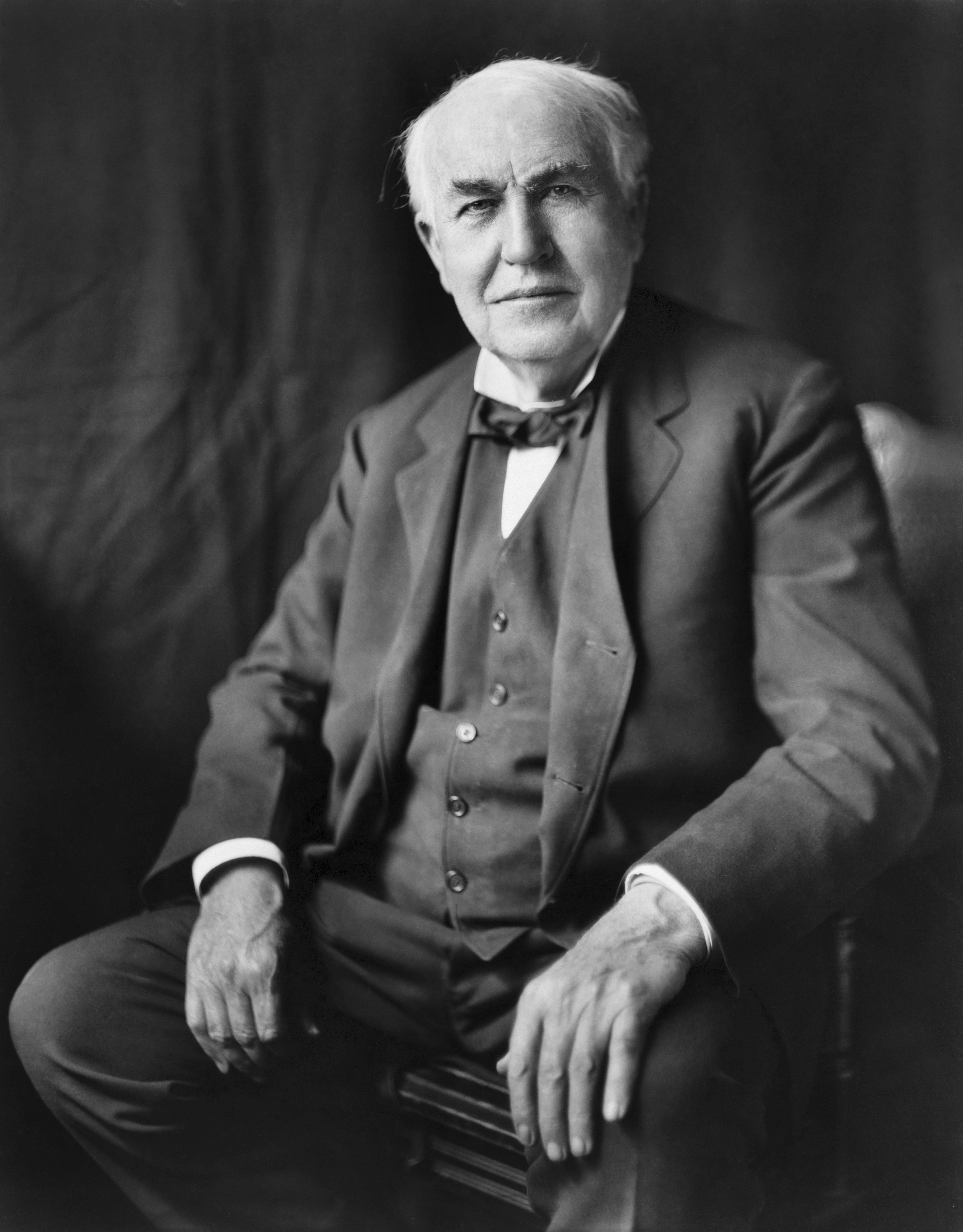
In his 84 years, Thomas Edison acquired a record number of 1,093 patentsThomas_Edison2 (singly or jointly) and was the driving force behind such innovations as the phonograph, the incandescent light bulb and one of the earliest motion picture cameras. He also created the world's first industrial research laboratory. Known as the "Wizard of Menlo Park," for the New Jersey town where he did some of his best-known work, Edison had become one of the most famous men in the world by the time he was in his 30s. In addition to his talent for invention, Edison was also a successful manufacturer and businessman who was highly skilled at marketing his inventions — and himself — to the public.

Serbian-American engineer and physicist Nikola Tesla (1856-19Tesla_aged_3643) made dozens of breakthroughs in the production, transmission and application of electric power. He invented the first alternating current (AC) motor and developed AC generation and transmission technology. Though he was famous and respected, he was never able to translate his copious inventions into long-term financial success — unlike his early employer and chief rival, Thomas Edison.

Edison not only invented the electric light bulb he also developed a means of transmission of electricity — direct current (DC). His assistant at the time was a 29-year old Serbian immigrant named Nikola Tesla. In 1885, Tesla claimed that he could redesign Edison's inefficient motor and generators, making an improvement in both service and economy. According to Tesla, Edison remarked, "There's fifty thousand dollars in it for you — if you can do it" — this has been noted as an odd statement from an Edison whose company was stingy with pay and who did not have that sort of cash on hand. After months of work, Tesla fulfilled the task and inquired about payment. Edison, claiming that he was only joking, replied, "Tesla, you don't understand our American humor." Instead, Edison offered a $10 a week raise over Tesla's $18 per week salary; Tesla refused the offer and immediately resigned.

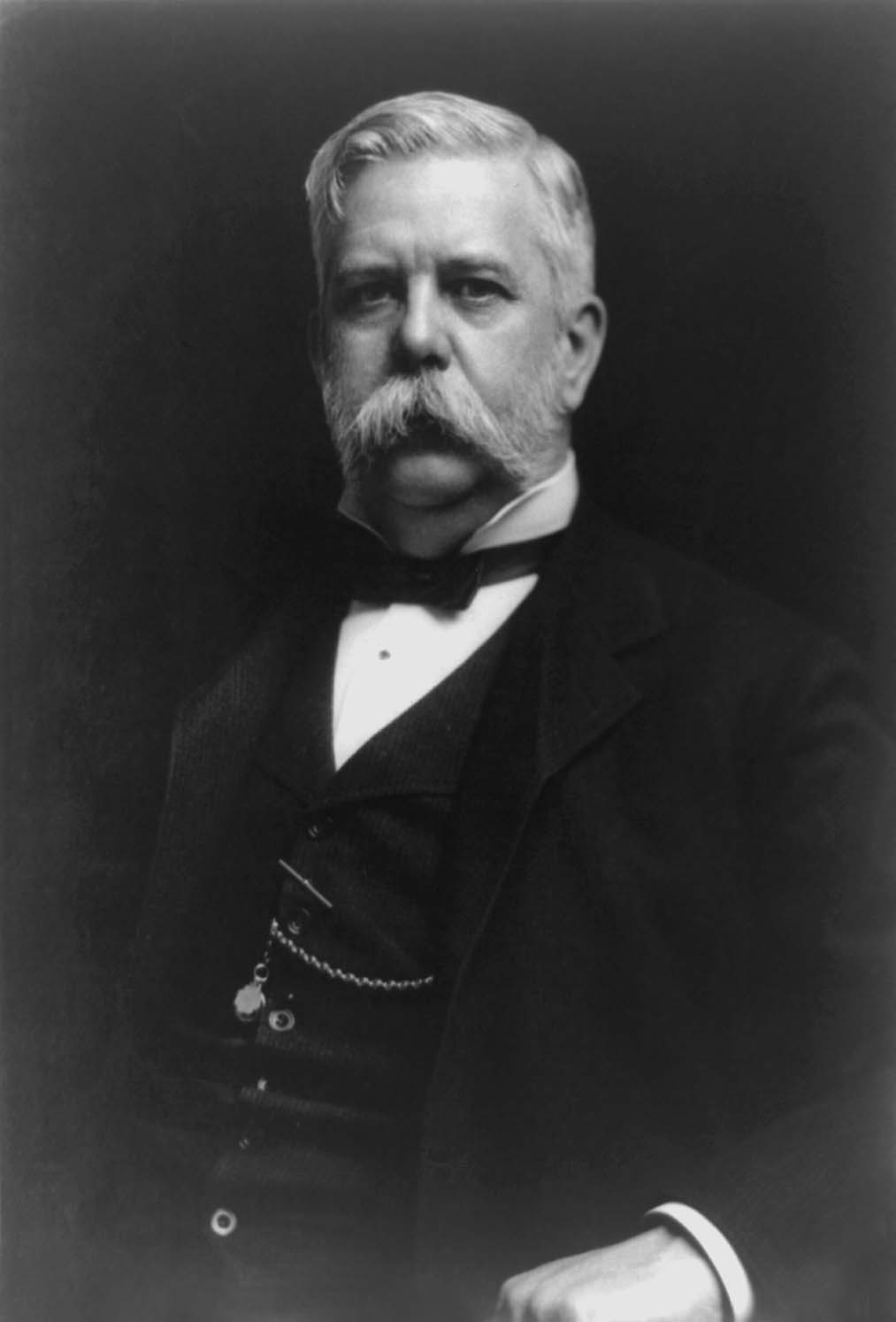
Tesla immediately teamed up with George Westinghouse who was famous for his development for air brakes on train cars. And now the current war began. Edison, who had partnered with J.P. Morgan were pushing DC whileGeorge_Westinghouse Westinghouse was pushing Tesla’s alternating current (AC). When Sing-Sing prison in New York was looking for a more “humane” method of executing prisoners they developed an electric chair using AC. The first trial was a botched failure and Edison and Morgan immediately began a nasty public relations campaign hyping the dangers of AC. This set Westinghouse back and in order avoid bankruptcy and convince investors to buy into AC Tesla signed all of his patent rights over to Westinghouse. At this time the Niagara Falls Power Company was building a massive hydro-electric generating plant to service the entire Northeast. They were taking bids from companies to provide the generators and were considering Westinghouse’s AC system and the Edison/Morgan DC system. The bidding war had begun.

In order to convince the public of the safety and efficiency of AC Westinghouse and Tesla worked feverishly to wire the 1893 World's Columbian Exposition (AKA Chicago World’s Fair) with thousands of lights. The Morgan/Edison (now General Electric) bid was $1.8 million and later reduced to $554,000. The Westinghouse/Tesla bid was $399,000. Westinghouse won the bid and had invent their own light bulb as General Electric refused them the rights to use the Edison bulb.

When the exposition opened and the great illumination was viewed by the public it convinced the Niagara Power to select the AC generators. Westinghouse had won the battle of the currents.

Meanwhile John Rockefeller was looking on from the sidelines wondering what would happen to his kerosene business now that electricity was beginning to light the nation. Rockefeller urged his scientists to come up with new ways to use petroleum and they did. One of the waste products from the refining of kerosene — a substance that was being dumped into the fields — was something called gasoline. But there was little use for gasoline until the emergence of the auto industry and Henry Ford.

With the introduction of the Model T Ford in 1908 the public was beginning to drive gasoline powered vehicles. Rockefeller’s Standard Oil empire was not only saved it was expanded through his vertical monopolies of owing the wells producing the oil and the refineries to owning the pipelines carrying his products and the service stations dispensing gasoline to the ultimate customer. With the widespread growth of the electrical industry a door had closed to Rockefeller, but with the growth of the automobile industry another door had opened.

Even though Morgan had lost the current war it did not take him long to dump Edison and buy into AC making General Electric one of world’s largest corporation.

Meanwhile with the PRR suffering setbacks in the Railroad business causing Carnegie and Scott to part ways it did not take the Scotsman long to jump head first into the steel business. The Bessemer process for making steel was not only a technical success it was also a great business success. Carnegie’s Homestead plant began turning out steel on a massive scale. With the development of Otis’s elevator taller and taller buildings became possible. The demand for Carnegie’s steel grew and grew as skyscrapers began to dot the cities of the nation. It was not only steel for buildings but steel for bridges, automobiles, and ships.

Carnegie built Pittsburgh's Carnegie Steel Company, which he sold to J.P. Morgan in 1901 for $480 million, creating the U.S. Steel Corporation. Carnegie devoted the remainder of his life to large-scale philanthropy, with special emphasis on local libraries, world peace, education and scientific research. With the fortune he made from business, he built Carnegie Hall, and founded the Carnegie Corporation of New York, Carnegie Endowment for International Peace, Carnegie Institution for Science, Carnegie Trust for the Universities of Scotland, Carnegie Hero Fund, Carnegie Mellon University and the Carnegie Museums of Pittsburgh, among others. His life has often been referred to as a true "rags to riches" story.

These men, while not perfect by any means and sometimes unethical, created whole industries supporting other businesses. Edison’s light bulb gave rise to the lamp industry with companies like Tiffany making lamps for the wealthy — lamps that sell for thousands of dollars at auctions today. Henry Ford’s auto plants created thousands of small, entrepreneurial enterprises supplying the auto industry — even to today’s Auto Zone. The cheap availability of steel brought forth the home appliance industry and gasoline not only fueled millions of automobiles but also allowed two brothers and bicycle makers in Dayton, Ohio to make a successful flight of something called an airplane on the wind-swept dunes of Kitty Hawk, North Carolina. Two high school dropouts who pioneered a trillion dollar aviation industry — an industry that transports billions of passengers safely each year around the globe.

Today many of our K-12 students learn virtually nothing of these giants and what they do learn is biased away from capitalism and towards something call social justice, They learn of the purported “evils” of the capitalistic system and the virtues of the collective. They learn that government is the source of all technology and invention. They have no idea of why the lights go on in their homes or classrooms when the flip a switch on the wall. They go into a high-rise building not knowing how steel and elevators were responsible for the construction of those buildings. And they ride in mom’s SUV or school bus with no idea of how the fuel that runs that vehicle got there. Even musicians who perform at Carnegie Hall probably don’t realize how this magnificent edifice came to be. It was not government who built it but the money from Carnegie’s steel. Yes, Mr. Obama, they did build it — not government.

We owe a great deal to these capitalist who were willing to risk everything of their visions and efforts. Yes, they made profits for without profits nothing would have happened. The next time you flip a light switch or ride an elevator give some thought to the men who built America.

Tuesday, September 4, 2012

Labor Day

"The government consists of a gang of men exactly like you and me. They have, taking one with another, no special talent for the business of government; they have only a talent for getting and holding office. Their principal device to that end is to search out groups who pant and pine for something they can't get and to promise to give it to them." — American writer H.L. Mencken (1880-1956)

Labor Day began over 100 years. To appreciate it, one needs to know the history preceding it.

At the time the United States was founded, most jobs were agricultural or in trades, such as blacksmiths, cobblers, bakers, upholsterers, etc. Then the Industrial Revolution began with the harnessing of water and steam power, leading to the creation of factories which could mass produce items inexpensively. Most factories were located in the Northern States.

In early United States history, there was no Income Tax, as the Federal Government was funded primarily from:

Excise Taxes on items like salt, tobacco, liquor; and

Tariff Taxes on imports making them more expensive, so people would buy goods produced in American factories.

The problem was that the Tariff Taxes that helped the North, hurt the South, as the South had no factories to protect. At one point, nearly 90% of the Federal Budget was from Tariff Taxes collected at Southern Ports, fueling the animosity which led up to the Civil War.

After the Civil War, the North passed more Tariff Taxes which allowed factories to grow enormous.

Inventions and advances in manufacturing made more and more goods available to the masses of people at cheaper and cheaper prices, resulting in the fastest increase in the standard of living and per capita income for common men and women in world history.

New ways of making stronger steel led to the building of bridges, buildings, steamboats, and mining machinery. Railroads now could take people safely and inexpensively across the entire nation opening up unprecedented mobility and opportunity. Immigrants arriving in America could get jobs working in factories.

George Pullman founded a Pullman Railroad Sleeping Car Company in Illinois just outside of Chicago. He saw that workers needed a place to live, so he built them houses in a safe little village around the factory. Their rent was deducted from their paychecks and they were paid in company script.

There were company owned grocery stores. It was thought to be a utopian workers' community and worked well for over a decade. Then something happened. In 1893, there was a nationwide financial panic and orders for railroad sleeping cars declined.

George Pullman had to lay off hundreds of employees, and make cuts in wages to the rest, though the rent and groceries stayed the same price. Employees walked out, demanding lower rents and higher pay.

Growing discontent provided a seedbed for Karl Marx's theory of class struggle and Communist redistribution of wealth.

A young worker named Eugene V. Debs led a strike of workers, and railroad workers across the nation boycotted trains carrying Pullman cars. There was rioting, pillaging, and burning of railroad cars. It became a national issue when mail trains were interrupted.

Democrat President Grover Cleveland declared the strike a federal crime and deployed 12,000 troops to break the strike. More violence erupted, and two men were killed.

In 1882, Matthew Maguire, a machinist, first proposed the holiday while serving as secretary of the CLU (Central Labor Union) of New York. Others argue that it was first proposed by Peter J. McGuire of the American Federation of Labor in May 1882, after witnessing the annual labor festival held in Toronto, Canada.

Oregon was the first state to make it a holiday in 1887. By the time it became a federal holiday in 1894, thirty states officially celebrated Labor Day. Following the deaths of a number of workers at the hands of the U.S. military and U.S. Marshals during the Pullman Strike, the United States Congress unanimously voted to approve rush legislation that made Labor Day a national holiday; President Grover Cleveland signed it into law a mere six days after the end of the strike. The September date originally chosen by the CLU of New York and observed by many of the nation's trade unions for the past several years was selected rather than the more widespread International Workers' Day because Cleveland was concerned that observance of the latter would be associated with the nascent Communist, Syndicalist and Anarchist movements that, though distinct from one another, had rallied to commemorate the Haymarket Affair in International Workers' Day. All U.S. states, the District of Columbia, and the territories have made it a statutory holiday.

It was an election year, and Grover Cleveland thought it would help his re-election if he appeased the workers, so he pushed through a National Labor Day. He chose the first Monday in September, rather than May 1, as he did not want it to be in coordination with the Communist "International Workers Day.

Eugene Debs went to prison and Cleveland lost the election, but Labor Day remained a national holiday.

Unions successfully advocated the 8 hour day, the 40 hour work week, minimum wages, safer working conditions, and more benefits for workers. With these unprecedented improvements came a consequence: "out-sourcing."

After World War II America helped rebuild Germany and Japan. And a global economy emerged. With newer factories and cheaper labor, foreign countries could produce items for less, whereas in America costs continued to increase with:

  • Higher wages;
  • Increased taxes;
  • Expensive lawsuits;
  • Burdensome government regulations;
  • Greater environmental restrictions; and
  • Crony capitalism, where government favors particular companies which support a political agenda, leaving other companies at a financial disadvantage.

These cost increases resulted in American made goods being more expensive as compared to foreign made goods.

As people bought less American made products, American factories shut down and jobs disappeared.

In 1950, about 50 percent of workers were union members, but today it has shrunk to around 7.6 percent in the private sector. But the power and influence of the public sector and teachers unions has been growing since the 1970’s and today the number of public sector and teacher union members far surpass those of the counterparts in the private sector.

America's increasingly uncertain economic future is weakening its international influence. Alexander Solzhenitsyn, who spent 11 years in Communist prisons and labor camps, warned in Washington, D.C., on June 30, 1975:

"I would like to call upon America to be more careful with its trust and prevent those, because of short-sightedness and still others out of self-interest, from falsely using the struggle for peace and for social justice to lead you down a false road. Because they are trying to weaken you; they are trying to disarm your strong and magnificent country in the face of this fearful threat. I call upon you: ordinary working men of America. Do not let yourselves become weak."

To bring jobs back to America, the answer is as simple as making it more profitable for factories to be located here than there.

Today’s labor movement is a far cry from the days of Matthew Maguire and Eugene V. Debs. It is no longer concerned with workers in the private sector. According to the U.S. Bureau of Labor Statistics in 2011, the union membership rate--the percent of wage and salary workers who were members of a union — was 11.8 percent, essentially unchanged from 11.9 percent in 2010 of wage and salary workers belonging to unions, at 14.8 million, also showed little movement over the year. In 1983, the first year for which comparable union data are available, the union membership rate was 20.1 percent and there were 17.7 million union workers.

In 2011, 7.6 million employees in the public sector belonged to a union, compared with 7.2 million union workers in the private sector. The union membership rate for public-sector workers (37.0 percent) was substantially higher than the rate for private-sector workers (6.9 percent). Within the public sector, local government workers had the highest union membership rate, 43.2 percent. This group includes workers in heavily unionized occupations, such as teachers, police officers, and firefighters. Private-sector industries with high unionization rates included transportation and utilities (21.1 percent) and construction (14.0 percent), while low unionization rates occurred in agriculture and related industries (1.4 percent) and in financial activities (1.6 percent).

Some of the highlights from the 2011 data are:

  • Public-sector workers had a union membership rate (37.0 percent) more than five times higher than that of private-sector workers (6.9 percent). To
  • Workers in education, training, and library occupations had the highest unionization rate, at 36.8 percent, while the lowest rate occurred in sales and related occupations (3.0 percent). (See table )
  • Black workers were more likely to be union members than were white, Asian, or Hispanic workers. (See table)
  • Among states, New York continued to have the highest union membership rate (24.1 percent) and North Carolina again had the lowest rate (2.9 percent). (See table)

In 2011, 7.6 million employees in the public sector belonged to a union, compared with 7.2 million union workers in the private sector. The union membership rate for public-sector workers (37.0 percent) was substantially higher than the rate for private-sector workers (6.9 percent). Within the public sector, local government workers had the highest union membership rate, 43.2 percent. This group includes workers in heavily unionized occupations, such as teachers, police officers, and firefighters. Private-sector industries with high unionization rates included transportation and utilities (21.1 percent) and construction (14.0 percent), while low unionization rates occurred in agriculture and related industries (1.4 percent) and in financial activities (1.6 percent).

Among occupational groups, education, training, and library occupations (36.8 percent) and protective service occupations (34.5 percent) had the highest unionization rates in 2011. Sales and related occupations (3.0 percent) and farming, fishing, and forestry occupations (3.4 percent) had the lowest unionization rates.

When it comes to money collected from public sector union dues the Democrats are the largest recipients by far with the National Education Association ($6,800,167) and the American Federation of State, County, and Municipal Employees ($4,235,500) leading the pack.

Public employee unions represent workers at every level of government – federal, state and local. Since contract negotiations for these workers are dependent not on private corporations, but on the size of government budgets, this is the one segment of the labor movement that can actually contribute directly to the people with ultimate responsibility for its livelihood. While their giving pattern matches that of other unions (which overwhelmingly support Democrats), public sector unions also concentrate contributions on members of Congress from both parties who sit on committees that deal with federal budgets and agencies. (You can see more statistics on this by clicking here)

Union bosses have made such a big deal about being upset with the DNC’s pick of Charlotte, North Carolina for its convention (even going so far as having an August “shadow convention”) that, while they may be in the state for the Barack Obama nomination celebration, they’re making every effort to make it look like they’re absent. As noted above North Carolina is a “Right to Work State” with the lowest percentage of union membership (2.9 percent) in the nation.

Adding insult to injury, not only is North Carolina the least unionized state in the nation, the stadium where Barack Obama is giving his acceptance speech was built by entirely union-free labor.

The lack of union support (and money) at the convention is likely why the DNC is giving away free tickets to people from neighboring states to go and watch Obama’s acceptance speech on Thursday.

Although about a dozen of the building trade unions, along with Machinists’ union boss Tom Buffenbarger are boycotting (and some plan to protest) the Democrats’ celebration, other union bosses are attending the convention. However, they are taking fewer members and a much lower profile than past conventions. It should also be noted that the unions are upset over Obama’s cancelation of the construction of the Keystone XL pipeline, a project that would have created 20,000 union jobs.

Eight years ago, when John Kerry tried to defeat the incumbent George W. Bush, he accused Bush of leading a “jobless recovery.” When the economy started creating hundreds of thousands of jobs, Kerry and the Democrats then claimed that Bush was creating mostly “McJobs,” low-wage, non-union positions rather than higher-paying jobs for people with significant skills.

Today, the Obama administration keeps claiming to have added 4.3 million jobs by choosing to start from February 2010 rather than the start of the recovery in June 2009 or the passage of Barack Obama's stimulus package in February 2009. The Obama recovery in full has only added less than 65,000 jobs per month, far below the level needed to keep up with population growth (125K-150K per month), and the civilian population participation rate has fallen to a 30-year low this spring. A new study now shows that even those jobs that have been added are the “McJobs" that Kerry inaccurately accused Bush's recovery of generating. We're not even keeping up with population growth in this recovery. The average jobs added per month since January has been 83,286, according to the Bureau of Labor Statistics, still a long way from keeping up with population growth. That's not a recovery in jobs at all, which anyone looking at the participation rate (63.7%) would instantly recognize. The data shows that even the paltry job creation of the Obama recovery has done little to advance the economy. Businesses won't invest in job-creating activities that require more expensive labor until they can reliably calculate future costs, which in this regulatory and tax environment, they cannot do. That's why companies are sitting on their capital, and why we won't get anything but McJobs in significant numbers until those policies change.

You can see that there is a split in today’s labor movement. Unlike the 1950s when 50% of American Workers belonged to unions — the vast majority in the private sector, particularly in manufacturing and construction — today’s labor movement is much more focused on the public sector employee. Unlike the private sector unions where the health of the business economy influences the wages and benefits the public sector unions are bankrupting the United States with their wage demands. Pensions, health and welfare costs, and work rules. It is the American Taxpayer that bears the financial burden for their demands.

Tuesday, July 17, 2012

Happy Birthday to the Magic Kingdom

“You cannot legislate the poor into prosperity, by legislating the wealth out of prosperity.” — Dr. Adrian Rogers (1931-2005)

Disneyland, Walt Disney's metropolis of nostalgia, fantasy, and futurism, opens on July 17, 1955. The $17 million theme park was built on 160 acres of former orange groves in Anaheim, California, and soon brought in staggering profits. Today, Disneyland hosts more than 14 million visitors a year, who spend close to $3 billion.

Walt Disney, born in Chicago in 1901, worked as a commercial artist before setting up a small studio in Los Angeles to produce animated cartoons. In 1928, his short film Steamboat Willy, starring the character "Mickey Mouse," was a national sensation. It was the first animated film to use sound, and Disney provided the voice for Mickey. From there on, Disney cartoons were in heavy demand, but the company struggled financially because of Disney's insistence on ever-improving artistic and technical quality. His first feature-length cartoon, Snow White and the Seven Dwarfs (1938), took three years to complete and was a great commercial success.

Snow White was followed by other feature-length classics for children, such as Pinocchio (1940), Dumbo (1941), and Bambi (1942). Fantasia (1940), which coordinated animated segments with famous classical music pieces, was an artistic and technical achievement. In Song of the South (1946), Disney combined live actors with animated figures, and beginning with Treasure Island in 1950 the company added live-action movies to its repertoire. Disney was also one of the first movie studios to produce film directly for television, and its Zorro and Davy Crockett series were very popular with children.

In the early 1950s, Walt Disney began designing a huge amusement park to be built near Los Angeles. He intended Disneyland to have educational as well as amusement value and to entertain adults and their children. Land was bought in the farming community of Anaheim California and construction began in 1954. In the summer of 1955, special invitations were sent out for the opening of Disneyland on July 17. Unfortunately, the pass was counterfeited and thousands of uninvited people were admitted into Disneyland on opening day. The park was not ready for the public: food and drink ran out, a women's high-heel shoe got stuck in the wet asphalt of Main Street USA, and the Mark Twain Steamboat nearly capsized from too many passengers.

Disneyland soon recovered, however, and attractions such as the Castle, Mr. Toad's Wild Ride, Snow White's Adventures, Space Station X-1, Jungle Cruise, and Stage Coach drew countless children and their parents. Special events and the continual building of new state-of-the-art attractions encouraged them to visit again. In 1965, work began on an even bigger Disney theme park and resort near Orlando, Florida. Walt Disney died in 1966, and Walt Disney World was opened in his honor on October 1, 1971. Epcot Center, Disney-MGM Studios, and Animal Kingdom were later added to Walt Disney World, and it remains Florida's premier tourist attraction. In 1983, Disneyland Tokyo opened in Japan, and in 1992 Disneyland Paris--or "EuroDisney"--opened to a mixed reaction in Marne-la-Vallee. The newest Disneyland, in Hong Kong, opened its doors in September 2005.

My first visit to Disneyland was in November of 1961 when my wife, 12-year old brother and I spent two weeks visiting California. Like millions of Americans we had watched he “Wonderful World of Disney” on TV each week. Walt Disney had a great deal going with ABC as each week he put on a commercial for the park in the guise of a TV show. People didn’t care they enjoyed the show and learned about Disneyland.

Disneyland did come easy for Walt Disney. He had dreamed of this park for84-3392 years. He wanted an amusement park not dominated by rollercoasters and midway games. He wanted to focus on children by presenting a clean and safe environment where they could enjoy his fantasy world.

During the 1970’s my wife worked as the operations officer for the Bank of America on Main Street. Even in the bank the employees had to dress in costumes commensurate with the character of the park. Employees of the park were not considered staff or employees – they were called characters and anyone appearing in public had to dress their part.

I would go to the park on Friday nights and meet up with my wife after work and we would spend the evening eating at one of the many restaurants and walking the park. This was great as it was free and Disneyland is at its best when he sun goes down and the lights come on.

Disneyland did come easy for Walt Disney. When he visited Germany in the early 1950’s with daughter she was awed by the Castle of Neuschwanstein in Bavaria. Disney told his daughter he would build her a similar castle in California, a castle that had stood for years as the symbol of the park.

85-0354_Neuschwanstein_16x20 PosterIt was not an easy task to build the Magic Kingdom. When Walt had developed his first plan he needed financing. There were no government subsidies in those days and the City of Anaheim was not going to kick in any bucks. Disney needed a bank to pony up the dollars for his dream. The problem was that since there were comparable parks in the nation the banks were leery of the project and Disney’s ability to pay back the loan.

Walt took his plans to the convention of amusement park operators in Chicago and presented his concept of the park. Suffice to say they were not impressed. They saw only one entrance and exit. There were no roller-coaster and a midway with vendors. The park would sell no alcoholic beverages. All of these were negatives in the eyes of the experts. This did not bode well for Walt’s plans. Walt was an artist and creator, not a banker of financier.

Fortunately for Walt his brother Roy did have skills and contacts in the financial world. Roy made the rounds of the banks and venture capitalist investors. Finally he convinced the Bank of America to take the risk and he rest is history. This is why for years a Bank of America branch office sat near the entrance on Main Street to serve the visitors and park’s merchants. According to my wife every day they would exchange thousands of dollars in foreign currency for the international visitors.

Walt, Roy and the Bank of America took a tremendous risk to build a park that would attract more than 14 million visitors each year. Yes, the Disney Corporation made money, but wasn’t that the purpose — it certainly was for the bank.

Disneyland put the sleepy town of Anaheim on the map. The city’s coffers were filled with tax dollars collected from the park in the form of property and sales taxes. Thousands of people got jobs at Disneyland, many of them young people who went on to bigger and better careers. It was great place to work. Where else could you rub shoulders Mickey Mouse and Snow White?

The park had a strict dress code. Characters were not allowed to take their costume heads off while they were “on stage” and there was a strict dress code for all employees, including the merchants and those in the bank. The park was clean and spotless. If you dropped something on the ground you as felt guilty as if you had thrown trash on your on floor. Even the parking was well organized with trams taking you from the lot to the park entrance. All buildings on Main Street were at 7/8 scale so as not to overpower the kids. During the construction Walt Disney lived at the park and supervised every bit of the construction.

Today Disney is a giant corporation with world-wide assets employing hundreds of thousands. The city of Anaheim had benefited beyond expectations from Disneyland. Motels, hotels, and restaurants were built that in turn paid taxes to the city and county. Shopping centers and business parks were built. A stadium was built that is home for a major league baseball team and an arena home to a professional hockey team. There was once a professional football team, but they decide to relocate to St. Louis.

My firm provided consulting engineering services to Disney. They were a though client to please. They demanded perfection and held us to impossible schedules, but they paid for what they demanded, albeit slowly.

Disney did not rely on government for their park or its expansion. They paid for the road improvements and utility extensions. They paid to the off-ramp from the I-5 Freeway to the park. They paid for the traffic lights and street lighting. They paid for new sewers and storm drains. I know because we did some of the engineering for these improvements.

As I mentioned above the benefits to the city of Anaheim and Orange County were immense. My daughter live in Anaheim and her cost for city provided electricity is one-third of what I pay to Southern California Edison. The residents, schools, and businesses have benefited from Disneyland and its expansion park California Adventure. And billions of people of all ages, nationalities, and races have enjoyed their time in the Magic Kingdom taking back lasting memories along with a few fuzzy animals, and of course a set of Mickey Mouse ears.

So the question arises as to what Disneyland owes to government. In President Obama’s mind Walt and Roy Disney did not build Disneyland, the government did. What an upside down country we are living in today.

So Happy 57th Birthday to Disneyland.