Search This Blog

Showing posts with label Entertainment. Show all posts

Thursday, May 29, 2014

Shame on the History Channel

“Those who cannot remember the past are condemned to repeat it.” — George Santayana

George Santayana’s comment on remembering the past rings true, but the History Channel’s memory is a bit clouded when it comes to World Wars 1 & 2. Tonight I finished watching there 3 part, six hour miniseries The World Wars” and found it to be not only inaccurate in many places but at the level for a second grader.

The series produced by the History Channel and narrated by two-time Oscar nominee Jeremy Renner (The Hurt Locker, The Town), this three-night event series features interviews with contemporary leaders, including John McCain, Colin Powell, John Major and David Miliband, along with noted historians from around the world.

According to the History Channel’s promo piece:

“An assassination in Sarajevo sparks a global war. For the next 30 years, deadly fighting rages across Europe, Africa, China and the Pacific.

Hitler. Churchill. De Gaulle. MacArthur. Patton. Stalin. Mussolini. We know them as legends. But they first learn what it will take to rise to greatness as young soldiers, fighting for their lives on the frontlines.

This is the story of a generation of men who come of age in the trenches of World War I, only to become the leaders of World War II. The lessons they learn on the frontlines shape them as they rise to power—and haunt them as the deadly fighting breaks out again. Some become heroes, forged in courage under fire. Others emerge as the most infamous villains the world has ever seen.

Theirs is one story—the story of a 30-year global struggle. A fight that will either save the world—or destroy it.”

While the concept of linking WWI and WWII into one world war of 30 years in length with only pauses here and there is a good and, what I believe, a valid concept their execution missed by a mile.

Anyone who has studied 20th century history and men like Wilson, Churchill, Hitler, and Stalin should be embarrassed at what the producers and writers of this series fed the viewing public. Those who are not familiar with the events of the 30 year period from 1914 to 1945, as no doubt most of today’s high school and college graduates are, will get a very flawed picture of the reasons, players, events, and ramifications of this period and how they affect us to this day.

Here are a few of the more glaring oversights and inaccuracies dished out by the series:

Wilson’s Reasons for Entering World War I:

The series portrays President Woodrow Wilson as a man who had no desire to intervene in the First World ar. Yes, they mentioned the sinking of the passenger ship Lusitania (1915) by a German U-Boat of the coast of Ireland and the infamous Zimmerman Telegram urging Mexico to enter the war on the side of the Central Powers in 1917. These events turned public opinion against Germany and gave Wilson a green light for declaring war on Germany but Wilson had designs on entering the war as he always was a Europhile since the time he spent at Johns Hopkins University a hotbed of progressivism and Europhiles where those like John Dewey had great influence.

They did not mention the resignation of Wilson’s Secretary of State William Jennings Bryan over what he believed was a dangerous action to enter a world war some 5,000 miles away. Nor was there any mention of Coronel House Wilson’s closest advisor and advocate of intervention into the war.

There was no mention of Wilson’s efforts to counter opposition to the war at home. Wilson pushed through Congress the Espionage Act of 1917 and thThomas_Woodrow_Wilson,_Harris_&_Ewing_bw_photo_portrait,_1919e Sedition Act of 1918 to suppress anti-British, pro-German, or anti-war opinions. While he welcomed socialists who supported the war, he pushed at the same time to arrest and deport foreign-born radicals. Citing the Espionage Act, the U.S. Post Office, following the instructions of the Justice Department, refused to carry any written materials that could be deemed critical of the U.S. war effort. Some sixty newspapers judged to have revolutionary or antiwar content were deprived of their second-class mailing rights and effectively banned from the U.S. mails.Mere criticism of the Wilson administration and its war policy became grounds for arrest and imprisonment. A Jewish immigrant from Germany, Robert Goldstein, was sentenced to ten years in prison for producing The Spirit of '76, a film that portrayed the British, now an ally, in an unfavorable light.

Also absent from the narrative was that Wilson set up the first western propaganda office, the United States Committee on Public Information, headed by George Creel (thus its popular name, Creel Commission), which filled the country with patriotic anti-German appeals and conducted various forms of censorship. All of these actions were in direct violation of the First, Fourth and Fifth Amendments to the Constitution.

Lenin and the Communist Revolution:

This was one of the most glaring inaccuracies of the series. While their mention of the German’s secretly bringing Vladimir Lenin into to Russia from his exile in Switzerland was correct the rest of this segment was totally distorted. The series writers had Lenin storming the Winter Palace and overthrowing the Tsar Nicholas II.

Actually there were two revolutions in Russia in 1917. The first was led by members of the military, civilian workers groups, and members of Russia’s parliament — the Duma. This revolution took place in March of 1917. The outcome of the demonstrations and strife was the abdication of the Tsar and his eventual being placed under house arrest by the provisional government.

When the leader of this provisional government, Alexander Kerensky, a young and popular lawyer and a member of the Socialist Revolutionary Party while instituting reforms that provided more civil liberties he did not withdraw from the war. . This is when the Germans smuggled Lenin into to Russia.

The political group that proved most troublesome for Kerensky, and would eventually overthrow him, was the Bolshevik Party, led by Vladimir Lenin. Lenin had been living in exile in neutral Switzerland and, due to democratization of politics after the February Revolution, which legalized formerly banned political parties, he perceived the opportunity for his Marxist revolution. Although return to Russia had become a possibility, the war made it logistically difficult. Eventually, German officials arranged for Lenin to pass through their territory, hoping that his activities would weaken Russia or even – if the Bolsheviks came to power — lead to Russia's withdrawal from the war. Lenin and his associates, however, had to agree to travel to Russia in a sealed train: Germany would not take the chance that he would foment revolution in Germany. After passing through the front, he arrived in Petrograd (St Petersburg) in April 1917.

With Lenin's arrival, the popularity of the Bolsheviks increased steadily. Over the course of the spring, public dissatisfaction with the Provisional Government and the war, in particular among workers, soldiers and peasants, pushed these groups to radical parties. Despite growing support for the Bolsheviks, buoyed by maxims that called most famously for "all power to the Soviets," the party held very little real power in the moderate-dominated Petrograd Soviet. Lenin and his followers were unprepared for how their groundswell of support, especially among influential worker and soldier groups, would translate into real power in the summer of 1917.

On 7 November 1917, Bolshevik leader Vladimir Lenin led his leftist revolutionaries in a revolt against the ineffective Provisional Government (Russia was still using the Julian Calendar at the time, so period references show a 25 October date). The October revolution ended the phase of the revolution instigated in February, replacing Russia's short-lived provisional parliamentary government with government by soviets, local councils elected by bodies of workers and peasants. Liberal and monarchist forces, loosely organized into the White Army, immediately went to war against the Bolsheviks' Red Army, in a series of battles that would become known as the Russian Civil War.

While the Bolsheviks did storm the Winter Palace it was not the Tsar who was overthrown, It was the Kerensky Provisional Government. I realize the story of the Russian Revolution and the rise of the Communist state is long and complicated but at least the writers of the series could have gotten this fact correct.

Versailles Peace Conference and Wilson’s 14 Points:

This was a topic very lightly covered. Too integrate the two world wars together the Versailles Peace Treaty is a subject that cannot be brushed over as it laid the groundwork for the rise of Hitler’s Nazi Party to power and should be considered as the single most cause of WWII.

There was no mention of Wilson’s 14 Points and how the European Leaders pretty much ignored them. It was Clemenceau of France, upon hearing of the Fourteen Points, was said to have sarcastically claimed “The good Lord only had ten!” While the 14 Points were the basis for the armistice they were not really incorporated into the final treaty.

There was no mention of Wilson failing health and the conference and the role played by his foreign policy advisor “Colonel” Edward M. House.

The fact that the Japanese, members of the winning side, walked out of the conference when they felt left out was brushed over with a light touch.

There was mention that the Germans were not present, but once again it was given a one or two sentence statement. The German snub and enormous reparations were the primary reasons for the rise of the Nazi Party and Adolph Hitler. The reparations demanded were the cause of the collapse of the German economy which resulted in the civil unrest in Germany.

The Failed League of Nations:

No mention was made of the League of Nations and how Wilson, a proponent, was unable to get the treaty accepted by the United States Senate. This resulted in feckless organization that had no power to enforce penalties on violators and without the treasure of the United States it was bound to failure. Nations will act in their own self-interest and that’s the way it was to be.

Mussolini’s Rise to Power:

Benito Mussolini was shown as a fascist dictator, but no mention was made of his corporatist policies which tied him closely to the Italian industrial leaders, which without their support he would have been relegated to the trash heap of failed wanabe dictators. It was the Italian industrialists that really made El Duce.

Hitler’s Annexations and Territorial Grabs:

While some time was given to the German reoccupation of the Rhineland and their takeover of two-thirds of Czechoslovakia little mention was made of the plebiscites in the French Occupied Saarland and the Anschluss with Austria.

The Battle of Britain and the Blitz:

This one really bugged me. The series had the Battle of Britain and the Blitz reversed on the timeline. They had the Blitz (the German night bombing of London and other cities in the UK coming prior to the RAF’s battle to stop the Luftwaffe from gaining air superiority over Britain. The Battle for Britain, or has Churchill described it as “Their Finest Hour” took place in the skies of England from July 10, 1940 to October 31, 1940.

The Battle of Britain was the first major campaign to be fought entirely by air forces and was also the largest and most sustained aerial bombing campaign to that date. The battle received its name from a speech Winston Churchill delivered to the British House of Commons on June 18, 1940, in which he stated "The Battle of France is over. I expect the Battle of Britain is about to begin." The German objective was to gain air superiority over the Royal Air Force (RAF), especially Fighter Command. From July 1940 coastal shipping convoys and shipping centers, such as Portsmouth, were the main targets; one month later, the Luftwaffe shifted its attacks to RAF airfields and infrastructure. As the battle progressed, the Luftwaffe also targeted aircraft factories and ground infrastructure. Eventually the Luftwaffe resorted to attacking areas of political significance and using terror bombing strategy – the Blitz.

Regardless of the ability of the Luftwaffe to win air superiority, Adolf Hitler was frustrated that it was not happening quickly enough. With no sign of the RAF weakening, and Luftwaffe air fleets taking punishing losses, the Luftwaffe was keen for a change in strategy. To reduce losses further, a change in strategy was also favored to take place at night, to give the bombers greater protection under cover of darkness. On 4 September 1940 after a RAF night rain on Berlin, in a long address at the Sportspalast, Hitler declared: "And should the Royal Air Force drop two thousand, or three thousand kilograms then we will now drop 300,000, 400,000, yes one million kilograms in a single night. And should they declare they will greatly increase their attacks on our cities, then we will erase their cities.”

The Blitz lasted from September 7, 1940 to May 21, 1941 and took the lives of 40 thousand civilians and injured as many as 139,000.

By preventing Germany from gaining air superiority, the battle ended the threat that Hitler would launch Operation Sea Lion, an amphibious and airborne invasion of Britain. However, Germany continued bombing operations on Britain, known as The Blitz. The failure of Germany to achieve its objectives of destroying Britain's air defenses, or forcing Britain to negotiate an armistice or an outright surrender, is considered its first major defeat and a crucial turning point in the Second World War

The Use of Documentary Footage:

The use of documentary footage was atrocious. In many scenes of German bombers shown during the Blitz and the invasion of Poland German four engine bombers were shown and in some cases the editors used footage of American B-17 bombers. At no time during WWII did the Germans use long-range four engine bombers. These scenes mad the series look amateurish and the documentary film researchers and editors could have done a proper job.

Roosevelt’s Constitutionally Illegal Support of Britain and Lend Lease:

No mention was made of Roosevelt’s providing illegal military support to Great Britain or his policy of Lend-Lease without it would have been almost impossible for England to survive.

The Battle of the Atlantic:

No mention was made of the German U-Boat campaign that almost destroyed Great Britain’s ability to survive. The German U-Boat offensive in the Atlantic cut off much of the war materials and foodstuffs until the United States entered the war after Hitler’s Declaration of War on the U.S on December 11, 1941. Once the U.S entered the WWII they were able to provide convoy support thus allowing the buildup of forces in the U.K. This was a major factor in the Second World War.

Japan’s Reasons for the Invasion of China and Korea:

The series focused on Roosevelt’s oil embargo which was correct but did mention Japan’s need for more natural resources than oil. They needed timber, iron ore, copper, rubber and other precious metals for their war effort, resources they did not have.

While the United States was still struggling to emerge from the Great Depression at the end of the 1930s, and would do so partly because of the war, Japan had emerged from its own period of depression, which had begun in 1926, by the mid-1930s. Many of the young soldiers mobilized into the Japanese army by the early 1930s came from the rural areas, where the effects of the depression were devastating and poverty was widespread. Their commitment to the military effort to expand Japanese territory to achieve economic security can be understood partly in these terms. The depression ended in the mid-1930s in Japan partly because of government deficits used to expand greatly both heavy industry and the military.

The Japanese military faced a particular tactical problem in that certain critical raw materials — especially oil and rubber — were not available within the Japanese sphere of influence. Instead, Japan received most of its oil from the United States and rubber from British Malaya, the very two Western nations trying to restrict Japan's expansion. U.S. President Franklin D. Roosevelt's embargo of oil exports to Japan pressured the Japanese navy, which had stocks for only about six months of operations.

The Japanese army, for its part, was originally concerned with fighting the Soviet Union, because of the army's preoccupation with Manchuria and China. The Japanese army governed Manchuria indirectly through the "puppet" state of Manchuria and developed heavy industry there under its favorite agencies, disliking and distrusting the zaibatsu (large Japanese corporations). But the Soviet army's resistance to Japanese attacks was sufficient to discourage northern expansion.

The Japanese army, for its part, was originally concerned with fighting the Soviet Union, because of the army's preoccupation with Manchuria and China. The Japanese army governed Manchuria indirectly through the "puppet" state of Manchukuo and developed heavy industry there under its favorite agencies, disliking and distrusting the zaibatsu (large Japanese corporations). But the Soviet army's resistance to Japanese attacks was sufficient to discourage northern expansion.

Meanwhile in 1937, the intensification of Chinese resistance to the pressure of the Japanese military drew Japan into a draining war in the vast reaches of China proper, and in 1940 into operations in French Indochina, far to the south. Thus, when the navy pressed for a "southern" strategy of attacking Dutch Indonesia to get its oil and British Malaya to control its rubber, the army agreed.

While it seems that economic factors were important in Japanese expansion in East Asia, it would be too much to say that colonialism, trade protection, and the American embargo compelled Japan to take this course. Domestic politics, ideology and racism also played a role.

Japan’s Brutality in China:

While much space was given to the Nazi’s brutality and the Holocaust no mention was made of Japan’s brutality during WWII. No mention was made of the Rape of Nanking or the Japanese Unit 731, a united devoted chemical, biological, and human experimentation. Also no mention was made of the Battan Death March. Possible this was done to preserve sympathy for Japan after the use of the atomic bomb on Hiroshima and Nagasaki.

The Russo-German Pact:

Not much space was given to the 1939 Russo-German Pact. Without this agreement with Stalin’s Soviet Union it is doubtful that Germany would have invaded Poland on September 1, 1939. This pact allowed Germany and the U.S.S.R. to spilt Poland in two giving each party their portion. Eventually Hitler voided the Pact on June 1, 1941 when he invaded the U.S.S.R.

The North African Campaign and El Alamein:

The series claims that the first use of American troops in the European Campaign was the Invasion of Sicily. This is blatantly wrong. The first use of U.S troops was in North Africa with the landings at Algeria. They did not even mention the fighting in North Africa and the defeat of Rommel’s Africa Corps. They wanted to focus on Patton’s performance in Sicily. No mention was made of the British Eighth Army’s final defeat of the Africa Corps at El Alamein and the eventually dominance of the Mediterranean. This cut off Hitler’s supply of oil from Libya and the allies ability to build air bases where their long-range bombers could reach other oil fields in Romania.

General Patton vs. General Eisenhower:

Not one word of mention was given to General Eisenhower the appointed Supreme Commander of all allied forces in Europe. The focus was on Lt. General Patton and his part in Operation Fortitude, a ruse conceived by the British to disguise the Normandy site for the invasion by forcing Hitler to believe the real invasion would take place at the Pas de Calais.

Fortitude was one of the major elements of Operation Bodyguard, the overall Allied deception stratagem for the Normandy landings. Bodyguard's principal objective was to ensure the Germans would not increase troop presence in Normandy by promoting the appearance that the Allied forces would attack in other locations. After the invasion (on June 6, 1944) the plan was to delay movement of German reserves to the Normandy beachhead and prevent a potentially disastrous counter-attack. Fortitude's objectives were to promote alternative targets of Norway and Calais.

The planning of Operation Fortitude came under the auspices of the London Controlling Section, a secret body set up to manage Allied deception strategy during the war. However, the execution of each plan fell to the various theatre commanders, in the case of Fortitude this was Supreme Headquarters Allied Expeditionary Force (SHAEF) under General Dwight D. Eisenhower. A special section, Ops (B), was established at SHAEF to handle the operation (and all of the theatre's deception warfare). The LCS retained responsibility for what was called "Special Means"; the use of diplomatic channels and double-agents.

While this faint was important it did not surpass the job Eisenhower did in planning the Normandy invasion and his tireless efforts of holding the allied coalition together — especially when it came to Charles De Gaul. If one did now know better watching this series would have you believe Patton won the war in Europe with his tanks. Yes General Patton’s role was not insignificant, especially during the Battle of the Bulge, but so were the efforts of many others. It was Eisenhower, as Supreme Commander, who made the tough decisions and held the political wolves at bay.

On the other side of the world the focus was on General MacArthur the overall commander of the army forces in the Pacific Theater. No mention was made of Admiral Nimitz, the overall naval commander and co-commander with MacArthur, and the role of the Marines in the brutal island-hopping war nor the naval battles such as the Coral Sea, The Battle for Leyte Gulf, The Philippine Sea, and Guadalcanal carried out in that theater of operations.

The Yalta and Potsdam Conferences:

Mention was made of the Tehran Conference between the big three; Roosevelt, Churchill, and Stalin where Stalin agreed to enter the war against Japan at some point. However, no mention was made of the Yalta Conference where to get agreement on unconditional surrender by Germany a physically weakened Roosevelt surrendered all of post-war Eastern Europe to the Stalin’s Soviet Union while a war-weary Churchill looked on. Also no mention was made of the Potsdam Conference after victory in Europe where President Truman got the same terms of surrender for Japan. I will say, however, that I thought Winston Churchill’s role in WWII was accurately displayed.

I began watching this series with great expectations but as the series drew on I became more and more disappointed with its soap opera appearance. I guess I was expecting too much from a six hour TV mini-series. Some of the historians had a chance to save the series with more cogent remarks but they fell into line with the writer’s narrative. It’s a shame as a series such as this had great possibilities to educate the viewers who were not aware of the history of the two world wars and their linking into a conflict lasting 30 years.

If you have the time and want to watch a comprehensive history of the Second World War I would suggest viewing the “Winds of War” and its companion series “War and Remembrance.” While a dramatic series it packs in a ton of accurate history.

If we want to follow George Santayana’s advice we have to view the past in a clear and accurate manner, not through the eyes of a victim of Alzheimer’s Disease.

Monday, June 3, 2013

Up, Up, and Away in Temecula

“Every man who loves peace, every man who loves his country, every man who loves liberty ought to have it ever before his eyes that he may cherish in his heart a due attachment to the Union of America and be able to set a due value on the means of preserving it.” — James Madison, Federalist No. 41.

One of the things I like about living in south Riverside County is the annual Temecula Valley Balloon and Wine Festival each June. The festival usually takes place on the first weekend in June and this year was no different. It is a three day celebration of the wines produced in the Temecula Valley and the fun and excitement of hot air ballooning.

Each year the festival takes place on the shores Lake Skinner on the eastern edge of the City of Temecula. The festival, while not as large and famous as the annual and famous Albuquerque International Balloon Fiesta held each September, is still a great celebration of ballooning and the fine wines of the Temecula Valley — wines that are on a par with the wines produced in the Napa and Sonoma valleys of California.

TBW-2011Map

This year marked the 30th anniversary of the festival. The Temecula Valley Balloon and Wine Festival, then known as the Rancho California Balloon and Wine Festival, was started in 1983 by Walt Darren, a commercial airline pilot and avid balloonist and by Evelyn Harker a veteran event organizer and fund raiser. Evelyn immediately suggested it might "fly" even better if it involved some of the area’s other natural attractions such as wine tasting, culinary presentations and entertainment. With an enormous task ahead, the assistance of two other community-minded individuals, Sherry Prysock and Mike Flaherty was enlisted and Evelyn became the first event chair person. The seed money was provided by Kaiser Development Company and sponsors came from the local community giving what they could with many contributions consisting of in-kind services and products.

At this time, there were only six wineries in the region. The first Balloon and Wine Festival was launched in the spring of 1984 and was a monumental success for a town of only 9,000 residents. More than 4,000 people were in attendance that year as 35 balloons were launched from the Rancho California Plaza area off Ynez Road (now Tower Plaza). The balloons flew over the serene pastures surrounding the area and the wine tasting was held in the parking lot of the current Tower Plaza.

As the Festival grew, music was added and the event was moved to the Sports Park. In 1986 as the event continued to grow, it was moved to Cherry Avenue and the first ever poster contest was held. During 1987-1988, the Festival was moved back to the Sports Park and in 1989; it was moved to its current location at Lake Skinner. In the beginning, parking was not even allowed on the Festival park grounds.

In 1988, a landmark year by all accounts, the Festival featured live big name entertainment with the Coasters and Little Anthony and the Imperials. In 1991 the Beach Boys entertained to growing crowds of locals and newcomers alike. Some of the early stages used were "handmade" by volunteers which is a far cry from the sophisticated production of recent years.

A few of the highlights and lowlights from the festival’s history during its years of growth and popularity are:

In 1991 the Temecula Valley Balloon and Wine Festival Association was formed when the Chamber of Commerce ceased producing the event. The mission statement of this new non-profit charitable organization was (and still is) to enhance the charitable, cultural, educational and economic development of the region.

During the 1992-1993 Festival years, no hot air balloons were launched but a balloon glow was presented by Paradise Chevrolet in 1993.

While the theme of hot air balloons and wine has always served to anchor the event, each year new attractions have been introduced. The Temecula Valley Balloon and Wine Festival has become a celebration of life with flavor and appeal for everyone and has become the premier event in the beautiful Temecula Valley.

In 1991 the festival was cancelled. In its place a concert headlined by the Beach Boys was held at the Rancho California —- now Southern California Golf Association —- Golf Course.

Perhaps it was the $25 ticket price, or maybe because the Beach Boys had a concert scheduled later that evening in Orange County, but attendance at the concert was disappointing. Some in the community wondered if the festival would ever recover. There was only one or two at the golf course. Highlight: No traffic, no lines, plenty of great seats for the concert.

In 1992 the Temecula Valley Chamber of Commerce, which had run the festival since the early days, turned over operations to a group of volunteers determined to keep the annual event alive. The event, renamed the Temecula Valley Balloon & Wine Festival, returned to Lake Skinner where it remains to this day. Traffic, though heavy, was manageable. The balloons were plagued, as sometimes happens near the Pacific Coast in Southern California, and the balloons were grounded on both days of the festival.

Fearing the trampling of endangered creatures at the nature reserve by automobiles, festival goers are required to park outside the Lake Skinner gate and ride yellow school buses to the festival grounds. This is not the case today as there is a graded parking area that can accommodate thousands of vehicles.

In 1994 for the first time since the event was reorganized in 1992, organizers said the festival made money.

Fog grounds once again grounds the balloons both days, but that’s not a bad thing for one man. A balloon pilot suffers a heart attack minutes after the Saturday balloon launch is cancelled. Had the skies been clear chances are he would have been soaring high above Lake Skinner when the attack occurred. The pilot was taken to a hospital and recovers.

Los Angeles radio disc jockeys Mark and Brian push a large Bob’s Big Boy statue dressed as Elvis Presley out of a hot-air balloon. “Elvis Bob” is attached to a bungee cord, however the length of that chord is “overguesstimated” and the statue smacks into the ground. Fortunately none of this stuff goes on today

In 1995 the event continues to grow and gain regional recognition.

With attendance up an estimated 35 percent over the previous year to an estimated 50,000 —- considered by most to be official high attendance mark —- festival organizers ponder moving the event to a larger location.

Balloons: Fly both days for the first time since 1989

Highlight: Scenes for the motion picture “A Weekend in the Country” starring Jack Lemmon, Christine Lahti, Rita Rudner and Dudley Moore are filmed in and around Temecula including at the festival. Many “locals” serve as “extras” on the film which, instead of being blockbuster boffo, is released straight to cable.

Entertainment: Lou Rawls, former Monkee Davy Jones, John Kay and Steppenwolf.

In 2000 in hopes of dodging the persistent fog of May, the festival is moved to June for the first time. The move pays immediate dividends.

Balloons: Fly both days.

The wine tasting area is moved from the back to the front of the festival area which pleases local wineries. A total of 14 Temecula area wineries participate, double the number from last year.

In 2008 about 40 balloons launch both days.

Headliners: For the 25th anniversary of the Festival Singer/Songwriter Kenny Loggins is booked to headline the main stage on Saturday. Pop rocker John Waite and rising county star Blake Shelton play Friday night, while pop band Ambrosia fills the Wine Stage on Sunday. The popular Motocross show returns Sunday to the main stage.

Highlight/Lowlight: Scenes for the movie “The Ugly Truth” starring Katherine Heigl are shot during the festival. Following the festival a former employee alleges spending improprieties causing sheriff’s detectives to launch an investigation. Festival officials open their books and the allegations are found to be baseless.

2010 brings sunny skies, warm temperatures and 40 soaring balloons each morning

Headliners: Paul Rodgers, the “voice of Bad Company,” Vertical Horizon, the Gin Blossoms on the main stage, jazz band Spyro Gyra on the wine stage and Motocross again on Sunday.

Highlight: The mostly completed multi-million dollar renovation of Lake Skinner by Riverside County provides better sight lines for the main stage and a more comfortable venue for festival goers. Saturday’s ticket price of $25, matching the mark set in 1991 for the Beach Boy concert, again leads to grumbling.

2011 balloons fly both days with sunny skies, comfortable temperatures in the 70s.

Headliners: Third Eye Blind, Dennis DeYoung: The Music of Styx and Ambrosia.

Great attendance, kudos all around. As always, someone who knows nothing about physics, is quoted in the newspaper because she’s disappointed the balloons didn’t fly in the afternoon.

Last year the balloons flew both days, although Sunday morning fog forces the pilots to drive away from the festival sight to launch.

Headliners: Lifehouse, Soul Asylum and John Waite

Organizers try a new traffic pattern to funnel patrons into the festival and also widen the entry way from two to four and six lanes. Food and wine pairings continue to draw rave reviews.

This year the balloons flew from the festival grounds on both days and on both nights the balloon glow was spectacular.

The hot air balloon is the oldest successful human-carrying flight technology.DSCN0124 It is part of a class of aircraft known as balloon aircraft. On November 21, 1783, in Annonay, France, the first untethered manned flight was performed by Jean-François Pilâtre de Rozier and François Laurent d'Arlandes in a hot air balloon created on December 14, 1782 by the Montgolfier brothers. Hot air balloons that can be propelled through the air rather than just being pushed along by the wind are known as airships or, more specifically, thermal airships.

A hot air balloon consists of a bag called the envelope that is capable of containing heated air. Suspended beneath is a gondola or wicker basket (in some long-distance or high-altitude balloons, a capsule), which carries passengers and (usually) a source of heat, in most cases an open flame. The heated air inside the envelope makes it buoyant since it has a lower density than the relatively cold air outside the envelope. As with all aircraft, hot air balloons cannot fly beyond the atmosphere. Unlike gas balloons, the envelope does not have to be sealed at the bottom since the air near the bottom of the envelope is at the same pressure as the air surrounding. For modern sport balloons the envelope is generally made from nylon fabric and the inlet of the balloon (closest to the burner flame) is made from fire resistant material such as Nomex. Beginning during the mid-1970s, balloon envelopes have been made in all kinds of shapes, such as rocket ships and the shapes of various commercial products, though the traditional shape remains popular for most non-commercial, and many commercial, applications.

Increasing the air temperature inside the envelope makes it lighter than the surrounding (ambient) air. The balloon floats because of the buoyant force exerted on it. This force is the same force that acts on objects when they are in water and is described by Archimedes' principle. The amount of lift (or buoyancy) provided by a hot air balloon depends primarily upon the difference between the temperature of the air inside the envelope and the temperature of the air outside the envelope. For most envelopes made of nylon fabric, the maximum internal temperature is limited to approximately 250° Fahrenheit.

It should be noted that the melting point of nylon is significantly greater than this maximum operating temperature — about 450°F. However, the lower temperatures are generally used because the greater the temperature, the more quickly the strength of the nylon fabric degrades over time. With a maximum operating temperature of 250°, balloon envelopes can generally be flown for between 400 and 500 hours before the fabric needs to be replaced. Many balloon pilots operate their envelopes at temperatures significantly less than the maximum to extend envelope fabric life.

The heart of the hot air balloon is the burner. The burner unit gasifies liquidFXP_7626 propane, mixes it with air, ignites the mixture, and directs the flame and exhaust into the mouth of the envelope. Burners vary in power output; each will generally produce 2 to 3 MW of heat (7 to 10 million BTUs per hour), with double, triple, or quadruple burner configurations installed where more power is needed. The pilot actuates a burner by opening a propane valve, known as a blast valve. The valve may be spring-loaded so that it closes automatically, or it may stay open until closed by the pilot. The burner has a pilot light to ignite the propane and air mixture. The pilot light may be lit by the pilot with an external device, such as a flint striker or a lighter, or with a built-in piezo electric spark.

Where more than one burner is present, the pilot can use one or more at a FXP_7601time depending on the desired heat output. Each burner is characterized by a metal coil of propane tubing the flame shoots through to preheat the incoming liquid propane. The burner unit may be suspended from the mouth of the envelope, or supported rigidly over the basket. The burner unit may be mounted on a gimbal to enable the pilot to aim the flame and avoid overheating the envelope fabric. A burner may have a secondary propane valve that releases propane more slowly and thereby generates a different sound. This is called a whisper burner and is used for flight over livestock to lessen the chance of spooking them. It also generates a more yellow flame and is used for night glows because it lights up the inside of the envelope better than the primary valve.

The balloon launch area is surrounded by the tents and stalls of theFXP_7697 sponsoring breweries and wineries. There are ample opportunities to walk about listing to the performing entertainers and purchase varying sizes of beer and wine. During the evening hours the lines waiting for a glass of wine or beer can get quite long, especially during the balloon glow.

This year there were 13 wineries and 7 brewers represented at the festival. A few of the better known wineries were: Wilson Creek, Monte de Oro, South Coast Winery and Spa, Van Roekel, Thornton Winery, and Canyon Crest Winery.

There is a very large food court located just beyond the launch area where you can purchase all varieties of food from bratwurst and burgers to cinnamon buns and ice cream. Also there is a gourmet restaurant located on the perimeter of the launch area where you can get a full meal. However, advanced reservations are needed and it’s quite expensive.

This was our third year visiting the festival and we took our two granddaughters (age 13 and 8) with us. I took my eldest granddaughter on the free tethered balloon ride. This s flight hat is tethered to the ground and rises about 150 feet above the festival grounds. It lasts about 5 minutes. She was quite impressed with the flight. The 8-year old did not want to take the flight as she does not like heights and the noise of the burner frightened her a bit.

After watching the balloons launch we left the festival grounds for some breakfast at Penfold’s, one of Temecula’s more famous breakfast spots. Then we returned home where the girls could take a nap before returning for the 8:30 p.m. balloon glow. A nap was needed as we were up at 4:30 a.m. to get to the festival grounds by 6:00 to see the balloons launch into the cool morning air.

FXP_7670Hot air balloons can reach altitudes 3,000 feet above mean terrain if the ambient air is cool and clear. But at Lake Skinner they hover at about 1,500to 2,000 feet as they float over the vineyards and orange groves making for a great panoramic view of the valley against the distant mountains. The altitude is determined by the temperature of the ambient air.

A balloon ride lasts about 40 minutes and can land 6 or 7 miles from the launch site. Not to worry though as a chase vehicle follows to balloon and is radio contact at al times. Once the balloon comes to earth it is collapsed, folded and loaded onto the trailer with its gondola. The passenger will ride in the van back to the launch site to enjoy the activities at the festival. The price of a balloon ride package is $210.00 per person and includes 45 - 60 minute balloon flight, Souvenir flight certificate. and Champagne and/or orange juice toast. Children: Must be 48 inches tall to participate, and must be accompanied on the flight by an adult. (No price discount for children).

General admission good for all day is $25.00 for adults and $17.00 for juniors (6-12). Children 5 and under are free.

One of the must see highlights is the balloon glow. Seven or eight balloonsFXP_7765 are inflated in the launch area and when it gets dark (around 8:30 p.m.) the burners are turned on full blast and the balloons are illuminated against the night sky. It’s quite a sight to see and a camera with a fast lens or a tripod is highly recommended. I used a hand-held Nikon D700 with a 35mm/f2.0 lens and shooting at ISO 1400. Even though the D700 is an FX camera (full frame DSLR) that creates very low noise (even at ISO 6400) I still wanted to keep the digital noise a low as possible. It worked just fine. The video I shot was with a Nikon Coolpix P510 that did a great job acquiring HD video. See a short video of the festival below.

Video of Temecula Valley Balloon and Wine Festival, June 1, 2013

My wife and I had a great time with our granddaughters at the festival. The got to learn about hot air balloons and they enjoyed the balloon glow. Kathy and I got our reward in watching the kids get a thrill out of the festival.

While not a large or famous as the Albuquerque Balloon Fiesta the Temecula Valley Balloon and Wine Festival is certainly worth a visit.

For a gallery of photos from the festival please click here. To view a larger image of the photos shown click on the photo.

Sunday, April 21, 2013

How About A Pie?

“Bureaucrats: they are dead at 30 and buried at 60. They are like custard pies; you can't nail them to a wall.” — Frank Lloyd Wright

After a week of watching nothing but news of the marathon bombers in Boston and the almost footnote coverage of the fertilizer plant explosion in West, Texas and the Gosnell trial I needed to take a breather. I needed to get away from the pundits and talking heads with their opinions on the causes of the Boston bombings and the contribution to the fog of news.

So on Saturday morning my wife, daughter, and I decided to drive some 70 miles from our home to the little hamlet of Santa Ysabel for breakfast and to but a couple of Julian Pies. It was a beautiful morning in Riverside and San Diego Counties where State Routh 79 would take us through the rolling, rural countryside. The yuccas and cactus were in bloom and although not in the quantities we have seen in the past there still patches of yellow, blue, and pink wildflowers along the roadside.

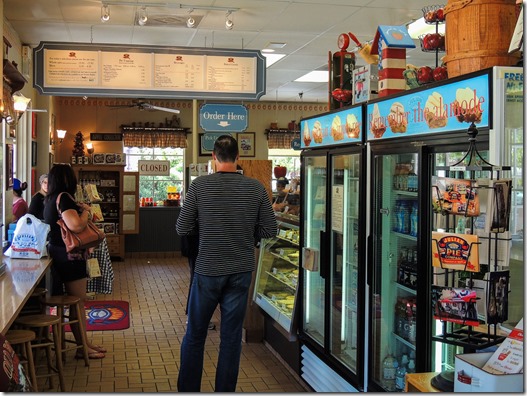
We reached the town of Santa Ysabel around 10:00 am and the first this we did was head for the Apple Country Restaurant for a hardy breakfast at a very reasonable cost. After breakfast we walked about 20 yards to the Julian Pie Bakery just north of the restaurant.

The Julian Pie Company became a reality for Liz Smothers in September of 1986. It all started when she and a neighbor began peeling apples for a local pie shop where she was soon employed to bake and sell pies. Tim, her son worked after school rolling dough. Liz’s husband Keith had a full-time job at the time working for AT&T. That would soon change as be began the study the art of orcharding. It should be noted that Julian, California is famous for its apple orchards and its apple cider.

Recognizing her expertise, two other pie shops hired her to bake for them. While Liz enjoyed the activity and baking for the pie shops, she had a desire to be creative on her own and not merely bake someone else's pie. With the assistance of a friend and emphasis on quality control and clean, neat surroundings, the Julian Pie Company began.

In 1989, Keith and Liz purchased an apple farm and with the help of son Dan, 17,000 trees were planted to supply fresh apples for the pie shop. While the orchard occupied much of Keith’s time, Liz’s expertise was in the kitchen ensuring quality control. Her goal was to produce a pie that would capture the essence of the small mountain town of Julian.

Being the youngest of eight children, Liz attributes the love of pie making to her mother. "One of my fondest memories is standing on a box beside my mother putting leftover pie dough in a metal jar lid to make a pie." Today she attributes the success of the pie shop to her dedicated team of bakers and staff.

On any given day you will find Dave, the oldest son, managing the Julian shop while Tim, the youngest son, heads up operations at the Santa Ysabel location. Daughter-in-law Brandi assists with the bookkeeping. Eldest daughter Joni and son Dan, while still supportive of the business enjoy other levels of success as an author and an electrical engineer.

Liz, while still participating in her love of pie making, leaves much of the overall operations to son Tim. Today she continues to oversee quality control and customer satisfaction and in addition serves as a consultant and primary resource for start-up businesses.

With a growing demand for Julian pies in local markets, the need to expand the production resulted in the opening of the Santa Ysabel facility in 1992. Keith was instrumental in helping Liz open this second location for the Julian Pie Company. Together they designed and purchased equipment for this new facility. In those early days Liz would bake the pies and Keith would deliver them. Julian Pies now delivers pies to San Diego and Riverside counties as well as shipping pies throughout the United States via their Internet site.

The Pie Companies busiest time of the year for Liz and her 45 employees is Thanksgiving. Ten days prior to Thanksgiving the “Thanksgiving Bake” as Liz calls it begins. During this period an average of 35,000 pies are baked and shipped and the bakery in Santa Ysabel

The Pie Company runs 24/7 during this period. Hundreds of pies are baking in the ovens while dozens of employees, each with a very specific job, work on an assembly line basis to get these pies out the door and to the Thanksgiving Day table. The vast majority of these pies are shipped via Federal Express to the on-line customers and the 79 retail outlets across the country with the Albertsons’ supermarket chain being their largest retail customer.

It starts at the “18-wheeler peeler”, a huge machine where apples are put in two at a time and the machine peels and cores them. The apples must be 2-5/8 inches in diameter for the machine to work properly and the staff makes sure that no seeds or peels are left. People don’t like seeds or peels in heir pies.

When possible, The Julian Pie Company use locally grown apples but there aren’t nearly enough apples to meet the demand, so most of the apples come from other parts of the country. Also different apples are used for different pies.

In 2007 the company invested in four massive ovens, each of which can bake 120 pies at a time. The pies rotate in the ovens as air circulates, ensuring that each pie is browned exactly the same way.

Each pie weighs 2.85 pounds or very close. He pies are made by hand, which means their weight might be off by a slice or two. A mixture of apple cider and egg whites is bushed on the tops of many of the pies to give the crust a golden brown color when baked. But it’s the crumb-toped pies that are the big sellers by a ratio of 2:1. According to Liz Smothers it’s the crumb-toped pies that keep them in business

Everything is made in units of ten for quality control. Ten pie crusts at a time — a bowl of crumb topping for ten pies.

The company does very little advertising, but it has been written up in many food and travel magazines and the Food Network cable channel did a documentary about the company in 2001.

The Julian Pie Company sells approximately 400,000 pies each year and at $14 dollars per pie that’s a gross revenue of $5.6 million dollars per year. They use 175,000 pounds of flour, 127,000 pounds of sugar, and 800,000 apples each year. And all of this comes from this approximately 5.200 square foot facility located on the little town of Santa Ysabel (33 6 35,-116 40 28)

I had been to the Julian Pies shops in Julian and Santa Ysabel before but this time I wanted to learn more about the pie baking business so I took some time to question the sales girl while Kathy and Gwen were seeking out the pies they wanted to purchase. Kathy wanted a pie to take home and eat (I suggested the apple/peach crumb) and Gwen wanted a frozen apple pie to take to her friend in Albuquerque on Monday. (Yes, they sell frozen unbaked pies that you can bake at home with instructions packed with the pie). She also purchased a dozen of their scrumptious apple doughnuts.

The sales girl was very knowledgeable of the company’s history and business practices. As the sales room was not too busy at this time she was able to spend some time giving me the information I was asking for.

Almost all their pies contain apples. Their pie menu includes:

The original traditional apple pie like grandma used to make with Granny Smith apples. This is their legacy apple pie.

Dutch, same as original apple pie, but has a sweet crumb top.

Natural, made with sweet apples and sweet apple cider. No preservatives, artificial flavors or sugar added. Tastes like a sweet apple cooked in its own juice.

Boysenberry Apple, a layer of boysenberries, topped with apples, has a crumb top.

Pecan pie with fresh pecans in a rich flavorful filling.

Strawberry Rhubarb, old fashioned favorite with sweet strawberries and tart rhubarb, has a flavor all its own.

Pumpkin Pie, a holiday favorite, has a rich spicy flavor.

Peach Apple, sweet sliced peaches layered with apples, has a crumb top. This is one of my favorites.

Apple Mountain Berry, Raspberries, strawberries and boysenberries tossed with apples and has a crumb top. This one is really good.

Raspberry Apple, whole raspberries layered with apples. Has a crumb top.

Cherry Apple, with tart Michigan cherries layered with apples and has a crumb top.

Blueberry Apple Crumb, whole blueberries mixed with tart apples with a sweet crumb top.

Blueberry, a pie packed full of blueberries to satisfy your blueberry craving with a crust top.

Blackberry, a country favorite bursting with flavor with a crust top.

To view a full on-line menu of their pies with clickable thumbnail images click here.

If you want to take the time to visit one of the Julian Pies stores here are the addresses.

Julian

Julian Pie Company 2225 Main Street, Julian, California (760) 765-2449

Santa Ysabel

Julian Pie Company 21976 Hwy. 79, Santa Ysabel, California (760) 765-2400

You don’t have to buy a whole pie as they sell slices that can be eaten with a cup of their various coffees at counter or on the patio of the Julian store. However, I think after tasting a slice of a Julian Pie you will want to take one (or two) home. A trip to Julian for a breakfast or lunch and a pie makes a relaxing day to get away from all of the hustle and bustle in life.

Photo Gallery

DSCN0094

The Apple Country Restaurant

DSCN0089

The Julian Pie Company – Santa Ysabel

DSCN0099

Some of the pies

DSCN0101

Caramel Apples

DSCN0103

The sales office and counter

DSCN0105-Edit

The friendly sales girl

For a complete gallery of photos click here

Monday, February 25, 2013

The Oscars

“What's fascinating is, people in Washington would rather spend time in Hollywood, and people in Hollywood would rather spend time in Washington.” — Arnold Schwarzenegger

Last night I watched the 85th Academy Awards show — now known as the “Oscars” in honor of the statuette that is given to the winners. Once again the Academy of Motion Picture Arts and Sciences (AMPAS) chose the Dolby Theater (formerly the Kodak Theater) as the venue for this gala night where Hollywood honors itself.

As usual the show was too long as were some of the acceptance speeches. The host, Seth MacFarlane, did a fair job, but to me some of his trials at humor fell short of the mark. I thought there were some highlights during the 3 hour and 35 minute show and definitely some low points. Here are my highlights:

76-year-old Shirley Bassey singing the theme song to Goldfinger during the salute to 50 years of James Bond 007 movies for which she received a standing ovation.

The tribute to 50 years of James Bond movies — no doubt the longest franchise in movie history with 23 films. It’s interesting to note that the first 007 movie — Dr. No had a filming budget of $1.2 million and the budget for the latest 007 film — Skyfall — was $230 million. This shows how the cost of movies has escalated in the past 50 years.

The musical performance by the cast of “Les Misérables.” Although the musical performances were a bit too long they did add a bit of entertainment to the commercial-laden show.

Adele Adkins singing the theme song she and Paul Epworth wrote for Skyfall for which they received the Oscar for best original song.

MacFarlane’s joke that Argo, a film about a secret operation to free some of the hostages during the Iran hostage crisis, was so secret the Academy did not know who the director was.

Now for the low points:

William Shatner dressed as his "Star Trek" character, appearing on a screen less than 10 minutes into the telecast to cut off what he called MacFarlane’s offensive jokes. Shatner said he was coming from the future to “stop you from destroying the Academy Awards.” He then went on to hold up a news article that read “Seth MacFarlane Worst Oscar Host Ever.”

Ben Affleck and Kathryn Bigelow not being nominated for best director while their films were box office hits

Jane Fonda appearing on stage as one of the presenters. The 75-year old has been was showcased no doubt in an attempt to rehabilitate herself for her traitorous efforts during the Vietnam War. I would venture to say that every Vietnam vet watching the show was tempted to turn off the TV when she walked into the spotlight.

And no doubt the lowest point was when the aging and boring Jack Nicholson turned to introduce Michelle Obama as the presenter for the best picture award. Ms. Obama appeared on the big jumbotron screen above the stage flanked by a cadre of military members to introduce the films and then announce the winner. The only thing she lacked was the addition of firefighters, first responders, and actors playing doctors dressed in white lab coats. However, you have to give her some degree of credit as it was after midnight on the east coast.

According to The Hollywood Reporter, the FLOTUS appearance was the work of Obama supporter and friend Harvey Weinstein and his daughter Lilly, who arranged for Academy representatives and show producers to secretly fly (via Disney's jet) to D.C. just two weeks ago to make the magic happen.

"This makes no sense, it adds nothing to the show," one industry expert told FOX411's Pop Tarts column with a bemused laugh, while another surmised it as something of a "suck job."

"Forget separation of church and state — we need a separation of Hollywood and state," conservative journalist Michelle Malkin retweeted, while others weighed in that it was "tacky and tasteless" and cheapened the Presidency.

After all they threw all the campaign parties, I guess it was Hollywood's way of acknowledging their continued love and support of the Obama's.

Quentin Tarantino’s Oscar acceptance speech for best original screen play for his horrible film racist film “Django Unchained.”

Now for my take on the winners and losers for best actress, actor, director, and film.

The Oscar for best actor went to Daniel Day-Lewis for his performance in “Lincoln.” I have not seen the film so I really have no opinion on this category, but I did like Ben Affleck’s performance in “Argo.”

Jennifer Lawrence took home the Oscar as best actress for her performance in "Silver Linings Playbook." In my opinion the best actress award should have gone to Jessica Chastain for her performance in “Zero Dark Thirty.” Her role of as the female CIA analyst who spent 10 years of her life doggedly chasing down Osama bin Laden was compelling and realistic.

The award for best director went to Ang Lee for his film "Life of Pi." I have not seen the Life of Pi and I am sure it is a beautiful and inspiring film but I think his award was cheapened without Affleck and Bigelow being in the running. This is the politics of Hollywood. Thank heavens Spielberg did not receive the award for his boring and historical inaccurate film “Lincoln.”

The Oscar for best picture went to "Argo." This is only the fourth time in the history of the Academy Awards that the nominee for best picture did not include the director. I was rooting for either Argo or Zero Dark Thirty. I thought both films were great and told compelling tales of the dedication and heroism of the much maligned people of the CIA.

Argo is the story about a CIA covert operator’s (Tony Mendez) effort to get six of the U.S. State Department employees out of Iran during the Iranian Revolution in 1979. While taking some license with historical facts the film still tells a great story of Mendez’s dedication and heroism — heroism for which he was awarded the Intelligence Star by the CIA.

Argo is historically flawed in a few of the scenes depicted in the film and for a few things not mentioned in the film:

  • The climax of film is a chase down an airport runway, as gun-toting members of the Revolutionary Guard try to stop the plane bearing the American refugees from taking off. "Absolutely none of that happened," says Mark Lijek – one of the freed hostages. "Fortunately for us, there were very few Revolutionary Guards about. It's why we turned up for a flight at 5.30 in the morning; even they weren't zealous enough to be there that early. The truth is the immigration officers barely looked at us and we were processed out in the regular way. We got on the flight to Zurich and then we were taken to the U.S. ambassador's residence in Berne. It was that straightforward."]
  • The part of the plot about the Revolutionary Guards discovering the diplomats' identities is fictional. They had left Iran with their fake identities with no hassle. So the scenes of trouble with the bearded guard at the last check point, the scene of the commander raiding the Canadian ambassador's residence, and the entire chasing scene at the airport and even on the runway are fictional.
  • There is a sequence in the film where the six go on a location scout in Tehran to create the impression they are movie people. According to Mark Lijek, the scene is total fiction.
  • "It's not true we could never go outside. John Sheardown's house had an interior courtyard with a garden and we could walk there freely," Mark Lijek says.
  • The screenplay has the escapees—Mark and Cora Lijek, Bob Anders, Lee Schatz and Joe and Kathy Stafford—settling down to enforced cohabitation at the residence of the Canadian ambassador Ken Taylor. In reality, after several nights—including one spent in the UK residential compound—the group was split between the Taylor house and the home of another Canadian official, John Sheardown.
  • The major role of producer Lester Siegel, played by Alan Arkin, is fictional.

The film depicts a dramatic last-minute cancellation of the mission by the Carter administration and a bureaucratic crisis in which Mendez declares he will proceed with the mission. Carter delayed authorization by only 30 minutes, and that was before Mendez had left Europe for Iran.

On the other hand:

After the film was previewed at the Toronto International Film Festival in September 2012, some critics said that it unfairly glorified the role of the CIA and minimized the role of the Canadian government (particularly that of Ambassador Taylor) in the extraction operation. Maclean's asserted that "the movie rewrites history at Canada's expense, making Hollywood and the CIA the saga's heroic saviors while Taylor is demoted to a kindly concierge." The postscript text said that the CIA let Taylor take the credit for political purposes, which some critics thought implied that he did not deserve the accolades he received. In response to this criticism, Affleck changed the postscript text to read: "The involvement of the CIA complemented efforts of the Canadian embassy to free the six held in Tehran. To this day the story stands as an enduring model of international co-operation between governments." The Toronto Star complained, "Even that hardly does Canada justice."

In a CNN interview, President Carter addressed the controversy by stating: "90% of the contributions to the ideas and the consummation of the plan was Canadian. And the movie gives almost full credit to the American CIA. And with that exception, the movie is very good. But Ben Affleck's character in the film was only in Tehran a day and a half. And the main hero, in my opinion, was Ken Taylor, who was the Canadian ambassador who orchestrated the entire process."Taylor himself noted that, "In reality, Canada was responsible for the six and the CIA was a junior partner. But I realize this is a movie and you have to keep the audience on the edge of their seats." In the film, Taylor is also shown threatening to close the Canadian embassy in the movie; in reality, this did not happen and the Canadians never considered abandoning the six Americans who had taken refuge under Canadian protection.

Affleck asserted: "Because we say it's based on a true story, rather than this is a true story, we're allowed to take some dramatic license. There's a spirit of truth" and that "the kinds of things that are really important to be true are—for example, the relationship between the U.S. and Canada. The U.S. stood up collectively as a nation and said, 'We like you, we appreciate you, we respect you, and we're in your debt.' There were folks who didn't want to stick their necks out and the Canadians did. They said, 'We'll risk our diplomatic standing, our lives, by harboring six Americans because it's the right thing to do.' Because of that, their lives were saved.

Historically flawed or nor I still think it was a very good film about an actual event. As I have said before — “don’t get you history from a movie. Instead use the movie as a motivation to delve into the facts and learn history on your own.”

I did, however, think Zero Dark Thirty was a little bit better than Argo and I also thought that Bigelow should have been nominated for best director and her writer Mark Boal should have won for original screen play. Boal’s screen play was far better than Quentin Tarantino’s for Django Unchained.

Zero Dark Thirty and Bigelow were doomed from the get go by the Hollywood elite. People like Ed Asner, the unabashed Marxist, and Martin Sheen called for a boycott of the film. They wanted the boycott on the basis that Bigelow and Boal glorified torture in the film. Of course Asner in his performance in “Roots” was a slave master. Did he endorse slavery? Oh, how shot the memory of the liberal progressive. As C. Roger Denson writes in the Huffington Post:

“We expect actors as talented and esteemed as Martin Sheen, Ed Asner, and David Clennon to know all about the principles of irony, catharsis and sublimation at play in theatrical dramatizations. Simply stated, these are methods of portraying human events and behaviors that are detrimental to real people and societies, but which -- besides providing fuel for artistic and entertaining dramatizations -- are crucial to our understanding that simulation of inhuman behavior can be for a higher end. An end such as informing audiences of the hidden and heinous activities we want to eliminate from our lives and our governments -- not least of which are those activities of which many in the audience may be unaware.”

Even Rotten Tomatoes, a publication devoted to criticizing films gave ZDT a 94 out of 100 rating.

The film, which has sparked outrage among both Democrats and Republicans in Washington over its depiction of torture, and allegations that the Obama administration leaked classified intelligence to help the making of the film, won no major Oscars on Sunday and only one award overall.

Just three months ago, the thriller, which culminates in Osama bin Laden’s killing by US Navy Seals, was a strong contender to pick up the biggest prize of Best Picture, as well as the Best Actress and Original Screenplay awards.

By the end of Sunday night, however, it had picked up just one award – a shared Oscar for Sound Editing, which was a tie with Skyfall.

Early signs of trouble came in mid-December when leading US Senators Dianne Feinstein and Carl Levin, both Democrats, and John McCain, the Republicans’ 2008 presidential candidate, sent a letter to movie studio Sony Pictures, castigating the film.

They called the film “grossly inaccurate and misleading” for suggesting torture helped the US track the al Qaeda leader to a Pakistani compound, where he was killed in 2011.

Three weeks later, the film’s director, Kathryn Bigelow, was omitted from the Oscar’s Best Director shortlist, chosen by about 5,800 movie industry professionals who make up the Academy of Motion Picture Arts and Sciences.

Bigelow was one of only four big directors to be snubbed while the film did receive five Oscar nominations

In January, Los Angeles Times film critic Kenneth Turan pointed the finger at Washington, writing: “Chalk up this year’s nominations as a victory for the bullying power of the United States Senate and an undeserved loss for Kathryn Bigelow.”

This is chilling as now these senators are calling for hearings to determine how much information Bigelow and Boal received from the CIA in the making of the film To this extent Boal has hired an attorney to represent him. These actions by the United States Senate harken back to the days of the Dies Committee (HUAC) and the Hollywood Ten — something the liberals in Hollywood still harp on. This is McCarthyism in reverse and it has a chilling effect on free speech.

It should be noted that the entire cast of ZDT is supporting a effort to get Dr. Shakil Afridi freed from a Pakistani prison. Afridi has been imprisoned for giving help to the United States for going door to door in Abbottabad under the guise of giving vaccination in order to collect DNA to determine if it truly was bin Laden sequestered in the compound where he was thought to be. Fox News reports:

“Zero Dark Thirty" actress Jessica Chastain has thrown her support behind the effort to free the jailed Pakistani doctor who was integral in helping the U.S. track down and kill Usama Bin Laden.

"[It ] breaks my heart he's still in prison," Chastain told Fox News on Sunday on the red carpet of the 85th annual Academy Awards, referring to Dr. Shakil Afridi.

Chastain played a C.I.A. agent who directed the operation to find Bin Laden, but told Fox news "there are hundreds of unsung heroes" in the successful operation and she didn't think there was "one person who should be credited."

Bob and Kira Lorsch and their RHL Group took out a full-page ad with the headline: “Oscar, Help Free Afridi. America’s Abandoned Hero.”

The ad, part of the group's “Free Dr. Afridi” campaign, read in part: “Dr. Shakil Afridi is the man who verified Usama bin Laden’s location in Pakistan for the United States. Without Dr. Afridi’s sacrifice, we may not have pinpointed the location of the world’s most dangerous terrorist. His Reward… he was abandoned, captured and is still being tortured by Pakistan ever since Bin Laden was killed in May 2011. After all, who will stand up to help America next time if this is how we treat our friends?”

The advertisement also acknowledged a number of individuals and organizations it says have championed the issue, including Rep. Dana Rohrabacher (R-Calif.), the cast and crew of "Zero Dark Thirty," and Fox News Correspondent Dominic DiNatale and Producer Sib Kaifee, whose exclusive reporting has helped shed light on the Afridi case.”

You can read my critique of Zero Dark Thirty by clicking here.

For those of you who managed to miss the Oscars or don’t much here is complete list of the winners:

1. Best Picture: "Argo."

2. Actor: Daniel Day-Lewis, "Lincoln."

3. Actress: Jennifer Lawrence, "Silver Linings Playbook."

4. Supporting Actor: Christoph Waltz, "Django Unchained."

5. Supporting Actress: Anne Hathaway, "Les Miserables."

6. Directing: Ang Lee, "Life of Pi."

7. Foreign Language Film: "Amour."

8. Adapted Screenplay: Chris Terrio, "Argo."

9. Original Screenplay: Quentin Tarantino, "Django Unchained."

10. Animated Feature Film: "Brave."

11. Production Design: "Lincoln."

12. Cinematography: "Life of Pi."

13. Sound Mixing: "Les Miserables."

14. Sound Editing (tie): "Skyfall," ''Zero Dark Thirty."

15. Original Score: "Life of Pi," Mychael Danna.

16. Original Song: "Skyfall" from "Skyfall," Adele Adkins and Paul Epworth.

17. Costume: "Anna Karenina."

18. Documentary Feature: "Searching for Sugar Man."

19. Documentary (short subject): "Inocente."

20. Film Editing: "Argo."

21. Makeup and Hairstyling: "Les Miserables."

22. Animated Short Film: "Paperman."

23. Live Action Short Film: "Curfew."

24. Visual Effects: "Life of Pi."

All in all the night of the Oscars was average. Once again the Hollywood elites pushed their liberal agenda on the film makers demonstrating the films they approved of and those they don’t. The only true way to judge a film is to see it yourself and notice the public’s reaction by the box office receipts.

According to Townhall.com through their first 65 days of release, Zero Dark Thirty has made over seven times as much in U.S. box office receipts as did The Hurt Locker, with nearly $90 million in receipts just in the United States. That figure then represents the real difference between being pro and anti-American at the U.S. box office.