Search This Blog

Showing posts with label Transportation. Show all posts

Wednesday, July 24, 2013

Which State Has The Worst Roads

“I do not think it is an exaggeration to say history is largely a history of inflation, usually inflations engineered by governments for the gain of governments.” — Friedrich August von Hayek

When I moved to California from Ohio in 1962 construction on the Interstate Highway System was in full bloom. States across the land were building bridges, buy rights of way, and laying down miles of concrete roadway.

Upon arrival in California I accepted a position as a highway engineering technician for the California Division of Highways (now Caltrans) and began working on the Santa Monica Freeway (I-10) in Los Angeles. We were building eight lanes of concrete roadway from downtown Los Angeles to the Coast Highway in Santa Monica. We were excited over what we were doing and thought this superhighway would solve much of the traffic problems in getting from Los Angeles to Santa Monica.

At the time we were building the Santa Monica Freeway there were hundreds of miles on freeway being built in Los, Angels, Ventura, and Orange counties the area covered by the district I worked for.

At the same time other states were building their interstates and as always when a massive undertaking such as the Interstate Highway System is underway there will be those who will take advantage of the program. Two examples come to mind. The first was the construction of the Tampa Bay causeway where the contractor used sea water to mix his concrete. The salt in the sea water weakens the strength of the concrete and will shorten its life. When this was discovered by inspectors from the Bureau of Public Roads (now the Department of Transportation) the project was stopped, the weaken concrete removes and replaces and the contractor ended up in jail.

The second example was discovered just east of my home town of Cleveland Ohio on the newly constructed I-90. When the roadway was opened a reporter to the Cleveland Plain Dealer was driving along the road just after a heavy rain storm. He noticed large puddles of water (birdbaths in the lexicon of highway engineers) and thought that this should not be happening. He began to write a series of articles about the condition of the roadway. These article brought attention to the Ohio Highway Department and they began an investigation as to why the roadway was sinking in spots. When they conducted test borings they discovered that the sub-base rather than being the required 8 inches thick was only 4 inches. It seems as the contractor has cheated on the sub-base charging for 8 inches while only delivering 4 inches. This amounts to 3097.6 cubic yards per mile for a dual roadway. As you can see if the contract was for a 10 mile section your about talking 31,000 cubic yards of expensive sub base material.

There were other scandals involving the Interstate program including interchanges to nowhere in the desert except dirt roads leading to ranches bids going to friends of local politicians.

Not all states were involved in these scandals and California was considered a model for the building of the Interstate System. This lead NBC’s Huntley-Brinkley Report to do a special on the Great Interstate Scandal where they exposed all of the shenanigans going on across the nation. They also closed their report with a segment on how to do it right. For that segment they brought their camera crews to the project I was working on. Of course they had Governor Pat Brown, the highway department’s chief engineer and our district engineer on site for the filming. They even took shots of my survey crew doing some work and interviewed one of the members.

In 1963 California was considered a model for all states to follow when building their highways. The Golden State was ranked as number one in the nation.

But all of that has changed. Now California is ranked number 47 for their roads. Even with the highest motor fuel taxes in the nation California is at the bottom of the list only ahead of Hawaii. Rhode Island, and Alaska.

The Libertarian Think Tank Reason Foundation has just released their annual report on the condition of our national highways. Their report states:

“The nation’s road conditions show slight improvement; North Dakota, Kansas and Wyoming have the best, most cost-effective highway systems and that Alaska, Rhode Island, Hawaii and California have the worst highway systems in study of pavement condition, congestion, deficient bridges, fatalities and cost-effectiveness.”

Reason Foundation’s Annual Highway Report measures the condition and cost-effectiveness of state-owned roads in 11 categories, including pavement condition on urban and rural Interstates, urban traffic congestion, deficient bridges, unsafe narrow lanes, traffic fatalities, total spending per mile of state roads and administrative costs per mile. The study’s rankings are based on data that states reported to the federal government for 2009, the most recent year with full spending statistics available.

Nationwide there was small progress in every category except for pavement condition on rural arterial roads. These improvements were achieved at a time when per-mile expenditures dropped slightly. Despite receiving stimulus funding from the federal government in 2009, spending on state roads decreased slightly, by 0.6%, in 2009 compared to 2008.

“It’s hard to believe it when you hit a pothole or see a bridge in Washington collapse, but the nation’s roads have been getting better,” said David Hartgen, author of the study and emeritus transportation professor at the University of North Carolina at Charlotte. “There are still several states struggling and plenty of problem areas but progress continues to be made.

Among the states plagued with problems are New Jersey and California. New Jersey spends $1.2 million per mile on its state-controlled roads. That’s nearly twice as much as the $679,000 per mile that the next biggest spending state—California—spends. North Carolina, home to the nation’s largest state highway system, spends $44,000 per mile on its roads. South Carolina spends just $31,000, the lowest per mile rate in the nation, according to a Reason Foundation study of all 50 state-controlled road systems.

Drivers in California and New Jersey may be wondering what they are getting in return for that money. More than 16 percent of urban Interstate pavement in each of those states is in poor condition. Only Hawaii ranks worse, with 27 percent of its urban Interstate pavement rated as poor.

Not only are California’s Interstates full of potholes, they are also jammed —smog.p0416.per.jpg80 percent of the state’s urban Interstates are congested. Minnesota has the next highest percentage of gridlocked Interstates, with 78 percent of urban Interstates deemed congested.

In terms of overall road conditions and cost-effectiveness, North Dakota has the country’s top ranked state-controlled road system, followed by Kansas (2nd), Wyoming (3rd), New Mexico (4th) and Montana (5th), according to Reason Foundation’s Annual Highway Report.

Alaska’s state-controlled road system is the lowest quality and least cost-effective in the nation. Rhode Island (49th), Hawaii (48th), California (47th), New Jersey (46th) and New York (45th) also perform poorly.

Vermont’s roads showed the most improvement in the nation, improving from 42nd in the previous report to 28th in the new overall rankings. New Hampshire (27th) and Washington (24th) both improved nine spots in the rankings.

Minnesota system plummeted 17 spots in the rankings, from 25th to 42nd and Delaware dropped nine spots to 20th.

Massachusetts had the lowest traffic fatality rate, while Montana had the highest.

Here is the Reason Foundation’s ranking for all 50 states:

1. North Dakota

2. Kansas

3. Wyoming

4. New Mexico

5. Montana

6. Nebraska

7. South Carolina

8. Missouri

9. South Dakota

10. Mississippi

11. Texas

12. Georgia

13. Oregon

14. Kentucky

15. Virginia

16. Nevada

17. Idaho

18. New Hampshire

19. North Carolina

20. Delaware

21. Tennessee

22. Indiana

23. Arizona

24. Washington

25. Ohio

26. Utah

27. Alabama

28. Vermont

29. Maine

30. Michigan

31. Wisconsin

32. West Virginia

33. Iowa

34. Illinois

35. Louisiana

36. Arkansas

37. Florida

38. Oklahoma

39. Pennsylvania

40. Maryland

41. Colorado

42. Minnesota

43. Massachusetts

44. Connecticut

45. New York

46. New Jersey

47. California

48. Hawaii

49. Rhode Island

50. Alaska

I can’t speak for all 49 states, but I can comment on a few of the reasons California’s roads have gotten so bad over the past few decades.

Bloated Caltrans civil service workforce.

It is estimated that Caltrans employs about 23,000 full-time civil service employees. this includes engineers, surveyors, mappers, maintenance workers, administrators, and clerical staff. Unlike other highway departments across the country Caltrans outsources less than 10% of its work to the private sector. Other states outsource between 30% to 70% of their engineering and maintenance services to the private sector on a competitive basis. This means that even when there is a reduced workload there is no reduction in Caltrans’ staff. This bloated staff is due to the political power of the public service unions in California, namely the Professional Engineers in California Government (PECG). This union dictates how much of Caltrans’ work is outsourced. This causes inefficiencies in balancing the work load and creates a larger demand for future pension liabilities

Increasing costs of health care for retired Caltrans employees.

Today about one-third of the money Caltrans collects from gas taxes and other motor vehicle fees are paid out to retirees for health care. Even with the highest gas taxes in the nation Caltrans is getting less money for maintenance of California’s roads and bridges and less and less money that should be reimbursed to local counties and cities for the maintenance of local streets. Also there has been very little new construction financed by the state. Most of the new construction is financed by counties through voter-approved sales tax measures.

The state raiding into the highway trust fund.

Until recently due to a voter approved initiative forbidding the state of California to raid the highway trust fund for the purpose of bolstering the general fund the state used money intended for maintenance of roads and bridges to be used to support the giant social welfare programs in California. After the passage of the initiative this was no longer allowed, but the state can still “borrow” highway money at the discretion of the Democrat controlled legislature. No matter how you cut it these highway funds do not end up maintaining the state’s roads and bridges.

In 50 years of mismanagement and union control the State of California has gone from no.1 in highway construction and management to no. 47.

Friday, July 19, 2013

The Myth of High Speed Rail

"When plunder becomes a way of life for a group of men living together in society, they create for themselves, in the course of time, a legal system that authorizes it and a moral code that glorifies it." — Frederic Bastiat

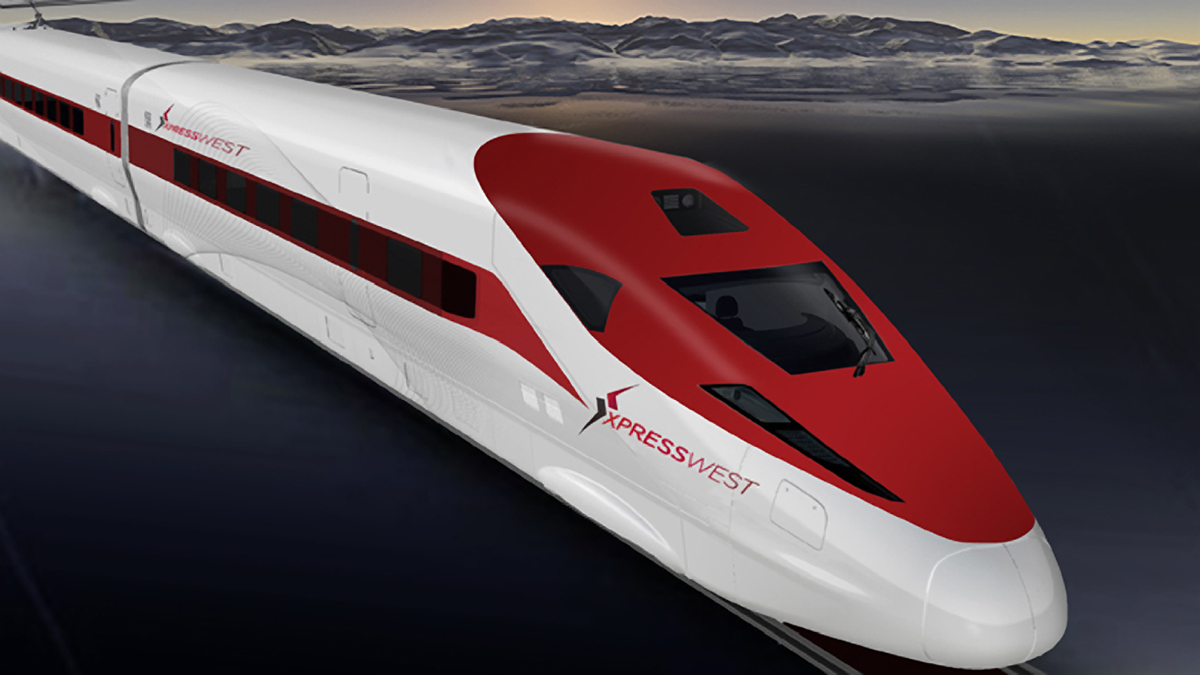
For the past two years I have been writing about the myth of high speed passenger rail. (See my blog from May 12, 2012 — “The Train to Nowhere, Part Deux”) In my May 12th blog I addressed the history of rail in the United States and talked about the proposed $7 billion dollar high speed rail from Victorville, California to Las Vegas, California. Since that time the name of the project has changed from DesertXpress to XpressWest and the United States Department of Transportation’s Federal Railroad Administration has nixed the requested $5.5 billion dollar loan.

On July 17th the Washington Post reported:

“WE’VE SEEN some bad policy ideas but not many more awful than the proposal to extend a $5.5 billion low-interest, 35-year federal loan to a West Coast start-up for a high-speed rail connection between Southern California and Las Vegas. This time, though, we are happy to report, common sense has prevailed: The Obama administration has stopped the project.

Backed by wealthy casino moguls, who in turn enjoyed the support of Senate Majority Leader Harry Reid (D-Nev.), a company called XpressWest wanted to lay tracks between Vegas and lonely Victorville, Calif., some 81 miles east of downtown Los Angeles. Several times larger than the largest amount ever loaned under the obscure federal Railroad Rehabilitation and Improvement Financing Program, the federal money would cover 80 percent of the project’s costs. The supposed public benefits were reduced carbon emissions, less auto traffic and, of course, more jobs.

What XpressWest struggled to explain was why taxpayers should bet on a proposition that private investors apparently found too risky: hordes of travelers driving to Victorville, parking their cars and then boarding the train for an 80-minute ride to Vegas — as opposed to driving the whole way, flying or taking “My Party Ride,” a limo-like bus trip for up to 30 passengers at $99 each, including food and drinks.

The whole thing had the makings of a boondoggle, for which taxpayers would eventually end up paying. Yet multiple federal and state agencies had given environmental and regulatory approvals, leaving the crucial matter of the loan up to the Transportation Department. Given the project’s political connections, DOT’s thumbs-up seemed inevitable — until June 28, when then-Secretary Ray LaHood, as one of his final acts in office, sent XpressWest Chairman Anthony Marnell II a letter saying that the department had decided to “suspend further consideration” of the loan.”

LaHood, in his June 28 letter to the company, cited "serious issues" with the application in the decision to cut the project off. He suggested the company was having difficulty ensuring that the project would be built with enough American products like U.S-made steel and iron.

Some of the letter was redacted, but LaHood also suggested concerns about the sheer size of the loan and the risk, and the company's apparent failure to submit additional documentation on other participants in the project.

"After several years of engagement with no resolution to the thresholdXpressWest-Train issues addressed in this letter and the significant uncertainties still surrounding the project, we have decided to suspend further consideration of XpressWest's loan request," LaHood wrote. The request had been under consideration with both his department and the Federal Railroad Administration.

The decision is a major blow to the project, as the federal loan was expected to make up the bulk of funding for the $6.9 billion rail line.

The 185-mile line was billed as the most advanced and fastest in the U.S. According to the company, it would connect Southern California and Vegas with an 80-minute train ride.

Yet critics warned that costs could spiral and ridership projections might be too rosy, and that such a massive federal investment was not wise.

The XpressWest line is running into a wall after another project — a proposed magnetic levitation (Maglev) train with a similar route — also ran into recent problems, as state planners backed away from that project and federal funding ran dry.

Sen. Jeff Sessions, (R-Alabama), top Republican on the Senate Budget Committee, and Rep. Paul Ryan, (R-Wisconsin)., chairman of the House Budget Committee, had earlier revealed they'd been told about the department's decision on XpressWest. The two lawmakers had been among the toughest critics of the project and loan, calling it "costly, wasteful and risky."

On February 12, 2013 Laura Carroll Reported in the Las Vegas Review Journal:

“At best, it could be another 18 months before any ground is broken on the XpressWest project - the same time frame backers gave the Las Vegas Review-Journal in 2009.

The reality of a high-speed train shuttling travelers between Victorville, Calif., and Las Vegas hinges on funding of $5.5 billion from the Railroad Rehabilitation and Improvement Financing, which is administered by the Federal Railroad Administration. XpressWest's first loan application was submitted in December 2010 and is still under review.

The nearly $7 billion project will largely be financed from this loan, if approved, and the rest in private equity investment.

At Tuesday's meeting of the Las Vegas Convention and Visitors Authority board of directors, XpressWest Chief Operating Officer Andrew Mack, said it could be six months before a decision is made on the application. If approved, it would be still another year before ground is broken.

"It's really dependent on the RRIF pay," Mack said. "That's really driving the schedule.

The train would be built adjacent to Interstate 15 with service every 20 minutes and one-ways taking about 80 minutes. The average fare is less than $100, Mack said. Each train would seat between 500 and 600 passengers.

If construction eventually starts, XpressWest estimates that 80,000 direct and indirect construction jobs will be created, with a third of those going to Southern Nevadans. The estimated economic output of the rail line during its lifetime is $7.8 billion.

In Las Vegas, two potential sites have been chosen for train stations: one across from the Rio and the other across from Mandalay Bay.”

The Transportation Department later said in a statement that "XpressWest has the ability to revive its application by significantly revising its request."

The project still has a powerful supporter in Congress — Senate Majority Leader Reid, as well as Republican Nevada Sen. Dean Heller.

According to the Las Vegas Review-Journal, Reid claims the administration has not "permanently foreclosed" the possibility of an investment. He stressed Friday that he plans to keep pushing for "this vital investment." Obviously this decision is a death blow to Reid and the backers of the project — a decision I totally agree with. (See the Fox News report from March 13, 2013)

According to an August 2012 tax risk assessment by the libertarian Reason Foundation should the Victorville to Las Vegas train commercial revenues fail to pay operating costs and debt service, the project would not have enough money to repay the federal loan, resulting in a default that would make Solyndra look like small change. Taxpayers would lose up to $6.5 billion in principal and any unpaid interest, an amount that could climb to more than $7.5 billion if a full six-year deferment of repayment is granted. The Taxpayer Risk Assessment identifies a number of concerns that could result in taxpayer losses.

This Taxpayer Risk Assessment examines the financial risks to taxpayers of the proposed XpressWest high-speed rail project from Victorville to Las Vegas. There would be no need for a Taxpayer Risk Analysis without government (taxpayer) involvement. For example, if a bus company were to establish a new service between Victorville and Las Vegas, there would be no taxpayer financial exposure under normal circumstances. The company would either succeed or fail depending on its ability to cover its costs through various commercial activities. As with private loans, the ability to secure the loan depends on the bank’s assessment of its successfully pay off — a natural inhibitor of risky propositions. XpressWest is intended to be self-supporting, with the construction and financing expenses and operating expenses covered by commercial revenues, principally passenger fares. Tellingly, the project sponsors are apparently unable to arrange conventional private sector financing and seek a federal loan with a subsidized interest rate, which would pass the risks on to taxpayers if the forecasted ridership should fail to materialize. Moreover, in the event of financial difficulty, state and local taxpayers could face significant pressure to provide funding to complete the system or to subsidize its operations. Thus, a Taxpayer Risk Assessment is necessary.

This Taxpayer Risk Analysis reviews ridership, revenue and capital cost forecasts to the extent that they are available. The principal focus is on ridership, since the repayment of the proposed federal loan from taxpayers is entirely dependent upon commercial revenues, principally the fares that will be paid by riders and ancillary revenues, such as advertising.

1. A Speculative Consumer Market: The greatest risk is that the potential consumer market for the train is far smaller, in geographical terms, than is assumed in the project documentation. There is no parallel for large numbers of drivers and airline passengers to travel well outside the urban areas in which they live to connect to a train (or plane) to any destination, much less one so close to Southern California as Las Vegas. As a result, common sense finds ridership and revenue likely to be a mere fraction of forecast. This would likely make repayment of the federal loan impossible. This risk to taxpayers of an exaggerated market is “unknown, but potentially severe.”

2. Materially Changed Circumstances: Even if the consumer market were geographically as large as assumed, growth in the Las Vegas tourist market has been far below forecasts in recent years. As a result, the base ridership figures are implausibly exaggerated and need to be revised downward. The ridership and revenue risk to XpressWest from this factor is high and risks make paying the federal debt impossible, calling for a taxpayer bailout.

3. Ridership and Revenue Forecast Model Concerns: The international record indicates that rail projects tend to average approximately 39% less in ridership than forecast. Specific factors of the ridership forecast for the Victorville to Las Vegas train indicate that actual ridership is likely to be 39% to 70% less than forecasted, even after adjustment for the materially changed circumstances. These factors include an optimistic estimate of the base year market, a market growth rate greater than in pre-recession years, an optimistic assumption of attraction from cars and an optimistic bus attraction assumption. Such rosy predictions increase the likelihood that the federal loan would not be repaid.

4. Capital Cost Escalation: Capital cost escalation for rail projects has been pervasive in similar projects, suggesting that capital cost escalation is likely to occur on the Victorville to Las Vegas train, leaving the project impossible to complete and triggering a default on the federal loan. Governments (federal, state and local) would be faced with difficult decisions about whether to complete the project, at elevated costs, with public funding or to fund dismantlement of a partially completed system.

5. Likely Commercial Losses: Even if there is no capital cost escalation, it is unlikely that the business plan for this project is flexible enough to deal with all the variations discussed above without suffering either higher costs or commercial revenue shortfalls. This inflexibility could lead to a default on the federal loan with the loss paid by taxpayers. Further, political pressure to keep the train operating could lead to a federal Amtrak-style takeover with subsidies, or the train could be operated with state and/or local subsidies. The risk of taxpayer loss from this factor is evaluated at “high.”

6. Higher Cost for Highway Expansion: Use of the median of I-15 for the Victorville to Las Vegas train could preclude the most cost-effective options to expand highway capacity. This would increase costs to taxpayers and highway users. The risk of higher expansion costs on I-15 is evaluated as “moderate.”

In 1991 I was involved with the proposed Maglev line from Anaheim to Las Vegas. This was to be a cooperative venture between Transrapid (the German consortium pushing their Maglev technology), The California High Speed Rail Corporation, and Bechtel to design, build and operate a Maglev train from Disneyland to Las Vegas. The technology seemed sound but there were two major problems. One is that they could not get a permit from Caltrans to use any right of way along the I-15 corridor and two; they could not find any investors. Eventually the right of way issue was solved by an act of the California Legislature, but there still was no money coming forth.

The majority of high-speed rail lines require large government subsidies from both general taxpayers and drivers. Even with generous subsidies, traveling by high-speed rail is still more expensive than flying for 12 of the 23 most popular high-speed rail routes in the world. Evidence suggests it can only be competitive on routes that are 200 to 500 miles in length.

High-speed rail is also very expensive to build. Most new routes cost at least $10 million per mile to construct. The cheapest European rail line costs more than $50,000 per seat to operate annually. A U.S. high-speed rail line would need ridership of 6 million to 9 million people per year to break even. The high-speed Acela service, despite operating in the busy Northeast Corridor, averages only 3.4 million passengers per year.

Advocates cite other advantages for high-speed rail, but most fall apart under close examination:

Environment: High-speed rail creates more pollution than it prevents because building a high-speed rail line is very energy-intensive.

Economic development: High-speed rail does not create much new development; it merely redirects development from one area to another.

Mobility: High-speed rail is unlikely to improve mobility since most of its potential passengers already travel by air.

Choice: Customers can already choose between a low-cost bus, a fast plane or a personalized car trip.

Most countries have built high-speed rail to relieve passenger overcrowding on their existing lines. The U.S. lacks this overcrowding, which suggests consumer demand for high-speed rail may not be there. Furthermore, freight rail dominates track usage, and railroad companies are reluctant to relinquish capacity, as is evident in the discussions surrounding the proposed multimodal passenger terminal in downtown Atlanta.

Any U.S. rail operator will have to compete on the same terms that cause Amtrak to lose large amounts of money each year. Railways are subject to outdated labor laws that were enacted when railroads did not face competition. Operating a passenger railroad in the existing regulatory environment is not a profitable proposition.

Our core cities, where people are most likely to board high-speed trains, are much less dense than European or Asian cities, which also limits the potential market.

The U.S. has far higher rates of car ownership than most other countries. Gas taxes are lower, road tolls are less common, and many cities — especially in the South and West — have grown up around the automobile.

As a result, high-speed rail is best regarded as a luxury toy this country cannot afford. For far less money, we could create a world-class highway and aviation system with first-rate bus and airplane service and far more flexibility.

We’d like to think that cost and feasibility concerns ultimately derailed this crazy train, but that is not what Mr. LaHood emphasized in his letter. Rather, he faulted XpressWest for not guaranteeing that it would get steel and other manufactured goods from U.S. suppliers. We disagree with protectionist “Buy America” thinking; still, in this case it at least shows that the project’s job-creation potential was always limited by the fact that no U.S. manufacturer makes high-speed rail cars or the needed heavy steel rails and electrification systems. However imperfect his rationale, Mr. LaHood reached the right result, and that’s cause for celebration.

Saturday, June 30, 2012

Refocusing the Federal Role and Program on Transportation

"It is hard to imagine a more stupid or more dangerous way of making decisions than by putting those decisions in the hands of people who pay no price for being wrong." — Thomas Sowell

In my previous blogs on our transportation infrastructure and the Highway Trust Fund I have covered the history of the Fund, the proper role for the federal government in transportation funding, and some possible changes that should be made. This blog will continue the discussion with how we can refocus the role of the federal government and the political feasibility of doing so.

As stated in my previous blogs on this issue I have liberally used comments from a report from The Reason Foundation’s Restoring Trust in the Highway Trust Fund. This is 2010 report authored by Robert Poole and Adrian Moore and expresses many of the thoughts I have expressed for the past 20 years. I give a tip of the hat to the Reason Foundation for publishing such a comprehensive and intelligent report. You can read the entire report by clicking here.

When I found this report I wanted to share it with others and I thought that by breaking it down into several blogs and adding my personal knowledge and experience as a professional engaged in transportation engineering, in both the public and private sectors, I could make the report more readable and understandable.

For the past 20 years I have seen our magnificent Interstate Highway System fall in disrepair and neglect due to the politics of allocating funds at both the federal and state DOT levels. I have seen time after time politicians, Democrat and Republican; raid the Highway Trust Fund to placate special interest groups wanting something not highway related for their towns or states.

Hopefully by reading these blogs you will come to a better understanding of how your user fees have been stolen for non-highway related projects.

Refocusing the Federal Role and Program on Transportation

What would it mean to refocus the federal program along the lines set forth in the previous section? One key provision would be to redefine federal highway user taxes as user fees for high-priority federal highway purposes only. The second key provision would be a credible commitment to rebuild and modernize the Interstate System to (1) facilitate interstate commerce and travel, and (2) reduce congestion, especially on urban Interstates, working with state and local governments. The only other uses of federal highway user-tax monies would be to:

  • Operate the refocused Federal Highway Administration;
  • Fund highway safety programs, and
  • Fund highway transportation research.

Based on that prescription, this section seeks to estimate the amount of annual spending that would be shifted from non-highway to highway purposes under this new approach. To do this, we must identify all the non-highway activities currently being funded out of the Highway Trust Fund. Our starting point is a 2009 Government Accountability Office report analyzing highway and non-highway expenditures from the Highway Trust Fund during the five-year period 2004-2008.32 The task is to go through the various categories identified in this report, separating them into those that relate directly to the refocused FHWA and those that do not.

Enhancements and Miscellaneous

GAO’s Table 2 identifies $3.75 billion worth of “transportation enhancement” projects funded by highway users during the five-year period. Just over $2 billion of this is for pedestrian and bicycle projects, with other monies going for scenic beautification, historic preservation, transportation museums, rehabilitation of historic transportation buildings and facilities, etc. None of these activities fit the refocused federal highway program definition. In addition, the GAO’s Table 3 identifies a mixture of highway-related (though not strictly construction or maintenance) and non-highway-related projects, totaling $24.2 billion over five years. To avoid confusion over how these items are treated, we reproduce here all the categories from GAO’s Table 3 and indicate which ones would remain as part of the refocused FHWA.

Table 1: Miscellaneous Highway Trust Fund Programs Retained and Not Retained (5-Year Totals)

Category

HTF Amount ($M)

Retained?

Safety

$8,111

Yes

Planning

$3,089

Yes

Traffic Engineering

$1,814

Yes

Utilities (ROW, etc.)

$1,586

Yes

Research

$1,321

Yes

Debt Service

$1,241

Yes

Rail/Highway Crossings

$1,100

Yes

Environmental/Highway

$449

Yes

Vehicle Weight Enforcement

$107

Yes

Other (trails, etc.)

$4,388

No

Administration (trails, etc.)

$ 355

No

Transit

$318

No

Training (non-FHWA)

$164

No

Ferryboats and Facilities

$121

No

Youth Conservation Service

$13

No

Source: GAO-09-729R

To summarize, of the $24.2 billion (over five years) for these miscellaneous expenditures, FHWA would retain $9.2 billion for various safety programs, $8.3 billion for the highway-related project activities, and $1.3 billion for research. Some $5.4 billion would become newly available for highway purposes.

Urban Mass Transit

During the five-year period analyzed by the GAO, the Federal Transit Administration received $34.6 billion from the HTF’s Mass Transit Account. But in addition, highway monies were “flexed” by state DOTs (as permitted by law) under three FHWA programs, as follows:

Congestion Mitigation and Air Quality (CMAQ)

$3.20 billion

Surface Transportation Program (STP)

1.83 billion

Other

0.06 billion

5-Year Total:

$5.09 billion

And another $0.32 billion was identified as transit spending in the GAO’s Table 3. Thus, over the five-year period, just over $40 billion of highway user tax revenue was shifted to transit.

Federal Highway Safety Regulation

In addition to providing funding for a variety of highway safety programs, the Highway Trust Fund (HTF) was the source of funding for the two federal highway safety agencies: the National Highway Traffic Safety Administration and the Federal Motor Carrier Safety Administration, accounting for $5.6 billion over five years. In general, federal safety agencies are paid for out of general fund monies, not user taxes. This is true of the Consumer Product Safety Commission, the safety regulatory functions of the Federal Aviation Administration, the Federal Railroad Administration, the Nuclear Regulatory Commission, and most of the budget of the Food and Drug Administration. Consistency argues for shifting NHTSA and FMCSA to general-fund support, as well. Based on the above paragraphs, the amounts the Highway Trust Fund would no longer fund are summarized in Table 2.

Table 2: Summary of Deletions from Highway Trust Fund

Category

5-Year Total

Annual Average

Transit (Mass Transit Account/flexed/other)

$40.01B

$8.00B

Safety Regulation (NHTSA, FMCSA)

$5.60B

$1.12B

Enhancements

$3.75B

$0.75B

Miscellaneous

$5.36B

$1.00B

Totals:

$54.72B

$10.87B

During the five-year period analyzed by the GAO, the FHWA spent $234.7 billion (after subtracting $8.4 billion of general fund money that covered a portion of the FTA’s budget). Thus, the average annual amount drawn from the Highway Trust Fund was $46.9 billion per year. Consequently, having $10.9 billion more to spend on highways would represent a 30.3% increase, with no change in current federal fuel tax rates.

However, during the SAFETEA-LU period, Congress directed that FHWA spending rely on both using current highway user tax receipts and drawing down the entire unspent balance in the HTF. Since that balance is now gone, during the next five years the only monies available to the FHWA are the projected receipts from highway user taxes. In August 2009 both the Congressional Budget Office and the Office of Management and Budget produced forecasts of HTF receipts and potential outlays for fiscal years 2010 through 2014. The figures on receipts from both sources were very similar, averaging $38.3 billion per year over that time period. In this new environment, shifting $10.9 billion per year from non-highway to highway purposes would mean an increase in federal highway spending from $27.4 billion ($38.3B minus $10.9B) to $38.3 billion, an increase of 39.8%.

How much additional Interstate investment would this permit? In FY 2006, the nation spent $16.75 billion on Interstate capital expenditures, and $2.28 billion on Interstate maintenance, for a total of $19.03 billion. Total gross federal highway spending that year was $32.3 billion. If we subtract the annual amounts of “retained” headquarters spending given in Table 1 (safety, planning, etc.) totaling $3.76 billion per year, the net available for spending on highway projects would be $28.5 billion per year. Thus, if all of that were devoted to Interstates, the net increase in Interstate investment would be $9.5 billion per year. That would be a 50% increase in Interstate spending.

The intent of this policy change is to increase total highway investment, especially on the Interstate system. Whether this $9.5 billion annual increase would be enough to rebuild and modernize the Interstate system over the next several decades must await a more rigorous assessment of what such a program would cost. Over 20 years, that annual increase would produce $190 billion. And this increase could be done without an increase in federal fuel tax rates.

Political Feasibility

How politically feasible is the refocusing of the federal highway program outlined in previous sections? Whether such a major shift could come about would depend principally on three considerations. First, would this approach cut the Gordian Knot that has prevented much-needed investment in America’s highway infrastructure in a way that could build support from those groups that care the most about that issue? Second, could supporters of transit and other transportation choices be assured of funding to replace what they now receive from the Highway Trust Fund? And what would be the impact on state DOTs from this shift? This section addresses these issues.

Gaining the Highway Community’s Support

Since enactment of the federal ISTEA reauthorization in 1991 (which increased the federal fuel tax rate by 5 cents/gallon), there have been no further increases in the federal fuel tax rate. And despite increased efforts on the part of public officials, only 21 of the 50 states have enacted any increases in state fuel taxes in that nearly two-decade period. Taxpayer groups at both federal and state levels increasingly point to non-highway uses of fuel taxes, which lead fuel taxes to be seen as “just another tax”—and this message appears to resonate with taxpayers. The proliferation of earmarks in recent transportation reauthorization measures has added to this public disaffection.

This point is borne out by a growing volume of public opinion survey data. A 2006 survey of California voters, by researchers from Portland State University and San Jose State University, offered voters 13 options (various tax and toll possibilities) to raise money for new transportation facilities in that state. The top-ranked choices, with support in the 50-60% range, were all toll options. Only 40% favored increasing the gas tax, and just 27% supported indexing it to inflation. And although transportation-only sales taxes are widely used in California’s urban counties, only 40% favored increased use of that option. Also in 2006, the American Automobile Association did a national survey of transportation funding options. Only 21% favored increasing the gas tax to pay for new highways, while 52% favored tolling for new capacity. In 2008, the National Cooperative Highway Research Program released a national synthesis report on voter/taxpayer response to tolling and road pricing. The study analyzed and summarized the results of numerous public opinion polls on aspects of this topic—a survey of surveys.40 One of the study findings was that “the public favors tolls if the alternative is taxes.

One likely explanation for all of these results is as follows. The typical voter, who is a motorist, knows that if she supports a tax increase (fuel tax, sales tax, etc.) dedicated to transportation, she will definitely pay more—but she doubts that her own transportation problems will be eased. On the other hand, by supporting toll funding, she has reasonable confidence that she will only pay more if a toll project built in her region is both convenient for her to use and a good value for the amount of toll charged. She is free to use that toll road or not. Members of the traditional highway community continue to advocate fuel tax increases as if they were what they used to be. For example, here is the former editor of Better Roads magazine in a recent editorial: “The fuel tax is a user fee. You pay for what you get, and you get what you pay for. And if we don’t start paying more for our roads, we are going to get a lot less.” Landers is talking about the fuel taxes of the 1950s and ‘60s, not the general-purpose public works taxes of today that voters have lost faith in.

The two national commissions, in 2008 and in 2009, ably documented the huge highway investment shortfall and the need to do something about it. But the Policy and Revenue Commission, instead of proposing a narrower focus for the federal program, proposed greatly expanding its scope to encompass much greater federal transit assistance, new high-speed rail initiatives, waterways improvements, freight-rail projects, and as well as new energy and environmental programs—all to be funded out of greatly increased federal and state gasoline taxes. Not only was their call for potentially tripling the federal gas tax dead on arrival, but their proposal would also have obliterated any remaining vestiges of the users-pay/users-benefit principle. It would have completed the job of converting what once was a true user fee into a general-purpose transportation/energy/environment tax, but with the burden of paying for everything falling solely on motorists and truckers.

The members of the traditional highway coalition—including the American Highway Users Alliance, the American Automobile Association, the American Trucking Associations and the American Road & Transportation Builders Association—all continue to use and support the “fuel tax = highway user fee” language. But historically, to varying degrees, these groups have been willing to support diversions of fuel taxes to other purposes in exchange for a larger total program (and hence more total highway funding). But while that approach succeeded in ISTEA and subsequent reauthorizations, what is currently on the table in the House reauthorization bill—STAA—would change that trade-off. As currently written, it would dramatically expand the ability of states to “flex” what used to be highway funding, to the point where at least one analyst has estimated that out of the proposed (but unfunded) six-year $450 billion total, “only $100 billion of this is dedicated to highways.”43 That is the combined total of the to-be-consolidated Interstate Maintenance and National Highway System programs. Most of the rest of the nominal highway spending is flexible, and the program also elevates and expands programs for sidewalks, bike paths and trails to a higher level by creating an Office of Livability within the FHWA to institutionalize and oversee them.

By contrast, the proposed refocusing called for in this report would actually provide for a 50% increase in much-needed federal highway investment, focused on the truly federal priority of rebuilding and modernizing the Interstate system. No reliable cost estimate has been made on what it would take to rebuild and modernize the Interstates over the next, say, 20 years. One national study of urban freeway interchange bottlenecks estimated benefits (but not costs) from reconstructing both the 24 most seriously congested major interchanges and 209 other congested ones. Assuming that each of the 24 major interchanges averaged $1 billion to rebuild and the other 209 averaged $500 million, the total cost would be $128 billion. But the benefits would greatly outweigh these costs. Cambridge Systematics estimated the 20-year savings in vehicle hours of delay at 48 billion and the gallons of saved fuel at 40 billion. At $26.50 per hour of vehicle delay45 and $3/gallon, the 20-year benefits would total $1.394 trillion, for a benefit/cost ratio of 10.9.

A 2005 study for the Institute of Defense Analysis estimated that adding networks of HOT lanes for congestion relief to the (mostly Interstate) urban freeway systems of the nation’s 19 most congested metro areas would cost $98 billion. As noted previously, AASHTO has called for a study of what it would cost to reconstruct all major Interstates as they reach the end of their original design life. And the U.S. DOT’s 2008 Conditions & Performance Report estimated the average annual investment needed to “improve” the conditions and performance of the Interstate System. Using a benefit/cost ratio threshold of 1.5, this report estimates the annual need at between $24 billion (with maximum use of congestion pricing) and $39 billion (with no pricing)—compared with the current annual Interstate capital investment of $16.5 billion. Thus, the annual increase would be somewhere between $7.5 billion and $22.5 billion, depending on the extent to which congestion pricing was implemented. Our proposed $9.5 billion per year increase in annual Interstate investment falls within that range.

Even with our proposal to use the bulk of federal highway user tax revenues for Interstate modernization, the system might need additional revenue and financing. If that’s the case, officials can increase the use of public-private partnerships, tolling, and congestion pricing. But there is currently little appetite among taxpayers and road users to increase what they pay into the system. There is a profound lack of trust in the current system, where the “Bridge to Nowhere” is the poster child for how decisions get made—politically, not sensibly. Beyond public opinion, there are sound reasons for highway users to be unwilling to pay more. The current system does not do well prioritizing the use of current user fees, with too many projects driven by politics, and too much spending of highway user fees on projects that don’t benefit those who pay the fees. The current system does not efficiently use current funds (e.g., by visibly seeking PPPs and other means to keep project costs low). Instead we see escalating project costs, repeated delays and excuses. Until transportation agencies rebuild user fee payers’ trust that current funds are being used in the best way possible, it is not reasonable to ask for more funds.

The question for highway supporters is whether to (a) continue supporting a federal program that is abandoning the users-pay/users-benefit principle, in hopes of eking out a net increase in highway funding, or (b) support the restoration of users-pay/users-benefit in a refocused program that has a reasonable chance of winning motorist and taxpayer support for increasing investment substantially in Interstate 2.0.

Funding Non-Highway Transportation

Would advocates of transit and “livability” support the proposed refocusing of the federal highway program? The default assumption must be “no,” simply because the transit community fought for years to get federal support at all, and fought many more years to gain access to a portion of highway user tax revenue. Why give up an assured status quo for a speculative future? Nevertheless, a strong case exists that transit and related programs for non-motorized urban transportation can continue to be well-funded, even without access to a portion of federal highway user tax revenue.

The reauthorization debate takes place amid considerable political and popular support for measures to reduce petroleum use and greenhouse gas emissions. That means Congress will be motivated to fund federal programs such as urban transit and other “livability” measures, in the mistaken belief that such measures are cost-effective ways to achieve those goals. There is not significant national benefit from or appropriate national goals served by such measures. At best, “livability” measures may be appropriate local goals. Should the federal government pursue such goals anyway, highway user taxes are not the only possible sources of federal funding. Such social goals, if pursued at all, should be transparently pursued with social funding sources such as general fund dollars and perhaps revenues from a cap-and-trade program if one is implemented.

General Fund Monies

During the 2008-2010 economic crisis, Congress has used general-fund monies three times to bail out the Trust Fund, supporting both its highway and transit components. The first bailout was $8 billion in September 2008, followed by $7 billion in July 2009 and $19.5 billion in March 2010. Congress authorized an additional $48 billion in general fund monies for surface transportation in the stimulus measure (American Recovery & Reinvestment Act) in February 2009. And all $13 billion of the stimulus money currently planned for federal high-speed rail support is general fund money. In effect, Congress has been expressing considerable willingness to spend general fund money on transportation infrastructure since 2008, and in a climate of popular support for reducing petroleum use and reducing greenhouse gases, that support seems likely to continue.

That doesn’t make it a good idea. A recent article in The New Republic made this point explicitly about transportation, criticizing the recent uses of general fund monies to bail out the Highway Trust Fund. It would make a lot of sense to leave the Highway Trust Fund a user pays/user benefits system. If broader social goals are sought from some non-highway transportation projects, it would make better sense to use general fund monies. Such programs reflect the nature of public goods—programs that provide general benefits to the public but for which it is not feasible to charge anything like what it costs to build, operate and maintain them. That is the case supporters make for such “social infrastructure” as trolleys, light rail, buses, sidewalks, bikeways, recreational trails, etc. Highways, on the other hand, can and should be self-supporting from user charges, which can be a combination of true user taxes and tolls. To ask highway users alone to support social infrastructure that they do not use because that social infrastructure produces general public benefits is unfair. If there are broad public benefits from transit, it should be paid for by general taxpayers. That is the principle under which general taxpayers pay for national defense, safety regulation, courts and welfare programs.

Cap and Trade Revenues

Some will argue that at a time of record federal budget deficits, it is not appropriate to add to the number of programs funded by general federal revenues. The benefits of a U.S. cap and trade system to try to limit greenhouse gases are controversial at best. But if such revenues existed, they might make more sense than general funds as a way to pay for social transportation projects.

Several proposed measures have called for doing that. The 2009 Kerry-Boxer Senate bill would devote a fixed portion (not yet specified) to “green” transportation, presumably mostly mass transit. The Carper-Specter CLEAN-TEA bill would allocate 10% of the revenues from any cap and trade measure to non-highway transportation projects such as urban transit and inter-city rail. And the 2010 Kerry-Lieberman American Power Act would allocate about $6 billion per year for transportation: one-third for the TIGER grant program, one-third for state/local transportation projects to reduce oil use and greenhouse gas emissions, and one-third for the Highway Trust Fund.

Noted transportation budget expert Jeff Davis has laid out a rationale for shifting transit funding from fuel taxes to non-highway revenue.48 Here is the argument, condensed and paraphrased:

A. All the taxes that flow into the Highway Trust Fund (including its Mass Transit Account) are paid for by motorists, truck owners and bus operators.

B. Those who don’t drive, such as regular transit users, don’t pay any fuel taxes.

C. The intent of increased federal transit spending is to shift trips from cars to transit, thereby reducing the amount of fuel sold and used.

D. Thus, increased transit spending from the Trust Fund uses Trust Fund dollars in order to reduce the revenues going into the Trust Fund.

E. Every serious transportation person agrees that there aren’t enough fuel tax revenues flowing into the Trust Fund to sustain current federal funding commitments.

F. If inadequate Trust Fund revenues are the big problem, “then in what universe can it possibly be a good idea to spend a greater percentage of the Trust Fund’s inadequate revenues on expanding transit systems in order to get more people to stop paying the taxes that suggest the Trust Fund, thus driving revenues down even further?”

Davis goes on from there to support using cap and trade revenues to fund transit, freeing up gas-tax dollars to more adequately support the Highway Trust Fund’s original purposes.

Federal vs. State and Local Support for Transit

It is also worth considering the same kinds of federalism issues addressed in Part 4 when it comes to transit and non-motorized transportation. Are these truly federal concerns? If federal funding were reduced, would metro areas be out of luck? How much of a difference does federal support make? An analysis of funding sources for all transit agencies listed in the National Transit Database for 2002, found that for those transit agencies with 2002 budgets of $10 million or more, the largest group received between 5 and 10% of their funding from the federal fuel tax; the next largest group received 10 to 15%. A small number received less than 5% (with some getting none at all), but some received upwards of 25%, with two outliers receiving 34.3% and 59.1%, respectively.

More recently, a National Cooperative Highway Research Program report analyzed trends and patterns in federal and state government support for urban transit systems.50 Using 2004 data, it identified seven states as having very large transit systems (CA, IL, MA, MD, NJ, NY and PA). Of the total in that year of $9.3 billion in state government support for transit, $7.6 billion was provided by those seven states, with all others accounting for the remaining $1.7 billion of state transit assistance. Of $7 billion in federal transit assistance that year, $4 billion went to the seven largest states and the remaining $3 billion went to all the others.

From these two sources, we can conclude that most transit agencies do not rely on the federal government for more than 20% of their total budgets, with many getting far less than that. In fact, data from the 2002 National Transit Database show that most of the very large transit agencies in the seven largest states received only 5 to 15% of their budgets from the federal government.

Transit is well-supported by state governments in states with large urban centers where there is significant demand for transit. While federal assistance is highly likely to continue in any case, concern about transit agencies’ funding should be based on an accurate understanding of the fact that most of the dollars supporting transit in the United States today are state and local, not federal.

Conclusion

He Reason Foundation’s study has suggested an alternative to most of the recent prescriptions for reshaping the federal surface transportation program. Recommendations from reports such as that of the Policy and Revenue Study Commission would greatly expand the size and scope of the federal program. They would require a large increase in existing federal highway fuel taxes. And by spending those fuel taxes on a much wider array of non-highway purposes, they would essentially eliminate the original users-pay/users-benefit rationale that was the basis for creating the federal Highway Trust Fund in 1956 as the key means to pay for the Interstate highway system.

Their study accepts the case for large-scale increases in highway investment, to eliminate the backlog of cost-effective highway and bridge repair and modernization projects to rebuild the aging Interstate System as it begins reaching the end of its original design life, and to improve mobility for people and goods where needed. But it argues that increasing federal investment is unlikely and unwise without major changes in focus and practices. To re-create public support for a revised federal program, that program must offer direct improvements in service to those asked to pay the bills. Interstate 2.0, rebuilding and modernizing the federal Interstate system, both urban and rural, could gain the support of motorists and truckers, since they would directly benefit from the reduced congestion and improved service quality that would result.

On the other hand, asking federal highway users to pay substantially more in order to fund expanded programs for sidewalks, bikeways, recreational trails and more transit is unlikely to succeed, since the large majority of highway users do not use, and would not benefit from, these mostly localized urban projects. Principles of federalism suggest that these kinds of projects are more appropriately funded at state or local levels of government. But if Congress sees fit to continue them at the federal level, they should be supported by all taxpayers, as the kind of social infrastructure funded by federal agencies concerned with urban amenities (HUD) and outdoor recreation (Interior).

Most states would be better off with the proposal presented in this paper. All would benefit from the major reconstruction and modernization of their most important highways, the Interstates. They would be freed from numerous cost-increasing federal requirements, and would have new incentives to refocus their state programs on cost-effective projects.

As funding alternatives, they would have new freedom to make use of tolling and public-private partnerships. The urgent need to rebuild and modernize vital Interstate highway infrastructure is bogged down by politics and the current system’s failure to prioritize projects that deliver the most benefits. Refocusing the federal program on Interstate highways and restoring the true user fee nature of the federal fuel tax offers a way to cut the Gordian knot.

President Obama provided a rationale for considering proposals such as this:

“If we are going to rebuild our economy on a solid foundation, we need to change the way we do business in Washington. We need to restore the American people’s confidence in their government—that it is on their side, spending their money wisely, to meet their families’ needs. That starts with the painstaking work of examining every program, every entitlement, every dollar of government spending and asking ourselves: Is this program really essential? Are taxpayers getting their money’s worth? Can we accomplish our goals more efficiently or effectively some other way.”

The Need for Increased Highway Investment

“To act on the belief that we possess the knowledge and the power which enable us to shape the processes of society entirely to our liking, knowledge which in fact we do not possess, is likely to make us do much harm.” — Friedrich August von Hayek.

In the last part of my blog on our Interstate Highway System I covered the Highway Trust Fund and the way it has devolved into pork-barrel program for politicians of all stripes and state and local officials to finance their pet projects and thusly turning the fund into a tax rather than its original concept as a user fee.

In this blog I want to detail the reasons we need to invest in our highway infrastructure, but without the pork-barrel non-highway projects.

Some of those supporting expanded diversion of highway user revenues, or even the termination of the users-pay/users-benefit principle, argue that since the Interstate system is long-since completed, the federal government should shift its focus to other priorities, such as promoting intermodal transportation, reducing Americans’ “dependence” on automobiles, and shifting as much freight as possible from truck to rail. They see the current reauthorization effort, coming as it does at a time of distress over greenhouse gases and concern over petroleum imports, as a historic opportunity to make such a shift.

But the age of highways, automobiles and trucks is far from being over. Trucks haul the large majority (by value) of all goods moved in America—and FHWA projections show that this truck volume will increase 2.5-fold by 2035. All responsible projections, based on continued growth in both population and GDP, show continued growth in driving, as measured by vehicle miles of travel (VMT), in coming decades—even though the rate of increase in VMT has been slowing down. Decades of spending far more per transit rider than per highway user in our major metropolitan areas has not halted the decline in transit’s market share of travel. People expect, and our economy depends on, improving mobility. We need a system that makes it easier for more people to connect to more places, and it remains roads and personal vehicles and trucks that provide that mobility. Consequently, the need for highway investment will continue.

There are five fundamental reasons why America must continue large-scale capital investments in its highway system.

  • First, highways and bridges wear out over time; yet limited preservation investment in recent decades has allowed the accumulation of huge backlogs of deferred maintenance and rehabilitation, leading to faster deterioration.
  • Second, when highways and bridges do wear out they must be replaced; much of the Interstate System will be in this situation in the next two decades. And the cost of replacement, 50 years after original construction, is many times that original cost.
  • Third, the places where Americans live and work have changed dramatically since the Interstate System was planned in the 1940s; hence, some new highways are needed to connect places that scarcely existed 70 years ago (e.g., the missing Interstate link between Phoenix and Las Vegas).
  • Fourth, given the enormous growth in both population and affluence since the 1950s, significant portions of our major highways are under-sized for current, let alone future, travel demand. Improved performance (e.g., reduced congestion) therefore requires additional capacity. A perfect example of this is the Santa Monica Freeway (I-10) from East Los Angeles to Santa Monica. When I worked on this project for the California Division of Highways in 1962-65 it had a design Average Daily Traffic (ADT) rate of 20,000 cars per day. Today it far exceeds that ADT. This also applies to I-405, a bypass freeway around Los Angeles.
  • Fifth, Americans continue to consume more, and goods move in this country mainly by roads. Almost 70% (by weight) of domestic freight moves by truck. And a great deal of the freight moved primarily by rail also moves by truck for part of its journey. Continuing to move more goods more quickly will require better performing roads. Just look out your door for the UPS or FedEx truck. As an anecdotal example during a recent road trip from Southern California to Montana alone I-15 I saw numerous UPS semi tractors pulling not one, not two, but three trailers along at 70 miles per hour. I also passed on of Wal-Mart’s giant distribution centers north of St. George Utah where there were hundreds of Wal-Mart tractor trailers being loaded from their giant railhead warehouse.

A number of organizations have made serious estimates of highway capital investment needs in recent years. They include the American Association of State Highway and Transportation Officials (AASHTO) the National Surface Transportation Policy and Revenue Study Commission, the National Surface Transportation Infrastructure Financing Commission, and the Federal Highway Administration (FHWA). All four use the same underlying database, but make somewhat different assumptions for their analysis.

Congress requires the FHWA to make estimates, every two years, of the capital costs needed to “maintain” and “improve” the existing highway and transit infrastructure of the United States, accounting for federal, state and local funding sources. Their biennial report is called the Conditions and Performance (C&P) Report. The 2008 edition was released early in 2010.

For the 2008 C&P report, the FHWA devised a number of different investment scenarios, using three different benefit/cost ratio thresholds for investment, and some scenarios which assumed that congestion pricing is applied to all congested highway segments. To begin with, in the reference year of 2006, federal, state and local governments invested $78.7 billion in the nation’s highways, bridges and streets. This capital investment was for both preservation/rehabilitation of existing infrastructure and for additions to current capacity. Over the next 20 years, to sustain current conditions (of bridges and pavements) and performance (especially congestion), FHWA’s model found that annual investment should be $105.6 billion—nearly $27 billion more than in the reference year.

To improve conditions and performance over the next 20 years, FHWA91-57 Interchange modelers analyzed scenarios in which all funded projects would have to pass a benefit/cost ratio hurdle of at least 1.0, 1.2 or 1.5. With the minimal requirement that benefits must at least equal costs (i.e., B/C = 1.0 or higher), the required annual investment would be $174.6 billion—more than double the current annual total of $78.7 billion. That number drops to $157.1 billion with a 1.2 B/C hurdle, and declines further to $137.4 billion with a 1.5 B/C hurdle. Given the enormity of the challenge involved in significantly increasing highway investment, we will use an investment threshold of a B/C ratio of at least 1.5 in this report.

FHWA also ran the same scenarios under the assumption that variable tolls (congestion pricing) would be used in conjunction with increased investment. Rather than devising an arbitrary rate at which pricing would be phased in, the modeling assumed that all congested highway segments would be priced immediately. While obviously unrealistic, these scenarios give us a lower bound on the annual investment levels needed for the various scenarios. Thus, to sustain current conditions and performance, annual investment with pricing would be only $71.3 billion, slightly less than the current total. For the nearly unconstrained “improve” scenario, widespread pricing would reduce the annual investment from (unpriced) $174.6 billion to $131.6 billion. And for our preferred B/C hurdle of 1.5, pricing would reduce the annual investment needed from the previous $137.4 billion to just $101.8 billion. That’s still a significant increase from the current $78.7 billion, even though the assumption of immediate and widespread congestion pricing is highly unrealistic.

The bottom line of this analysis is that assuming the use of a realistic 1.5 B/C threshold for highway capital investment projects, the annual amount needed to improve highway conditions and performance nationwide is between $102 billion and $137 billion. Any number within that range would be a large increase over the reference year total of $78.7 billion.

There is some uncertainty in all this. For example, the level of need to replace worn-out highways and bridges is in dispute. A recent National Cooperative Highway Research Program (NCHRP) study included a Task 14, which concluded that current Interstate reconstruction needs are not adequately reflected in the C&P and related reports. The most recent AASHTO Bottom Line report summarizes this finding:

“Today large parts of the Interstate system are reaching the age where major reconstruction will be required. This work has already begun around the country and reconstruction costs have been dramatic. It is not possible at this time to estimate the costs involved in a complete reconstruction of the system. A special analysis conducted to assess how to obtain reconstruction cost estimates recommends that the states conduct a complete systematic nationwide inventory of the Interstate system to determine the future investment requirements.”

But all of these reports take as given the current system for funding transportation and, more importantly, the current level of efficiency and priorities. Given the large gap between estimated needs and estimated revenue, the smart thing to do is think about how to tackle the gap from every direction. Therefore, it is crucial to note several caveats to the estimates from AASHTO, the Policy and Revenue Commission, the Infrastructure Financing Commission and the FHWA.

First, because they are the sum of federal, state and local capital spending on highways, these totals imply no specific shortfall amount at the federal level. Most recent reports (such as those from AASHTO and the two national commissions) assumed that the federal government should cover its “historic” share of 45% of the total. But what share should come out of federal funding depends critically on how the federal role is defined, which is one of the subjects of this paper. Current federal revenues are probably enough to maintain the current Interstate system and some other crucial national highways. The vast majority of the unmet needs for new roads and the unfunded maintenance are on road systems of more state and local importance and should not be federal priorities. So there may be little or no “gap” in federal funding vs. needs.

Secondly, most of the totals in highway groups’ needs estimates implicitly assume that all of the highway projects involved would be un-priced, such that they appear “free” at the point of use. But economists understand that pricing can significantly affect how much of a good or service will be used, and provide better information for making decisions about what investments are needed. Hence, as in the 2008 C&P report, alternative scenarios that involve various degrees of pricing would produce lower total capital investment needs.

Third, many estimates of highway and transit needs are derived not from a performance-based prioritization process, but from a highly politicized process where projects are moved to the top based on preferences of legislators on key state or congressional committees, or to chase after “free” federal funding. Likewise, a significant portion of current transportation funds is spent on projects with popular or political appeal but little mobility benefits. The many metro areas that spend 30-50% of all transportation funds on transit, bicycle and walking paths that account for less than 10% of travel (and thus are spending only 50-70% on the road system that carries at least 90% of travel) will continue to have vast unmet “needs.” Proper prioritization of the use of transportation funds will do much to close the needs gap.

Fourth, these estimates assume costs based on the current way of doing projects, rather than examining ways to reduce project costs. State and local governments could do much to reduce the costs of building new transportation projects and maintaining existing ones. Wider use of design-build project approaches would reduce project costs by 5 to 10%. Many projects that could be priced could be built with at least some of the cost from private capital in public-private partnerships (PPPs) that can reduce the costs of the project. Even PPPs that don’t involve private capital, such as availability payment structures, can reduce project costs. State and local governments that contract out road maintenance typically save 10 to 20%, and that could be much more widely practiced.

So how does this all add up? We would say that there is a great deal that can be done to close the needs gap with current revenue. But even if we did all that, at least for the next decade or so there is a clear case for increasing highway investment in America. The current reauthorization will be a failure if it does not address this critically important need.

Highway Funding Beyond the Fuel Tax

In 2006 a special committee of the Transportation Research Board concluded that although the fuel tax had served the nation well as the 20th century’s primary source of highway funding, it was not up to the task of doing so in the 21st century.26 This conclusion was based on plausible projections of increased motor vehicle fuel economy, a likely evolution to nonpetroleum sources for vehicle propulsion, and other factors. While recommending that the nation retain the principle of users-pay funding, the TRB committee urged expanded use of tolling and a gradual transition to a more direct form of paying for highway use, based on miles traveled. (It also called for developing broad-based tax support for transit, rather than increasing the extent of transfers from highway user revenues.) Finally, it called for further research on the impact of finance arrangements on transportation system performance.

Those concerns and recommendations set the stage for Congress to create the National Surface Transportation Infrastructure Financing Commission. Its 2009 final report recommended that the nation begin planning now to transition from motor fuel taxes to road-use charges based primarily on Vehicle Miles Traveled (VMT charges). Some advocate that replacing fuel taxes with VMT charges is the preferred way forward, for 21st-century highway funding.

However, I emphasize that if the nation should adopt VMT charges, not VMT taxes. This is not mere semantics. This paper has stressed the many advantages of the users-pay/users-benefit model for highway funding. As noted in the main text, this means of paying for highway use is analogous to bills (based on usage) for using other network utilities such as electricity, telecommunications, water, natural gas, etc. Hence, a VMT charge should be configured as a payment for the use of roadway infrastructure. As such, its amount and structure should be based on two principles:

  • Cost recovery—enabling the infrastructure provider to recover the full (life-cycle) costs of building, operating, maintaining, expanding and ultimately replacing the infrastructure in response to customer demand.
  • System management—structuring the charges to manage short-term (hourly, daily) demand for best overall service to customers.

The cost recovery principle obviously means that the charge per mile traveled can be different for different categories of roads: urban expressway vs. rural two-lane highway, major urban arterial vs. neighborhood street, etc. The costs of building and maintaining different categories of roads vary enormously, reflecting not only the type and size of road but also geography and land costs. Cost recovery also means that the charge per mile can be different for types of vehicles that impose markedly different cost to the roadway provider—as heavy trucks do compared with almost all other types of vehicles.

The system management principle means that various forms of congestion pricing are legitimate, as long as they are used to manage traffic flow rather than to extract monopoly profits. This may require some type of regulatory oversight. The fear I have of using VMT cost recovery the state and federal fuel taxes will remain in place and the used will be double taxed. This is what usually happens when new taxing schemes are introduced.

Suppose we went to a VMT for of pricing to finance our federal highway system. Consider if you drive 20,000 miles per and your vehicle averages 24 miles per gallon (many newer 6-cylinder attain this figure on a regular basis).This would mean you are purchasing 833 gallons of gasoline per year. With a federal fuel tax of 18½ cents per gallon you are contributing $154 dollars to the highway fund. If the federal government no longer charged the fuel tax and went to VMT they would have to charge you $0.0077 per mile – which would no doubt be rounded up to one-cent.

This would be fine, but we all know from our history with uncapped taxes, such as sales taxes, that is always a creep factor to these taxes. Also, there is the problem of metrics and the collection of the tax. Would you now have a box to fill in on your incomes statement? Would this work on an honor system – something I very much doubt? How would the government measure the mileage you drive? Would you put your yearly beginning and ending mileage on your tax return or would each car be equipped with a monitoring GPS unit that would record your mileage? If GPS was used this would open a Pandora’s Box of mischief for the government. Like you cell phone usage the government could retrieve data showing where you drove and this, without a warrant, could violate your constitutional rights. I am sure many folks would not want the government to know how many trips they made to the Pussy Cat Ranch, Mary Sue’s Massage Parlor, or their local gun store. Another method might to have the vehicle owner get a mileage check each year when they renew their license plates. This would be similar to your smog test. As you can see while he argument may make financial sense for highway funding due to the increase gas mileage vehicles are achieving but the metrics are problematic.

These principles are equally applicable to roads built and operated by state DOTs, by government toll authorities, and by investor-owned companies operating under long-term concession agreements.

What has not been included in these principles are road-user payments for negative externalities imposed by road users on the surrounding people and environment. Addressing such externalities—noise, tailpipe emissions, CO2 emissions, etc.—is a task for government in its regulatory role. In the United States, this is sometimes done via regulations (e.g., CAFÉ standards on motor vehicle fuel economy, technology mandates such as catalytic converters) and sometimes via externality taxes (e.g., proposed carbon taxes or the cap-and-trade alternative). Various states have also legislated requirements for noise walls along certain types of roadways in urban areas.

It is legitimate for government to take action against externalities that cause harm to non-consenting parties. But our distinction is between the roads-utility function (which can be carried out by DOTs, toll authorities, and concession companies) and the regulatory function (which is purely governmental).

Some of those proposing VMT charges want such charges to be based on a host of factors that are regulatory in nature—such as engine size, CO2 emission level, number of occupants, etc. Doing so would seriously blur the distinction between a charge and a tax, thereby undercutting the utility-pricing model and the many benefits of the close connection between users-paying and users-benefitting. It would also increase the political difficulty of replacing fuel taxes with VMT charges, by introducing a host of “social engineering” factors that would engender opposition.

What is the Appropriate Federal Role?

Why do we have a federal government? Most historians and political scientists would say that it exists to do things that the state governments cannot do—and potentially to keep the states from doing harmful things. One of the reasons for replacing the Articles of Confederation with the Constitution was that under the former, the original 13 states were erecting barriers to interstate commerce. To the framers of the Constitution, fixing this problem was so important that it led them to include the interstate commerce clause. Yet despite the widely accepted view of the appropriateness of the federal government ensuring the free flow of interstate commerce, the idea of the federal government, rather than the states, building and operating highways was controversial right up until the creation of the Interstate highway system.

To be sure, in the first half of the 20th century there was a well-marked system of U.S. highways, ranging from US1 on the east coast to US101 on the west coast. But it was well-established that these highways were owned, operated and maintained by the states, though they took advantage of modest federal aid that was provided, based on a two-cent federal fuel tax. (Prior to the creation of the Highway Trust Fund in 1956, however, the federal gas tax was considered general federal revenue, and federal highway aid was appropriated each year from general revenues.)

From time to time, experts on federalism have questioned the current division of responsibilities between the federal, state and local governments. In her 1992 book for the Brookings Institution, Alice Rivlin recommended that “The federal government should eliminate most of its programs in education, housing, highways, social services, economic development, and job training,” so that it could focus its resources on more truly national priorities.

In 2004, Tom Downs, a former senior official with a number of federal, state and local transportation agencies, gave the Turner Lecture at the annual American Society of Civil Engineers conference. His assessment was that the federal transportation program had evolved into little more than a revenue block grant to the states, with no clear national objectives. After further cataloguing the program’s shortcomings, he suggested that “It is time to seriously consider an option that has been rejected out of hand in the past, namely a reversion of the federal gas tax to the states.

Still more recently, the Government Accountability Office, in a whole series of reports, has cited many of the same shortcomings of the federal programs as have other critics. It recommended “identifying issues in which there is a strong federal interest and determining what federal goals should be related to those interests — for issues in which there is a strong federal interest, ongoing federal financial support and direct federal involvement could help meet federal goals. But for issues in which there is little or no federal interest, programs and activities may best be devolved to other levels of government.

If we could start with a clean sheet of paper in the highway sector, it would seem obvious that federal transportation dollars should be narrowly focused on transportation projects that are clearly national in scope or impact. Instead of focusing on funding state programs through a highly politicized process plagued by redistribution, pork-barrel spending and projects that would never pass a benefit/cost analysis, federal transportation policy should focus on key areas of national interest:

Maintaining the Interstate System — The federal government should work with states to maintain the core national mobility and goods movement network.

Interstate Highway upgrades — When state highways link up regionally in fast-growing corridors, sometimes an upgrade to an Interstate will make sense, and the federal government should partner with states to accomplish that.

Multi-state coordination — Some transportation problems, particularly in expanding urban areas, have taken on multi-state dimensions. The federal government can serve a useful role in mediating and even coordinating transportation decisions, infrastructure and funding, given its constitutional role in facilitating interstate commerce.

Freight corridors — Producers need the roads to get materials in and products out; services need roads to interact with customers, and consumers need roads to connect with goods and services. Protecting interstate commerce is a national issue and federal transportation policy should ensure that major interstate goods movement corridors and bottlenecks receive adequate capacity and maintenance.

Transportation research, safety and related issues — The federal government has been the lead driver on a lot of research into new technologies and methods of managing transportation systems, coordinating common standards, incentivizing experimentation and innovation. Highway safety regulation, in a major nation involved in the global economy, needs to be uniform and national in scope, so it is appropriate that the National Highway & Traffic Safety Administration (NHTSA) and the National Motor Carrier Safety Administration (NMCSA) be part of the U.S. Department of Transportation and federally funded.

The current federal surface transportation program, as noted, bears little resemblance to this model. Congress has gradually expanded the “federal” program—originally concerned almost exclusively with the Interstate highway system—into an all-purpose highway, streets, sidewalks, bikeway and transit program, with many additional frills and flourishes, called “enhancements.” There is no federal purpose for this enormous expansion of scope other than (1) it enables members of Congress to provide desired projects to organized interest groups, and (2) those paying the federal “highway user taxes” have failed to protest effectively at the diversion of their “highway utility bill” payments to these ever-expanding purposes.

I have liberally used comments from a report from The Reason Foundation’s Restoring Trust in the Highway Trust Fund. This is 2010 report authored by Robert Poole and Adrian Moore and expresses many of the thoughts I have touted for the past 20 years. My hat tip to the Reason Foundation for publishing such a comprehensive and intelligent report. You can read the entire report by clicking here.

In my next blog on this issue I will address some of the recommendations to restore trust in our federal and state highway trust funds along with expanding and maintaining our Interstate Highway System.