Search This Blog

Showing posts with label Economy. Show all posts

Tuesday, July 23, 2013

It Finally Happened

“It is hard to imagine a more stupid or more dangerous way of making decisions than by putting those decisions in the hands of people who pay no price for being wrong.” — Thomas Sowell

Before I begin this blog I want to share a video that was done by Steven Crowder of PJTV in December of 2009. In the video Crowder takes you on a tour of the motor city and shows what has and is happening to the once great manufacturing center of the world.

And there is another video from the Reason Foundation address the issues causing the demise of Detroit.

In my search of YouTube videos about Detroit I found several hundred that would have be suitable for this article, but you can do that on your own by simply typing “Detroit in Ruins” in the search field.

In December 2010 I posted an article about the “Vanishing Detroit” in which I wrote about the history and potential demise of the motor city. In the concluding paragraphs of the article I state:

“This is a condition not limited to Detroit. Cities such as Oakland, St. Louis, Cleveland, and many others are approaching the same precipice of economic bankruptcy. With the massive costs for welfare and social services, shrinking tax base, poor schools, unfunded liabilities for public service workers pensions, teachers unions with the protection of underperforming teachers and increasing demands for higher wages and guaranteed pensions and a political class that panders for votes we are approaching a time in our history when cities are beginning to fail.

Until now cities have been relying on funds from state and the federal government to bails them out of their financial woes. With states experiencing the same malaise and the rising deficits of the federal budgets money for these cities are no longer going to be available. Perhaps the time has come for these cities to realize the mess they are in and declare bankruptcy rewrite their public service and teacher union contracts and tighten their belts in all areas of spending so they can survive. No more promises, no more pandering to special interest groups and no more fountains and stadiums unless they are totally financed with private money.”

Most rational economists and rational thinking people have been predicting the demise and eventual bankruptcy of Detroit for years. Now it has become official and no amount of state or, God forbid, federal funds can solve the problem.

Last week Governor Rick Snyder filed for Chapter 9 bankruptcy for the city of Detroit. The once leader of American industry has now joined the junk heap as a third world city. Chapter 9, Title 11 of the United States Code is a chapter of the United States Bankruptcy Code, available exclusively to municipalities that assists them in the restructuring of debts..

Why did this happen and will it happen to other American cities?

Michigan Gov. Rick Snyder and the bankruptcy specialist he appointed to fix Detroit’s1019-Rick-Snyder-ads.JPG_full_600 unprecedented financial problems put the blame Sunday squarely on the city and defended their decision to file for Chapter 9.

The Republican governor said Detroit created the problems and stood steadfast behind his decision to file Thursday for bankruptcy, with the city roughly $19 billion in debt.

“This is a tragic, difficult decision, but a right one,” he told CBS' "Face the Nation." “It’s not about just more money, it’s about accountable government.”

He said corruption and city leaders ignoring warning signs for 60 years contributed to the problems. Among his biggest concerns, Snyder said, is the decline of municipal services for Detroit’s remaining 700,000 residents, including police response times of nearly one hour.

Snyder said the state cannot help and asking for a federal bailout is “not the right answer,” though Washington has that option.

The Obama administration has extended no offer to help, after Congress and the White House agreed to bail out Chrysler and General Motors during the recent recession.

“Can we help Detroit? We don’t know,” Vice President Joe Biden said last week. His remarks followed White House Press Secretary Jay Carney appearing to rule out such assistance.

“That's something that local leaders and creditors are going to have to resolve,” he said. “But we will be partners in an effort to assist the city and the state as they move forward.”

Among the emerging concerns is that the federal government would have to help repeatedly, considering Chicago reportedly has an unfunded pension liability of at least $19 billion while Los Angeles’ is estimate to be as much as $30 billion.

The bankruptcy filing for Detroit marks a final step in the chrome-plated city’s decades-long decline — which started with the country’s overall manufacturing slowdown and continued with the departure of U.S. automakers and residents, leaving behind a sprawling city trying to survive on dwindling coffers.

Detroit was in the 1950s a worldwide hub of auto manufacturing, making it the fourth-largest U.S. city with one of the country’s highest per-capita incomes.

However, the so-called Motor City’s decline started soon after with residents — following their counterparts in other U.S. cities — starting to move to the suburbs and take with them businesses, jobs and tax dollars.

Historians argue the deadly 1967 riot in Detroit, one of the many so-called “race riots” across the country in the 1960s, accelerated the trend.

And as the population dwindled from roughly 1.8 million to 700,000, city officials struggled to keep up with municipal services in the 142-square-mile city, with a tax base just half of what it was in the 1950s.

Meanwhile, auto companies began opening plants in other cities as Japan-made cars dominated the international market. By 2009, the U.S. auto industry collapsed with the entire economy, eventually pulling down Detroit with it. When the UAW demanded high wages and more benefits the auto companies began moving to right to work states in the south so they could better compete with the Japanese car companies that were manufacturing cars and trucks there. As this happened the unions got what they wanted, but the jobs began to vanish and with that the tax base declined.

The city’s efforts to provide and maintain such basic services as law enforcement andDetroit Then And Now Photo Gallery trash removal were further complicated by the costs of paying union contracts and benefits, which have contributed to nearly $15 billion in unfunded liabilities for the city.

Once again these public service unions got the raises and pensions they demanded and the Democrats gave into their demands to get their financial support and their votes but the city did not have the money to fund these liabilities.

In addition, Detroit has a roughly 18 percent unemployment rate, one of the country’s highest violent-crime rates and about 80,000 blighted or abandon buildings.

“Chronic budget problems have taken a significant toll on everyday life for citizens,” Snyder said recently. “Detroiters deserve to feel safe when they walk down the street, to have their street lights on, to have the bus show up to take them to work.”

However, the city also has a history of corruption that has led to its financial problems, including Mayor Kwame Kilpatrick resigning in a 2008 sex-and-perjury scandal that cost the city almost $9 million from a lawsuit and legal fees.

Years of Democratic Party rule, corruption, escalating social welfare programs, failing public schools, high taxes, demands of the teachers and public service unions, racial tensions, gangs, and a rising crime rate have finally taken heir toll on Detroit.

The recent bankruptcy filing in Detroit is raising red flags about other major U.S. cities also dealing with billions in under-funded retiree benefits, prompting the question — who might be next?

Just last week, Chicago’s credit rating was downgraded as a result of its $19 billion in under-funded pension liabilities.

Moody's Investors Service called the liabilities “very large and growing" and warned that Chicago, the country’s third-largest city, faces a “tremendous strain’’ in trying to meet future funding requirements and public safety demands.

A similar scenario, though decades in the making, largely doomed Detroit, whose average police response time has grown to more than 50 minutes.

And like Michigan, which appears in no position to bail out Detroit, Illinois is dealing with its own $97 billion pension shortfall.

To be sure, other smaller cities have filed for bankruptcy, most notably California’s Stockton and San Bernardino in 2012. No other city of Detroit's size appears to be on the cusp of imminent financial collapse.

However, those bankruptcy filings together have resulted in speculation about whether more are on the horizon

Other cities now on the radar include Cincinnati, Minneapolis, Portland, Ore., and Santa Fe, N.M. — following Moody’s saying in April that they and 11 other municipalities were being reviewed for a possible credit downgrade, the result of a new analysis system that further considers pension liabilities.

Though much of the national concerns have focused on pension liabilities, heath care costs for retired municipal employees pose an equally if not larger problem.

Amid the $18.5 billion in long-term debt that led Detroit to file for bankruptcy is roughly $3.5 billion in under-funded pension liabilities. However, roughly $5.7 billion of that debt is health care costs and so-called “other post-employment benefits.”

The situation is highlighted a Pew Charitable Trusts Study of 61 major U.S. cities that found they collectively had enough money to cover 74 percent of pension liabilities but only 6 percent of health care liabilities.

The total difference between what the cities owed to retired employees and what was covered equaled $217.2 billion, according the report, “A Widening Gap in Cities.” It was released in January and based on 2009 numbers, the most complete data at the time.

The nonprofit group also released a report in March that found New York City has a combined $1.15 billion in under-funded pension and health-care costs, followed by such major cities as Philadelphia, at $8.6 billion. In comparison, that figure for Detroit was $12.9 billion.

The video clip shown here is from PJTV and the three commentators summarize the reasons Detroit and other cities will continue to fail.

As our nation continues down the road of higher taxes, more regulations, and runaway spending by politicians only interested in the next election more cities will fail. Just wait until 30 million illegal immigrants are added in the equation.

Today we have 47 million people on food stamps. That’s 15% of the population. Even college students are receiving food stamps today.

Rather than use the meager funds available to cities and states for big union contracts, luxury projects like light rail, and promoting more welfare programs they need to pay attention to the basic municipal functions of police and fire services, garbage collection, repairing crumbling sewer lines, streets, and bridges — the things people pay property taxes for.

Since the early days of the Republic, America’s cities have been centers of innovation, wealth, and power. As they grew larger and their governments more commanding, places like Boston, Chicago, Newark, New York, Philadelphia, and St. Louis also became battlegrounds where political machines contended for influence. The early ideal of the part-time citizen-legislator gave way to the professional pol. In his 1904 “The Shame of the Cities, Lincoln Steffens observed that big-city governments across America had been undermined by a series of problems, including police corruption, politicians using the public till for their own gain, and rampant bribery in awarding public contracts, known at the time as “boodle.”

The Democratic Party is a party of special interest groups, or “factions” as James Madison called them. There are racial groups, LGBT groups, unions (both private and public sector), teachers unions, environmentalists, and pro-abortion advocates. All of these groups want something and the Democratic Party is who they turn to for it. They want plunder and the Democrats will give it to them as long as it brings them votes. They don’t care about the future. They only care about the next election and how to retain their power.

Decades of corruption built a mountain of liabilities, while scaring off the taxpayers needed to finance those promises. It’s like a movie trailer for the blockbuster disaster film to come, when America’s declining demographics catch up with the federal government’s vastly higher mountain of unfunded commitments. Detroit is the city our debt monster destroyed to get limbered up for the greater fiscal carnage to come.

Death spirals spin even faster when it’s possible for productive workers to escape. Thedetroitbt12_20130723_030548 population implosion in Detroit was swifter and more dramatic than our national workforce collapse, because it was relatively easy for citizens to escape the degenerate loop of declining municipal services and rising taxes but in the long run, the result will be the same. There are people capable of fleeing the United States entirely, when our moment of truth arrives. Their departure will be a good sign that the Great Crash is at hand. The loss of their capital and business acumen will hasten our collapse.

We should stop the death spiral before things get bad enough for the smart money to take a powder. Of course, there were people in Detroit who said the same thing, twenty or thirty years ago. They were drowned out by a perpetual-motion political machine, which promised the good times would keep rolling forever. Even now, frantic liberals are gibbering that Republican austerity measures somehow killed Detroit, even though Democrats held absolute power for fifty years. You’ll hear the same things right before the end at the national level too. In the very near future, you’ll be told your Social Security and Medicare benefits are being cut because evil rich people don’t want to pay enough taxes to fund them. It won’t matter that there literally isn’t enough money in the entire world to cover Uncle Sam’s long-term liabilities. Anger and resentment will be milked for power until the very end. Those who do the milking will soar away from the wreckage with millions of dollars in their pockets.

Pension and benefit liabilities are really just a concentrated form of the same toxin eating away at every level of government: deficit spending. They’re just another way to spend tomorrow’s money, which is easy, because tomorrow casts very few votes in today’s elections. The people who fret over “sustainable” development at environmentalist conferences are nowhere to be found when it’s time to discuss sustainable government. Forward-thinking “progressives” are perfectly happy to be ruled by the dead hand of past entitlement promises. Those who regard the U.S. Constitution as a dead scrap of old parchment think union benefit plans are chiseled on tablets of stone.

Here’s a trick question for you: What does the government buy with its billions in deficitDetroit money? The correct answer is: commitments. Very little of that crazy deficit spending is a one-time outlay, evaporating without trace in the next fiscal year. Governments use money they don’t have to rack up long-term spending commitments, which quickly acquire human faces. Cut a million in spending, and you’ll be putting this government employee out of work, or trimming back a program that person depends on for their livelihood. Lay a finger on the pension plans of Detroit, and you’ll outrage people who are counting on those payments to finance their lengthy retirements. Promises were made. Reform is betrayal. You’ll never see a more motivated group of voters than people who believe their well-earned benefits are at risk.

Maybe the people who made all those unsustainable promises should have thought about the grim day when it would become impossible to keep them. Perhaps the outraged beneficiaries should direct their ire at the people who bought their support by making commitments that can no longer be fulfilled. But it doesn’t work that way. The people who made the unsustainable commitments are long gone. Criticizing them is living in the past. All that’s left to discuss is how today’s young people will be indentured to pay off bills they never had a chance to vote against. Fate is written one borrowed dollar at a time, and the “progressives” tell us it cannot be unwritten. We surrender control of our fate whenever we allow the government to spend money it doesn’t have. We leave our children with a hope chest full of chains.

Liberals pretend that debt is only a concern when they want to talk about tax increases. And even then, it’s not that big of a concern. They’re not interested in balancing the budget, much less paying off the mountain of debt already incurred. Skeptics are told there’s no reason to worry, we’ll always be able to borrow more money. And then the day arrives that we can’t. It happens fast. The final promises of unlimited government credit are still ringing in our ears. Contrary to the promises of charlatans, government debt is not an abstract number floating on some spreadsheet. Money cannot be printed forever. There comes a moment that the cost of financing debt abruptly explodes, and suddenly the government’s financial commitments balloon by 30 percent, 50 percent, or more. Draconian tax increases are presented as the only possible solution. The geese that lay our golden eggs are duly strangled. And then what? It’s funny how quickly political rhetoric can shift from bright futures of unlimited possibility, to grim demands for the cash needed to fulfill ironclad entitlement commitments.

Private corporations and unions make unsustainable problems too, but at some point0722-Business-Detroit_full_600 unsupportable demands will kill off the host organism. The company and its unions collapse together, leaving others to pick up the pieces and devise a more workable business plan. That’s what happened with the Twinkie — it’s back on store shelves following a cycle of creative destruction. But that’s not what happened with Big Auto or Detroit, is it? When the operation reaches a certain size, we’re told it can’t be allowed to undergo the cleansing cycle of death and rebirth which means suddenly it’s everyone’s problem.

As goes Detroit, so goes America. The steering wheel is lashed in place, a cement block has been dropped on the gas pedal, the emergency exits are welded shut, and nervous passengers are told to swallow their complaints. The commitments that were so very easy to make yesterday will become impossible to fulfill tomorrow. The range of options available to deal with fiscal crisis will be dramatically restricted, as every strategy to increase economic growth is pronounced unthinkable. How much flexibility does Detroit have to win investors, and attract productive labor back to the city? How much flexibility will Barack Obama’s successor have to restart the American economy? Promises become curses, then wither away into epitaphs.

For more photos of crumbling Detroit please click here.

As Stephen D. Eide, a senior fellow at the Manhattan Institute’s Center for State and Local Leadership, writes in the Daily Beast:

“However long it takes, bankruptcy will cut Detroit’s debt, but that’s a necessary, not sufficient condition of any revitalization. On its own, bankruptcy can’t reform city government, reduce unemployment, bring down the crime rate, or reverse depopulation. Eventually, Kevyn Orr will exit the stage, and leave those challenges for Detroit’s citizens and public officials to resolve. In the near-term, the task for Detroit city government is usefully simple: bring down the debt. If progress is made on other fronts along the way, private sector actors will most likely be responsible. Government was not the only cause of Detroit’s decline, and will play, at most, a supporting role in the city’s revival.”

Monday, June 10, 2013

Fairness vs. Liberty and Entrepreneurship

“The champions of socialism call themselves progressives, but they recommend a system which is characterized by rigid observance of routine and by a resistance to every kind of improvement. They call themselves liberals, but they are intent upon abolishing liberty. They call themselves democrats, but they yearn for dictatorship. They call themselves revolutionaries, but they want to make the government omnipotent." — Economist Ludwig von Mises (1881-1973)

We have an administration that is dedicated to something called “fairness.” Obama’s call for this form of class warfare is not new. It dates back to the beginning of the Progressive movement at the turn of the twentieth century. It ebbed and flowed with various administrations. Grover Cleveland was not a fan and neither were Warren Harding, Calvin Coolidge, and Ronald Reagan. Woodrow Wilson, while an ardent progressive in his later years, was lukewarm on the issue. Franklin Roosevelt and Lyndon Johnson were no doubt its biggest advocates both in words and policies.

Our economy is lousy, the labor force participation rate is the lowest in 31 years, we’ve had 50 consecutive months with real unemployment over 8 percent, and a record 47 million people are on food stamps, so one might expect President Obama would welcome as much help as he could get. Surely he would want private sector job creators — investors and entrepreneurs — to have the strongest possible incentives for turning around this Obama “recovery” where household incomes are falling faster than they fell in the Bush recession.

But Obama’s priority is class warfare. That’s why he relentlessly denounces job creators as “millionaires and billionaires.” That’s why he demands that they be punished with higher tax rates.

Recently New York Senator Charles Schumer, one of Obama’s comrades, vowed that there would be no bipartisan budget deal without higher taxes on the rich.

What is it that drives class warriors? “Fairness,” of course, is the familiar battle cry, but according to the IRS the top 1 percent of taxpayers pay about 36 percent of federal income taxes. Before the financial meltdown when the rich were richer, the top 1 percent paid over 40 percent. By any standard, that’s a lot — especially considering that as we have heard, 47 percent of taxpayers don’t pay any income tax.

We need to understand that class warfare is a mortal enemy of economic growth and jobs. At the very least, class warfare means “progressive” taxation — higher tax rates on investors and entrepreneurs, eventually reaching confiscatory levels. In many places, class warfare has gone much farther with suffocating regulations, exchange controls, asset seizures, arbitrary imprisonment and other measures that suppress private property rights and throttle a market economy.

Confiscatory tax rates cannot be justified as revenue-generators, because they don’t raise much money. They discourage work, they drive away investors and entrepreneurs to lower-tax jurisdictions, and there aren’t enough rich people to keep the government going very long, even if all their assets were expropriated. If assets were expropriated this year that would be a one-time event, and next year government would have no choice but to plunder the middle class and the poor.

Whatever tax revenue is realized means less money available for private employers to hire people and less money for consumers to buy things. This offsets any possible benefits from government spending — the theoretical “stimulus” effect is zero.

Actually, the economy suffers when money is taxed away from private individuals and spent by government. In part, this is because regardless how smart politicians and bureaucrats might be, they have only a miniscule fraction of the total knowledge in a society. Politicians and bureaucrats tend to have book learning that’s related to academic credentials, whereas specific, practical knowledge needed to make an economy work is dispersed among multitudes of ordinary people. This includes knowledge about the best locations for a particular business, individuals most likely to be good employees, changing consumer preferences, the most suitable business models, and technologies and so on.

Private individuals not only have such knowledge, they have stronger incentives than politicians or bureaucrats to use the knowledge effectively. It’s well-known that people tend not to be as careful with other people’s money as they are with their own money.

It’s hard to argue, as class warriors do, that the rich have “too much,” meaning compared to average pay or some other arbitrary standard. Pay is a matter of supply and demand. Many people can do good yard work, but it’s tough to find individuals capable of turning around a troubled computer company — particularly when large amounts of money and large numbers of jobs are at stake.

In any event, as Henry Ford once said employees aren’t really paid by bosses. They’re paid by consumers who voluntarily buy a company’s goods or services among many possible choices available in the marketplace. Newspapers aren’t able to pay as many people or pay as much money like they used to, because more consumers are reading news online for free.

Some people earn large amounts of money by taking risks that other people don’t want. Commodities speculators assume the risk that prices of various commodities might go up or down. Insurance companies assume the risk that various adverse events might happen. If confiscatory taxation limits the gains needed to offset losses, fewer people will be willing to help others avoid risks.

Is it fair that some people get rich because they’re lucky? No, but government didn’t earn the money, either, and it’s hard to think of any moral justification for seizing it. If government did seize the money, undoubtedly politicians and bureaucrats with the most clout would make sure it was spent to help enhance their power, and why would that be wonderful? When lawfully-acquired private property is secure, people have incentives to make the most of their luck, by investing some of the money which would make more equity capital available, by saving some of the money which would make more lending possible and/or by spending it which would mean more revenue for private businesses.

Quite apart from incentive effects, progressive taxation has contributed to hideous complexity in the tax code. This is because the higher tax rates go, the stronger the incentives various interest groups have to lobby for special treatment, and since politicians always need more campaign contributions, they’re eager to oblige lobbyists. The more complex the tax code, the more arbitrary and capricious enforcement is sure to be. With high top rates, progressive taxation promotes an illusion of “fairness,” while causing considerable unfairness.

Lindy L. Paull, who served as chief of staff for the Joint Committee on Taxation, reported:

“The Internal Revenue Code consists of nearly 1.4 million words and includes 693 separate sections that impact individual taxpayers. The Treasury Department has issued some 20,000 pages of regulations containing over 8 million words. Individual taxpayers who file an annual Form 1040 must deal with its 79 lines, 144 pages of instructions and 11 schedules totaling 443 lines plus instructions to go with them. There are 19 separate worksheets imbedded in the Form 1040 instructions, and the possibility of filing numerous other forms, depending on the circumstances.”

Despite these problems with class warfare, Obama has led America along the class warfare road. He has made it clear he’ll try to escalate class warfare now that he’s elected for a second term.

Argentina’s progressive president Christina Kirchner has gone farther and shows what we might expect. Several years ago, she seized private pensions supposedly to help cover government budget deficits. Government spending subsequently soared 40 percent! Frightened Argentines fled the country, carrying suitcases stuffed with cash. The government retaliated by organizing teams of dogs trained to sniff vehicles and luggage for the scent of flight capital.

Class warfare tends to intensify, because people don’t like to be pushed around. If government threatens their property or their lives, they’re likely to push back. Dedicated class warriors could be counted on to assert their power with more force. Class warfare attracts people who like to use force, which is why class warfare is associated with so many thugs.

During the French Revolution, the Jacobin class warrior Maximilien Robespierre believed in “equality of wealth,” and he enforced confiscatory taxes with the guillotine.

Other much-admired class warriors like Lenin, Stalin and Mao were strong believers in executing class enemies.

During the Bolshevik Revolution, Lenin declared class war against wicked capitalists, seizing privately-owned land, banks, wholesale and retail businesses. He triggered a famine in which an estimated 5 million Russians starved to death in the breadbasket of the USSR — the Ukraine. Lenin was famously reported to have remarked that “You can’t make an omelet without breaking eggs.”

Lenin’s successor Stalin pursued class war against “kulaks” — supposedly rich peasants who might have had several cows. Kulaks were demonized as “bloodsuckers, vampires and profiteers.” In 1929, Stalin ordered their property seized, and some 7 million people subsequently starved to death.

Mao denounced “capitalist-roaders,” “counter-revolutionaries” and other class enemies. He promoted the “Great Leap Forward” in which as many as 45 million Chinese people were worked, starved or beaten to death between 1958 and 1962.

Where did all this class warfare come from?

According to tax historian E.R.A. Seligman, progressive taxation goes back to Athens during the sixth century B.C.E., but it disappeared in the Roman republic and empire. In some parts of Italy after about 1000 C.E., town populations embraced the idea of taxing people differently, but they persuaded assessors that poor people should pay higher rates than the rich.

The history of taxation abounds with struggles among interest groups, each of which has tried to push tax burdens on somebody else. For example, the Medici family that controlled Renaissance Florence manipulated progressive tax rates to ruin their rivals. As Seligman explained, “Individuals were frequently reduced to beggary, and forced sales of property to pay taxes were a common occurrence.” Ruthless tax collectors provoked much political turmoil during the 1400s.

In 1795, the revolutionary French government (the Directorate) imposed a 100 percent tax on income above modest exemptions. Not surprisingly, people subject to the tax scrambled to transfer assets out of harm’s way, and the tax yielded only about a fifth of what officials had anticipated. Martin-Michel-Charles Gaudin, the French finance minister at the time, observed that the 100 percent tax caused much resentment, but “no real revenue was to be expected.”

The first U.S. income tax was enacted in 1862, during the Civil War, and there were two brackets (three percent of incomes from $600 to $10,000 and five percent for incomes above that). That tax ended in 1871. The Confederacy had a progressive income tax, too.

Progressive taxation didn’t become widespread until after 1900. Self-styled “progressives” promoted higher tax rates for the rich. Ironically, though, peacetime progressive tax rates were very low by our standards. High — progressive — tax rates were mainly a consequence of war, notably World War I and World War II. During World War II, FDR issued an executive order that outlawed annual pay exceeding $25,000 (the equivalent of perhaps $200,000 today). High income tax rates persisted into the 1960s, because of the Cold War. Since then, progressives, who claim to love peace, have worked hard to revive high wartime rates. They opposed the Kennedy, Reagan and Bush across-the-board tax cuts of the 1960s, 1980s and 2000s respectively.

Progressive taxation has survived as a dogma that the rich should pay higher tax rates simply because they have more money. Like Obama, Schumer and so many others, today’s defenders of class warfare don’t feel they need to provide a moral, philosophical or economic justification for it. The case for class warfare boils down to nothing more than envy and resentment.

The last extended discussion about progressive taxation in the United States — on property, personal incomes, corporate incomes and inheritance — was more than a century ago. Farmers were having a hard time, because the number of farms quadrupled between 1850 and 1900, and total cultivated acreage nearly tripled to more than 840 million acres. Soaring food production generated downward pressure on prices for agricultural commodities, and farmers struggled to cut their costs. Farmers resented having to pay higher prices for imported goods, because of high tariffs that were the principal source of federal revenue. The farmers had a point.

Farmers in the South and West wanted an income tax from which they could be exempt, an income tax that would push the tax burden onto the rich who lived in the East. An income tax bill was introduced in nearly every session of Congress during the 1870s and 1880s. “Most of the agitation was by those active in the ‘share-the-wealth’ and ‘soak-the-rich’ campaigns,” reported historians Roy G. Blakey and Gladys C. Blakey. Those income tax bills were buried by the Republican-controlled House Ways & Means Committee.

More and more people spoke out for a progressive income tax. Felix Adler, who founded the popular Ethical Culture movement, demanded an income tax with rates up to 100 percent. A publication called The Progressive Taxpayer urged higher tax rates on the rich to “maintain among men a certain real equality.” Joseph Pulitzer, the New York newspaper publisher, beat the drums for special taxes on high incomes, luxuries and inheritances.

The main political opponents of the income tax were Republicans who defended high tariffs, but there were principled opponents without conflicting interests, too. Economist David A. Wells, who had previously supported an income tax, became a critic. He called graduated rates the beginning of “unmasked confiscation.” Tax historian Randolph Paul pointed out that many Democratic newspapers like the New York Times, Brooklyn Eagle and Boston Globe opposed an income tax because it could authorize inquisitorial power to pry into people’s private lives. The higher the rates and the more aggressively an income tax was enforced, the more it would promote evasion and capital flight. The Milwaukee Journal warned about “a tax of tyrants.” Such critics had a point.

Paradoxically, in 1894, an income tax bill was passed as an amendment to the Wilson-Gorman tariff bill. President Grover Cleveland, a low-tax, freeGorman trade Democrat, didn’t want an income tax or high tariffs. He refused to sign the final bill, but Congress had enough votes to make it law. The income tax provision was subsequently overturned by the Supreme Court due to its violation of Article 9, Section 4 of the Constitution.

As it turned out, most of the arguments offered on behalf of progressive taxation were satisfied by proportional taxation where everybody pays the same rates — in modern lingo, a flat tax. The same rate applied to a higher income yields more tax revenue.

The traditional justification for proportional rates is the idea that people should pay for the most fundamental benefit of government — namely, national defense. The more property people own, the greater their presumed benefit, and the more they should pay. To be sure, governments often start wars and imperil their citizens. Many governments also become tyrannical and seize their citizens’ property or worse. There’s no precise formula in the taxing business.

Ultimately, the progressive income tax became law, in 1913, because about 98 percent of the people were exempted, and perhaps they anticipated sharing some of the loot. It’s not hard to see why that was a formula for legislative success.

But Milton Friedman warned people to “always look a gift horse in the mouth.” The presumed “fairness” of our progressive income tax was illusory, even after President Franklin Delano Roosevelt hiked income tax rates during the Great Depression. FDR’s New Deal programs, intended to help the middle class and the poor, were funded mainly by the middle class and the poor, because the biggest source of federal revenue during the 1930s was the federal excise tax. It applied to beer, cigarettes, soda, chewing gum and other cheap pleasures enjoyed disproportionately by the middle class and the poor. Under FDR, depression era excise taxes more than doubled. Until 1936, the federal excise tax generated more revenue than the federal personal income tax and the federal corporate income tax combined.

During World War II, the federal income tax became a people’s tax. Millions of previously-exempt citizens had to pay it. In 1942, for instance, the IRS received some 28 million tax returns — 1,300 percent more than a decade earlier.

While progressive taxation can make the rich poorer, it makes the poor poorer, too. If the aim is to foster economic growth and jobs, then one needs to forget about class warfare.

Economists in the French Enlightenment (like Jacques Turgot) and the Scottish Enlightenment (like Adam Smith) recognized that essential humanimages institutions such as language, culture, legal customs, mutual aid societies and markets develop spontaneously when governments get out of the way. In The Wealth of Nations, for instance, Smith, who supported proportional taxation, observed that “Little else is requisite to carry a state to the highest degree of opulence from the lowest barbarism but peace, easy taxes, and a tolerable administration of justice.”

Government power is exercised only in the absence of liberty. If you are legally compelled to do something, you are not free to refuse. The government does spend a good deal of time making “suggestions” and offering optional “benefits” these days, but all of this activity is funded by the compulsory seizure of wealth.

Power takes many forms. Money is power. Everything the government does requires funding. The ability to take money unevenly from the populace, assigning different tax rates and exemptions to people, conveys tremendous power. The tax code can be used to reward favored constituents, and punish behavior the government disapproves of.

Taxation is really a form of command, even under a relatively flat and simple system, because after all, time is money. As the calculation of Tax Freedom Day each year demonstrates, when the government takes a percentage of your income, it is commanding a certain percentage of your labor; you work for the State until April or May each year to pay off your tax burden. Paying taxes in currency is a much less painless way of surrendering time to the government than impressing people into servitude on some governmentb90229924ecd4c78a980abd8e4b44329-e1369158211929 project for a couple of days a week, or a few months each year. Paying taxes through invisible paycheck deductions is even more painless. But the essential nature of the transaction, as a form of command, remains the same. That’s why it was grotesque to hear a top IRS official under Congressional interrogation in the recent scandal describe it as “poor customer service.” We are not the government’s customers; there is nothing voluntary about the transaction. Shulman seemed not to realize that he worked for us, not the reverse. This is the effect of power on the mentality of the bureaucrats and masterminds in Washington, D.C.

Spending money without taxation — in other words, deficit spending — is also an expression of power. It is the rejection of a limit upon the State, namely that it should spend only the money it has been given. Rather than presenting the people with a set of proposals and asking if they are willing to cover the estimated costs, the government does what it pleases, and hands the invoices to a generation of children that never had a chance to say no. In this way, authority is taken from people who cannot refuse, rather than being requested from respected citizens by their humble officials.

Information is also a form of power. It can be very valuable, both in terms of how it is used, and the expense involved in accumulating it. Bureaucracies are eager to gather all sorts of information about the people they regulate. The people, in turn, believe they exercise power over government by demanding transparency. What they learn about the conduct of government officials influences their votes.

When the flow of information becomes unequal, the party with more data assumes a position of power and dominance over the less well-informed. If you spent a few hours locked in a room with someone who asked you a barrage of intrusive questions under penalty of perjury, while answering none about himself, you’d have no illusions about whether he was more powerful than you.

We find ourselves looking at a particularly painful imbalance of power between American citizens and their central government. The Administration is not willing to disclose much about itself. Its high officials are impervious to consequences for their action — they’re more likely to be promoted than punished after a scandal. But they are gathering enormous amounts of information about us, and improperly disclosing it for their own benefit.

Even leaving scandals aside, we have before us a system of government that requires a very deep sea of power beneath it to stay afloat. It cannot function without monitoring the public in countless ways, and exerting a high201212_teaparty level of compulsive control. It has to take a vast amount of money from the public, and it grows extremely upset at the suggestion that it should make do with any less. It spends a fantastic amount of money it doesn’t actually have, periodically using its own insolvency as a weapon against the public, twisting concern about the national debt into an irresistible demand for higher taxes. Growing amounts of behavior are forbidden, regulated, or even mandated. More and more of what the government does is not even subject to the political process any more — for example, we are told we’ll never even have a chance to vote on reclaiming control of our health care. Many decisions have been swept off the table and there’s an awful lot going on underneath the table.

This means the old understanding of “privacy” has become obsolete. You’re not allowed to conduct your life away from the unblinking gaze of the government any more. Everything is taxed, monitored, and controlled. All business is the government’s business. They have to know what we’re up to, before they can tell us what to do.

As it grows, the government becomes less concerned with the strict performance of carefully outlined duties. It has its own interests, and it looks out for them. It treats its allies much differently than its perceived adversaries, as any conservative group seeking a tax exemption, or information from the Environmental Protection Agency, can testify.

As the French economist Frederic Bastiat stated some 150 years ago when talking about the creep of socialism into the French economy:

"These socialist writers look upon people in the same manner that the gardener views his trees. Just as the gardener capriciously shapes the trees into pyramids, parasols, cubes, vases, fans, and other forms, just so does the socialist writer whimsically shape human beings into groups, series, centers, sub-centers, honeycombs, labor-corps, and other variations. And just as the gardener needs axes, pruning hooks, saws, and shears to shape his trees, just so does the socialist writer need the force that he can find only in law to shape human beings. For this purpose, he devises tariff laws, relief laws, and school laws."

This is the nature of government power. Of course it seems arrogant, for its great works are justified as moral crusades when they are actually moral hazards. How can a few selfish dissenters be allowed to stand in the way of almighty Progress? Who are you, to doubt the judgment of top officials? Social justice must be dispensed, wealth must be re-distributed to the deserving, discourse must be purified, and the Earth itself must be saved. You little people aren’t really qualified to ask questions about it, much less refuse to participate. And if you want a government that asks fewer questions of you, insist on making it smaller. The big ones are always pushy.

Saturday, June 8, 2013

Fixing a Rigged Game

“In fact, the best thing we could do on taxes for all Americans is to simplify the individual tax code. This will be a tough job, but members of both parties have expressed an interest in doing this, and I am prepared to join them.” — Barack Obama

The game is rigged against the regular guy in America today. And it's rigged in favor of big business, the politically connected, and the wealthy.

If Republicans and conservatives want to reform themselves, they need to begin with this fact. Admit it. Understand it. Declare it. Decry it. And start fixing it.

Here's the evidence the game is rigged:

Corporate profits soared to a record $1.73 trillion annualized rate in the first quarter of 2013, more than triple what they were in 2001, according to data from the Bureau of Economic Analysis.

Banks made a record $40.1 billion in profits in the first quarter, 16 percent higher than a year before, according to FDIC data. The big banks have grown much faster than the economy. Last year, Bloomberg News found that the five largest banks held assets equal to 56 percent of the economy, up from 43 percent in 2006, before the fiscal crisis the big banks caused -- and before the taxpayers bailed them out.

And how's the regular guy doing?

New business formation continues to fall to record lows. In 1980, nearly half of all firms were less than five years old. The latest data from the Kaufmann Foundation puts that number at about one-third.

And the working man isn't faring better. Unemployment, while improving, is still high. Maybe worse is the collapse of median household income -- down more than 7 percent since 2008, and it is not noticeably climbing.

Meanwhile, federal spending hit a record 26.9 percent of GDP in 2010. While it dropped a bit to 24.8 percent in 2012, that is still higher than any year between World War II and 2009 and 18 percent higher than the average year from the previous five decades.

So it's no surprise that seven of the 10 richest counties in the United States are in the Washington, D.C., area. Revolving-door lobbyists and government contractors are living the high life in McLean, Georgetown, and Great Falls.

Jeff Jacoby reports in the Boston Globe that Washington booms – thanks to other people’s money:

“In the months since President Obama signed the order to cut federal outlays by $85 billion, the Washington Post reported last week, the region has added 40,000 jobs. “Income-tax receipts have surged in Virginia, beating expectations. Few government contractors have laid off workers.” There is no sign of the economic hellfire and brimstone foretold by Fuller, who says it’s a “surprise” to him that Washington’s economy is still booming. “We’ve done better than I expected,” he confessed.

The real surprise is that anyone is still surprised by the affluence of the Washington area.

According to the most recent census data, seven of the nation’s 10 wealthiest counties surround Washington — including the only three counties in the United States with median incomes above $100,000: Loudoun, Fairfax, and Arlington, all in Northern Virginia. In 2010, there were six Washington-area counties in the Top 10; in 2007, there were five. The Great Recession may have left great swaths of America reeling, but it didn’t stop Washington from surging even higher in the income rankings.

If the worst recession in decades couldn’t tarnish Washington’s opulence, sequestration — a political budget maneuver designed to achieve merely a tiny reduction in the growth of federal spending over the next decade — isn’t likely to either.

Coverage of the D.C. area’s high-flying economy sometimes sounds like an episode of “Lifestyles of the Rich and Famous.” In a front-page article last weekend — “What Sequester? Washington Booms as a New Gilded Age Takes Root” — The Wall Street Journal described the extraordinary wealth of Washington’s “moneyed brain trust,” beneficiaries of a generation’s worth of soaring government budgets and immense political aggrandizement. Examples of extravagance are everywhere, from the flourishing Aston Martin dealership selling sports cars at $120,000 and up to the Georgetown hotel that charges $22 for a martini.

Washington hasn’t grown so rich because it is home to industries that produce wealth through commerce or manufacturing or invention. Unlike Silicon Valley or Manhattan or Houston or Hollywood, Washington’s primary activity isn’t the creation of goods and services that have intrinsic value in themselves, and that raise the national standard of living. Government doesn’t generate new income — it redistributes income that others have already generated. Through taxes, spending, and regulation, the federal establishment now dominates more of the private economy than ever, directly confiscating trillions of dollars earned in the private economy, and indirectly controlling the fate of tens of trillions more.

“Power is the great aphrodisiac,” Henry Kissinger famously claimed. It is also a great conduit to other people’s money. When a single tweak in the tax code can make or break a business, when fortunes are being doled out through federal bailouts and contracts, when regulations can decide the future of industries and interest groups, it stands to reason that so many will spend so much to get a piece of what government controls.

“Most federal activity involves taking money from some people, giving it to others, and keeping a big chunk as a transaction fee,” says the Cato Institute’s David Boaz. At its broadest, that “transaction fee” is reflected in everything from overpaid federal employees to Washington’s gargantuan lobbying industry to the clustering of America’s wealthiest counties in suburban Washington.”

Take account of total compensation - wages plus benefits - and the disparity is even more striking. In 2008, total federal civilian compensation averaged $119,982 - more than twice the $59,908 in wages and benefits earned by the average private-sector employee. Chris Edwards, a scholar at the Cato Institute, has documented the steady widening of the gap: In 1960, federal workers averaged $1.24 for every $1 earned by a private employee. By 1980, the federal advantage was up to $1.51; in 2000 it was $1.66. Now it is $2 - and climbing. When ranked alongside 72 industries that span the US economy, federal employees take home the seventh-highest average compensation. Among the workers they out earn, Edwards shows, are those in such fields as computer systems design, chemical products, and legal services.

A full-page ad in The Wall Street Journal several years ago was the clearest evidence yet of the approaching showdown. “We are the Private Sector. And we’ve had enough,’’ the ad proclaimed. It announced the launch of The Free Enterprise Nation, which describes itself as the first national organization intended to represent the interests of the majority of Americans who work in the private economy. Its message was blunt: “The private sector provides pay and benefits for public-sector workers that we cannot afford to provide for ourselves .We need to change public policy

The game is rigged, and conservatives can point out that the chief game rigger is government. The tax code is convoluted, regulations are terrifying, big businesses that fail get bailed out while small entrepreneurs get crushed by bureaucracy.

If you're already doing well, or if you're well connected and can hire a former congressman, senator, or Cabinet secretary — you're OK. Otherwise, you're not.

Conservatives and Republicans would do well to admit this, and declare it a serious problem. Attacking Obama for "hating success" or being "anti-business" is not only factually flimsy, it is a political loser. Such attacks don't appeal to the folks who have been suffering in our current economy.

Driven by the insight that the game is rigged in favor of the wealthy and well-connected, Republicans can push a free-market populist response. Free-market populism is, for one thing, a moral stance, manifested through rhetoric and action.

Republicans have become more comfortable lately denouncing "crony capitalism" and even "corporate welfare." After blaming politicians who use public power to enrich private interests, Republicans also ought to shame some of the "capitalists" and their lobbyists who demand handouts and protective regulations.

Republicans ought to abolish corporate welfare, including subsidies for exports and green-energy projects. Break up the big banks. Get rid of corporate tax credits.

Politically, these policies checkmate Democrats because corporatism is at the heart of President Obama's economic agenda. Subsidies for Boeing, Chrysler and General Electric are the building blocks of Obama's "New Economic Patriotism." ObamaCare was built in collusion with drug makers and the hospital lobby.

If Republicans destroy the stale myth of Washington versus Wall Street — and make it clear it's really K Street, Wall Street and Pennsylvania Avenue versus Main Street — Democrats lose much of their rhetorical advantage.

Ending federally granted privilege is politically helpful because clear moral0605oped_jacoby-874 stances are winners. But voters often want something tangible and immediate from politicians. In the short term, dismantling corporatism helps mostly the minority of voters that are or want to be entrepreneurs.

Many conservative reformers advocate a package of policies to aid middle-class families. This is dangerous territory because the Left can always out-Santa Claus the Right. Any conservative "gifts" to the middle class should be consistent with the message that Big Government isn't their friend.

So, here's one: abolish the payroll tax — totally and permanently. It's a tax on employment. It's a tax on someone's first dollar. And it's specious to say that it funds Social Security and Medicare — both entitlements are funded on the margin by general revenues. So give up the charade and abolish a regressive federal tax.

As a pointed out in a previous blog: How Did We Get in this IRS Mess? A flat tax would be a good way to accomplish this.

“For example, let the flat rate be 20%, and let the deductions be $20,000 per adult and $7,000 per dependent. Under such a system, a family of four making $54,000 a year would owe no tax. A family of four making $74,000 a year would owe tax amounting to 0.20 × (74,000 − 54,000) = $4,000, as under a flat tax with deductions. But families of four earning less than $54,000 per year would owe a "negative" amount of tax (that is, it would receive money from the government). For example, if it earned $34,000 a year, it would receive a check for $4,000. The NIT is intended to replace not just the USA's income tax, but also many benefits low income American households receive, such as food stamps and Medicaid. The NIT is designed to avoid the welfare trap — effective high marginal tax rates arising from the rules reducing benefits as market income rises. An objection to the NIT is that it is welfare without a work requirement. Those who would owe negative tax would be receiving a form of welfare without having to make an effort to obtain employment. Another objection is that the NIT subsidizes industries employing low cost labor, but this objection can also be made against current systems of benefits for the working poor.”

Consider this. A family of four making $60,000 will pay $4,490 (7.5%) in payroll taxes ($3,720 for Social Security and $870 for Medicare). The employer will pay a similar 7.5% amount. (The maximum earnings for Social Security is $113,700 and there is no limit for Medicare)

Now let’s look at the same family of four with a flat tax rate of 20%. That family of four making $60,000 would pay 0.20 x ($60,000 -$54,000) = $1,200. But the same family will have saved $4,490 in payroll taxes. If the family’s income were $100,000 the tax amount would be $9,200 and the payroll tax savings would be $7,650 for a total tax of $1,550. For $200,000 it would be $29,200 -$9,949 for payroll taxes for a total tax of $19,251.

Keep in mind that these commutations also apply to small businesses that create two-thirds of the jobs in the United States.

(These figures have been calculated using the Payroll Tax Calculator for 2013 from the Tax Policy Center.)

You will no doubt ask: Isn’t this going to reduce the amount of money the federal government will collect? The answer is yes, but isn’t that the point. Reduce the money, reduce the power.

In a 2012 article in Forbes Magazine by Addison Wiggin: “Flat Tax Is Fantasy In U.S. But Works Fine Behind Old Iron Curtain” Wiggin writes:

“The first comprehensive proposal for a U.S. flat tax came in the 1985 book The Flat Tax, by economists Robert Ernest Hall and Alvin Rabushka.

“Today, the flat tax idea is perhaps even more politically remote, in the United States, than it was in 1985,” Mr. Lewis says. “However, the rest of the world caught on to the idea. Today there are at least 40 governments with flat tax-type systems, most of which made the switch in just the last decade.”

A sizeable number of these countries used to lie behind the Iron Curtain.DRUS11-27-12-11 Messrs. Hall and Rabushka served as consultants to many of those governments as they implemented a flat tax.

The flat tax a panacea? Hardly. Central bankers can still muck up the works; thus, many of these countries were swept up in the Panic of 2008.

But “we could take 2007 as a representative pre-crisis year,” Mr. Lewis suggests. “How did the flat tax countries do then?

“For 13 countries for which information was available from the IMF, the average GDP growth rate was 10.0%, ranging from 6.2% (Slovakia) to 23.1% (Ukraine).”

Lewis further studied 10 countries from which International Monetary Fund data are available, examining the flat tax’s impact on overall revenues. Revenues rose an average of 17.7%… and that’s after throwing out Estonia’s outlier increase of 81%. Only the Czech Republic saw revenue fall — by a minuscule 0.5%, as crisis encircled the globe in 2008.

How about revenue as a percentage of GDP, a favorite measure of policy wonks? That looks good too. On average, the ratio was virtually unchanged in those 10 countries, down 0.1%.

“Most of the seemingly impossible promises of the flat-taxers–higher growth, stable revenue/GDP ratio, rising government revenue–are, in fact, common and repeatable,” Mr. Lewis concludes.

Meanwhile, back in Washington, the politicians argue about how to prevent automatic tax increases and spending cuts totaling $607 billion, which would barely cut the deficit in half.”

Theo Caldwell writes in the Daily Caller: Fair Tax or Flat Tax:

“But for all the hullabaloo around the IRS of late, with some claiming complaints against the agency are overwrought, and others going so far as to question the motives, intelligence, and parentage of those of us who have called for its abolition, there has not emerged any kind of reasoned argument in favor of keeping the tax authority just the way it is.

What has come to the fore, however, is a healthy competition between two credible, if not complementary, alternatives to America’s current tax system. That is, should we move to a Fair Tax or a Flat Tax?

Simply put, would a consumption tax on goods and services (Fair Tax), or a single, small rate of tax on income (Flat Tax) be a better way to fund our government? The short answer is that either would be preferable to the Byzantine, corrupt tax system America has now

Folks are fond of saying you can’t replace something with nothing. This is, of course, complete rhubarb, and if the U.S. government could learn to replace something with nothing, it would go a long way toward solving its monumental debt and deficit problems. But in this case, we do need to pay for our public sector somehow, and since it would defeat the purpose to replace something with two things, it behooves us to consider which of these worthy ideas would work best.

First, the Fair Tax: There is legislative support for this approach, as the Fair Tax Act of 2013 works its way through Congress, sponsored by Rep. Rob Woodall of Georgia as H.R.25 in the House, and by Sen. Saxby Chambliss, also of Georgia, as S.122 in the Senate.

The gist of the plan is to phase out the IRS over three years, replacing income taxes with a sales tax on new goods and services, excluding necessities, of 23 percent. This figure is reached by combining the 15% income tax bracket with 7.65% employee payroll taxes, both of which would be eliminated. As to that last, fairtax.org stresses that its plan eliminates the payroll tax, and this is not an insignificant feature.

Many workers, particularly those with lower earnings, feel the bite of payroll taxes when they collect their paychecks, even if they do not end up with a federal income tax liability for the year. If we mean what we say about simplifying the tax code, then whatever system and rates we settle on ought to be straightforward and clear, and should account for whatever effect, if any, payroll and Social Security taxes will have on take-home wages.

A Flat Tax of, say, 10 percent should mean exactly that — not 10 percent, plus additional levies for retirees, unemployment, etc., that are not normally part of the income tax conversation.

If that can be accomplished, there is much to be said for the simplicity and transparency of a Flat Tax. Sen. Ted Cruz of Texas and The Heritage Foundation are among those calling for this approach. Americans spend billions of hours and hundreds of billions of dollars trying to comply with the country’s impossibly complex tax code. The opportunity cost to the productive economy is extraordinary.

Something that is often lost in income tax discussions is that these rates also apply to small businesses, which create two-thirds of the new jobs in America, and almost all of which file at individual rates. If a Flat Tax can eliminate the expensive and time-consuming task of tax preparation, not only for individuals but for job-creators as well, that would be a boon to America’s beleaguered employment market.

The primary question of whether to abolish the IRS having been answered in the affirmative by both sides, disagreement between Fair Tax and Flat Tax proponents is akin to the quarrels of the Yooks and the Zooks in Dr. Seuss’ Butter Battle Book (to whatever extent Seuss intended the tome as a moral relativist metaphor for the Cold War, it was misbegotten — but it actually works here). In that tale, both sides enjoy toast, but are at loggerheads as to whether it should be buttered on the top or the bottom. The applicable lesson here is, having agreed on the big issue, residual differences can be worked out over breakfast.

And so they should be, with the American people as arbiter (though if everyone’s coming to the breakfast, making a reservation seems sage). Politics being the art of the possible, if there is an appetite in the land for a Fair Tax, and political leadership able to make it happen, Flat Tax folks should sign on, perhaps keeping personal lists of I-told-you-so’s, in case the system falters. Likewise, if the Flat Tax finds a market and effective champions, Fair Taxers should offer support.

Whichever option prevails, let us seize this opportunity to reform America’s tax system and change the country for the better.”

This reflects the heart of conservative reform: Level the playing field by getting government out of the game. If we can’t learn from the recent scandals and abuses of federal power and overreach such as the IRS targeting the Tea Party, the DOJ taping in to reporter’s e-mail and phone records, gun-running to Mexico, and the NSA’s data mining we will be doomed as a free society. The only true remedy is to close the taxpayer’s checkbook.

Wednesday, April 17, 2013

Progressivism — The Scourge To Our Constitutional Form Of Government, Part 2

“A conservative is someone who makes no changes and consults his grandmother when in doubt.” — Woodrow Wilson

In the first part of this commentary I covered the beginnings of the rise of Progressivism in the United Sates with the administrations of Theodore Roosevelt and Woodrow Wilson. In this second part we will explore the administration succeeding Wilson up to the beginning of World War Two.

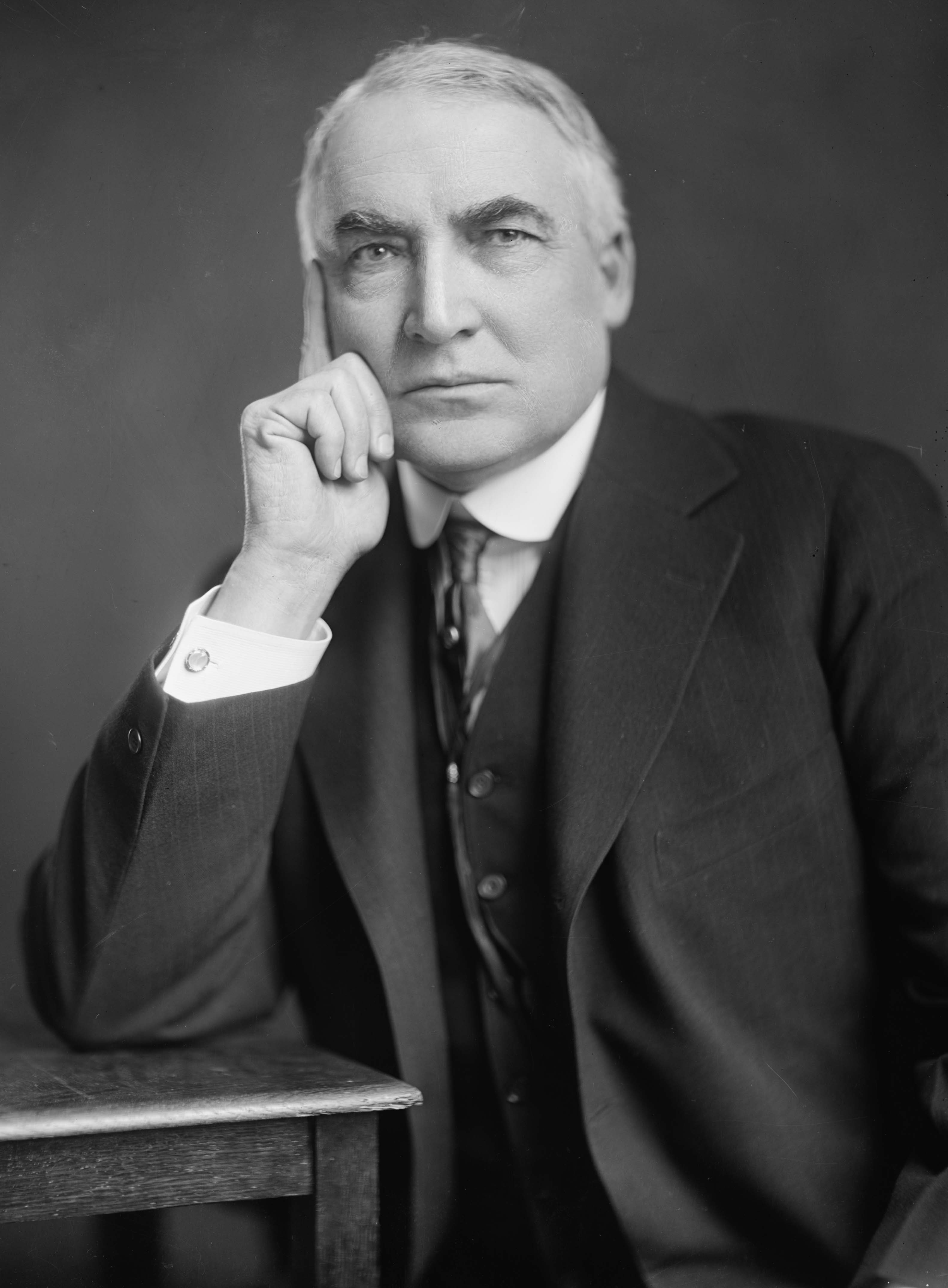
In the election of 1920 the people were fed up with the 8 years of Wilson’s tyrannical progressive policies. The Republican candidate Warren G. Harding defeated the Democratic ticket of James Cox and Franklin Roosevelt garnering 60% of the popular vote and an Electoral College margin of 404 to 127.

Former president Theodore Roosevelt had been the frontrunner for the441px-Warren_G_Harding-Harris_&_Ewing Republican nomination, but his health collapsed in 1918. He died in January 1919, leaving no obvious heir to his progressive legacy. As a result, both major parties ultimately turned to dark horse candidates from the electoral-vote-rich state of Ohio. To help his campaign, Cox chose future president Franklin D. Roosevelt (a fifth cousin of Theodore) as his running mate. Harding virtually ignored Cox and essentially campaigned against Wilson, calling for a return to "normalcy." With an almost 4-to-1 spending advantage, Harding won a landslide victory.

Harding's promise was to return the United States to pre-world war mentality; without the thought of war tainting the minds of the American people. During the campaign he stated:

"America’s present need is not heroics, but healing; not nostrums, but normalcy; not revolution, but restoration; not agitation, but adjustment; not surgery, but serenity; not the dramatic, but the dispassionate; not experiment, but equipoise; not submergence in internationality, but sustainment in triumphant nationality."

This election was the first since the ratification of the Nineteenth Amendment on August 18, 1920, and thus the first in which women had the right to vote in all 48 states (in the 1916 presidential election, about 30 states had permitted women to participate). As a result, the total popular vote increased dramatically, from 18.5 million in 1916 to 26.8 million in 1920. This election is also notable for being the first of three in which a sitting U.S. senator was elected president (the others were 1960 and 2008).

The election was dominated by the aftermath of World War I and a hostile response to certain policies of Woodrow Wilson, as well as the massive reaction against the reformist zeal of the Progressive Era. The wartime economic boom had collapsed. Politicians were arguing over peace treaties and the question of America's entry into the League of Nations, which was overturned because of the return to non-interventionist opinion, a continuation of the nation's opinion since the early 1800s. Overseas, there were wars and revolutions. At home, 1919 was marked by major strikes in the meatpacking and steel industries, and large-scale race riots in Chicago and other cities. Anarchist attacks on Wall Street produced fears of radicals and terrorists. The Irish Catholic and German communities were outraged at Wilson's foreign policy, and his political position was critically weakened after he suffered a severe stroke in 1919 that rendered him unable to speak on his own behalf.

Harding's Treasury Secretary, Andrew Mellon, ordered a study that claimed to demonstrate that as income tax rates were increased, money was driven underground or abroad. Mellon concluded that lower rates would increase tax revenues. Based on this advice, Harding cut taxes, starting in 1922. The top marginal rate was reduced annually in four stages from 73% in 1921 to 25% in 1925. Taxes were cut for lower incomes starting in 1923.

Revenues to the treasury increased substantially. Unemployment also continued to fall. Libertarian historian Thomas Woods contends that the tax cuts ended the Depression of 1920–1921 and were responsible for creating a decade-long expansion.

Although Harding’s administration was racked with scandals like Tea Pot Dome and crony appointments the nation entered into one of the greatest growth periods in our history. While Harding began to stem the rushing tide he did not reverse it. Upon his unexpected death on August 2, 1923 at the Palace Hotel in San Francisco his Vice President Calvin Coolidge was sworn in as President of the United States.

A Republican lawyer from Vermont, Coolidge worked his way up the ladder ofCalvin_Coolidge-Garo Massachusetts state politics, eventually becoming governor of that state. His conduct during the Boston Police Strike of 1919 thrust him into the national spotlight and gave him a reputation as a man of decisive action. Soon after, he was elected as the 29th Vice President in 1920 and succeeded to the Presidency upon the sudden death of Warren G. Harding in 1923. Elected in his own right in 1924, he gained a reputation as a small-government conservative, and also as a man who said very little.

Coolidge restored public confidence in the White House after the scandals of his predecessor's administration, and left office with considerable popularity. As a Coolidge biographer put it, "He embodied the spirit and hopes of the middle class, could interpret their longings and express their opinions. That he did represent the genius of the average is the most convincing proof of his strength." Some later criticized Coolidge as part of a general criticism of laissez-faire government. His reputation underwent a renaissance during the Ronald Reagan Administration, but the ultimate assessment of his presidency is still divided between those who approve of his reduction of the size of government programs and Progressives who believe the federal government should be more involved in regulating and controlling the economy.

In the election of 1924 Coolidge was returned to the White House by a margin of 54% of the popular vote and an Electoral College margin of 382 to 138 over his Democratic opponent John Davis carrying 35 states to Davis’ 12.

During Coolidge's presidency the United States experienced the period of rapid economic growth known as the "Roaring Twenties". He left the administration's industrial policy in the hands of his activist Secretary of Commerce, Herbert Hoover, who energetically used government auspices to promote business efficiency and develop airlines and radio. With the exception of favoring increased tariffs, Coolidge disdained regulation, and carried about this belief by appointing commissioners to the Federal Trade Commission and the Interstate Commerce Commission who did little to restrict the activities of businesses under their jurisdiction — the regulatory state under Coolidge was, as one biographer described it, "thin to the point of invisibility."

Although not an isolationist, Coolidge was reluctant to enter into foreign alliances. Coolidge saw the landslide Republican victory of 1920 as a rejection of the Wilsonian idea that the United States should join the League of Nations. While not completely opposed to the idea, Coolidge believed the League, as then constituted, did not serve American interests, and he did not advocate membership in it. He spoke in favor of the United States joining the Permanent Court of International Justice, provided that the nation would not be bound by advisory decisions. The Senate eventually approved joining the Court (with reservations) in 1926. The League of Nations accepted the reservations, but it suggested some modifications of their own. The Senate failed to act; the United States never joined the World Court.

Coolidge's economic policy has often been misquoted as "generally speaking, the business of the American people is business". Some have criticized Coolidge as an adherent of the laissez-faire ideology, which they claim led to the Great Depression. On the other hand, other historians offer some context based on Coolidge's sense of federalism: As Governor of Massachusetts, Coolidge supported wages and hours legislation, opposed child labor, imposed economic controls during World War I, favored safety measures in factories, and even worker representation on corporate boards. Did he support these measures while president? No, because in the 1920s, such matters were considered the responsibilities of state and local governments. Amity Shlaes writes in Hillsdale College’s February edition of Imprimis:

“Finally, a lesson about politics. The popularity of Harding and Coolidge, and the success of their policies—especially Coolidge’s—following a long period of Progressive ascendancy, should give today’s conservatives hope. Coolidge in the 1920s, like Grover Cleveland in the previous century, distinguished government austerity from private-sector austerity, combined a policy of deficit cuts with one of tax cuts, and made a moral case for saying “no.” A political leader who does the same today is likely to find an electorate more inclined to respond “yes” than he or she expects.”

Coolidge rejected running again in 1928 as he believed he had been in the White House long enough and the people were growing tired of him He reluctantly supported Herbert Hoover at the Republican Convention, a man he really did not care for. On one occasion he remarked that "for six years that man has given me unsolicited advice—all of it bad." Even so, Coolidge had no desire to split the party by publicly opposing the popular commerce secretary's nomination.

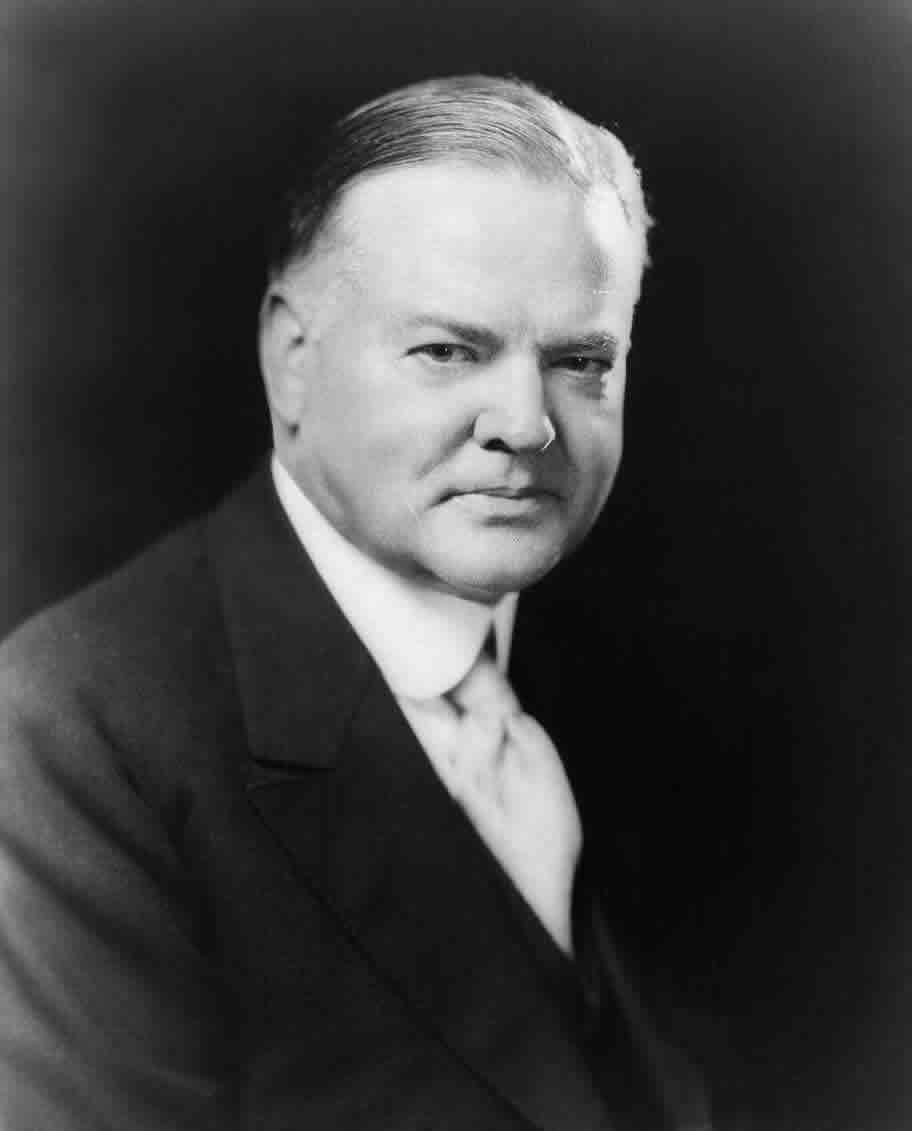
With the majority of Americans satisfied with Coolidge’s domestic and foreign policies and the good economy Hoover won by a landslide over his Democratic opponent Al Smith, the Governor of New York, with 58% of the popular vote and a margin in the Electoral College of 444 to 87 carrying 40 states.

Hoover entered office with a plan to reform the nation's regulatory system,HerbertHoover believing that a federal bureaucracy should have limited regulation over a country's economic system. A self-described progressive and reformer, Hoover saw the presidency as a vehicle for improving the conditions of all Americans by encouraging public-private cooperation — what he termed "volunteerism". Hoover saw volunteerism as preferable to governmental coercion or intervention which he saw as opposed to the American ideals of individualism and self-reliance. Long before he had entered politics, he had denounced laissez-faire thinking.

October 22, 1928 Hoover gave his famous Rugged Individualism speech where he stated:

“Bureaucracy is ever desirous of spreading its influence and its power. You cannot give to a government the mastery of the daily working life of a people without at the same time giving it mastery of the peoples’ souls and thoughts. Every expansion of government means that government in order to protect itself from political consequences of its errors and wrongs is driven onward and onward without peace to greater and greater control of the country’s press and platform. Free speech does not live many hours after free industry and free commerce die.

It is false liberalism that interprets itself into the Government operation of business. The bureaucratization of our country would poison the very roots of liberalism that is free speech, free assembly, free press, political equality and equality of opportunity. It is the road, not to more liberty, but to less liberty. Liberalism should be found not striving to spread bureaucracy, but striving to set bounds to it. True liberalism seeks freedom first in the confident belief that without freedom the pursuit of all other blessings and benefits is vain. That belief is the foundation of all American progress, political as well as economic. Liberalism is a force truly of the spirit, a force proceeding from the deep realization that economic freedom cannot be sacrificed if political freedom is to be preserved. Even if governmental conduct of business could give us more efficiency instead of giving us decreased efficiency, the fundamental objection to it would remain unaltered and unabated. It would destroy political equality. It would cramp and cripple mental and spiritual energies of our people. It would dry up the spirit of liberty and progress. It would extinguish equality of opportunity, and for these reasons fundamentally and primarily it must be resisted. For a hundred and fifty years liberalism has found its true spirit in the American system, not in the European systems.

I wish to say something more on what I believe is the outstanding ideal in our whole political, economic and social system -- that is equality of opportunity. We have carried this ideal farther into our life than has any other nation in the world. Equality of opportunity is the right of every American, rich or poor, foreign or native born, without respect to race or faith or color, to attain that position in life to which his ability and character entitle him. We must carry this ideal further than to economic and political fields alone. The first steps to equality of opportunity are that there should be no child in America that has not been born and does not live under sound conditions of health, that does not have full opportunity for education from the beginning to the end of our institutions, that is not free from injurious labor, that does not have stimulation to accomplish to the fullest of its capacities.

It is a matter for concern to our Government that we shall strengthen the safeguards to health, that we shall strengthen the bureaus given to research, that we shall strengthen our educational system at every point, that we shall develop cooperation by our Federal Government with state governments and with the voluntary bodies of the country that we may bring not only better understanding but action in these matters.

Furthermore, equality of opportunity in my vision requires an equal opportunity to the people in every section of our country. In these past few years some groups in our country have lagged behind others in the march of progress. They have not had the same opportunity. I refer more particularly to those engaged in the textile, coal and in the agricultural industries. We can assist in solving these problems by cooperation of our Government. To the agricultural industry we shall need advance initial capital to assist them, to stabilize and conduct their own industry. But this proposal is that they shall conduct it themselves, not by the Government. It is in the interest of our cities that we shall bring agriculture into full stability and prosperity. I know you will cooperate gladly in the faith that in the common prosperity of our country lies its future.”

As you can by reading Hoover’s words while touting rugged individualism he was actually expressing progressive ideas of government intervention into the lives and economy of the America.

Prior to the start of the Great Depression, Hoover's first Treasury Secretary, Andrew Mellon, had proposed and seen enacted, numerous tax cuts, which cut the top income tax rate from 73% to 24%. When combined with the sharp decline in incomes during the early depression, the result was a serious deficit in the federal budget. Congress, desperate to increase federal revenue, enacted the Revenue Act of 1932, which was the largest peacetime tax increase in history. The Act increased taxes across the board, so that top earners were taxed at 63% on their net income. The 1932 Act also increased the tax on the net income of corporations from 12% to 13.75%.

The final attempt of the Hoover Administration to rescue the economy occurred in 1932 with the passage of the Emergency Relief and Construction Act, which authorized funds for public works programs and the creation of the Reconstruction Finance Corporation (RFC). The RFC's initial goal was to provide government-secured loans to financial institutions, railroads and farmers. The RFC had minimal impact at the time, but was adopted by President Franklin D. Roosevelt and greatly expanded as part of his New Deal. These programs were the first “bail outs” of private industries by government and increased the national debt from 20% of GDP to 40% not unlike what is happening today under Obama.

To pay for these and other government programs and to make up for revenue lost due to the Depression, in addition to the Revenue Act of 1932 Hoover agreed to roll back several tax cuts that his Administration had enacted on upper incomes. The estate tax was doubled and corporate taxes were raised by almost 15%. Also, a "check tax" was included that placed a 2-cent tax (over 30 cents in today's economy) on all bank checks. Hoover also encouraged Congress to investigate the New York Stock Exchange, and this pressure resulted in various reforms. All of these measures did little or nothing to mitigate the effects of the Depression.

For this reason, years later, libertarians argued that Hoover's economics were statist. Franklin D. Roosevelt blasted the Republican incumbent for spending and taxing too much, increasing national debt, raising tariffs, and blocking trade, as well as placing millions on the government dole. Roosevelt attacked Hoover for "reckless and extravagant" spending, of thinking "that we ought to center control of everything in Washington as rapidly as possible." Roosevelt's running mate, John Nance Garner, accused the Republican of "leading the country down the path of socialism".

Even so, New Dealer Rexford Tugwell later remarked that although no one would say so at the time, "practically the whole New Deal was extrapolated from programs that Hoover started."

Although Hoover had come to detest the presidency, he agreed to run again in 1932, not only as a matter of pride, but also because he feared that no other likely Republican candidate would deal with the depression without resorting to what Hoover considered dangerously radical measures.

Hoover was nominated by the Republicans for a second term. He had originally planned to make only one or two major speeches, and to leave the rest of the campaigning to proxies, but when polls showed the entire Republican ticket facing a resounding defeat at the polls, Hoover agreed to an expanded schedule of public addresses. In his nine major radio addresses Hoover primarily defended his administration and his philosophy. The apologetic approach did not allow Hoover to refute Democratic nominee Franklin Roosevelt's charge that he was personally responsible for the depression.

In his campaign trips around the country, Hoover was faced with perhaps the most hostile crowds of any sitting president. Besides having his train and motorcades pelted with eggs and rotten fruit, he was often heckled while speaking, and on several occasions, the Secret Service halted attempts to kill Hoover by disgruntled citizens, including capturing one man nearing Hoover carrying sticks of dynamite, and another already having removed several spikes from the rails in front of the President's train.

The election of 1932 was a disaster for the Republican Party. Franklin Roosevelt and his running mate John Nance Garner defeated Hoover by a margin of 57% to 40% in the popular vote and 472 to 59 in the Electoral College. Hoover carried only 6 states to FDR’s 42. The voters also gave Roosevelt a Democrat controlled House and Senate — a condition that would last until the end of WWII. Roosevelt had near dictatorial powers and he would use them.

Roosevelt's "First 100 Days" concentrated on the first part of his strategy:FDR_in_1933 immediate relief. From March 9 to June 16, 1933, he sent Congress a record number of bills, all of which passed easily. To propose programs, Roosevelt relied on leading Senators such as George Norris, Robert F. Wagner and Hugo Black, as well as his Brain Trust of academic advisers. Like Hoover, he saw the Depression caused in part by people no longer spending or investing because they were afraid. Roosevelt believed he could cure these ills with increased federal spending, higher taxes and the police power of the federal government. As for the Constitution it was just a bothersome document that was getting in the way of the masterminds of his “Brain Trust.”

Relief measures included the continuation of Hoover's major relief program for the unemployed under its new name: Federal Emergency Relief Administration. The most popular of all New Deal agencies — and Roosevelt's favorite — was the Civilian Conservation Corps (CCC), which hired 250,000 unemployed young men to work on rural local projects. While no doubt, as I have stated, the CCC provided valuable and needed public works it was still reducing unemployment by expanding government.

Congress also gave the Federal Trade Commission broad new regulatory powers and provided mortgage relief to millions of farmers and homeowners. Roosevelt expanded a Hoover agency, the Reconstruction Finance Corporation, making it a major source of financing for railroads and industry. Roosevelt made agricultural relief a high priority and set up the first Agricultural Adjustment Administration (AAA). The AAA tried to force higher prices for commodities by paying farmers to take land out of crops and to cut herds. While this seemed like a good policy at the time the unintended and tyrannical consequences were and still are severe (See Wickard v Filburn). It was a total revision of the Interstate Commerce Clause enumerated in Article I, Section 8 of the Constitution.

Reform of the economy was the goal of the National Industrial Recovery Act (NIRA) of 1933. It tried to end cutthroat competition by forcing industries to come up with codes that established the rules of operation for all firms within specific industries, such as minimum prices, agreements not to compete, and production restrictions. Industry leaders negotiated the codes which were then approved by NIRA officials. Industry needed to raise wages as a condition for approval. Provisions encouraged unions and suspended anti-trust laws. The NIRA was found to be unconstitutional by unanimous decision of the U.S. Supreme Court on May 27, 1935. (See Schechter Poultry Corp. vs. United States).In this decision the U.S. Supreme Court found that the NIRA invalidated regulations of the poultry industry according to the non-delegation doctrine and as an invalid use of Congress's power under the commerce clause. This was a unanimous decision that rendered the National Industrial Recovery Act, a main component of President Roosevelt's New Deal, unconstitutional.

Roosevelt opposed the decision, saying "The fundamental purposes and principles of the NIRA are sound. To abandon them is unthinkable. It would spell the return to industrial and labor chaos." The Judicial Procedures Reform Bill of 1937 was a legislative initiative proposed Roosevelt to add more justices to the U.S. Supreme Court. Roosevelt's purpose was to obtain favorable rulings regarding New Deal legislation that had been previously ruled unconstitutional. The central and most controversial provision of the bill would have granted the President power to appoint an additional Justice to the U.S. Supreme Court, up to a maximum of six, for every sitting member over the age of 70 years and 6 months. On March 29, the Supreme Court published its opinion upholding a Washington state minimum wage law in West Coast Hotel Co. v. Parrish by a 5–4 ruling, after Associate Justice Owen Roberts had joined with the wing of the bench more sympathetic to the New Deal. Since Roberts had previously ruled against most New Deal legislation, his perceived about-face was widely interpreted by contemporaries as an effort to maintain the Court's judicial independence by alleviating the political pressure to create a court friendlier to the New Deal. His move came to be known as "the switch in time that saved nine."

In 1937 the Supreme Court, with Robert’s concurrence, in the case of the National Labor Relations Board v. Jones & Laughlin Steel Corporation that declared that the National Labor Relations Act of 1935 (commonly known as the Wagner Act) was constitutional by a 5-4 decision. This decision reversed the interpretation of the Commerce Clause enumerated in Article I, Section 8 and it effectively spelled the end to the Court's striking down of New Deal economic legislation, and greatly increased Congress's power under the Commerce Clause. The act established the federal rights of workers to organize unions, to engage in collective bargaining, and to take part in strikes — the unintended consequences of this are enormous today. Roosevelt’s threat to pack the Court had succeeded and now his power was unlimited as farmer Filburn would discover in 1942. The Progressives had won a major victory that is still with us when it comes to the Court. It is an odd coincidence that it was Justice Owen Roberts who flip-flopped on the Roosevelt’s New Deal programs and it was Justice John Roberts who went out of his way to find enough whole cloth to declare ObamaCare as a tax and Constitutional. Beware of any judge with the last name of Roberts.

In 1933, major new banking regulations were passed. In 1934, the Securities and Exchange Commission was created to regulate Wall Street.

Recovery was pursued through "pump-priming" (that is, federal spending — also called stimulus). The NIRA included $3.3 billion of spending through the Public Works Administration to stimulate the economy, which was to be handled by Interior Secretary Harold Ickes. Roosevelt worked with Republican Senator George Norris to create the largest government-owned industrial enterprise in American history — the Tennessee Valley Authority (TVA) — which built dams and power stations, controlled floods, and modernized agriculture and home conditions in the poverty-stricken Tennessee Valley. It could also be considered one of the greatest overreaches of federal power in the history of the United States something Grover Cleveland or Calvin Coolidge would never have sanctioned. The TVA's service area covers most of Tennessee, portions of Alabama, Mississippi, and Kentucky, and small slices of Georgia, North Carolina, and Virginia. It was the first large regional planning agency of the federal government and remains the largest. The development of TVA was probably in violation of not only Article I, Section 8, but also of the 5th and 10th Amendments. It put the U.S. government squarely in the public utilities business something our Founders had no intention of doing. TVA, like education, demonstrates what the corrosive power of federal dollars (taxpayer’s money) can accomplish.

Executive Order 6102 declared that all privately held gold of American citizens was to be sold to the U.S. Treasury and the price raised from $20 to $35 per ounce. Exceptions were made for jewelers, coin collectors and a few others. The goal was to counter the deflation which was paralyzing the economy.

Roosevelt tried to keep his campaign promise by cutting the federal budget — including a reduction in military spending from $752 million in 1932 to $531 million in 1934 and a 40% cuts in spending on veterans' benefits — by removing 500,000 veterans and widows from the pension rolls and reducing benefits for the remainder, as well as cutting the salaries of federal employees and reducing spending on research and education. However, this was soon seen to be a mistake and most benefits were restored or increased by 1934. These benefit cuts also did not last. In June 1933 Roosevelt restored $50 million in pension payments, and Congress added another $46 million more. Veterans groups like the American Legion and the Veterans of Foreign Wars won their campaign to transform their benefits from payments due in 1945 to immediate cash when Congress overrode the President's veto and passed the Bonus Act in January 1936.

Roosevelt also kept his promise to push for repeal of Prohibition. On March 23, 1933, he signed the Cullen–Harrison Act redefining 3.2% alcohol as the maximum allowed. That act was preceded by Congressional action in the drafting and passage of the 21st Amendment, which was ratified later that year. The repeal of prohibition also brought in new tax revenues and helped Roosevelt keep a major campaign promise.

All of Roosevelt’s New Deal programs, while adding to the power and size of the federal government, did little to reduce unemployment or rejuvenate the private sector economy. The average unemployment rates during the depression were:

  • 1929: 3.2%
  • 1930: 8.9%
  • 1931: 16.3%
  • 1932: 24.1%
  • 1933: 24.9%
  • 1934: 21.7%
  • 1935: 20.1%
  • 1936: 16.9%
  • 1937: 14.3%
  • 1938: 19.0%
  • 1939: 17.2%3

Full employment (below 5%) did not return until the war years of the early 1940s. (Click here for a timeline of the Great Depression.)

The shining star in the early years of the Roosevelt Administration was the passage of the Social Security Act in 1935. The Social Security Act was drafted during Franklin Delano Roosevelt's first term by the President's Committee on Economic Security, under Frances Perkins, and passed by Congress as part of the Second New Deal. The act was an attempt to limit what were seen as dangers in the modern American life, including old age, poverty, unemployment, and the burdens of widows and fatherless children. By signing this act on August 14, 1935, President Roosevelt became the first president to advocate federal assistance for the elderly. It was also the beginning of federal entitlements and the largest Ponzi scheme in the history of the world where one generation would pay for the retirement of the preceding generation.

While considered by many to be unconstitutional in 1937 the Supreme Court upheld the Social Security Act in Helvering v. Davis as constitutional by deeming it a tax, not an entitlement. The Court held that Social Security was constitutionally permissible as an exercise of the federal power to spend for the general welfare, and did not contravene the 10th Amendment. The Court defended the constitutionality of the Social Security Act of 1935, requiring only that welfare spending be for the common benefit as distinguished from some mere local purpose. It affirmed a District Court decree that held that the tax upon employees was not properly at issue, and that the tax upon employers was constitutional.

In writing for the majority Justice Benjamin N. Cardozo stated that this decision supported the right of the Congress to interpret the "general welfare" clause in the U.S. Constitution. Cardozo stated:

"Congress may spend money in aid of the 'general welfare'. There have been great statesmen in our history who have stood for other views. The line must still be drawn between one welfare and another, between particular and general. Where this shall be placed cannot be known through a formula in advance of the event. The discretion belongs to Congress, unless the choice is clearly wrong, a display of arbitrary power, not an exercise of judgment. This is now familiar law."

In 2008 50,898,244 out of a population of 310 million were receiving Social Security checks (16% of the population) amounting to $615,344,000,000 dollars. This number is growing exponentially as we are running out of people to pay for it.

On September 23, 1932, during his campaign for the presidency, Roosevelt gave an address to the Commonwealth Club in San Francisco where he laid out his progressive ideology:

“As I see it, the task of Government in its relation to business is to assist the development of an economic declaration of rights, an economic constitutional order. This is the common task of statesman and business man. It is the minimum requirement of a more permanently safe order of things.

The Declaration of Independence discusses the problem of Government in terms of a contract. Government is a relation of give and take, a contract, perforce, if we would follow the thinking out of which it grew. Under such a contract rulers were accorded power, and the people consented to that power on consideration that they be accorded certain rights. The task of statesmanship has always been the re-definition of these rights in terms of a changing and growing social order. New conditions impose new requirements upon Government and those who conduct Government.

Every man has a right to his own property; which means a right to be assured, to the fullest extent attainable, in the safety of his savings. By no other means can men carry the burdens of those parts of life which, in the nature of things, afford no chance of labor; childhood, sickness, old age. In all thought of property, this right is paramount; all other property rights must yield to it. If, in accord with this principle, we must restrict the operations of the speculator, the manipulator, even the financier, I believe we must accept the restriction as needful, not to hamper individualism but to protect it.

The final term of the high contract was for liberty and the pursuit of happiness. We have learned a great deal of both in the past century. We know that individual liberty and individual happiness mean nothing unless both are ordered in the sense that one man’s meat is not another man’s poison. We know that the old "rights of personal competency," the right to read, to think, to speak, to choose and live a mode of life, must be respected at all hazards. We know that liberty to do anything which deprives others of those elemental rights is outside the protection of any compact; and that Government in this regard is the maintenance of a balance, within which every individual may have a place if he will take it; in which every individual may find safety if he wishes it; in which every individual may attain such power as his ability permits, consistent with his assuming the accompanying responsibility.

Faith in America, faith in our tradition of personal responsibility, faith in our institutions, faith in ourselves demand that we recognize the new terms of the old social contract. We shall fulfill them, as we fulfilled the obligation of the apparent Utopia which Jefferson imagined for us in 1776, and which Jefferson, Roosevelt and Wilson sought to bring to realization. We must do so, lest a rising tide of misery, engendered by our common failure, engulf us all. But failure is not an American habit; and in the strength of great hope we must all shoulder our common load.”

The final act of the progressive Roosevelt was the issuance of Executive Order 9066 interning over 100,000 innocent Japanese-Americans in “relocation camps” in violation of the 5th and 6th Amendments to the Constitution.

On November 10, 1937, Henry Morgenthau, U.S. Secretary of the Treasury during the administration of Franklin D. Roosevelt, gave a speech to the Academy of Political Science at New York's Hotel Astor, in which he noted that the Depression had required deficit spending, but that the government needed to cut spending to revive the economy. In his speech, he said:

"We want to see private business expand. We believe that one of the most important ways of achieving these ends at this time is to continue progress toward a balance of the federal budget.

We have tried spending money. We are spending more than we have ever spent before and it does not work. And I have just one interest, and if I am wrong somebody else can have my job. I want to see this country prosperous. I want to see people get a job. I want to see people get enough to eat. We have never made good on our promises. I say after eight years of this Administration we have just as much unemployment as when we started and an enormous debt to boot."

This was Roosevelt’s legacy of progressivism. The Great Depression was the war the progressives were looking for.