Search This Blog

Showing posts with label Land Ownership. Show all posts

Tuesday, April 24, 2012

The Largest Land Rush In History

The rights of persons, and the rights of property, are the objects, for the protection of which Government was instituted. — James Madison

On April 22, 1889 the largest land give-away in history began. At precisely high noon, thousands of would-be settlers make a mad dash into the newly opened Oklahoma Territory to claim cheap land.

The nearly two million acres of land opened up to white settlement was located in Indian Territory, a large area that once encompassed much of modern-day Oklahoma. Initially considered unsuitable for white colonization, Indian Territory was thought to be an ideal place to relocate Native Americans who were removed from their traditional lands to make way for white settlement. The relocations began in 1817, and by the 1880s, Indian Territory was a new home to a variety of tribes, including the Chickasaw, Choctaw, Cherokee, Creek, Cheyenne, Comanche, and Apache.

By the 1890s, improved agricultural and ranching techniques led some white Americans to realize that the Indian Territory land could be valuable, and they pressured the U.S. government to allow white settlement in the region. In 1889, President Benjamin Harrison agreed, making the first of a long series of authorizations that eventually removed most of Indian Territory from Indian control.

To begin the process of white settlement, Harrison chose to open a 1.9 million-acre section of Indian Territory that the government had never assigned to any specific tribe. However, subsequent openings of sections that were designated to specific tribes were achieved primarily through the Dawes Severalty Act (1887), which allowed whites to settle large swaths of land that had previously been designated to specific Indian tribes.

On March 3, 1889, Harrison announced the government would open the 1.9 million-acre tract of Indian Territory for settlement precisely at noon on April 22. Anyone could join the race for the land, but no one was supposed to jump the gun. With only seven weeks to prepare, land-hungry Americans quickly began to gather around the borders of the irregular rectangle of territory. Referred to as "Boomers," by the appointed day more than 50,000 hopefuls were living in tent cities on all four sides of the territory.

The events that day at Fort Reno on the western border were typical. AtOklahome Land Rush 11:50 a.m., soldiers called for everyone to form a line. When the hands of the clock reached noon, the cannon of the fort boomed, and the soldiers signaled the settlers to start. With the crack of hundreds of whips, thousands of Boomers streamed into the territory in wagons, on horseback, and on foot. All told, from 50,000 to 60,000 settlers entered the territory that day. By nightfall, they had staked thousands of claims either on town lots or quarter section farm plots. Towns like Norman, Oklahoma City, Kingfisher, and Guthrie sprang into being almost overnight.

An extraordinary display of both the pioneer spirit and the American lust for land, the first Oklahoma land rush was also plagued by greed and fraud. Cases involving "Sooners" — people who had entered the territory before the legal date and time— overloaded courts for years to come. The government attempted to operate subsequent runs with more controls, eventually adopting a lottery system to designate claims. By 1905, white Americans owned most of the land in Indian Territory. Two years later, the area once known as Indian Territory entered the Union as a part of the new state of Oklahoma.

The Oklahoma Land Rush of 1889 was the first land run into the Unassigned Lands and included all or part of the 2005 modern day Canadian, Cleveland, Kingfisher, Logan, Oklahoma, and Payne counties of the U.S. state of Oklahoma. The land run started at high noon on April 22, 1889, with an estimated 50,000 people lined up for their piece of the available two million acres.

The Unassigned Lands were considered some of the best unoccupied public land in the United States. The Indian Appropriations Bill of 1889 was passed and signed into law with an amendment by Illinois Representative William McKendree Springer, that authorized President Benjamin Harrison to open the two million acres for settlement. Due to the Homestead Act of 1862, signed by President Abraham Lincoln, legal settlers could claim lots up to 160 acres (1/4 of a Section) in size. Provided a settler lived on the land and improved it, the settler could then receive the title to the land.

After years of trying to open Indian Territory, President Grover Cleveland, on March 2, 1889, signed the 1889 Act which officially opened the Unassigned Lands to white settlers via homestead. On a side note, Grover Cleveland signed the Act into law days before his successor, Benjamin Harrison, took over as President of the United States. However, under a section in this original act, those who entered these unassigned lands illegally, before their respective racing times as designated in the President’s opening proclamation, would be denied the rights to the lands they claimed. These people were termed "Sooners,” with this section of the act being termed as the "sooner clause.” But there was growing political pressure to open these unassigned lands to settlement quickly. Thus, later in 1889, an amendment to the Indian Appropriations Act allowed President Benjamin Harrison to be involved in this historical bill as well, proclaiming unassigned lands were open for settlement under much less stringent rules.

The opening to settlement of a choice portion of Indian Territory in OklahomaOklahome Land Rush Map set off one of the most bizarre and chaotic episodes of town founding in world history. A railroad line crossed the territory, and water towers and other requirements for steam rail operation were located at intervals along the tracks that connected Arkansas and Texas. Two places — Oklahoma Station and Guthrie Station — seemed particularly well located for eventual urban development. In the months before the territory was opened, individuals and groups representing town site companies scouted these locations and prepared town plans for these sites.

Congress had failed to provide for any form of civil government. Although the area had been surveyed into the standard system of 6-mile square townships and mile-square sections of 640 acres each, no sites for towns had been designated let alone laid out in streets and lots. The rules simply provided that at noon on April 22 persons gathered at the Arkansas or Texas borders would be permitted to enter, seek a parcel of unclaimed land, and file a claim of ownership in accordance with the applicable Federal laws governing the disposal of the public domain. Federal marshals, railroad personnel, and other persons lawfully in the territory before the opening ("legal sooners") were prohibited from filing land claims — a provision that was more violated than observed.

On May 18, 1889 a William Willard Howard wrote for Harper’s Weekly:

“In some respects the recent settlement of Oklahoma was the most remarkable thing of the present century. Unlike Rome, the city of Guthrie was built in a day. To be strictly accurate in the matter, it might be said that it was built in an afternoon. At twelve o'clock on Monday, April 22d, the resident population of Guthrie was nothing; before sundown it was at least ten thousand. In that time streets had been laid out, town lots staked off, and steps taken toward the formation of a municipal government. At twilight the camp-fires of ten thousand people gleamed on the grassy slopes of the Cimarron Valley, where, the night before, the coyote, the gray wolf, and the deer had roamed undisturbed. Never before in the history of the West has so large a number of people been concentrated in one place in so short a time. To the conservative Eastern man, who is wont to see cities grow by decades, the settlement of Guthrie was magical beyond belief; to the quick-acting resident of the West, it was merely a particularly lively town-site speculation.

The preparations for the settlement of Oklahoma had been complete, even to the slightest detail, for weeks before the opening day. The Santa Fe Railway, which runs through Oklahoma north and south, was prepared to take any number of people from its handsome station at Arkansas City, Kansas, and to deposit them in almost any part of Oklahoma as soon as the law allowed; thousands of covered wagons were gathered in camps on all sides of the new Territory waiting for the embargo to be lifted. In its picturesque aspects the rush across the border at noon on the opening day must go down in history as one of the most noteworthy events of Western civilization. At the time fixed, thousands of hungry home-seekers, who had gathered from all parts of the country, and particularly from Kansas and Missouri, were arranged in line along the border, ready to lash their horses into furious speed in the race for fertile spots in the beautiful land before them. The day was one of perfect peace. Overhead the sun shown down from a sky as fair and blue as the cloudless heights of Colorado. The whole expanse of space from zenith to horizon was spotless in its blue purity. The clear spring air, through which the rolling green billows of the promised land could be seen with unusual distinctness for many miles, was as sweet and fresh as the balmy atmosphere of June among New Hampshire's hills.

As the expectant home-seekers waited with restless patience, the clear, sweet notes of a cavalry bugle rose and hung a moment upon the startled air. It was noon. The last barrier of savagery in the United States was broken down. Moved by the same impulse, each driver lashed his horses furiously; each rider dug his spurs into his willing steed, and each man on foot caught his breath hard and darted forward. A cloud of dust rose where the home-seekers had stood in line, and when it had drifted away before the gentle breeze, the horses and wagons and men were tearing across the open country like fiends. The horsemen had the best of it from the start. It was a fine race for a few minutes, but soon the riders began to spread out like a fan, and by the time they had reached the horizon they were scattered about as far as eye could see. Even the fleetest of the horsemen found upon reaching their chosen localities that men in wagons and men on foot were there before them. As it was clearly impossible for a man on foot to outrun a horseman, the inference is plain that Oklahoma had been entered hours before the appointed time. Notwithstanding the assertions of the soldiers that every boomer had been driven out of Oklahoma, the fact remains that the woods along the streams within Oklahoma were literally full of people Sunday night. Nine-tenths of these people made settlement upon the land illegally. The other tenth would have done so had there been any desirable land left to settle upon. This action on the part of the first claim-holders will cause a great deal of land litigation in the future, as it is not to be expected that the man who ran his horse at its utmost speed for ten miles only to find a settler with an ox team in quiet possession of his chosen farm will tamely submit to this plain infringement of the law.

Some of the men who started from the line on foot were quite as successful in securing desirable claims as many who rode fleet horses. They had the advantage of knowing just where their land was located. One man left the line with the others, carrying on his back a tent, a blanket, some camp dishes, an axe, and provisions for two days. He ran down the railway track for six miles, and reached his claim in just sixty minutes. Upon arriving on his land he fell down under a tree, unable to speak or see. I am glad to be able to say that his claim is one of the best in Oklahoma. The rush from the line was so impetuous that by the time the first railway train arrived from the north at twenty-five minutes past twelve o'clock, only a few of the hundreds of boomers were anywhere to be seen. The journey of this first train was well-nigh as interesting as the rush of the men in wagons. The train left Arkansas City at 8:45 o'clock in the forenoon. It consisted of an empty baggage car, which was set apart for the use of newspaper correspondents, eight passenger coaches, and the caboose of a freight train. The coaches were so densely packed with men that not another human being could get on board. So uncomfortably crowded were they that some of the younger boomers climbed to the roofs of the cars and clung perilously to the ventilators. An adventurous person secured at great risk a seat on the forward truck of the baggage car.

In this way the train was loaded to its utmost capacity. That no one was killed or injured was due as much to the careful management of the train as to the ability of the passengers to take care of themselves. Like their friends in the wagons, the boomers on the cars were exultant with joy at the thought of at last entering into possession of the promised land. At first appearances of the land through which the train ran seemed to justify all the virtues that had been claimed for it. The rolling, grassy uplands, and the wooded river-bottoms, the trees in which were just bursting into the most beautiful foliage of early spring, seemed to give a close reality of the distant charm of green and purple forest growths, which rose from the trough of some long swell and went having away to meet the brighter hues in the far-off sky. Throughout all the landscape were clumps of trees suggesting apple orchards set in fertile meadows, and here and there were dim patches of gray and white sand that might in a less barbarous region be mistaken for farm-houses surrounded by hedges and green fields. Truly the Indians have well-named Oklahoma the "beautiful land." The landless and home-hungry people on the train might be pardoned their mental exhilaration, when the effect of this wonderfully beautiful country upon the most prosaic mind is considered. It was an eager and an exuberantly joyful crowd that rode slowly into Guthrie at twenty minutes past one o'clock on that perfect April afternoon. Men who had expected to lay out the town site were grievously disappointed at the first glimpse of their proposed scene of operations. The slope east of the railway at Guthrie station was dotted white with tents and sprinkled thick with men running about in all directions.”

Over the years there has been much debate and criticism of this legal land grab. There are those who say that this land grab took from the Native Indians land that had been promised them under several treaties. But, the fact remains that it opened vast tracts of free land to many easterners who wanted to challenge nature to establish a homestead that they could call home — a homestead with legal fee title that would allow them to live, farm or do with as they pleased as long as they met the requirements of the Homestead Act.

In my blog What Separates The Rich From The Poor I point out that the most single contribution to the economic success in the United States was the ability for free men to possess land — land that was theirs under the color of title — land that could be passed on to their heirs or assignees at their will. No other nation in history has had such a policy to allow opportunity to its citizens.

Today Oklahoma is a vibrant state with industrious citizens. It has farming, ranching, and oil. Historic Route 66 passes through much of this Oklahoma land. As I write in my 17 part essay on Route 66 (parts Nine and Ten):

“On April 22, 1889, the unassigned lands of the area were opened up for settlement, which quickly became known as the “Great Oklahoma Land Run.” When the signal was given along the outer boundaries, the Fort Reno soldiers were assigned to keep order among the many rushing pioneers flooding the area.

No sooner was the land opened for settlement when the Rock Island Railroad began to build a line from Caldwell, Kansas to the south bank of the Canadian River. Near Fort Reno, a settlement had sprung up called Reno City, which quickly decided to relocate nearer the railroad. Buildings, pioneers and businesses wasted no time uprooting and moving the entire town which they called El Reno. In January, 1890, the first train arrived in the community, which quickly became a rail center for the productive wheat harvests of Canadian County. In March of 1890, El Reno was named the county seat.”

Over the ensuing years Oklahoma developed from a territory devoted to Native Indian lands to one of the most productive states in the union. Even the Dust Bowl years of the 1930’s could not stop the industrious and persevering citizens of Oklahoma. As I write in Part Four of my essay on Route 66:

“Dust Bowl conditions fomented an exodus of the displaced from Texas, Oklahoma, and the surrounding Great Plains to adjacent regions. More than 500,000 Americans were left homeless. 356 houses had to be torn down after one storm alone. Many Americans migrated west looking for work. Some residents of the Plains, especially in Kansas and Oklahoma fell ill and died of dust pneumonia or malnutrition.

The Dust Bowl exodus was the largest migration in American history within a short period of time. By 1940, 2.5 million people had moved out of the Plains states; of those, 200,000 moved to California. With their land barren and homes seized in foreclosure, many farm families were forced to leave. Migrants left farms in Oklahoma, Arkansas, Missouri, Iowa, Nebraska, Kansas, Texas, Colorado and New Mexico, but all were generally referred to as "Okies".

The Homestead Act was also responsible for much of the settlement of the Dakotas, Nebraska, Wyoming, Montana, and New Mexico. Today the federal government owns millions of acres of land. Perhaps we should consider another Oklahoma Land Grab for all of those who wish to leave the urban decay of our eastern cities and look for new opportunities and liberties under the blue skies of these fallow lands.

Tuesday, October 11, 2011

Day Ten of Our Lincoln Highway Road Trip

Today we were on the road by 07:00 to explore the historic Lincoln Highway through Pennsylvania. We had our map books organized and the main points of interest identified. It was fairly easy to follow the track of the Lincoln Highway as it mainly followed US 30 with exceptions where US 30 was realigned. The Pennsylvanian Department of Transpiration (PennDOT) has done a great job of marking the Lincoln Highway with highway shields.

The weather was not as great as it had been for the past nine days. The skies were overcast but bright. No blue skies until midafternoon. Traffic was heavy because it was a holiday today (Columbus Day)

Interruption! I had to quit as I lost the Internet connection and could not upload any photos.

I am resuming on Day Eleven so I will combine the two day.

Day Ten Resumed.

Our journey along the historic Lincoln Highway took us along US 30 through New Oxford and Gettysburg where we got some great photos. We had no problems following the route as it was marked well by PennDOT.

The day was one of those partially sunny days with a hazy sun andDSCN2502 sometimes breaks of blue. There were several murals painted on buildings and barns along the way and the autumn colors varied from town to town. There were some really neat colored trees along the country roads.

We stopped at a roadside fruit stand in St. Thomas, PA. They had some great farm grown tomatoes so I bought one and ate it on the spot. It was the best tomato I have had for years, ripened on the vine and fresh from the farm. Kathy bought some apples and gourds to take home to Gwen for decorating the house for Halloween and Thanksgiving.

About 2:00 pm we arrived at the memorial for United Flight 93. This is the new memorial that is still under construction and I did not care for it. First you have to take a bus to the actual memorial and then hike about a half a mile to the wall with the names of the victims. I felt this new memorial was too cold. The old memorial was constructed by people and had more passion and warmth connected to it. This memorial was designed and built by engineers and architects and it looked like they were more concerned with their achievements than the victims of the terrorists. Also there were not enough restrooms.

We spent about two hours at the memorial; most of the time spent hikingFXP_8912 back to the wall of names and then back to the bus stop. It was good exercise. Also, unless you are a family member you cannot walk out to the large rock that serves of a headstone for the mass grave of the victims. Perhaps in a few years when the National Park Service gets some more money it will be a better memorial — I hope so.

Day Eleven: Greensburg, PA to Mansfield, Ohio.

We started out again at 07:30 am along US 30 towards Pittsburg and the Ohio River. I decided to take the Interstate in order to avoid going through Pittsburg during the morning rush hour. Even using the Interstate the traffic was heavy and there were the usual orange barrels blocking lanes for construction. I don’t think they ever stop fixing the roads in Pennsylvania.

We crossed into a small portion of West Virginia where we got fuel and the visited the world’s largest tea pot at Chester, West Virginia. We then crossed of the Ohio River into the buckeye state and then made our way east along the river to the survey marker marking the boundary of Ohio and Pennsylvania and the beginning of Jefferson rectangular land scheme for the United States.

Once the Land Ordinance of 1785 was passed by Congress surveyors needed DSCN2661to establish the boundary of Pennsylvania and Ohio to implement the first seven ranges of the rectangular land scheme of townships and sections. This sectionalized land scheme, after being refined, became the basis of land in the United States, with the exception of the Mexican ranchos, west of this boundary marker. It was the basis for transferring land to soldiers in payment for their service in the revolutionary war, the homesteads of the mid-west, and building of the transcontinental railroad. It is also why the United States is the wealthiest land in the world. (See my article on “What Separates the Rich From the Poor.”) After practicing land surveying for 55 years I was quite excited to see the monument where the sectionalized land system began.

After leaving the boundary between Ohio and Pennsylvania we made our way west along US 30 and the Lincoln Highway. The Ohio Department of Transportation, like PennDOT, has done a great job of marking the historic Lincoln Highway. We meandered on and off US 30 to the old alignment of the Lincoln Highway and were able to locate one of the first test sections of the roadway. The test section was a one mile section of roadway where they engineers developed a standardized lane width and cross fall. This test section would be used as a standard for all subsequent constructions.

Abound noon we made it to Canton, Ohio and The Professional Football Hall of Fame. If you are a pro football fan this is a “must” visit. There are 267 busts of the hall of famers enshrined to this date. The exhibits are great and they tell the history of pro football from its founding days to the present. There are video displays, movies and of course a gift shop. The gift shop is great as you can buy everything from mouse pads and cups to jerseys of your favorite team.

We spent about two hours at the hall of fame and then got some lunch and visited the McKinley Memorial in Canton. Then it was time to head for Mansfield and our hotel. It was a great day with lots of fall colors and good Ohio scenery. Tomorrow we will travel through the remainder of Ohio and Indiana to Joliet, Illinois.

You can see all of my pictures by clicking here. Don’t forget to click the “Slideshow” button at the upper right to view the largest image.

Till Wednesday night.

Wednesday, May 11, 2011

This Day in History–May 11, 1934

On this day in 1934, a massive storm sends millions of tons of topsoil flying from across the parched Great Plains region of the United States as far east as New York, Boston and Atlanta.

At the time the Great Plains were settled in the mid-1800s, the land was covered by prairie grass, which held moisture in the earth and kept most of the soil from blowing away even during dry spells. By the early 20th century, however, farmers had plowed under much of the grass to create fields. The U.S. entry into World War I in 1917 caused a great need for wheat, and farms began to push their fields to the limit, plowing under more and more grassland with the newly invented tractor. The plowing continued after the war, when the introduction of even more powerful gasoline tractors sped up the process. During the 1920s, wheat production increased by 300 percent, causing a glut in the market by 1931.

That year, a severe drought spread across the region. As crops died, windimage381 began to carry dust from the over-plowed and over-grazed lands. The number of dust storms reported jumped from 14 in 1932 to 28 in 1933. The following year, the storms decreased in frequency but increased in intensity, culminating in the most severe storm yet in May 1934. Over a period of two days, high-level winds caught and carried some 350 million tons of silt all the way from the northern Great Plains to the eastern seaboard. According to The New York Times, dust "lodged itself in the eyes and throats of weeping and coughing New Yorkers," and even ships some 300 miles offshore saw dust collect on their decks.

The dust storms forced thousands of families from Texas, Arkansas, Oklahoma, Colorado, Kansas and New Mexico to uproot and migrate to California, where they were derisively known as "Okies"--no matter which state they were from. These transplants found life out West not much easier than what they had left, as work was scarce and pay meager during the worst years of the Great Depression.

Another massive storm on April 15, 1935--known as "Black Sunday"--brought even more attention to the desperate situation in the Great Plains region, which reporter Robert Geiger called the "Dust Bowl." That year, as part of its New Deal program, President Franklin D. Roosevelt's administration began to enforce federal regulation of farming methods, including crop rotation, grass-seeding and new plowing methods. This worked to a point, reducing dust storms by up to 65 percent, but only the end of the drought in the fall of 1939 would truly bring relief.

You can read more by clicking here

Thursday, April 28, 2011

Despite Obama’s Claim, the Poor are Not Getting Poorer

"Need is not demand. Effective economic demand requires not merely need but corresponding purchasing power." — Henry Hazlitt

An Article in the Daily Caller debunks Obama’s claim that the rich are getting richer and the poor are getting poorer. Caroline May reports; “In his mid-April speech on the budget deficit, President Obama echoed conventional wisdom when he cited the rich are getting richer and the poor are getting poorer as a reason to raise taxes on the wealthy in order to reduce the national debt.

Research, published at The Journal of Policy Analysis and Management, from Cornell economist Richard Burkhauser, Joint Committee on Taxation economist Jeff Larrimore, and Indiana University economist Kosali Simon, however, suggests that the president’s piece of conventional wisdom isn’t entirely accurate. According to the findings, while the rich have indeed been getting richer, for the last 30 years so too have the poor and middle class.”

“Burkhauser told The Daily Caller that Obama’s suggestion that the poor are getting poorer understates the amount of income to which Americans actually have access. The president does not take into account, Burkhauser explained, tax unit shifts, government transfers, and other sources of income such as health care benefits.”

“The bottom line is [conventional wisdom] asks what’s been happening to private personal income over time and they are right if you look at that for tax units, things do not look very good for the middle class,” he said. “But if you take other things into account, the reason the country has not gotten in a civil war is because things are not that bad. In fact everybody has done better.”

“Burkhauser’s research shows what has actually been happening to the lives of Americans over the last thirty years — not just counting the amount of money individuals made in the market, but the actual income that people get in their hands to spend.”

79-07-Income-Growth

“This isn’t a zero sum game, where one group wins at the expense of others,” Burkhauser said. “The growth in productivity of Americans in the top twenty percent of tax units increased the size of the economic pie sufficiently to register major gains across the entire distribution of after-tax income.”

No group in our nation is poorer than the Native Americans. I have driven through Indian reservations in Arizona and New Mexico and seen some of the most deplorable living conditions of any location in this nation. These reservations reminded me of some of poverty stricken areas I have seen in third world counties. There are broken down automobiles parked in front of dilapidated homes or trailers. The people look unhealthy and many suffer extreme obesity. Alcoholism is no doubt a major disease and unemployment reaches upwards of 50%. Education is second rate and most kids do not graduate from high school.

One thing you will notice when you enter a reservation are the signs warning you not to take photographs or video. The roads are marked with federal highway signs noting you are on an Indian reservation. It’s almost as if you are entering another country. In fact you are. It’s the nation of the Bureau of Indian Affairs.

I know when you read this you will ask, “what about the Native Americans who own the casinos?” I’m talking about those tribes that have casinos and resorts. Those Native Americans do not represent the majority of Indians living in his nation. They are the fortunate ones who live close enough to a big city where there is a demand for gaming facilities. The Native Americans I am talking about are the ones who are basically wards of the Federal Government living in squalor on government controlled reservations.

The BIA is an agency of the federal government of the United States within the US Department of the Interior. It is responsible for the administration and management of 55,700,000 acres of land held in trust by the United States for Native Americans in the United States, Native American Tribes and Alaska Natives. The Bureau of Indian Affairs is one of two Bureaus under the jurisdiction of the Assistant Secretary — Indian Affairs: the Bureau of Indian Affairs and the Bureau of Indian Education, which provides education services to approximately 48,000 Native Americans.

The BIA's responsibilities once included providing health care services to American Indians and Alaska Natives. In 1954, that function was legislatively transferred to the U.S. Department of Health, Education and Welfare, now known as the Department of Health and Human Services, where it has remained to this day as the Indian Health Service (IHS).

Why is this? It goes back to the whole process of herding Native Americans onto reservations and then having the federal government “take care of them.” They were never allowed to integrate into the American fabric and they depend on the largess of the federal government for their sustenance.

If you talk to bureaucrats in the Bureau of Indian Affairs you will hear that what we need is more taxpayer money to improve the lives of these impoverished people. In essence more welfare payments will make things better.

There is, however, one tribe of Native Americans that never fell under the control of the BIA. They are the Lumbees. In 1956, the United States Congress passed H.R. 4656, known as the Lumbee Act, which recognized the Lumbee as Native Americans. In consultation with the tribe as a condition of recognition, Congress at the same time excluded the Lumbee from receiving the federal services ordinarily provided to federally recognized tribes through the Bureau of Indian Affairs.

You might think this was injustice forced on his tribe of Native Americans If you think this you are mistaken. The Lumbees are not interested in federal control.

A few weeks ago John Stossel, of Fox News, had a segment of his program devoted to the Lumbee Tribe. Here is what Stossel wrote in Human Events on April 27, 2011; “The U.S. government has "helped" no group more than it has "helped" the American Indians. It stuns me when President Obama appears before Indian groups and says things like, "Few have been ignored by Washington for as long as Native Americans."

“Ignored? Are you kidding me? They should be so lucky. The government has made most Indian tribes wards of the state. Government manages their land, provides their health care, and pays for housing and child care. Twenty different departments and agencies have special "native American" programs. The result? Indians have the highest poverty rate, nearly 25 percent, and the lowest life expectancy of any group in America. Sixty-six percent are born to single mothers.”

“Nevertheless, Indian activists want more government "help.”

“It is intuitive to assume that, when people struggle, government "help" is the answer. The opposite is true. American groups who are helped the most, do the worst.”

“Consider the Lumbees of Robeson County, N.C. — a tribe not recognized as sovereign by the government and therefore ineligible for most of the "help" given other tribes. The Lumbees do much better than those recognized tribes.”

“Lumbees own their homes and succeed in business. They include real estate developer Jim Thomas, who used to own the Sacramento Kings, and Jack Lowery, who helped start the Cracker Barrel Restaurants. Lumbees started the first Indian-owned bank, which now has 12 branches. The Lumbees' wealth is not from casino money.”

“We don't have any casinos. We have 12 banks," says Ben Chavis, another successful Lumbee businessman. He also points out that Robeson County looks different from most Indian reservations.”

"There's mansions. They look like English manors. I can take you to one neighborhood where my people are from and show you nicer homes than the whole Sioux reservation."

“Despite this success, professional "victims" activists want Congress to make the Lumbees dependent — like other tribes. U.S. Rep. Mike McIntyre, D-N.C., has introduced the Lumbee Recognition Act, which would give the Lumbees the same "help" other tribes get — about $80 million a year. Some members of the tribe support the bill.”

“Of course they do. People like to freeload.”

“Lawyer Elizabeth Homer, who used to be the U.S. Interior Department's director of Indian land trusts, says the Lumbees ought to get federal recognition.”

"The Lumbees have been neglected and left out of the system, and have been petitioning for 100 years. ... They're entitled, by the way."

“People like Homer will never get it. Lumbees do well because they've divorced themselves from government handouts. Washington's neglect was a godsend.”

“Some Lumbees don't want the handout.”

"We shouldn't take it!" Chavis said. He says if federal money comes, members of his tribe "are going to become welfare cases. It's going to stifle creativity. On the reservations, they haven't trained to be capitalists. They've been trained to be communists."

“Tribal governments and the Bureau of Indian Affairs manage most Indian land. Indians compete to serve on tribal councils because they can give out the government's money. Instead of seeking to become entrepreneurs, members of tribes aspire to become bureaucrats.”

"You can help your girlfriend; you can help your girlfriend's mama. It's a great program!" Chavis said sarcastically.”

“Because a government trust controls most Indian property, individuals rarely build nice homes or businesses. No individual on the reservation owns the land. So they can't develop it," Chavis added. "Look at my tribe. We have title and deeds to our land. That's the secret. I raise cattle. I can do what I want to because it's my private property."

“I did a TV segment on the Lumbees that I included in a special called "Freeloaders." That won me the predictable vitriol. Apparently, I'm ignorant of history and a racist.”

“The criticism misses the point. Yes, many years ago white people stole the Indians' land and caused great misery. And yes, the government signed treaties with the tribes that make Indians "special." But that "specialness" has brought the Indians socialism. It's what keeps them dependent and poor.”

“On the other hand, because the U.S. government never signed a treaty with the Lumbees, they aren't so "special" in its eyes. That left them mostly free.”

“Freedom lets them prosper.”

As I watched Stossel’s show and saw the interviews I keep thinking of those reservations in Arizona and New Mexico. I also thought of the third world and developing nations, especially in Central and South America that I have seen or worked in. These nations also are socialistic in nature. People look to the government to relieve them of poverty and provide jobs and education. This is what got Hugo Chavez elected in Venezuela.

Stossel has it right. Freedom and private ownership of land is the key to wealth. I have written blogs and published articles on this subject. It is the private ownership of land and the security of that ownership that separates the rich from the poor, not the largess of any government program.

Tuesday, March 15, 2011

What the Media Missed in Egypt

"Individual Muslims may show splendid qualities, but the influence of the religion paralyses the social development of those who follow it" — Winston Churchill, 1899

While all of the hubbub over Egypt was going on in the media last month they missed one of the fundamental reasons for the ongoing unrest and revolt in the Middle East. The talked a lot about freedom and democracy, but neglected the real underlying reason for this unrest — money.

On December 8, 2010 I posted a blog “What Separates the Rich from the Poor.” Since then my post turned into an article for American Surveyor and is available April edition. The article expands on my blog post and contains photographs.

In my blog post and article I quote the writings of Hernando De Soto, a Peruvian economist through his book; “The Mystery of Capital: Why Capitalism Triumphs in the West and Fails Everywhere Else.” My publisher received an e-mail from Dr. De Soto requesting a copy of the article, which he sent and as of this witting I am waiting for a response from Dr. De Soto.

588px-Hernando_de_Soto_Polar_bw_hi_resOn February 3, 2011 Dr. De Soto published an opinion piece, “Egypt's Economic Apartheid”, in the Wall Street Journal recounting his recent experience in Egypt. He states: “More than 90% of Egyptians hold their property without legal title. No wonder they can't build wealth and have lost hope.” This was the main point of my blog post. The ability hold a legal and recognized title to the land you own or occupy is the primary reason western nations with a defined and consistent court system have vibrant and entrepreneurial economies — economies that have separated them for the poor and underdeveloped nations of the world. This is especially true in he Muslim world where the laws of sharia dictate how land is passed on or parceled out.

A headline that appeared on Al Jazeera on Jan. 14, a week before Egyptians took to the streets, affirmed that the real terror eating away at the Arab world is socio-economic marginalization."

The Egyptian government has long been concerned about the consequences of this marginalization. In 1997, with the financial support of the U.S. Agency for International Development, the government hired the Institute for Liberty and Democracy. It wanted to get the numbers on how many Egyptians were marginalized and how much of the economy operated "extra-legally"—that is, without the protections of property rights or access to normal business tools, such as credit, that allow businesses to expand and prosper. The objective was to remove the legal impediments holding back people and their businesses.

A blurb from the ILD web site states: “The ILD emerged as an effective agent of change first in their home country of Peru and then answered the call of heads of state around the developing world. In the early 1990’s, they conceptualized, mounted and then managed the only successful system of property formalization in Peru. According to independent evaluations of the results of the ILD’s reforms, the poor of Peru obtained US$ 9.4 billion in net benefits between 1991 and 2003: 6.3 million Peruvians below the poverty line now legally own their real estate assets whose value increased by US$ 2.2 billion, while the income of the owners increased by US$ 3.2 billion; 380,000 business enterprises belonging mainly to the poor were formalized, generating 560,000 additional legal jobs and increasing tax revenue by US$ 300 million a year.” De Soto and his crew know what they are talking about and the have a track record of success.

After years of fieldwork and analysis—involving over 120 Egyptian and Peruvian technicians with the participation of 300 local leaders and interviews with thousands of ordinary people— in 2004 the ILD presented a 1,000-page report and a 20-point action plan to the 11-member economic cabinet. The report was championed by Minister of Finance Muhammad Medhat Hassanein, and the cabinet approved its policy recommendations.

Egypt's major newspaper, Al Ahram, declared that the reforms "would open the doors of history for Egypt." Then, as a result of a cabinet shakeup, Mr. Hassanein was ousted. Hidden forces of the status quo blocked crucial elements of the reforms.

Seven years later, when the streets were filled with so many Egyptians calling for change, it is worth noting some of the key facts uncovered by the ILD’s investigation and 2004 report:

Egypt's underground economy was the nation's biggest employer. The legal private sector employed 6.8 million people and the public sector employed 5.9 million, while 9.6 million people worked in the extralegal sector.

As far as real estate is concerned, 92% of Egyptians hold their property without normal legal title

The ILD estimated the value of all these extra-legal businesses and property, rural as well as urban, to be $248 billion—30 times greater than the market value of the companies registered on the Cairo Stock Exchange and 55 times greater than the value of foreign direct investment in Egypt since Napoleon invaded—including the financing of the Suez Canal and the Aswan Dam. (Those same extra-legal assets would be worth more than $400 billion in today's dollars.).

I can attest to this from my dealings in Egypt. One of the conditions of the Israeli-Egyptian peace accord was for the United States to pony up $3 million each year to both nations. Most of Israel’s share went to defense while Egypt used the money for so called “infrastructure improvements.” One of those improvements was a $300 million dollar mapping project of the Nile Delta. This project would supposedly give Egypt the ability to better manage the waters of the Nile and act a as benefit to commerce.

One of my project managers (I’ll call him Dave) was so taken with an opportunity to work on such a project he left my employee and took a position as a project manager for one of the U.S. contractors to USAID — the agency funding the project. After about six months I ran into Dave at a conference and I asked him what he was doing back in the United States. He said the pay was good, the benefits better, but he could no longer stand working with the Egyptians. He said they never came to work. Instead the took the USAID supplied survey equipment, computers and aerial mapping plotters home and ran underground businesses — just as Dr. De Soto claims.

The problem is that these entrepreneurs who operate outside the legal system are held back. They do not have access to the business organizational forms (partnerships, joint stock companies, corporations, etc.) that would enable them to grow the way legal enterprises do. Because such enterprises are not tied to standard contractual and enforcement rules, outsiders cannot trust that their owners can be held to their promises or contracts. This makes it difficult or impossible to employ the best technicians and professional managers—and the owners of these businesses cannot issue bonds or IOUs to obtain credit.

Nor can such enterprises benefit from the economies of scale available to those who can operate in the entire Egyptian market. The owners of extra-legal enterprises are limited to employing their kin to produce for confined circles of customers.

Dr. De Soto goes on to state: “Without clear legal title to their assets and real estate, in short, these entrepreneurs own what I have called "dead capital"—property that cannot be leveraged as collateral for loans, to obtain investment capital, or as security for long-term contractual deals. And so the majority of these Egyptian enterprises remain small and relatively poor. The only thing that can emancipate them is legal reform. And only the political leadership of Egypt can pull this off. Too many technocrats have been trained not to expand the rule of law, but to defend it as they find it. Emancipating people from bad law and devising strategies to overcome the inertia of the status quo is a political job.”

I found this same situation while working as a contractor for the United States Trade and Development Agency in Bursa, Turkey. The Mayor of Bursa told me that he estimated more than half of the homes being constructed in his city and the outlying regions were being built on untitled land. Turkey is not constrained by Sharia Law, but they have laws regulating the ownership of property going back to the Ottoman Empire. These laws make it difficult to obtain title to land and pass it on to one’s heirs or assignees. Once again, the occupants of these houses, while having a place to live have no real stake in the city’s or nation’s economy. They are totally dependent on the sweat of their brow and the employment from others to provide for their families.

De Soto states: “The key question to be asked is why most Egyptians choose to remain outside the legal economy? The answer is that, as in most developing countries, Egypt's legal institutions fail the majority of the people. Due to burdensome, discriminatory and just plain bad laws, it is impossible for most people to legalize their property and businesses, no matter how well intentioned they might be.”

“The examples are legion. To open a small bakery, our investigators found, would take more than 500 days. To get legal title to a vacant piece of land would take more than 10 years of dealing with red tape. To do business in Egypt, an aspiring poor entrepreneur would have to deal with 56 government agencies and repetitive government inspections.”

All this helps explain who so many ordinary Egyptians have been "smoldering" for decades. Despite hard work and savings, they can do little to improve their lives.

Bringing the majority of Egypt's people into an open legal system is what will break Egypt's economic apartheid. Empowering the poor begins with the legal system awarding clear property rights to the $400 billion-plus of assets that the ILD found they had created. This would unlock an amount of capital hundreds of times greater than foreign direct investment and what Egypt receives in foreign aid.

I found the same conditions existing in Sri Lanka while working on a World Bank contract for the Sri Lankan Urban Development Authority. One of the main missions of the contact was to develop a Geographic Information System that would allow the UDA to present available parcels of land to potential investors — mainly commercial investors wanting to build manufacturing facilities. They were fearful that one day the textile industry (Victoria Secret, et. al.) would up an move one day to Bangladesh where labor would be cheaper.

Sri Lanka, while having a history of British rule had some semblance of British laws pertaining to the ownership of property. But, they still had over 750,000 parcels with illegal residences on them — residences that offered no real equity or collateral to the occupants.

Leaders and governments may change and more democracy might come to Egypt — and other nations in the Middle East. But unless its existing legal institutions are reformed to allow economic growth from the bottom up, the aspirations for a better life that are motivating so many demonstrating in the streets and rebelling against their governments will remain unfulfilled.

Based on my experience working and traveling in these countries I am not optimistic over the outcome. The Middle East is dominated by Islamic law and tribal leaders. Governments may change. Leaders may change but he underlying legal systems will remain the same. This also pertains to Latin America. The ILD did a great job in Peru and El Salvador, but the remainder of the region has not changed. It also pertains to the former eastern bloc communist nations where land titling and registration laws go back to feudal times.

We can pour billions into these nations and nothing will really change as the money slowly drifts down into the underground economies or the leaders at the top skim off their share. This is what the media consistently misses. I guess they are just too dumb or lazy to explore the real story. The only media person I have seen to understand this issue is John Stossel of Fox News. esriLg2009

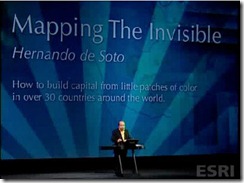
In 2009 DR. De Soto addressed the the ESRI User Group Conference in San Diego. This conference the largest GIS conference in the world attended by more than 30,000 GIS professionals form all over the world each year. You can on the picture to view the video of Dr.De Soto’s address.


This is postscript to this blog post. In the post I mentioned I had responded to a request from ILD for a copy of my article. I was pleased to receive this e-mail from Gabriel Arrisueño, the Lima manger for ILD:

Dear Mr. Henstridge,

My name is Gabriel Arrisueño and I am a manager at the ILD. It was a pleasure to read your article and your kind comments about the ILD and our work. Your on-the-ground experience as a surveyor provides a fresh perspective on the importance of titling and registration. I fully agree with you that clear boundaries can lead to clear property rights, and they in turn set the ground for economic growth and social peace. I personally liked the link you make between legal title and job creation in the different industries surrounding titling and the virtuous economic circle it kick starts.

Moreover, I enjoyed your eloquent description, from your Romanian experience, of how focusing solely on technology, without taking into consideration the institutional aspects of land reform, can conspire against the sustainability of a system. I would like to add that understanding, documenting and mapping the different rights over land, often invisible to the “legal” world, is a sine qua non condition for the success of a formalization program, and indeed for the functioning of any land registration system. Without fully grasping reality, all we will have is an incomplete, and often unreliable, collection of databases and administrative procedures. Furthermore, a sound legal and institutional framework (laws, agencies, and procedures) supported by technology suited to the needs and means of a specific country, can achieve more, and at a much lower cost, than state of the art technology with the wrong institutional framework characterized by unclear responsibilities and overlapping of functions.

Thank you again for sharing this article and for helping raise awareness of the importance of clear and secure property rights supported by sound surveying.

Best regards,

Gabriel

Gabriel Arrisueño Fajardo
Manager
INSTITUTO LIBERTAD Y DEMOCRACIA
Las Begonias 441 Piso 9, San Isidro, Lima - Perú
T  +51 (1) 616-6100  | F +51 (1) 616-6190|

You may view a PDF of the article as published by clicking here