Search This Blog

Showing posts with label Statists. Show all posts

Friday, October 31, 2014

Will This Election Matter?

"No compact among men ... can be pronounced everlasting and inviolable, and if I may so express myself, that no wall of words, that no mound of parchment can be so formed as to stand against the sweeping torrent of boundless ambition on the one side, aided by the sapping current of corrupted morals on the other." — George Washington, draft of first Inaugural Address, 1789

Much has been said and predicted about and for this upcoming midterm national election. The pundits and pollsters are falling over themselves to toss out predictions as to how many seats in the Senate and House the Republicans will take. The party “strategists” are doing their job of pushing the party’s talking points and spinning their message to potential voters.

The long-awaited midterm elections are but days away, and Republican optimism is beginning to cross the border into giddiness. Last week RedState’s Erick Erickson all but declared the Senate won, despite many close races:

“With the President’s numbers so bad and the GOP’s numbers so good, it makes you wonder what is going on in the state level polling that shows so many races so close. That national polling trickles down to states.

Perhaps there is some over-compensation and over-correction that is, ironically, going to cause a lot of pollsters to repeat the mistakes of 2012. There is no evidence that the voters who vote for Barack Obama are the Democrats’ voters. They are Barack Obama’s voters.

They did not show up for him in 2010 and the hysteria and race baiting the Democrats have stooped to in these final weeks suggests they know these voters will not show up for him in 2014 either.

The end of Barack Obama’s Presidency approaches.”

And at Hot Air, Ed Morrissey has been predicting a wave that will finish off the Democrat majority in the Senate for some time. After looking at a round of polling showing GOP fortunes improving in the home stretch, his co-blogger Noah Rothman declared a “universal shift in momentum toward Republican candidates and away from Democrats and the independents who would caucus with them if elected. A late-breaking wave is cresting.”

Erickson, Morrissey, and Rothman aren’t alone. The conservative punditocracy seems almost united in its expectation of a coming Republican Senate, and there are even predictions that the GOP will not just sneak back into power, but will hold a majority with breathing room when the smoke clears.

The GOP currently sits at 45 seats in the Senate, but gains in non-competitive races in West Virginia and Montana — where the Democrats have quite possibly the worst candidate for the U.S. Senate in modern memory — are a given. Despite some buzz earlier in October to the contrary, a Republican pickup in South Dakota now looks more likely than not. And Republicans hold leads in Arkansas, Alaska, Louisiana, and Colorado that appear safe enough for cautious optimism. Additionally, Iowa looks like a close victory for the GOP. That lineup would put the party at 53 seats. Then there are potential GOP upsets in North Carolina or New Hampshire, where Democrat incumbents are polling at significantly less than the magic number of 50 percent.

A Republican sweep, the wave election some predict, could carry those last two, push back the Democratic challengers in the red states up for grabs such as Kansas and Georgia, and run the GOP’s total up to 55 seats. And if the number gets that big, then it might even get bigger: Maine’s independent Senator Angus King might note the shifting of the winds and caucus with the Rs rather than the Ds (the Republican governor Paul LePage is now polling at a significant advantage, indicating King might be safer in the new majority in the near future) and it’s not impossible that West Virginia Democrat Joe Manchin, increasingly alienated from his own party, might decide to flip.

In Colorado, Mark Udall has been dubbed “Mark Uterus” for his incessant reliance on “War on Women” rhetoric against his Republican opponent Cory Gardner. So far a campaign on free contraception has failed to deliver on expectations, particularly when Gardner began to call for birth control to be sold over the counter. Democratic National Committee chairwoman Debbie Wasserman Schultz earned the disgust of even many in the mainstream media for accusing, at least figuratively, Wisconsin governor Scott Walker of being an abuser of women.

In Louisiana, Democrats are using shadowy union-funded PACs to push black turnout through mailers and door-hangers. In North Carolina and Georgia, the appeal is even more naked — complete with imagery of lynchings and references to the Ferguson riots. A Florida-based, SEIU-funded group is selling bulletproof vests as a fundraiser to support a web ad telling black voters that unless they pull the lever for Democrats the police will shoot their children.

The turnout will be low, probably less than 35% of eligible voters, and the party that can generate the most passion in their supporters will probablybarack-obama-2008-excel-speech win. In some states the election is a walk-away for the Republicans and in other states it’s too close to call. But the trend is towards the Republican Party due to the unpopularity of President Barack Obama. He has been laden with issues and scandals demonstrating his lack of leadership. Issues and scandals such as the; The IRS’s illegal attacking conservative groups, Fast and Furious, the Bengasi debacle, thelarge_KanzlerGermany_Obama_2008_Meye handling of the Ebola virus, the rise of ISIS in Iraq and Syria, the aggressions of Russia in the Ukraine, the atrocious performance of the VA, the mass invasion of illegal immigrants across our southern border, and the targeting of reporters of FOX News. Yes, the man who, in 2008 at Mile High Stadium in Denver in front of Greek Columns and 200,000 screaming Germans at the Brandenburg Gate in Berlin, had the most popularity of and Democratic candidate in decades. Now his popularity ratings are dipping below 40% and the hope and change man is not a welcome guest on the campaign trail of many Democrats.

According to a recent article in the Washington Post:

“Democrats have been running from Barack Obama for some time, but now they’re already beginning to point fingers over the looming Election Day debacle. “This off-year election has become almost entirely a referendum on the president,” said one Democrat consultant. “It’s not just anger at [ObamaCare]. He has become, in my opinion wrongly, the symbol of dysfunction in Washington. That has led to a demoralized Democratic base, energized Republicans and those in the middle have an easy way of venting their frustration, and that is to punish the president’s party.” Another consultant added, “It is not all Obama but a lot of it is.” Part of the problem is that Obama thinks it’s all about Obama. “Make no mistake,” he said, “[my] policies are on the ballot.” And it’s killing Democrats.”

Oh yes this election matters to the politicians but will it really change the direction out Republic is going or stop the slide of governance away from the vision and Constitution of our Founders? I don’t think so. To me the election is synonymous with arranging the deck chairs on the Titanic.

For the past 100 years the progressive statists have been dragging the Republic away from our cultural, religious, and constitutional roots. The politicians may change, but the masters of the administrative state and academia will remain to carry out their cubicles and classrooms to dictate policy, regulate your lives, tax your earnings, and fill young minds with liberal-progressive clap trap. To change this it will take much more than one election. It may take 5, 10, or 20 elections along with the demise of the academics and statists. It will need a new generation of educated voters steeped in the values of our culture and dedicated to the vision of our Founders to really make a difference and bring our Republic back to the center.

I don’t mean to be a naysayer or negative about this important election, but I am a realists. I have written ad-nauseum about the rise of the administrative state and the power of the statists supported by the liberal progressive agenda along with the corruption of our education system from k12 through the university system. This is a powerful cabal that will be difficult to defeat if we want to return to the roots and visions that made this Republic the greatest nation in the history of the world.

Kathryn Jean Lopez writes on culture for the Heritage Foundation:

“There is no sugarcoating it. With each passing year, on most cultural fronts, things have been getting worse. There is coarseness to our society and a shredding of real ties that bind us to one another. Only about half of Americans are currently married, and about half of the children in the U.S. will spend time outside a household with a married mom and dad. Whatever the circumstances, that has an impact on people and culture, and it shows up in indicators from fertility rates to teen drug use. Our brotherly social safety net is fraying, and we now look to government instead, compounding our problems. After all, bureaucracy doesn’t do love as well as civil society does.

The brave new world of family life today, with seemingly endless prospects for future chaos, makes one nostalgic for the days when we were at least agreed on some of the fundamentals for a good, healthy home environment for children and women and men. Our lack of a common vocabulary and understanding of human nature has made public opinion — and now even our lawmaking and courts—susceptible to wild claims about truth and tolerance in spite of social science evidence about marriage and family to the contrary. Devoid of reason, history, and tradition, these claims simply wouldn’t have made any sense a few decades ago.

As recently as a decade or so ago, a sensitive cultural observer might have referred to “broken homes” without the prospect of a politically correct shutdown. That shutdown of serious dialogue about the direction of our society is a hallmark of what has been dubbed an “Insatiable New Intolerance.” As a powerful, thinly veiled intolerance has established its power—throughout the culture: in education, the entertainment industry, medicine, and politics—the outlook can seem grim for anyone holding traditional views of marriage, family, and life.”

Americans have good reason to be proud of our country’s many achievements in science and technology. The U.S. is home to Silicon Valley, the technology capital of the world, and to 16 of the world’s top 20 scientific universities. Many of the essential devices we use every day such as the television, automobile, airplane, internet, personal computer and smartphone were invented by Americans.

The passion for scientific discovery in America goes all the way back to our nation’s founders, many of whom were deeply engrossed in the sciences as well as the politics of their day. In addition to authoring the Declaration of Independence, Thomas Jefferson was an excellent mathematician and a prolific inventor. Beginning in 1797, Jefferson served as president of the American Philosophical Society, the country’s leading scientific institution.

When he became president of the United States a few years later, Jefferson sent Lewis and Clark to explore the new Louisiana Territory and chart a route to the Pacific Ocean. Before the expedition embarked, Jefferson sent Lewis to Philadelphia for training in medicine and the natural sciences. The president was adamant that Lewis and Clark document every detail of their trip — the people they met, the animals they encountered, the plants they found, and the geology they observed.

The explorers sent many specimens back east to Jefferson, including some live animals (such as a prairie dog and a few magpies). They became the first people to describe a number of plant and animal species for science, including the grizzly bear.

The curiosity of the founding generation of Americans — including such figures as Jefferson, Franklin, Washington, and others — shaped America profoundly. The spirit of discovery became one of the nation’s defining characteristics as Americans rushed west into the frontier, then connected the continent through a busy network of steamships, railroads, and telegraphs. The belief that there was a better future ahead — and that American ingenuity was the key to it all — was an important cultural foundation on which many of the accomplishments we see today were built.

Today, the pioneering sense of excitement about the future has all but disappeared, in part because we are doing a poor job of helping the next generation appreciate the great achievements of our past.

Indeed, for two generations now we have failed to teach American history in our schools, and as a result, many students struggle with the very basics. Just 20 percent of fourth-graders, 17 percent of eighth-graders and 12 percent of twelfth-graders are at grade-level proficiency in American history, according to the Department of Education’s National Assessment of Educational Progress.

A majority of fourth graders don’t know the purpose of the Lewis and Clark expedition, Department of Education data show. Most fourth graders can’t say why the pioneers moved west. And two-thirds don’t understand that westward migration resulted in new states being added to the union.

We must do a better job. If children fail to learn American history, they cannot possibly understand how America became the great country it is today. And more importantly, they won’t be able to help America remain the most pioneering and prosperous nation on earth.

So while this election can be a first step towards returning our Republic to the vision of our Founders it will mean little if we, as a nation, cannot, begin a return to our cultural, religious, and constitutional roots and reverse 100 years of liberal-progressive destruction of these roots. Politicians will follow the will of the people if that will is strong and continuous. Ronald Reagan showed us how to express this will and provide the constitutional leadership this Republic so urgently needs. If we cannot do this than this election is more of a trick than a treat.

Tuesday, May 21, 2013

Did The IRS Scandal Begin at the Top

“It will be of little avail to the people that the laws are made by men of their own choice if the laws be so voluminous that they cannot be read, or so incoherent that they cannot be understood.” ― James Madison, Federalist No. 62, 1788

When James Madison issued the words quoted above in Federalist No. 62 he could have been speaking about the current U.S. Tax Code. In Federalist 62 Madison was addressing how the Senate should be constructed and empowered. He wrote the following pertaining to voluminous, complicated, and mutable laws:

“The internal effects of a mutable policy are still more calamitous. It poisons the blessing of liberty itself. It will be of little avail to the people, that the laws are made by men of their own choice, if the laws be so voluminous that they cannot be read, or so incoherent that they cannot be understood; if they be repealed or revised before they are promulgated, or undergo such incessant changes that no man, who knows what the law is to-day, can guess what it will be to-morrow. Law is defined to be a rule of action; but how can that be a rule, which is little known, and less fixed?

Another effect of public instability is the unreasonable advantage it gives to the sagacious, the enterprising, and the moneyed few over the industrious and uniformed mass of the people. Every new regulation concerning commerce or revenue, or in any way affecting the value of the different species of property, presents a new harvest to those who watch the change, and can trace its consequences; a harvest, reared not by themselves, but by the toils and cares of the great body of their fellow-citizens. This is a state of things in which it may be said with some truth that laws are made for the FEW, not for the MANY.

In another point of view, great injury results from an unstable government. The want of confidence in the public councils damps every useful undertaking, the success and profit of which may depend on a continuance of existing arrangements. What prudent merchant will hazard his fortunes in any new branch of commerce when he knows not but that his plans may be rendered unlawful before they can be executed? What farmer or manufacturer will lay himself out for the encouragement given to any particular cultivation or establishment, when he can have no assurance that his preparatory labors and advances will not render him a victim to an inconstant government? In a word, no great improvement or laudable enterprise can go forward which requires the auspices of a steady system of national policy.”

Madison wrote these words 225 years ago in support of ratification of the newly adopted constitution. If he were alive today he would not only be appalled at the U.S. Tax Code, ObamaCare and the millions of regulations issuing forth from the various departments of executive branch. Although Congress has authorized these departments such as the IRS, Health and Human Services, the EPA, the Departments of Energy, Education, Agriculture, Treasury, and Interior the power to regulate and issue regulations they rarely read, or even are aware of the regulations and he impact they have on we the people.

This brings us to the current scandal brewing to a boil of the illegal actions of the IRS in targeting Tea Party and conservative organizations by slow-walking or denying their applications for a 501(c)(4) tax exemption.

The spin from Obama’s minions in the press and his spokespersons know and “strategist” is that this policy originated from some low-level drones working in the Cincinnati office of the IRS. This is pure unadulterated balderdash!

Was the White House involved in the IRS's targeting of conservatives? No investigation needed to answer that one. Of course it was.

President Obama and Company are in full deniability mode, noting that the IRS is an "independent" agency and that they knew nothing about its abuse. The media and Congress are sleuthing for some hint that Mr. Obama picked up the phone and sicced the tax dogs on his enemies.

Mr. Obama now professes shock and outrage that bureaucrats at the IRS did exactly what the president of the United States said was the right and honorable thing to do. "He put a target on our backs, and he's now going to blame the people who are shooting at us?" asks Idaho businessman and longtime Republican donor Frank VanderSloot.

Mr. VanderSloot is the Obama target who in 2011 made a sizable donation to a group supporting Mitt Romney. In April 2012, an Obama campaign website named and slurred eight Romney donors. It tarred Mr. VanderSloot as a "wealthy individual" with a "less-than-reputable record." Other donors were described as having been "on the wrong side of the law."

This was the Obama version of the phone call — put out to every government investigator (and liberal activist) in the land.

Twelve days later, a man working for a political opposition-research firm called an Idaho courthouse for Mr. VanderSloot's divorce records. In June, the IRS informed Mr. VanderSloot and his wife of an audit of two years of their taxes. In July, the Department of Labor informed him of an audit of the guest workers on his Idaho cattle ranch. In September, the IRS informed him of a second audit, of one of his businesses. Mr. VanderSloot, who had never been audited before, was subject to three in the four months after Mr. Obama teed him up for such scrutiny.

The last of these audits was only concluded in recent weeks. Not one resulted in a fine or penalty. But Mr. VanderSloot has been waiting more than 20 months for a sizable refund and estimates his legal bills are $80,000. That figure doesn't account for what the president's vilification has done to his business and reputation.

The Obama call for scrutiny wasn't a mistake; it was the president'sobama_angry1-620x413 strategy — one pursued throughout 2012. The way to limit Romney money was to intimidate donors from giving. Donate, and the president would at best tie you to Big Oil or Wall Street, at worst put your name in bold, and flag you as "less than reputable" to everyone who worked for him: the IRS, the SEC, the Justice Department. The president didn't need a telephone; he had a megaphone.

The same threat was made to conservative groups that might dare play in the election. As early as January 2010, Mr. Obama would, in his state of the union address, cast aspersions on the Supreme Court's Citizens United ruling, claiming that it "reversed a century of law to open the floodgates for special interests" (read conservative groups).

The president derided "tea baggers." Vice President Joe Biden, Senate Majority Leader Harry Reid, and Nancy Pelosi compared them to "terrorists." In more than a dozen speeches Mr. Obama raised the specter that these groups represented nefarious interests that were perverting elections. "Nobody knows who's paying for these ads," he warned. "We don't know where this money is coming from," he intoned.

In case the IRS missed his point, he raised the threat of illegality: "All around this country there are groups with harmless-sounding names like Americans for Prosperity, who are running millions of dollars of ads against Democratic candidates. And they don't have to say who exactly the Americans for Prosperity are. You don't know if it's a foreign-controlled corporation."

On the other hand “as applications from conservative groups sat in limbo, groups with obviously liberal names were approved in as little as nine months”, USA Today reported last Tuesday. These included Bus for Progress and Progress Florida.

According to the Daily Caller’s Charles C. Johnson, the Barack H. Obama Foundation — directed by Abongo Malik Obama, the president’s half-brother and best man at his wedding — filed IRS Form 990s for 2008 through 2010 in May 2011. It then scored 501(c)(3) tax-exempt status on June 26, 2011, retroactive to April 30, 2008. The reputedly Virginia-based foundation won this valuable designation without registering with state authorities. Evidently, IRS officials did not care that, as the Daily Caller stated, Abongo Obama “was accused of being a wife beater and seducing the newest of his twelve wives while she was a 17-year-old school girl.”

IRS also sent ProPublica, a liberal news organization, the confidential, unapproved nonprofit applications of nine conservative groups. ProPublica redacted financial information and then published six of these forms.

A pro-traditional-matrimony group called the National Organization for Marriage claims that the IRS gave copies of its tax documents to the pro-gay-marriage Human Rights Campaign. NOM says that HRC used those leaked documents to slam NOM and a donor identified therein: Mitt Romney.

IRS wants to hire 1,954 new agents to enforce 47 different provisions of ObamaCare. Combine these political leaks with the electronic medical records that doctors and insurers soon must render unto Obama’s bureaucrats. Imagine an exposé on conservative activists who use Viagra. Why not out a rising GOP star whose psychotherapist treats her exotic sex fantasies? Far-fetched? Not after this week. Indeed, 15 IRS agents are being sued in California court for allegedly swiping without a search warrant the medical records of some 10 million Americans in March 2011.

Short of directly asking federal agencies to investigate these groups, this is as close as it gets. Especially as top congressional Democrats, like Chuck Schumer and Max Baucus were putting in their own versions of phone calls, sending letters to the IRS that accused it of having "failed to address" the "problem" of groups that were "improperly engaged" in campaigns. Because guess who controls that "independent" agency's budget?

The IRS is easy to demonize, but it doesn't exist in a vacuum. It got its heading from a president, and his party, who did in fact send it orders — openly, for the world to see. In his Tuesday press grilling, no question agitated White House Press Secretary Jay Carney more than the one that got to the heart of the matter: Given the president's "animosity" toward Citizens United, might he have "appreciated or wanted the IRS to be looking and scrutinizing those." Mr. Carney cut off the reporter with "That's a preposterous assertion."

Preposterous because, according to Mr. Obama, he is "outraged" and "angry" that the IRS looked into the very groups and individuals that he spent years claiming were shady, undemocratic, and even law-breaking. After all, he expects the IRS to "operate with absolute integrity." Even when he does not.

So who are these low-level drones responsible for the illegal actions of the IRS?

Steven Miller — the acting head of the Internal Revenue Service while the scandal unfolded. He was fired from the post on Wednesday after an internal IRS report found that poor management, and not partisan politics, led to an "inappropriate" focus on conservative groups starting in 2010. The IRS has acknowledged Miller knew about the targeting of conservative groups in 2012 but did not disclose the practice. He was the former deputy IRS commissioner for services and enforcement and had been at the agency for more than 25 years.

At a House of Representatives hearing last Friday, Miller apologized for "foolish mistakes" made at the IRS and said they resulted from a heavy workload. He leaves the agency in June.

Douglas Shulman — IRS commissioner before Miller took over in the acting capacity in November 2012. A Democrat, he was appointed to the post under Republican President George W. Bush in 2008.

In March 2012, Shulman told lawmakers that IRS personnel applied no extra scrutiny to conservative groups, although the new report from the Treasury Inspector General for Tax Administration (TIGTA) said that Miller knew of the targeting as early as March 8, 2012.

Congressional leaders sent letters to Shulman inquiring about IRS targeting as early as June 2011. According to the inspector general, the IRS's Determinations Unit began targeting conservative groups in March or April of 2010.

Danny Werfel — the White House budget official selected by Obama to replace Miller as acting IRS chief on May 22.

The Obama administration's point man in overseeing the "sequestration" budget cuts, he will now tackle the IRS scandal.

Lois Lerner — director of the IRS's tax-exempt division who broke the news of the scandal on May 10 at an American Bar Association function when she publicly apologized for the discriminatory practices. The admission came just days after she testified in Congress but did not mention it. According to the inspector general, Lerner learned about the targeting as early as June 29, 2011.

Lawmakers have called for her removal from the IRS.

Miller on Friday acknowledged that the scandal-exposing question-and-answer session had been planned.

Joseph Grant — IRS acting commissioner of tax exempt/government entities division at the center of the scandal. On last Thursday he announced plans to retire on June 3 after joining the IRS in 2005. He took over the reins of the tax exempt division in late 2010 and Lerner worked under him.

Sarah Hall Ingram — Preceded Grant as head of the IRS's tax-exempt division when the targeting of conservative groups began. Since December 2010, she has headed up the IRS division handling Obama administration's healthcare reform and received $103,000 in bonuses.

William Wilkins — IRS chief counsel who is an Obama political appointee. He is the top legal adviser and takes the lead on all litigation involving the IRS. His office, although not necessarily Wilkins personally, knew of the targeting as early as August 2011, according to TIGTA. The IRS said Wilkins did not participate in the August 2011 meeting, which the agency said involved "staff attorneys several layers below Wilkins."

J. Russell George — Treasury Department inspector general for tax administration. Investigated the complaints against the IRS and issued the public report on targeting of conservative groups. The IRS is an arm of the Treasury Department and lawmakers at the hearings are scrutinizing George for not issuing warnings about the practice earlier.

IRS's Cincinnati field office employees — oversaw the reviews of tax-exempt applications. According to TIGTA, the Ohio unit set its own criteria for checking tax-exempt groups in the absence of clear guidance from more senior officials.

Republican lawmakers have named five workers they hope to bring in for questioning: Holly Paz, Washington-based director of rulings and agreements for the tax exempt division; Greg Muthert, a veteran Cincinnati office worker; Joseph Herr and Elizabeth Hofacre, who were cited by some Tea Party groups as handling their tax-exempt applications; and John Shafer, whom lawmakers described as "screening group manager."

A congressional aide said the five workers were chosen based on a timeline from the TIGTA report that listed the job roles involved in the activity. It was unclear whether these employees had any role in any wrongdoing.

President Barack Obama — has said he was not aware of the ongoing practice, calling it intolerable and inexcusable. His Press Secretary Jay Carney said the White House Counsel was notified of the IRS's targeting during the week of April 22.

Obama has appeared multiple times in public to condemn the IRS's actions and has promised to cooperate with congressional investigations and a Justice Department probe, but he has not demanded a special prosecutor look into the allegations.

Representative Dave Camp — Republican chairman of the House Ways and Means Committee that is investigating the matter. On June 3, 2011, he sent a letter to then-Commissioner Shulman, inquiring about IRS targeting of taxpayers who donated to conservative groups and audits of tax-exempt organizations. The IRS then halted reviews of any tax-exempt groups but never addressed targeting concerns.

Representative Darrell Issa — Republican chairman of the Oversight and Government Reform Committee also conducting an investigation. He is seeking interviews with five IRS employees to learn more about the tax-exempt reviews.

Senator Max Baucus — Democratic chairman of the Senate Finance Committee, who said his tax code revamp will examine rules for nonprofit group's political activities in hopes of preventing such scandals in the future.

It should be obvious to anyone who can read or watch the TV news that these individuals are not low-level drones working in the Queen City. I am sure this list will grow as the hearings

The Washington Post’s editorial board wrote that, “A bedrock principle of U.S. democracy is that the coercive powers of government are never used for partisan purposes.”

In her apology, Lois G. Lerner, IRS director of exempt organization, insisted that the extra scrutiny was not politically motivated. The narrow focus on partisanship as the primary point of controversy is dangerous. This is not first and foremost a partisan issue.

It doesn’t matter whom the IRS was targeting or what specific beliefs they held: the fact remains that for years the agency used its power to coerce, discourage and intimidate Americans from speaking out against what they viewed as bad policies, stifling the First Amendment right of every citizen to hold government accountable.

The president says he was not aware of the problem. If so, then the state of our freedom is far worse than any of us has imagined — the gray suits of the administrative state are in place and already taking over.

Pundits have compared the current scandal to Watergate, but this one, frankly, is worse.

When the abuses of Watergate – which included misuse of the IRS to launch audits against Nixon’s enemies — were discovered, they stopped and the perpetrators were brought to justice.

We don’t yet know just how high the knowledge of the IRS practice reached, but it’s already clear that a broad element of the agency — including those with the power to stop it — knew about this blatant violation of basic constitutional rights for years and did nothing to stop it.

Despite Ms. Lerner’s statements to the contrary, it’s clear the IRS has been using its power for years to discourage and intimidate Americans from participating in their right to hold government accountable.

This abuse of power and “unequal treatment under the law” is truly chilling, and must not be brushed away with apologies or toothless inspector-generals’ reports.

It demands a rigorous congressional investigation and severe punishment of the power-drunk bureaucrats who carried it out.

No government agency must be allowed to abuse its powers so blatantly and get away with it. The freedom Americans hold so dearly is at stake.

We must demand that government account for its actions.

Sen. Mike Lee (R-Utah) rightly captured the problem in a written statement when he said, “this shameful abuse of power transcend partisan differences. This should not be dismissed as just another conflict between left and right; it is a conflict between the federal government and the American people.”

Sen. Ted Cruz (R-Texas) noted, “What’s just as concerning is the expansive role this agency is charged to take in enforcing ObamaCare. An agency that has admitted to engaging in such corrupt, political activities has no place assessing or monitoring Americans’ personal health information.”

Finally, Sen. Rand Paul (R-Ky.) said, “The First Amendment cannot and should not be renegotiated depending on which party holds power… I am determined to hold the IRS accountable for these unjust acts.”

We, the people, must demand that congressional leaders and the Obama administration get to the bottom of this issue and remove not just the responsible parties but the threat to our freedoms.

The IRS’s actions are the stuff of Third World juntas, not the greatest constitutional republic in human history.

It is unacceptable for a government agency use its power to intimidate American citizens into silence. We must stop this abuse of government over the governed and ensure this never happens again to any segment of the American population, regardless of their political leanings.

Friday, May 17, 2013

The Tyranny of the Administrative State

"The time to guard against corruption and tyranny is before they shall have gotten hold on us. It is better to keep the wolf out of the fold, than to trust to drawing his teeth and talons after he shall have entered." — Thomas Jefferson (1781)

As we watch a string of scandals detonate across the Obama Administration, we should all be able to agree that the abuse of government power to punish political opposition is hideously wrong. Sometimes we struggle to define the precise boundaries of “corruption,” as a growing government extends its power into the private sector, and the daily conduct of its business becomes inherently corrupt. Special interests swarm around the Leviathan State like remora fish around a shark. Everyone is either getting punished or subsidized by the government. Political connections become the most valuable economic resource. (If only President Obama’s cronies in the “green energy” racket had been given half the scrutiny this Administration directed at Tea Party groups, imagine how much money taxpayers would have saved!)

The ruling class reaches the apex of its power when it no longer has to tax and spend money to promote its agenda, or even deploy coercive regulations that could be traced back to particular administrators; instead, the ruling class need only express its desires, and those eager to curry favor will scramble to obey. For an example, watch the unfolding scandal around Health and Human Services Secretary Kathleen Sebelius’ efforts to squeeze money out of the industries she regulates.

But even in that thick stew of corruption — as competition under the impartial rule of law is replaced by a struggle to win the zero-sum affections of the State — we can easily see that government itself is the greatest “special interest” of all. When politicians and bureaucrats abuse power to protect themselves, we should recoil in disgust. There are right and wrong ways for politicians to win support, but there is no “good” way for them to punish opposition. I don’t think that even Woodrow Wilson, the father of today’s administrative state, would have gone this far. Although his alter ego Col. House advocated the powerful administrative state in his book “Phillip Dru, Administrator.”

This disgust grows particularly acute when the Internal Revenue Service is corrupted. We are obliged to place a great deal of faith in the IRS. The agency carries an extraordinary burden of public trust.

Our tax system is no simple matter of computing a flat percentage against easily documented income. Both individuals and corporations must submit an enormous amount of information to the IRS, so their compliance with the State’s agenda can be measured. The tax code is an instrument of control, not just a method of gathering revenue. If that’s all it was, it would be much less intrusive, and the IRS would be much smaller. This is one of the main reasons for Congress to throw out our current system of collecting taxes under the 16th Amendment and institute either a fair tax or a flat tax. (I favor the flat tax as it would virtually eliminate the IRS and it’s thousands of employees).

The government distributes a great deal of favor through the current tax code. Behaving in the “right” way earns various deductions and credits. Excessive success and “incorrect” investment is punished. In order for this system to function, the behavior of citizens and their corporations must be carefully monitored. Failure to comply with this surveillance brings unfortunate consequences (unless the offender has powerful political connections, of course.)

As the tax code grows, and exerts greater levels of control, the volume of information Americans must place into Internal Revenue’s trust necessarily grows. It can’t work any other way. Every activity with tax ramifications must be monitored. Very few activities are without tax ramifications now. ObamaCare is one prominent example of a bill that makes vast new segments of American life the business of the IRS, at both the individual and corporate level.

The IRS must fulfill this trust with the highest level of fidelity, respecting the privacy of every American. Whatever moral legitimacy Big Government retains depends upon this utterly. The IRS is a socialist’s favorite agency, nourishing the State with blood drawn from the unruly private sector, while simultaneously imposing the economic preferences of wise and benevolent government. It brings in revenue to fund the State, and it controls private behavior. It must conduct itself as the sacred temple of socialism, in which the sanctity of the tax confessional is absolute.

Otherwise, a system that has already been criticized as tyranny becomes completely indistinguishable from it. The IRS is not meant to serve as an opposition research team for the ruling Party. Its power is not meant to stifle discourse. No one should believe that more fervently than a sincere liberal. No one should have less tolerance for the corruption of that sacred encounter between citizens and their rulers, in which the property of individuals is transformed into sustenance for the divine general will of The People.

Liberals believe with all their hearts that every citizen should have a voice in shaping the general will, do they not? They measure “freedom” not by independence from the government, but rather by the ability to influence its course. Everyone is allowed to speak, then an election settles our differences, and everyone is expected to obey the winners. If the government is able to use its power to suppress that noble democratic process — especially the singular power of the IRS — what are we left with, except the mere tyranny that liberals claim to oppose?

To be honest, our gigantic central government already has many other resources for influencing the electoral process. It has many resources for purchasing votes and intimidating dissent. The ideal of a leviathan government that humbly serves The People is the absurd primal delusion of the modern Left. Let us begin with the absolutely unacceptable sin of corrupting the IRS, work our way back through every agency, and see how many Americans we can set free from that delusion. It’s what our Founders believed in 1776 when they laid out their list of grievances to King George in the Deceleration of Independence. They wanted to live free from the abuses of a tyrannical government — something many of us want today.

In his commencement remarks to graduates sparsely convened in the Ohio State University football stadium in Columbus last weekend, Barack Hussein Obama offered the following observations and advice:

"Unfortunately, you've grown up hearing voices that incessantly warn of government as nothing more than some separate, sinister entity that's at the root of all our problems; some of these same voices also doing their best to gum up the works. They'll warn that tyranny is always lurking just around the corner. You should reject these voices. Because what they suggest is that our brave and creative and unique experiment in self-rule is somehow just a sham with which we can't be trusted. We don't think the government is the source of all our problems we understand that this democracy is ours. And as citizens, we understand that it's not about what America can do for us, it's about what can be done by us, together, through the hard and frustrating but absolutely necessary work of self-government. And class of 2013, you have to be involved in that process."

Clearly, Obama's absurd and overtly partisan assertions were aimed at young constituents whom he hopes embody the future of his Socialist Democratic Party. After all, an effective speechmaker knows his audience, and Obama knows that most of these youthful citizens are indoctrinated in government institutions since they were weaned.

Indeed, the socialist protagonist, Karl Marx, wrote, "The education of all children, from the moment that they can get along without a mother's care, shall be in state institutions at state expense." Marx's disciple, Vladimir Ilyich Lenin, concurred: "Give me four years to teach the children and the seed I have sown will never be uprooted."

From the days of Woodrow Wilson to those of Barack Obama, and encompassing all the "progressives" in between, taxpayer-funded academic institutions have been the breeding ground for generations of socialists. For most leftists, the crucial years that cemented their worldview were the ones they spent in our nation's colleges and universities.

Brothers Tamerlan and Dzhokhar Tsarnaev, who are accused of setting the bombs that exploded at the Boston Marathon, attended the University of Massachusetts. Maybe they hated our nation before college, but if you want lessons on hating America, college attendance might be a good start. Let's look at it.

Walter Williams writes in Townhall.com about hating America:

"We need to think very, very clearly about who the enemy is. The enemy is the United States of America and everyone who supports it." That's taught to University of Hawaii students by Professor Haunani-Kay Trask. Richard Falk, professor emeritus at Princeton University and the U.N. Human Rights Council's Palestine monitor, explained the Boston bombings by saying, "The American global domination project is bound to generate all kinds of resistance in the post-colonial world." Professor Falk has also stated that President George W. Bush ordered the destruction of the twin towers.

University of Southern California professor Darry Sragow preaches hate to his students in his regulation of elections and political finance class, recently telling them that Republicans are stupid, racist losers and that they are angry old white people. A few years ago, Rod Swanson, a UCLA economics professor, told his class, "The United States of America, backed by facts, is the greediest and most selfish country in the world." Penn State University professor Matt Jordan compared supporters of the voter ID laws to the Ku Klux Klan. Professor Sharon Sweet, an algebra teacher at Brevard Community College, told her students to sign a pledge that read, "I pledge to vote for President Obama and Democrats up and down the ticket." Fortunately, the college's trustees fired her.

University of Rhode Island history professor Erik Loomis tweeted, "I want (National Rifle Association executive vice president) Wayne LaPierre's head on a stick." He asked, "Can (we) define NRA membership as dues contributing to a terrorist organization?" Here's a sample of how Professor Loomis frequently expresses himself: "Motherf---ing f---heads f---ing f---." Then there's Georgetown law professor Louis Michael Seidman, who explained our national problems by saying, "But almost no one blames the culprit: our insistence on obedience to the Constitution, with all its archaic, idiosyncratic and downright evil provisions." Professor Seidman worked for The Public Defender Service for the District of Columbia. When he was sworn in as an officer of the court, I wonder what constitution he swore to uphold and defend.

Parents don't have to wait for college admission for their youngsters to receive America-hating lessons. Scott Compton, an English teacher at Chapin High School in Chapin, S.C., was put on administrative leave after he allegedly threw an American flag on the floor and stomped on it in front of his students. He has chosen to resign.

An Advanced Placement world geography teacher at Lumberton High School in Texas encouraged students to dress in Islamic clothing and instructed them to refer to the 9/11 hijackers not as terrorists but as "freedom fighters." They were also told to stop referring to the Holocaust as genocide. John Valastro, the superintendent of the Lumberton Independent School District, told Fox News that the teacher did absolutely nothing wrong.

In McAllen, Texas, teachers tried to force a teenager to sing the Mexican national anthem and recite Mexico's pledge of allegiance. The teen refused, saying it was against her beliefs as an American. She was thrown out of the class and given a failing grade for that day's assignment. Her father has filed a lawsuit on behalf of his daughter against the McAllen Independent School District.

Investor's Business Daily ran a story that shows student indoctrination is official union policy: "A New Low From The California Federation Of Teachers: Urine Indoctrination" (12/5/12). The union's website has a cartoon narrated by leftist Hollywood actor Ed Asner. In tones used when reading to children, Asner says: "(Rich people) love their money more than anything in the whole world. Over time, rich people decided they weren't rich enough, so they came up with ways to get richer." The cartoon finishes its class warfare message by graphically depicting "the rich" urinating on the poor.

These people running our education system are destroying the minds and values of our young people, and we allow them to do it.”

These examples are but a few of the thousands that occur every year in our K-12 and higher education systems. Unless you can afford a religious-based private school or home school you child will be subjected to this indoctrination on a daily basis as they are prepared for citizenship in the utopian society of the progressive left.

As for higher education you will have to search for colleges and universities such as Hillsdale College and Liberty University if you do not want to become a drone of the tyrannical, progressive state. Once these drones are matriculated many of them enter the world of academia to propagate more drones or enter government services where they can bask in the comfort of the good life afforded by civil service.

Todd Starnes of Fox News.com has provided us with a list the top 100 universities that have selected liberal graduation speakers:

“When it comes to selecting a commencement speaker, the nation’s top 100 universities lean decidedly left, according to a new survey by the Young America’s Foundation.

Of the top 100 universities listed by U.S. News and World Report, 62 have selected liberal commencement speakers and only 17 selected conservatives. The YAF said the political affiliations of the remaining speakers was unclear.

“It goes to show you how administrators are unwilling to reach out and provide an alternative viewpoint,” YAF’s Adam Tragone told Fox News. “There’s a plethora – a deluge of liberals compared to conservatives on this year’s list.”

The YAF’s 20th annual Commencement Speakers Survey shows a who’s-who of liberals invited to impart words of wisdom to college graduates – from Oprah Winfrey at Harvard University to House Minority Leader Nancy Pelosi at the University of California – Davis.

Speakers at the top 10 schools include:

  1. Harvard University – Oprah Winfrey
  2. Princeton University – Ben Bernanke
  3. Yale University – Cory Booker
  4. Columbia University – Lee C. Bollinger
  5. University of Chicago – Abbie J. Smith
  6. MIT – Drew Houston
  7. Stanford University – Michael Bloomberg
  8. Duke University – Melinda Gates

Among the handful of conservatives to get speaking invites were Ga. Sen. Saxby Chambliss and former Texas Sen. Kay Bailey Hutchison.

“It’s like one last dose of liberalism given by the academia community to the students before they go off and begin their careers,” Tragone told Fox News. “It fulfills the stereotype that most Americans think academia is full of liberal ideology and conservatives are put to the wayside.”

…

“Liberal media representatives will also be plentiful. Four employees of The New York Times will deliver remarks – along with representatives from NPR, PBS and CNN.

Tragone said it’s disheartening that the nation’s universities seem to ignore conservative voices.

“The message it sends to conservative students is to be wary and always at attention of liberal bias that exists in academia,” he said.

YAF’s Ron Robinson pointed out that it’s a clear example of liberal indoctrination.

“As tuition and student loan debt grow at historic rates, what are students getting for their money?” he asked. “An education from leftist professors that—combined with the Obama administration’s policies—has left 53 percent of recent grads unemployed or underemployed. These commencement speakers are just the icing on higher education’s indoctrination cake.”

Obama claimed, "Unfortunately, you've grown up hearing voices that incessantly warn of government as nothing more than some separate, sinister entity that's at the root of all our problems; some of these same voices also doing their best to gum up the works. They'll warn that tyranny is always lurking just around the corner."

I'm not sure what incessant voices those might be — certainly not those of our Founders — because a growing number of college graduates can't name but a few if any. And they're certainly not the voices of a majority of government schoolteachers and professors, who are little more than useful idiots in the service of socialism.

Obama might be talking about the handful of courageous young American Patriots on campuses across the nation — those who stand in the face of peer and professorial ridicule in order to speak in defense of Liberty. Or maybe he's referring to that rarest of creatures, the conservative professor whose lone voice extols the virtues of Liberty amid the academic statism desert.

Or perhaps the voices Obama alludes to are those of the current generation of grassroots Patriots, who gave rise to the Tea Party movement a couple of years back. They fortunately "gummed up the works" in the 2010 midterm elections when they sent more than 70 Democrats packing and replaced them with grassroots conservatives to retake the House of Representatives. That provided a gauntlet to Obama's socialist agenda, one that notably crushed the crown jewel of that agenda last month — his so-called "assault weapons" ban (known in our humble shop as the defensive weapons ban.)

Obama continued, "You should reject these voices. Because what they suggest is that our brave and creative and unique experiment in self-rule is somehow just a sham with which we can't be trusted."

Well, not quite. It is Obama and his statist cadres who believe that "we, the people" can't be trusted, and thus he has perpetually campaigned since 2006 to implement his plan of "fundamentally transforming the United States of America." Obama's objective is to reject the voices of those who support Liberty and the Rule of Law over the rule of men, the terminus of which is always tyranny. As Lord Acton famously wrote, "Power tends to corrupt, and absolute power corrupts absolutely."

Finally, Obama said, "We don't think the government is the source of all our problems we understand that this democracy is ours. And as citizens, we understand that it's not about what America can do for us, it's about what can be done by us, together."

This is just a heap of unadulterated double-speak.

First, in regard to "the source of our problems," I remind you of the inimitable words of Ronald Reagan, which are truer today than when he spoke them in 1981: "government is not the solution to our problem; government is the problem." As his colleague Margaret Thatcher once said, "Socialist governments traditionally do make a financial mess. They always run out of other people's money. They then start to nationalize everything and control everything by other means."

Second, we are not a "democracy," but a Constitutional Republic. Of course, a "community organizer" wouldn't know the difference, but someone who bills himself a "constitutional scholar" should!

Third, "it's not about what America can do for us"? This is clearly some kind of cheap JFK knockoff. John Kennedy, of course, said, "Ask not what your country can do for you — ask what you can do for your country." But Obama has built his constituent voter blocs on the exact opposite theme, "Ask not what you can do for your country — ask what your country can do for you."

And, when Obama says, "it's about what can be done by us, together," he's not talking about equal partners, but about government dominion over people. This is in keeping with the socialist theme trumpeted at the grand opening of his 2012 Democratic National Convention in Charlotte, North Carolina: "Government is the only thing we all belong to!"

To summarize, here is the shorter catechism of Obama's message to graduates of The Ohio State University, and, of course, to college graduates everywhere: "Government is great, Government is good, and you should thank us for your food. By its hands we all are fed, government provides our daily bread."

As long as we have tyrannical and unfettered government agencies such as the IRS, Department of Justice, The EPA, Homeland Security with its TSA, Health and Human Services, and the Department of Education with their political appointees and life-long bureaucrats we have but little chance of remaining a republic as envisioned by our founders. Congress seems to be no match for this leviathan of masterminds and statist.

As long as the American People are more concerned with the bread and circuses being offered by our entertainment industry, the horrible left-wing bias of our public education system, and the shallow and biased reporting of the fourth estate there is little chance of any sustained pressure to change or reverse 100 years of progressivism.

However, on a more positive note as the ancient Chinese philosopher Confucius is claimed to have said: “the longest journey begins with the first step.” Perhaps we have taken a first step with the uncovering of the tyrannical abuses of the IRS. Let us hope so.

Oh, and one more closing comment of the mentality of our noble leader Barack Obama and his disrespect for our military. As Confucius stated: “a picture is worth a thousand words.” Evidently the Marines have Obama’s back, but does he have their back?

umbrella-641x375

Wednesday, April 17, 2013

Progressivism — The Scourge To Our Constitutional Form Of Government, Part 2

“A conservative is someone who makes no changes and consults his grandmother when in doubt.” — Woodrow Wilson

In the first part of this commentary I covered the beginnings of the rise of Progressivism in the United Sates with the administrations of Theodore Roosevelt and Woodrow Wilson. In this second part we will explore the administration succeeding Wilson up to the beginning of World War Two.

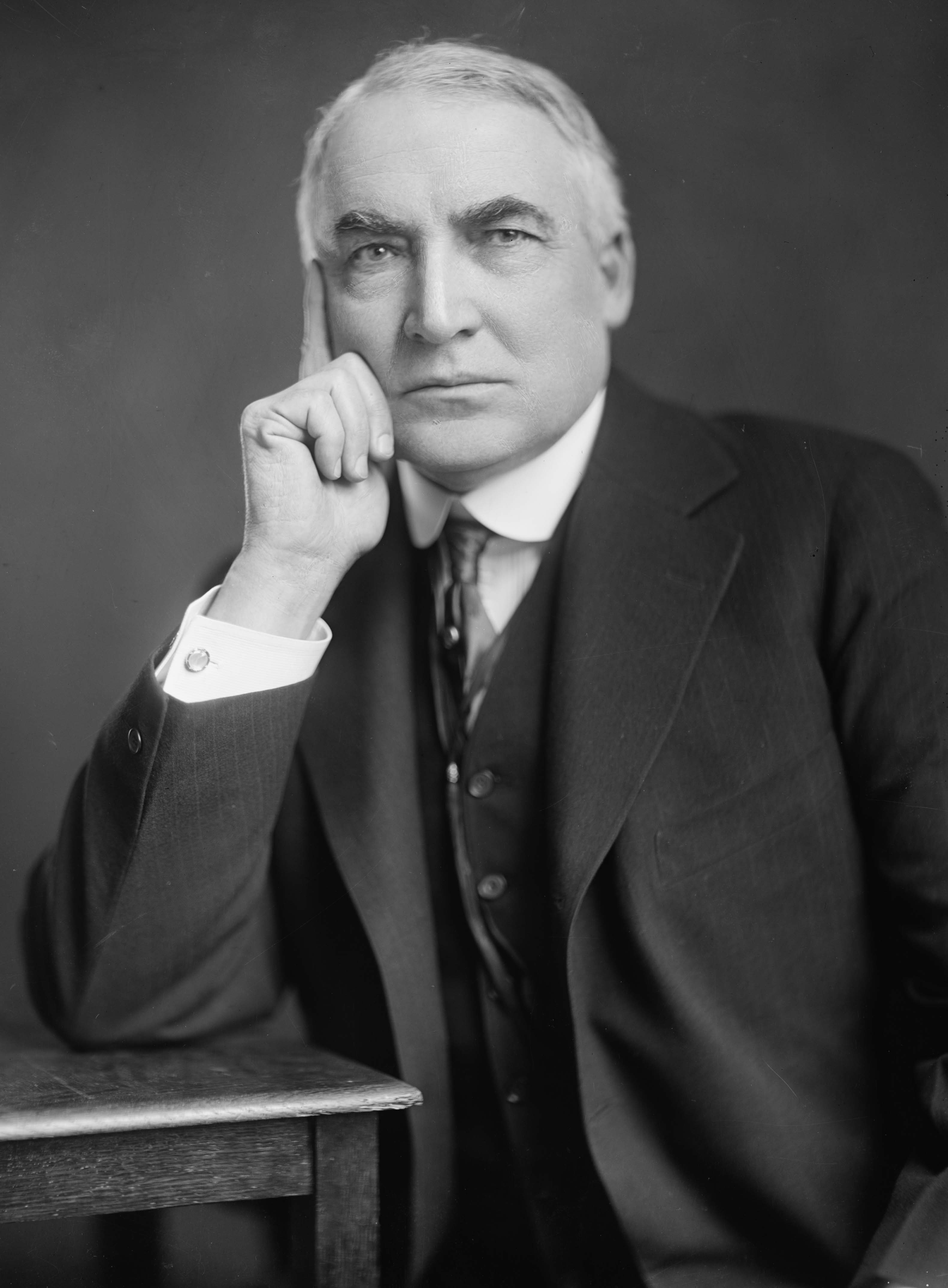
In the election of 1920 the people were fed up with the 8 years of Wilson’s tyrannical progressive policies. The Republican candidate Warren G. Harding defeated the Democratic ticket of James Cox and Franklin Roosevelt garnering 60% of the popular vote and an Electoral College margin of 404 to 127.

Former president Theodore Roosevelt had been the frontrunner for the441px-Warren_G_Harding-Harris_&_Ewing Republican nomination, but his health collapsed in 1918. He died in January 1919, leaving no obvious heir to his progressive legacy. As a result, both major parties ultimately turned to dark horse candidates from the electoral-vote-rich state of Ohio. To help his campaign, Cox chose future president Franklin D. Roosevelt (a fifth cousin of Theodore) as his running mate. Harding virtually ignored Cox and essentially campaigned against Wilson, calling for a return to "normalcy." With an almost 4-to-1 spending advantage, Harding won a landslide victory.

Harding's promise was to return the United States to pre-world war mentality; without the thought of war tainting the minds of the American people. During the campaign he stated:

"America’s present need is not heroics, but healing; not nostrums, but normalcy; not revolution, but restoration; not agitation, but adjustment; not surgery, but serenity; not the dramatic, but the dispassionate; not experiment, but equipoise; not submergence in internationality, but sustainment in triumphant nationality."

This election was the first since the ratification of the Nineteenth Amendment on August 18, 1920, and thus the first in which women had the right to vote in all 48 states (in the 1916 presidential election, about 30 states had permitted women to participate). As a result, the total popular vote increased dramatically, from 18.5 million in 1916 to 26.8 million in 1920. This election is also notable for being the first of three in which a sitting U.S. senator was elected president (the others were 1960 and 2008).

The election was dominated by the aftermath of World War I and a hostile response to certain policies of Woodrow Wilson, as well as the massive reaction against the reformist zeal of the Progressive Era. The wartime economic boom had collapsed. Politicians were arguing over peace treaties and the question of America's entry into the League of Nations, which was overturned because of the return to non-interventionist opinion, a continuation of the nation's opinion since the early 1800s. Overseas, there were wars and revolutions. At home, 1919 was marked by major strikes in the meatpacking and steel industries, and large-scale race riots in Chicago and other cities. Anarchist attacks on Wall Street produced fears of radicals and terrorists. The Irish Catholic and German communities were outraged at Wilson's foreign policy, and his political position was critically weakened after he suffered a severe stroke in 1919 that rendered him unable to speak on his own behalf.

Harding's Treasury Secretary, Andrew Mellon, ordered a study that claimed to demonstrate that as income tax rates were increased, money was driven underground or abroad. Mellon concluded that lower rates would increase tax revenues. Based on this advice, Harding cut taxes, starting in 1922. The top marginal rate was reduced annually in four stages from 73% in 1921 to 25% in 1925. Taxes were cut for lower incomes starting in 1923.

Revenues to the treasury increased substantially. Unemployment also continued to fall. Libertarian historian Thomas Woods contends that the tax cuts ended the Depression of 1920–1921 and were responsible for creating a decade-long expansion.

Although Harding’s administration was racked with scandals like Tea Pot Dome and crony appointments the nation entered into one of the greatest growth periods in our history. While Harding began to stem the rushing tide he did not reverse it. Upon his unexpected death on August 2, 1923 at the Palace Hotel in San Francisco his Vice President Calvin Coolidge was sworn in as President of the United States.

A Republican lawyer from Vermont, Coolidge worked his way up the ladder ofCalvin_Coolidge-Garo Massachusetts state politics, eventually becoming governor of that state. His conduct during the Boston Police Strike of 1919 thrust him into the national spotlight and gave him a reputation as a man of decisive action. Soon after, he was elected as the 29th Vice President in 1920 and succeeded to the Presidency upon the sudden death of Warren G. Harding in 1923. Elected in his own right in 1924, he gained a reputation as a small-government conservative, and also as a man who said very little.

Coolidge restored public confidence in the White House after the scandals of his predecessor's administration, and left office with considerable popularity. As a Coolidge biographer put it, "He embodied the spirit and hopes of the middle class, could interpret their longings and express their opinions. That he did represent the genius of the average is the most convincing proof of his strength." Some later criticized Coolidge as part of a general criticism of laissez-faire government. His reputation underwent a renaissance during the Ronald Reagan Administration, but the ultimate assessment of his presidency is still divided between those who approve of his reduction of the size of government programs and Progressives who believe the federal government should be more involved in regulating and controlling the economy.

In the election of 1924 Coolidge was returned to the White House by a margin of 54% of the popular vote and an Electoral College margin of 382 to 138 over his Democratic opponent John Davis carrying 35 states to Davis’ 12.

During Coolidge's presidency the United States experienced the period of rapid economic growth known as the "Roaring Twenties". He left the administration's industrial policy in the hands of his activist Secretary of Commerce, Herbert Hoover, who energetically used government auspices to promote business efficiency and develop airlines and radio. With the exception of favoring increased tariffs, Coolidge disdained regulation, and carried about this belief by appointing commissioners to the Federal Trade Commission and the Interstate Commerce Commission who did little to restrict the activities of businesses under their jurisdiction — the regulatory state under Coolidge was, as one biographer described it, "thin to the point of invisibility."

Although not an isolationist, Coolidge was reluctant to enter into foreign alliances. Coolidge saw the landslide Republican victory of 1920 as a rejection of the Wilsonian idea that the United States should join the League of Nations. While not completely opposed to the idea, Coolidge believed the League, as then constituted, did not serve American interests, and he did not advocate membership in it. He spoke in favor of the United States joining the Permanent Court of International Justice, provided that the nation would not be bound by advisory decisions. The Senate eventually approved joining the Court (with reservations) in 1926. The League of Nations accepted the reservations, but it suggested some modifications of their own. The Senate failed to act; the United States never joined the World Court.

Coolidge's economic policy has often been misquoted as "generally speaking, the business of the American people is business". Some have criticized Coolidge as an adherent of the laissez-faire ideology, which they claim led to the Great Depression. On the other hand, other historians offer some context based on Coolidge's sense of federalism: As Governor of Massachusetts, Coolidge supported wages and hours legislation, opposed child labor, imposed economic controls during World War I, favored safety measures in factories, and even worker representation on corporate boards. Did he support these measures while president? No, because in the 1920s, such matters were considered the responsibilities of state and local governments. Amity Shlaes writes in Hillsdale College’s February edition of Imprimis:

“Finally, a lesson about politics. The popularity of Harding and Coolidge, and the success of their policies—especially Coolidge’s—following a long period of Progressive ascendancy, should give today’s conservatives hope. Coolidge in the 1920s, like Grover Cleveland in the previous century, distinguished government austerity from private-sector austerity, combined a policy of deficit cuts with one of tax cuts, and made a moral case for saying “no.” A political leader who does the same today is likely to find an electorate more inclined to respond “yes” than he or she expects.”

Coolidge rejected running again in 1928 as he believed he had been in the White House long enough and the people were growing tired of him He reluctantly supported Herbert Hoover at the Republican Convention, a man he really did not care for. On one occasion he remarked that "for six years that man has given me unsolicited advice—all of it bad." Even so, Coolidge had no desire to split the party by publicly opposing the popular commerce secretary's nomination.

With the majority of Americans satisfied with Coolidge’s domestic and foreign policies and the good economy Hoover won by a landslide over his Democratic opponent Al Smith, the Governor of New York, with 58% of the popular vote and a margin in the Electoral College of 444 to 87 carrying 40 states.

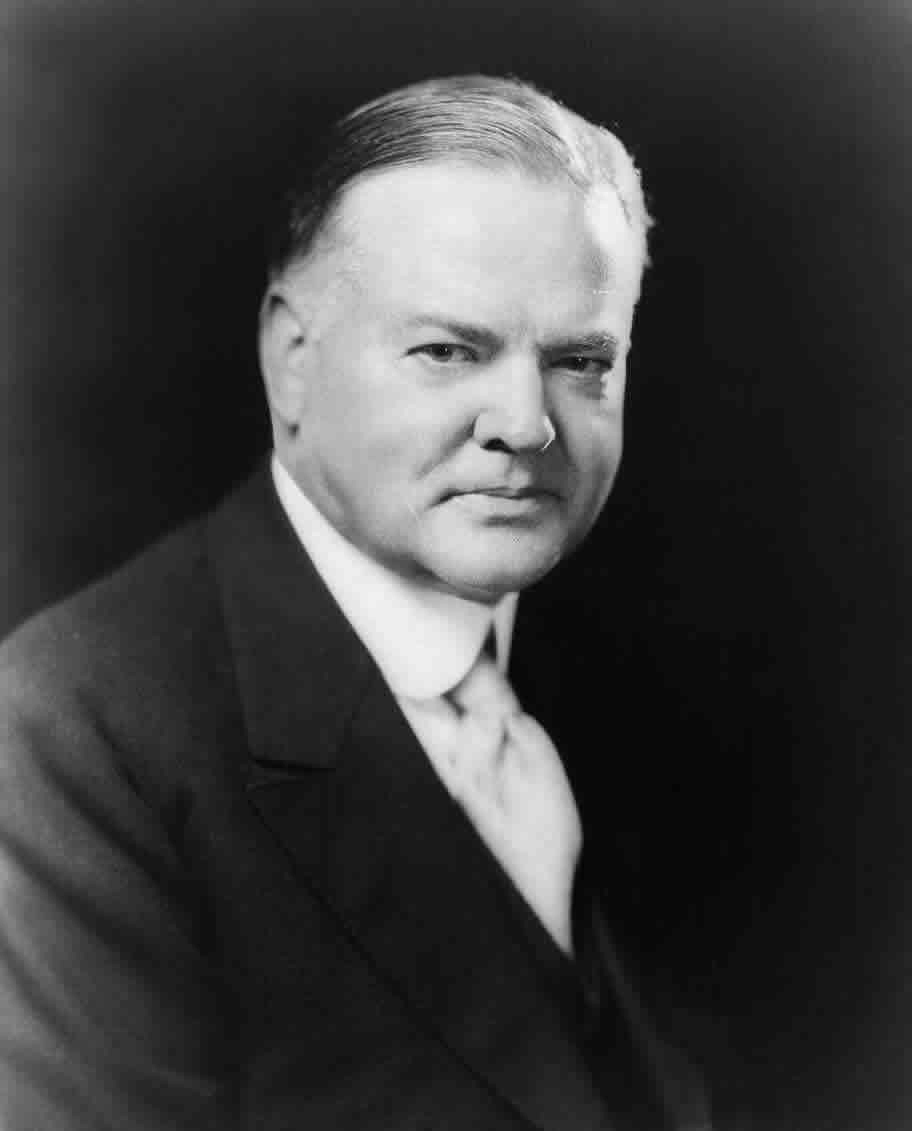
Hoover entered office with a plan to reform the nation's regulatory system,HerbertHoover believing that a federal bureaucracy should have limited regulation over a country's economic system. A self-described progressive and reformer, Hoover saw the presidency as a vehicle for improving the conditions of all Americans by encouraging public-private cooperation — what he termed "volunteerism". Hoover saw volunteerism as preferable to governmental coercion or intervention which he saw as opposed to the American ideals of individualism and self-reliance. Long before he had entered politics, he had denounced laissez-faire thinking.

October 22, 1928 Hoover gave his famous Rugged Individualism speech where he stated:

“Bureaucracy is ever desirous of spreading its influence and its power. You cannot give to a government the mastery of the daily working life of a people without at the same time giving it mastery of the peoples’ souls and thoughts. Every expansion of government means that government in order to protect itself from political consequences of its errors and wrongs is driven onward and onward without peace to greater and greater control of the country’s press and platform. Free speech does not live many hours after free industry and free commerce die.

It is false liberalism that interprets itself into the Government operation of business. The bureaucratization of our country would poison the very roots of liberalism that is free speech, free assembly, free press, political equality and equality of opportunity. It is the road, not to more liberty, but to less liberty. Liberalism should be found not striving to spread bureaucracy, but striving to set bounds to it. True liberalism seeks freedom first in the confident belief that without freedom the pursuit of all other blessings and benefits is vain. That belief is the foundation of all American progress, political as well as economic. Liberalism is a force truly of the spirit, a force proceeding from the deep realization that economic freedom cannot be sacrificed if political freedom is to be preserved. Even if governmental conduct of business could give us more efficiency instead of giving us decreased efficiency, the fundamental objection to it would remain unaltered and unabated. It would destroy political equality. It would cramp and cripple mental and spiritual energies of our people. It would dry up the spirit of liberty and progress. It would extinguish equality of opportunity, and for these reasons fundamentally and primarily it must be resisted. For a hundred and fifty years liberalism has found its true spirit in the American system, not in the European systems.

…

I wish to say something more on what I believe is the outstanding ideal in our whole political, economic and social system -- that is equality of opportunity. We have carried this ideal farther into our life than has any other nation in the world. Equality of opportunity is the right of every American, rich or poor, foreign or native born, without respect to race or faith or color, to attain that position in life to which his ability and character entitle him. We must carry this ideal further than to economic and political fields alone. The first steps to equality of opportunity are that there should be no child in America that has not been born and does not live under sound conditions of health, that does not have full opportunity for education from the beginning to the end of our institutions, that is not free from injurious labor, that does not have stimulation to accomplish to the fullest of its capacities.

It is a matter for concern to our Government that we shall strengthen the safeguards to health, that we shall strengthen the bureaus given to research, that we shall strengthen our educational system at every point, that we shall develop cooperation by our Federal Government with state governments and with the voluntary bodies of the country that we may bring not only better understanding but action in these matters.

Furthermore, equality of opportunity in my vision requires an equal opportunity to the people in every section of our country. In these past few years some groups in our country have lagged behind others in the march of progress. They have not had the same opportunity. I refer more particularly to those engaged in the textile, coal and in the agricultural industries. We can assist in solving these problems by cooperation of our Government. To the agricultural industry we shall need advance initial capital to assist them, to stabilize and conduct their own industry. But this proposal is that they shall conduct it themselves, not by the Government. It is in the interest of our cities that we shall bring agriculture into full stability and prosperity. I know you will cooperate gladly in the faith that in the common prosperity of our country lies its future.”

As you can by reading Hoover’s words while touting rugged individualism he was actually expressing progressive ideas of government intervention into the lives and economy of the America.

Prior to the start of the Great Depression, Hoover's first Treasury Secretary, Andrew Mellon, had proposed and seen enacted, numerous tax cuts, which cut the top income tax rate from 73% to 24%. When combined with the sharp decline in incomes during the early depression, the result was a serious deficit in the federal budget. Congress, desperate to increase federal revenue, enacted the Revenue Act of 1932, which was the largest peacetime tax increase in history. The Act increased taxes across the board, so that top earners were taxed at 63% on their net income. The 1932 Act also increased the tax on the net income of corporations from 12% to 13.75%.

The final attempt of the Hoover Administration to rescue the economy occurred in 1932 with the passage of the Emergency Relief and Construction Act, which authorized funds for public works programs and the creation of the Reconstruction Finance Corporation (RFC). The RFC's initial goal was to provide government-secured loans to financial institutions, railroads and farmers. The RFC had minimal impact at the time, but was adopted by President Franklin D. Roosevelt and greatly expanded as part of his New Deal. These programs were the first “bail outs” of private industries by government and increased the national debt from 20% of GDP to 40% not unlike what is happening today under Obama.

To pay for these and other government programs and to make up for revenue lost due to the Depression, in addition to the Revenue Act of 1932 Hoover agreed to roll back several tax cuts that his Administration had enacted on upper incomes. The estate tax was doubled and corporate taxes were raised by almost 15%. Also, a "check tax" was included that placed a 2-cent tax (over 30 cents in today's economy) on all bank checks. Hoover also encouraged Congress to investigate the New York Stock Exchange, and this pressure resulted in various reforms. All of these measures did little or nothing to mitigate the effects of the Depression.

For this reason, years later, libertarians argued that Hoover's economics were statist. Franklin D. Roosevelt blasted the Republican incumbent for spending and taxing too much, increasing national debt, raising tariffs, and blocking trade, as well as placing millions on the government dole. Roosevelt attacked Hoover for "reckless and extravagant" spending, of thinking "that we ought to center control of everything in Washington as rapidly as possible." Roosevelt's running mate, John Nance Garner, accused the Republican of "leading the country down the path of socialism".

Even so, New Dealer Rexford Tugwell later remarked that although no one would say so at the time, "practically the whole New Deal was extrapolated from programs that Hoover started."

Although Hoover had come to detest the presidency, he agreed to run again in 1932, not only as a matter of pride, but also because he feared that no other likely Republican candidate would deal with the depression without resorting to what Hoover considered dangerously radical measures.

Hoover was nominated by the Republicans for a second term. He had originally planned to make only one or two major speeches, and to leave the rest of the campaigning to proxies, but when polls showed the entire Republican ticket facing a resounding defeat at the polls, Hoover agreed to an expanded schedule of public addresses. In his nine major radio addresses Hoover primarily defended his administration and his philosophy. The apologetic approach did not allow Hoover to refute Democratic nominee Franklin Roosevelt's charge that he was personally responsible for the depression.

In his campaign trips around the country, Hoover was faced with perhaps the most hostile crowds of any sitting president. Besides having his train and motorcades pelted with eggs and rotten fruit, he was often heckled while speaking, and on several occasions, the Secret Service halted attempts to kill Hoover by disgruntled citizens, including capturing one man nearing Hoover carrying sticks of dynamite, and another already having removed several spikes from the rails in front of the President's train.

The election of 1932 was a disaster for the Republican Party. Franklin Roosevelt and his running mate John Nance Garner defeated Hoover by a margin of 57% to 40% in the popular vote and 472 to 59 in the Electoral College. Hoover carried only 6 states to FDR’s 42. The voters also gave Roosevelt a Democrat controlled House and Senate — a condition that would last until the end of WWII. Roosevelt had near dictatorial powers and he would use them.

Roosevelt's "First 100 Days" concentrated on the first part of his strategy:FDR_in_1933 immediate relief. From March 9 to June 16, 1933, he sent Congress a record number of bills, all of which passed easily. To propose programs, Roosevelt relied on leading Senators such as George Norris, Robert F. Wagner and Hugo Black, as well as his Brain Trust of academic advisers. Like Hoover, he saw the Depression caused in part by people no longer spending or investing because they were afraid. Roosevelt believed he could cure these ills with increased federal spending, higher taxes and the police power of the federal government. As for the Constitution it was just a bothersome document that was getting in the way of the masterminds of his “Brain Trust.”

Relief measures included the continuation of Hoover's major relief program for the unemployed under its new name: Federal Emergency Relief Administration. The most popular of all New Deal agencies — and Roosevelt's favorite — was the Civilian Conservation Corps (CCC), which hired 250,000 unemployed young men to work on rural local projects. While no doubt, as I have stated, the CCC provided valuable and needed public works it was still reducing unemployment by expanding government.

Congress also gave the Federal Trade Commission broad new regulatory powers and provided mortgage relief to millions of farmers and homeowners. Roosevelt expanded a Hoover agency, the Reconstruction Finance Corporation, making it a major source of financing for railroads and industry. Roosevelt made agricultural relief a high priority and set up the first Agricultural Adjustment Administration (AAA). The AAA tried to force higher prices for commodities by paying farmers to take land out of crops and to cut herds. While this seemed like a good policy at the time the unintended and tyrannical consequences were and still are severe (See Wickard v Filburn). It was a total revision of the Interstate Commerce Clause enumerated in Article I, Section 8 of the Constitution.

Reform of the economy was the goal of the National Industrial Recovery Act (NIRA) of 1933. It tried to end cutthroat competition by forcing industries to come up with codes that established the rules of operation for all firms within specific industries, such as minimum prices, agreements not to compete, and production restrictions. Industry leaders negotiated the codes which were then approved by NIRA officials. Industry needed to raise wages as a condition for approval. Provisions encouraged unions and suspended anti-trust laws. The NIRA was found to be unconstitutional by unanimous decision of the U.S. Supreme Court on May 27, 1935. (See Schechter Poultry Corp. vs. United States).In this decision the U.S. Supreme Court found that the NIRA invalidated regulations of the poultry industry according to the non-delegation doctrine and as an invalid use of Congress's power under the commerce clause. This was a unanimous decision that rendered the National Industrial Recovery Act, a main component of President Roosevelt's New Deal, unconstitutional.

Roosevelt opposed the decision, saying "The fundamental purposes and principles of the NIRA are sound. To abandon them is unthinkable. It would spell the return to industrial and labor chaos." The Judicial Procedures Reform Bill of 1937 was a legislative initiative proposed Roosevelt to add more justices to the U.S. Supreme Court. Roosevelt's purpose was to obtain favorable rulings regarding New Deal legislation that had been previously ruled unconstitutional. The central and most controversial provision of the bill would have granted the President power to appoint an additional Justice to the U.S. Supreme Court, up to a maximum of six, for every sitting member over the age of 70 years and 6 months. On March 29, the Supreme Court published its opinion upholding a Washington state minimum wage law in West Coast Hotel Co. v. Parrish by a 5–4 ruling, after Associate Justice Owen Roberts had joined with the wing of the bench more sympathetic to the New Deal. Since Roberts had previously ruled against most New Deal legislation, his perceived about-face was widely interpreted by contemporaries as an effort to maintain the Court's judicial independence by alleviating the political pressure to create a court friendlier to the New Deal. His move came to be known as "the switch in time that saved nine."

In 1937 the Supreme Court, with Robert’s concurrence, in the case of the National Labor Relations Board v. Jones & Laughlin Steel Corporation that declared that the National Labor Relations Act of 1935 (commonly known as the Wagner Act) was constitutional by a 5-4 decision. This decision reversed the interpretation of the Commerce Clause enumerated in Article I, Section 8 and it effectively spelled the end to the Court's striking down of New Deal economic legislation, and greatly increased Congress's power under the Commerce Clause. The act established the federal rights of workers to organize unions, to engage in collective bargaining, and to take part in strikes — the unintended consequences of this are enormous today. Roosevelt’s threat to pack the Court had succeeded and now his power was unlimited as farmer Filburn would discover in 1942. The Progressives had won a major victory that is still with us when it comes to the Court. It is an odd coincidence that it was Justice Owen Roberts who flip-flopped on the Roosevelt’s New Deal programs and it was Justice John Roberts who went out of his way to find enough whole cloth to declare ObamaCare as a tax and Constitutional. Beware of any judge with the last name of Roberts.

In 1933, major new banking regulations were passed. In 1934, the Securities and Exchange Commission was created to regulate Wall Street.

Recovery was pursued through "pump-priming" (that is, federal spending — also called stimulus). The NIRA included $3.3 billion of spending through the Public Works Administration to stimulate the economy, which was to be handled by Interior Secretary Harold Ickes. Roosevelt worked with Republican Senator George Norris to create the largest government-owned industrial enterprise in American history — the Tennessee Valley Authority (TVA) — which built dams and power stations, controlled floods, and modernized agriculture and home conditions in the poverty-stricken Tennessee Valley. It could also be considered one of the greatest overreaches of federal power in the history of the United States something Grover Cleveland or Calvin Coolidge would never have sanctioned. The TVA's service area covers most of Tennessee, portions of Alabama, Mississippi, and Kentucky, and small slices of Georgia, North Carolina, and Virginia. It was the first large regional planning agency of the federal government and remains the largest. The development of TVA was probably in violation of not only Article I, Section 8, but also of the 5th and 10th Amendments. It put the U.S. government squarely in the public utilities business something our Founders had no intention of doing. TVA, like education, demonstrates what the corrosive power of federal dollars (taxpayer’s money) can accomplish.

Executive Order 6102 declared that all privately held gold of American citizens was to be sold to the U.S. Treasury and the price raised from $20 to $35 per ounce. Exceptions were made for jewelers, coin collectors and a few others. The goal was to counter the deflation which was paralyzing the economy.

Roosevelt tried to keep his campaign promise by cutting the federal budget — including a reduction in military spending from $752 million in 1932 to $531 million in 1934 and a 40% cuts in spending on veterans' benefits — by removing 500,000 veterans and widows from the pension rolls and reducing benefits for the remainder, as well as cutting the salaries of federal employees and reducing spending on research and education. However, this was soon seen to be a mistake and most benefits were restored or increased by 1934. These benefit cuts also did not last. In June 1933 Roosevelt restored $50 million in pension payments, and Congress added another $46 million more. Veterans groups like the American Legion and the Veterans of Foreign Wars won their campaign to transform their benefits from payments due in 1945 to immediate cash when Congress overrode the President's veto and passed the Bonus Act in January 1936.

Roosevelt also kept his promise to push for repeal of Prohibition. On March 23, 1933, he signed the Cullen–Harrison Act redefining 3.2% alcohol as the maximum allowed. That act was preceded by Congressional action in the drafting and passage of the 21st Amendment, which was ratified later that year. The repeal of prohibition also brought in new tax revenues and helped Roosevelt keep a major campaign promise.

All of Roosevelt’s New Deal programs, while adding to the power and size of the federal government, did little to reduce unemployment or rejuvenate the private sector economy. The average unemployment rates during the depression were:

  • 1929: 3.2%
  • 1930: 8.9%
  • 1931: 16.3%
  • 1932: 24.1%
  • 1933: 24.9%
  • 1934: 21.7%
  • 1935: 20.1%
  • 1936: 16.9%
  • 1937: 14.3%
  • 1938: 19.0%
  • 1939: 17.2%3

Full employment (below 5%) did not return until the war years of the early 1940s. (Click here for a timeline of the Great Depression.)

The shining star in the early years of the Roosevelt Administration was the passage of the Social Security Act in 1935. The Social Security Act was drafted during Franklin Delano Roosevelt's first term by the President's Committee on Economic Security, under Frances Perkins, and passed by Congress as part of the Second New Deal. The act was an attempt to limit what were seen as dangers in the modern American life, including old age, poverty, unemployment, and the burdens of widows and fatherless children. By signing this act on August 14, 1935, President Roosevelt became the first president to advocate federal assistance for the elderly. It was also the beginning of federal entitlements and the largest Ponzi scheme in the history of the world where one generation would pay for the retirement of the preceding generation.

While considered by many to be unconstitutional in 1937 the Supreme Court upheld the Social Security Act in Helvering v. Davis as constitutional by deeming it a tax, not an entitlement. The Court held that Social Security was constitutionally permissible as an exercise of the federal power to spend for the general welfare, and did not contravene the 10th Amendment. The Court defended the constitutionality of the Social Security Act of 1935, requiring only that welfare spending be for the common benefit as distinguished from some mere local purpose. It affirmed a District Court decree that held that the tax upon employees was not properly at issue, and that the tax upon employers was constitutional.

In writing for the majority Justice Benjamin N. Cardozo stated that this decision supported the right of the Congress to interpret the "general welfare" clause in the U.S. Constitution. Cardozo stated:

"Congress may spend money in aid of the 'general welfare'. There have been great statesmen in our history who have stood for other views. The line must still be drawn between one welfare and another, between particular and general. Where this shall be placed cannot be known through a formula in advance of the event. The discretion belongs to Congress, unless the choice is clearly wrong, a display of arbitrary power, not an exercise of judgment. This is now familiar law."

In 2008 50,898,244 out of a population of 310 million were receiving Social Security checks (16% of the population) amounting to $615,344,000,000 dollars. This number is growing exponentially as we are running out of people to pay for it.

On September 23, 1932, during his campaign for the presidency, Roosevelt gave an address to the Commonwealth Club in San Francisco where he laid out his progressive ideology:

“As I see it, the task of Government in its relation to business is to assist the development of an economic declaration of rights, an economic constitutional order. This is the common task of statesman and business man. It is the minimum requirement of a more permanently safe order of things.

…

The Declaration of Independence discusses the problem of Government in terms of a contract. Government is a relation of give and take, a contract, perforce, if we would follow the thinking out of which it grew. Under such a contract rulers were accorded power, and the people consented to that power on consideration that they be accorded certain rights. The task of statesmanship has always been the re-definition of these rights in terms of a changing and growing social order. New conditions impose new requirements upon Government and those who conduct Government.

…

Every man has a right to his own property; which means a right to be assured, to the fullest extent attainable, in the safety of his savings. By no other means can men carry the burdens of those parts of life which, in the nature of things, afford no chance of labor; childhood, sickness, old age. In all thought of property, this right is paramount; all other property rights must yield to it. If, in accord with this principle, we must restrict the operations of the speculator, the manipulator, even the financier, I believe we must accept the restriction as needful, not to hamper individualism but to protect it.

…

The final term of the high contract was for liberty and the pursuit of happiness. We have learned a great deal of both in the past century. We know that individual liberty and individual happiness mean nothing unless both are ordered in the sense that one man’s meat is not another man’s poison. We know that the old "rights of personal competency," the right to read, to think, to speak, to choose and live a mode of life, must be respected at all hazards. We know that liberty to do anything which deprives others of those elemental rights is outside the protection of any compact; and that Government in this regard is the maintenance of a balance, within which every individual may have a place if he will take it; in which every individual may find safety if he wishes it; in which every individual may attain such power as his ability permits, consistent with his assuming the accompanying responsibility.

…

Faith in America, faith in our tradition of personal responsibility, faith in our institutions, faith in ourselves demand that we recognize the new terms of the old social contract. We shall fulfill them, as we fulfilled the obligation of the apparent Utopia which Jefferson imagined for us in 1776, and which Jefferson, Roosevelt and Wilson sought to bring to realization. We must do so, lest a rising tide of misery, engendered by our common failure, engulf us all. But failure is not an American habit; and in the strength of great hope we must all shoulder our common load.”

The final act of the progressive Roosevelt was the issuance of Executive Order 9066 interning over 100,000 innocent Japanese-Americans in “relocation camps” in violation of the 5th and 6th Amendments to the Constitution.

On November 10, 1937, Henry Morgenthau, U.S. Secretary of the Treasury during the administration of Franklin D. Roosevelt, gave a speech to the Academy of Political Science at New York's Hotel Astor, in which he noted that the Depression had required deficit spending, but that the government needed to cut spending to revive the economy. In his speech, he said:

"We want to see private business expand. We believe that one of the most important ways of achieving these ends at this time is to continue progress toward a balance of the federal budget.

We have tried spending money. We are spending more than we have ever spent before and it does not work. And I have just one interest, and if I am wrong somebody else can have my job. I want to see this country prosperous. I want to see people get a job. I want to see people get enough to eat. We have never made good on our promises. I say after eight years of this Administration we have just as much unemployment as when we started and an enormous debt to boot."

This was Roosevelt’s legacy of progressivism. The Great Depression was the war the progressives were looking for.