Search This Blog

Showing posts with label European Union. Show all posts

Friday, June 21, 2013

Obama Fails in Berlin

“There are many people in the world who really don't understand-or say they don't-what is the great issue between the free world and the Communist world. Let them come to Berlin!” — John F. Kennedy, Berlin, June 26, 1963.

Barack Obama returned to Berlin on Wednesday, almost five years to the day from when he delivered his famous "Victory Column" speech that cemented his reputation as an international rock star. Unfortunately, his reception this time was a lot different.

An estimated 200,000 people turned out in July 2008 to see then Candidate Obama deliver an address in front of one of Germany's most notable landmarks. He took a lot of criticism from Germans for his choice of location and from his U.S. political opponents who weren't happy about seeing an American presidential hopeful being adored by tens of thousands of foreigners. The Berlin event was larger than any of his U.S. campaign stops, though some critics even disputed the crowd figures. (Republicans in the heat of a campaign, obviously found other flaws with the speech.)

Fast forward to 2013, and many are now saying that Obama's reputation is "tarnished," by his recent snooping scandals, his extensions of the war on terror, and the hard luck realities of failing to deliver on all your promises. (Even ones you didn't really make.) He's "demystified" and "no longer a superstar" in German eyes. Now he's just another world leader on a state visit, and whatever problems people have with U.S. policy are on his shoulders.

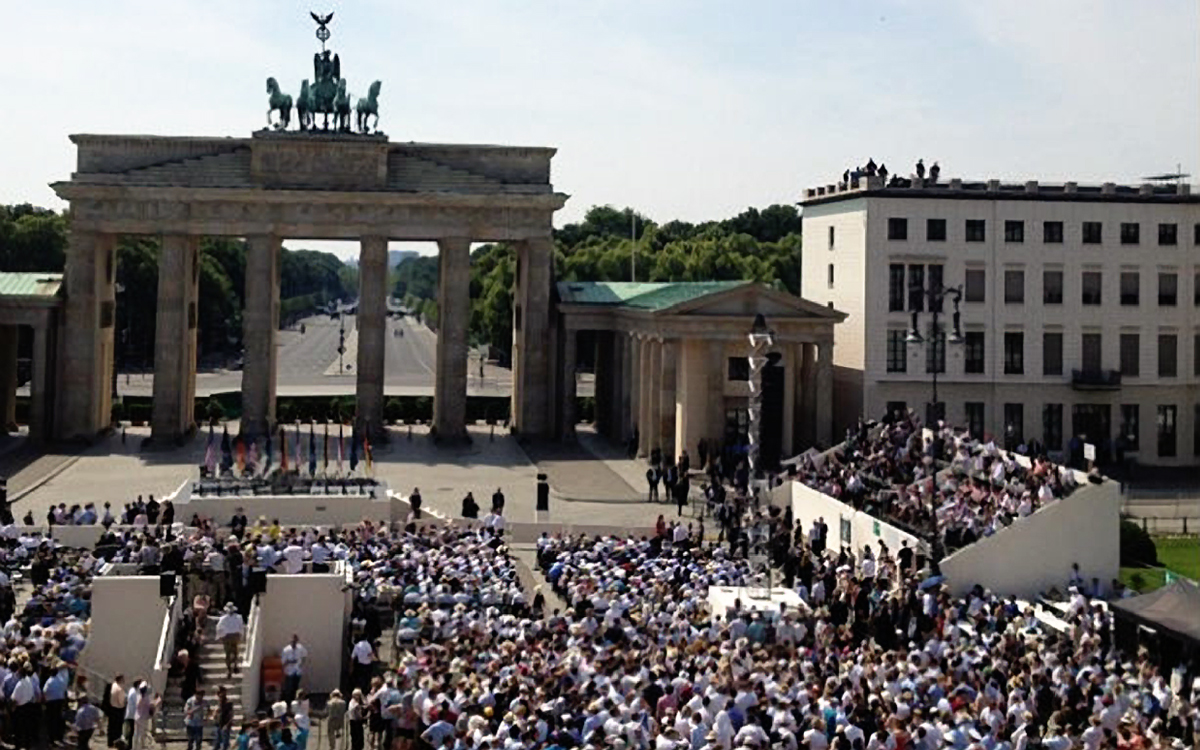
And instead of opening up the speech to the whole city, Obama spoke in front only about 5,000-6,000 spectators, all of them invited guests.

The White House pool report revealed that only 6,000 will be in attendance for Obama's Berlin speech on Wednesday:

“The stage for the president's speech is set up on the East side of the Brandenburg Gate,AP401450731793 in the old East Berlin. The sun is pounding down and there are around 6,000 invited guests according to German authorities. There are bleachers set up either side of the square, with a big two story riser facing the stage which has a row of bullet proof glass and 12 U.S., German and EU flags and the grand backdrop of the Gate. There is a large standing crowd between the bleachers.”

The actual crowd count at the Brandenburg Gate speech was 4,500.

His speech on Wednesday (you can click here for a detailed comparison vs. the 2008 speech) called for a reduction in global nuclear weapons (through more negotiations with Russia) and defended the idea of Western intervention in Syria. Hammering on the theme of "peace with justice," he also discussed closing Guantanamo Bay and taking action on climate change, calling it the "global flood of our time." (Much more on that here.) But it was notably different in tone than 2008's more sweeping view of the world, which was a speech more fitting for a candidate.

Nonetheless, directly out of the Brandenburg gate, the president commenced with injecting race and gender into the conversation when he said "Angela and I don't exactly look like previous German and American leaders." Obama then informed the audience, consigned by invitation to stand in the blistering heat listening to his blather, that Michelle, Malia, and Sasha, rather than endure his grueling speech, chose instead to experience the "beauty and the history of Berlin" (at American taxpayers' expense).

But probably the most amazing aspect of Obama's Berlin speech was his typical lack of self-awareness when making assertions that conflict with everything he does. For instance, although President Obama is actively persecuting the "unoriginated birthright of man," he quoted German philosopher Immanuel Kant, who said "freedom is the 'unoriginated birthright of man, and it belongs to him by force of his humanity.'"

Obama even posed questions Americans ask about him:

“Will we live free or in chains? Under governments that uphold our universal rights, or regimes that suppress them? In open societies that respect the sanctity of the individual and our free will, or in closed societies that suffocate the soul?”

In Berlin, Obama attempted to one-up Ronald Reagan's "Peace through Strength" strategy by stealing John F. Kennedy's "Peace with Justice" mantra and scheduled the revision to take place at Brandenburg Gate, where his social justice spiel paled in comparison to authentic Reagan strength.

The president's references were pitiful attempts to support the liberal dream of a daisy-holding, Kumbaya-singing utopia that the human condition prevents.

Ignoring nations stoking the nuclear flames, President "Ich bin ein Dumbkopf" cited JFK's famous 1963 "Ich bin ein Berliner" speech when suggesting that Germans "lift their eyes beyond the dangers of today to the day of peace with justice." Caught up in the rapture of the moment, Obama apparently missed the contradiction in mentioning Kennedy's assassination five months after he promoted "peace with justice."

Speaking of contradictions, Mr. Obama shared that Kennedy's words are "timeless becauseObama - speech they call upon us to care more about things than just our own self-comfort." This from a president who's about to embark on a $100 million African vacation, toting along a wife whose "self-comfort" demands recently included bunking in a $3,300-a-night Princess Grace suite in Ireland.
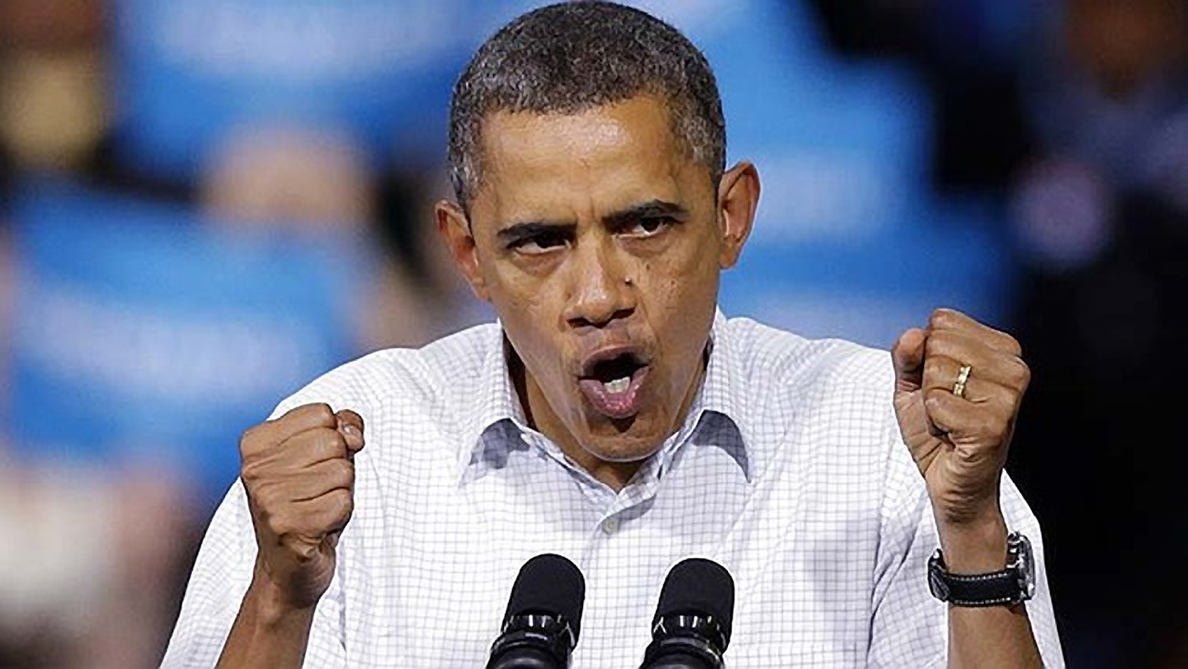
President Obama has been facing increasing scrutiny both at home and abroad as scandal after scandal rocks the administration. From Ireland the president went to Germany to talk about the dangers of global number of nuclear weapons, climate change and his views on social justice.

After encouraging youthful unemployed Germans to relinquish self-comfort, citizen of the world Obama shifted to "For we are not only citizens of America or Germany — we are also citizens of the world. And our fates and fortunes are linked like never before." That is, unless linking "fates and fortunes" means sharing a $3,300-a-night hotel room with Michelle Obama.

Never mentioning pressure cookers, hijacked airplanes, banana hammock bombers, or wild-eyed Muslims gunning down American soldiers, and after riding around in an armored limo and building a mysterious underground bunker beneath the White House, Obama proclaimed, "We may no longer live in fear of global annihilation, but so long as nuclear weapons exist, we are not truly safe."

President Obama also seemed to imply that food stamps and unemployment checks may be the answer to the threat of worldwide terrorism, which he claimed results from the "agony of an empty stomach or the anguish of unemployment."

Then, after dissing Catholic education in Ireland, Obama dredged up sins that penitent nations have already remediated when he unnecessarily brought up intolerance and abuses "based on race, or religion, gender or sexual orientation."

Obama then advanced a concept that he doesn't apply to Christians or American conservatives, which is that "When we stand up for our gay and lesbian brothers and sisters and treat their love and their rights equally under the law, we defend our own liberty as well."

That's when the "Peace with justice" rant began. Obama cited free enterprise and freedom, neither of which he's a huge fan of. From there, he segued into environmentalism, closing Guantanamo, ending the Afghan war, controlling the drones he has surveilling U.S. airspace, undermining the Constitution and calling it "balancing the pursuit of security with the protection of privacy," and meeting moral obligations that have nothing to do with morality.

Funny, Obama proves he's vulnerable to nuclear self-destruction whenever the Teleprompter is unavailable. Yet, he imagines peace can only be realized through sending a message to America's enemies that in a nuclear-aggressive environment the most powerful nation in the world is voluntarily reducing the number of its nuclear warheads.

Not to worry though; Barack quoted James Madison and then claimed that he too is moving "beyond a mindset of perpetual war." The president cited a 2016 'secure nuclear materials' summit, which despite the growing threat of international terrorism, Obama believes is a "step" toward "creating a world of peace with justice."

The problem is that the guy who said "Threats to freedom don't merely come from the outside. They can emerge from within" is the one threatening America's freedom, and the perpetual warfare he speaks of is not America's doing.

Appearing on MSNBC's Andrea Mitchell Reports on Wednesday, NBC's chief White House correspondent Chuck Todd came up with a long list of excuses for President Obama'sgatetodd poor speech performance in Berlin: "I want to give you a little context here there was an attempt to shrink the crowd size. Maybe they would have gotten 25, 30, 40,000 people. President Obama feeds off a crowd very well."
Todd then grasped at other reasons for the lackluster event: ".you had that very distracting glass and you could just see that the President himself wasn't feeding off of the crowd. And I think look, part of it, it was hot. Those folks were out there for two and a half hours it can sap your energy a little bit. And I just wonder if that added a little bit to this."

Barack Obama ended with a Martin Luther King Jr. quote crescendo:

"Injustice anywhere is a threat to justice everywhere."

In the end, so too does "loss of freedom in America threaten freedom everywhere." That loss is precisely why, both in Germany and here at home, free people must grasp the potentially harmful impact the 'peace-loving' guy riding around in a million dollar armored vehicle and standing behind eight inches of bulletproof glass seeks to impose on the Western world.

Tuesday, June 14, 2011

Why is NATO like McHale’s Navy?

“NATO was facing collective military irrelevance after years of inadequate defense spending by most of its members.” — Robert Gates, Secretary of Defense, June 10, 2011

On June 10, 2011 Secretary of Defense Robert Gates said before a meeting of Europe security experts in Brussels:

“In March, the alliance unanimously backed the decision to go to war in Libya to protect civilians from forces loyal to Moammar Gaddafi but less than half of NATO's 28 members were participating in the military operation and fewer than a third are conducting airstrikes against ground targets.

"Frankly, many of those allies sitting on the sidelines do so not because they do not want to participate, but simply because they cannot, the military capabilities simply aren't there."

You can read more by clicking here

Anyone old enough remembers the 60s sitcoms Gomer Pyle -USMC, F Troop, and McHale's Navy. A review of DVDs of those fine, funny shows of yore should be high on anyone's list who's been following NATO's misadventure in Libya. Incoming Secretary of Defense Leon Panetta may want to take a look-see. After watching a few episodes of each show, you'd swear Gomer Pyle is leading McHale's zanies and F Troop fumblers across Libya's desert sands in side-slapping futility — all set to laugh track guffaws.

Okay, NATO doesn't have boots on the ground in Libya, so Gomer and his goofs aren't zigzagging across North Africa. NATO, you see, can't make up its collective mind to put boots on the ground. NATO can't make up its collective mind to dispatch Muammar Gaddafi, either. One day the irascible Muammar is on NATO's hit list, the next day he's off — sort of. It's all high, humorous, and deadly incompetence, this game of whack-a-dictator that NATO is playing with Gaddafi.

Gaddafi pops his head up in some hamlet or village and NATO launches a barrage of missiles or drones or whatever's left in its dwindling munitions stockpile. Gaddafi escapes but some poor fellahin who happens to be in the wrong place at the wrong time gets a one-way ticket to paradise to meet some virgins.

NATO's Libyan adventure is premised on a lie — or, at least, a semi-lie. The lie is that NATO has intervened in Libya to protect innocents from Gaddafi's ghoulish depravity. NATO's leaders — so-called — might as well have declared that they're in Libya for the chil'ren's sake. "The chil'ren" is the all-purpose throwaway line that progressives use to justify any and every use or expansion of government, so why not use it to justify war?

The truth is that the Europeans who conceived the Libyan mess are a more cynical lot; they're using a humanitarian cover to protect vital Western European oil interests in the Middle East, but they're doing very poorly. You see, national self-interest is long out of vogue among progressives — European and American. Oil is too practical and tawdry a concern. The West must be about upholding selfless ideals. Hence, the need for Florence Nightingale to ride into Libya on the back of a Tomahawk missile or in the cockpit of an F-16 Fighting Falcon.

Though NATO's dithering incompetence in the Libyan fight might make for a few laughs for us observers, it's far less humorous and more instructive to NATO's and America's enemies (Opps — competitors; we must be scrupulously PC).

The Chinese, Russians, and Iranians — chief among the world's black hats — are watching avidly as NATO stumbles and bumbles in Libya — or never gets to Libya with troops in the first place, since the Great Libyan Humanitarian Intervention of 2011 is being run by committee (you know, committees, those wonderful collections of human beings tasked with designing elephants but concocting camels instead).

The military brass in China, Russia, and Iran must be licking their chops and taking copious notes. The once-mighty NATO can't make quick work of Gaddafi and his tiny semi-professional army. The United States — the world's remaining superpower, for the time being, anyway — and the NATO member capable of galvanizing resolve and leading the coalition to a swift victory in Libya is sitting on the sidelines — kind of. The U.S. is helping out, but halfheartedly. President Barack Obama, a thoroughly Kool-Aid drinking progressive, says the U.S. is weary of being the world's leader; let NATO's Barney Fifes figure out how to shoot straight and beat the bad guys.

Let's not forget that the Brits and Americans have had tougher fights in North Africa. Generals Montgomery and Patton drove Rommel and the tough-as-nails Germans out of North Africa during World War II. Are the Michael Jackson lookalike Muammar Gaddafi and his AK-47 wielding thugs tougher than Rommel and his Panzer divisions?

No one is suggesting that Libya is America's fight. There is no discernible vital American interest at stake in the overthrow of Gaddafi and the establishment of a new government there. Yeah, Gaddafi is a bad guy; everyone remembers Lockerbie, and most everyone knows that Gaddafi has given a helping hand to terrorists (militants for Islam - PC again). There are ways of exacting revenge for Gaddafi's deadly gambits like taking the guy out surgically and covertly without full-blown war. If we did it to Osama bin Laden we could do it to Gaddafi.

Or perhaps we could send in three or our four jeep teams with four SAS types and a .50 caliber Browning attached to each jeep like the 60’s series The Rat Patrol.

Yet, you can bet your bottom ruble that Putin and his gangster-cohorts are gaming moves to make against a weak and wavering Western Europe in light of NATO's impotent Libyan performance. Empire is in every Russian's DNA; Putin is certainly no exception. And Russians have a very Asian sensibility; they'll wait for exploitable opportunities, even if that's years down the road.

The Chinese are aggressively building blue water navy, and not to provide humanitarian relief in far-flung corners of the world, but to dominate the Asian Pacific region — and, perhaps, one day, say, the Indian Ocean. Mr. Obama's shoulder shrugs and masked hostility to U.S. global leadership is on full display in the NATO-Libyan imbroglio. The Chinese aren't dopes.

Chinese Leader Hu Jintao and Generals Liang Guanglie and Chen Bingde must be wondering if Mr. Obama's "We are the World — not Leaders" oath marks a permanent departure for the U.S. in global affairs, especially those involving military elements. A less assertive U.S. makes China's strategic and tactical moves — backed up by a strong military and the will to use it — much easier in the coming years.

And Iran? Despite the “marvelous” European and American team effort to shutdown Iran's nuclear weapons program, Iran's mullahs and President Mahmoud Ahmadinejad continue to intrepidly push ahead. The Iranians have already drawn a bead on Western impotence. The Libyan comedy starring NATO can only affirm that the Iranians need only finish making the bombs that they hope to kill Israelis with while cowing Europeans and Americans in the process.

Supreme Leader Ayatollah Ali Khamenei and President Mahmoud Ahmadinejad are gambling men, and from their perspective, NATO's Libyan bog is a green light to keep rolling the dice. Can you say mushroom clouds over Tel Aviv? If so it will be a tribute to the Europeans and Americans.

Consequences? Not always a pleasant word in global affairs. Even with an eventual victory in Libya, NATO has already botched it. NATO's enemies have a predator's keen eye and instincts. NATO's Libyan pratfalls and tail-chasing have been fully registered in Moscow, Beijing, and Tehran. The consequences longer term can't be good — and that goes for the U.S., too.

As Michelle Bachmann said in last night’s GOP debate:

“Our policy in Libya is substantially flawed. It's interesting. President Obama's own people said that he was leading from behind. The United States doesn't lead from behind. As commander in chief, I would not lead from behind.

We are the head. We are not the tail. The president was wrong. All we have to know is the president deferred leadership in Libya to France. That's all we need to know. The president was not leading when it came to Libya.”

Monday, June 13, 2011

A Single North America?

"I am well aware of the toil and blood and treasure that it will cost to maintain this Declaration, and support and defend these States." — John Adams

Talk of efforts to create a North American Union has been derided by the elite — politicians, talking heads and the mainstream media — as conspiracy-theory nuttery. But a leaked United States diplomatic cable proves the leaders of the U.S., Canada and Mexico have been working to create a borderless North America, similar to the European Union, since at least 2005.

The cable, leaked by WikiLeaks and reported on by the Canadian National Post, said: “An incremental and pragmatic package of tasks for a new North American Initiative (NAI) will likely gain the most support among Canadian policymakers. The economic payoff of the prospective North American initiative … is available, but its size and timing are unpredictable, so it should not be oversold.”

In the cable, U.S. diplomats focused on a number of key areas to move forward with continental integration, including a possible common currency, labor markets, international trade and the borders of the three countries, according to the article.

Diplomats were negotiating how to handle professional-licensing laws and work-permit systems between the three countries, which would make it easier for people to move from one country to the other.

The Administration of President Barack Obama is currently in discussions with Canadian Prime Minister Stephen Harper about creating the first step of the process by laying the groundwork for a stronger perimeter-security arrangement, intelligence sharing and trade deals, the paper reported.

Globalists pushing for a one-world government are taking an incremental approach to achieve their goal by combining countries into larger entities. They believe this will make it easier to combine larger regions into a single whole later on.

Questions about the possibility of a union of the countries have been met with disdain and denials by Administrations past and present. But these cables prove they were lying while trying to cover up the fact that they were negotiating away America in secret.

The National Post article states:

The details are currently being hashed out by officials from both countries. The proposed deal aims to improve the flow of cross-border traffic and increase security against terrorist threats.

Opposition parties have expressed a certain wariness over the lack of transparency of the talks and say they worry Harper will be too willing to make concessions to the U.S. over security issues, in order to gain an advantage in cross-border trade.

In the cable, U.S. diplomats focused on a number of key areas to move forward with continental integration, including a possible common currency, labour markets, international trade and the borders of the three countries.

The cable said Canadian economists were split on whether a fixed exchange rate, or a move to adopt the U.S. greenback, would benefit this country.

The document states Canadian economists point to labour markets as one of the areas which could have the greatest benefit for all three countries.

“They advocate freeing up professional licensing laws, and developing a quick, simple, low-cost work permit system, at least for U.S. and Canadian citizens,” the cable said.

It goes on to say North America would be well served by implementing a single, continent wide, tariff or a customs union arrangement.

The proposed customs union would eliminate the North American Free Trade Agreement’s “restrictive” rules of origin.

“NAFTA’s (rules of origin) are so restrictive that importers often prefer to pay the tariff rather than try to prove North American origin,” the cable said.

The cable concludes with a caveat: “There is little basis on which to estimate the size of the ‘upside’ gains from an integration initiative concentrating on non-tariff barriers of the kind contained in NAI. For this reason we cannot make the claims about how large the benefits might be on a national or continental scale.”

On February 8, 2011 the Toronto Star reported in an article entitled, Canada kept U.S. border talks under wraps:

“The federal government deliberately kept negotiations on a border deal with Washington secret while it planned ways to massage public opinion in favour of the pact, according to a confidential communications strategy.

The 14-page public relations document recommended that talks keep a “low public profile” in the months leading up to the announcement by Prime Minister Stephen Harper and U.S. President Barack Obama. At the same time, the government would secretly engage “stakeholders” — interested parties such as big business groups and others — in a way that respected “the confidentiality of the announcement.”

In advance, the government departments involved — including industry, foreign affairs, international trade and citizenship and immigration — were to “align supportive stakeholders to speak positively about the announcement,” according to the strategy prepared by Public Safety Minister Vic Toews’ officials.

On Friday, Harper and Obama signed off on a plan that for the first time envisions throwing up a single security ring around the perimeter of Canada and the U.S. The wide-ranging blueprint calls for increased cooperation between the two countries’ police, border and intelligence agencies; an integrated Canada-U.S. exit-entry system using high-tech identification techniques and more sharing of information about Canadians with U.S. authorities.

At least three major business organizations — the Canadian Chamber of Commerce, the Canadian Council of Chief Executives and the Canadian Trucking Alliance — quickly issued statements praising the framework agreement Friday.”

"To preserve and extend the benefits our close relationship has helped bring to Americans and Canadians alike, we intend to pursue a perimeter approach to security, working together within, at, and away from the borders of our two countries to enhance our security and accelerate the legitimate flow of people, goods, and services between our two countries," the declaration announced in the preamble.

The decision to declare a continental perimeter for the United States and Canada, designed to effectively combine the two nations in mutual national security and economic efforts, affirms the Obama administration's intent to implement the key objectives of the Security and Prosperity Partnership of North American in a way that avoids the type of public scrutiny and criticism that dogged President George W. Bush after he openly declared his plans with the SPP.

Way back in June 2006 World Net Daily reported:

“Despite having no authorization from Congress, the Bush administration has launched extensive working-group activity to implement a trilateral agreement with Mexico and Canada.

The membership of the working groups has not been published, nor has their work product been disclosed, despite two years of massive effort within the executive branches of the U.S., Mexico and Canada.

The groups, working under the North American Free Trade Agreement (NAFTA) office in the Department of Commerce, are to implement the Security and Prosperity Partnership, or SPP, signed by President Bush, Mexican President Vicente Fox and then-Canadian Prime Minister Paul Martin in Waco, Texas, on March 23, 2005.

The trilateral agreement, signed as a joint declaration not submitted to Congress for review, led to the creation of the SPP office within the Department of Commerce.

The SPP report to the heads of state of the U.S., Mexico and Canada, -- released June 27, 2005, -- lists some 20 different working groups spanning a wide variety of issues ranging from e-commerce, to aviation policy, to borders and immigration, involving the activity of multiple U.S. government agencies.

The working groups have produced a number of memorandums of understanding and trilateral declarations of agreement.

The Canadian government and the Mexican government each have SPP offices comparable to the U.S. office.

Geri Word, who heads the SPP office within the NAFTA office of the U.S. Department of Commerce affirmed to WND last Friday in a telephone interview that the membership of the working groups, as well as their work products, have not been published anywhere, including on the Internet.”

Many SPP working groups appear to be working toward achieving specific objectives as defined by a May 2005 Council on Foreign Relations task force report, which presented a blueprint for expanding the SPP agreement into a North American Union that would merge the U.S., Canada and Mexico into a new governmental form.

I have posted two video clips from Lou Dobbs when he was with CNN. What is interesting are the comments by Democrat politicians criticizing the SPP agreement and George Bush. Now that Obama has expanded on Bush’s initial agreement by signing a new and expanded agreement with Prime Minister Stephen Harper there seems to be no criticism from the left.

Lou Dobbs on the NAU
More on he NAU by Lou Dobbs

The additional three videos I posted detail some of the goals of the NAU and the people behind it. They are worth watching.

NAU: Fact or Fiction–Part 1
NAU: Fact or Fiction–Part 2
NAU: Fact or Fiction–Part 3

While trade agreements are worthy things like all international agreements and treaties they should be debated and approved by the people through their elected representatives — the Congress.

The European Union began as the European Economic Union with the goal of stabilizing trade and tariffs between the parties of the agreement. As Margaret Thatcher once said it would allow a citizen of the UK to buy a bottle of wine in France and bring it home without paying a tariff.

Over the years the EEC morphed into the EU which now regulates every aspect of life within the member states. They regulates everything from he size and shape of a banana to the size of a tractor seat. With the exception of the UK they have their own currency, the Euro, and they have their own courts that can overrule decisions of national courts. They have a parliament seated in Strasbourg France and a giant bureaucracy headquartered in Luxembourg. All of this came about with the Europeans desire to take a vacation in another country and bring back a bottle of wine or a slice of cheese.

In a July 26, 2010 opinion piece by Phil Boehmke in American Thinker he states:

“This morning our friends in Great Britain awoke to this frightening headline in the UK Daily Mail, "European police to spy on Britons: Now ministers hand over Big Brother powers to foreign officers." The European Union which has been so wildly successful in economic matters is implementing two new law enforcement policies which will further weaken the sacred and time honored protections of national sovereignty.

The new powers are known as the European Investigation Order (EIO), which is intended as a partner to the highly controversial European Arrest Warrant (EAW).

One of the major concerns about the EAW, to which Britain is signed up, is that it has been used to investigate the most minor misdemeanors, such as "theft of a dessert" in a Polish restaurant.

Now member states want to make it easier to gather evidence on another's soil. The proposal requires an ‘opt in', which means Britain could sit back and play no part in the new regime.”

While we debate our economy, the three wars we are fighting and Weiner’s Weiner there are forces within our government combining with the Canadians and Mexicans to bring the NAU to fruition and make it something much more than an agreement for truckers. Agreements like this have a history of morphing into something far different than their original intent. Democrats, Republicans, Libertarians and Independents should be very cautious in their support for the NAU.

This is just another attempt by the “one-worlders” like George Soros and his Open Society Institute and Open Borders Society to force into a global society. The NAU will eventually impact every aspect of lives and national economy. It will control the way we do business, our court decisions, our laws, our environmental policies, our immigration policies, and just about everything we do. It will absolutely destroy the Tenth Amendment to the Constitution by the power of treaties.

Friday, June 10, 2011

Gates Blasts NATO

"An association of men who will not quarrel with one another is a thing which has never yet existed, from the greatest confederacy of nations down to a town meeting or a vestry." — Thomas Jefferson

I have written several blog posts on the ineffectiveness of the North Atlantic Treaty Organization (NATO) and that the alliance has pasted its useful shelf life. Today I feel vindicated by Secretary of Defense Robert Gates.

The ongoing involvement in Libya and the inability of the NATO members to mount a unified campaign against Muammar Gaddafi has proven to be the death knell of the 62 year old alliance.

The Treaty of Brussels, signed on March 17, 1948 by Belgium, the Netherlands, Luxembourg, France, and the United Kingdom is considered the precursor to the NATO agreement. The treaty and the Soviet Berlin Blockade led to the creation of the Western European Union's Defense Organization in September 1948. However, participation of the United States was thought necessary in order to counter the military power of the USSR, and therefore talks for a new military alliance began almost immediately.

These talks resulted in the North Atlantic Treaty, which was signed in Washington, D.C. on 4 April 1949. It included the five Treaty of Brussels states, as well as the United States, Canada, Portugal, Italy, Norway, Denmark, and Iceland. Popular support for the Treaty was not unanimous; some Icelanders commenced a pro-neutrality, anti-membership riot in March 1949. The NATO mission statement was as follows:

“The Parties of NATO agreed that an armed attack against one or more of them in Europe or North America[ shall be considered an attack against them all. Consequently they agree that, if such an armed attack occurs, each of them, in exercise of the right of individual or collective self-defense will assist the Party or Parties being attacked, individually and in concert with the other Parties, such action as it deems necessary, including the use of armed force, to restore and maintain the security of the North Atlantic area.”

Such action as it deems necessary, including the use of armed force" does not necessarily mean that other member states will respond with military action against the aggressor(s). Rather they are obliged to respond, but maintain the freedom to choose how they will respond. This differs from Article IV of the Treaty of Brussels (which founded the Western European Union) which clearly states that the response will be military in nature. However, it is often assumed that NATO members will aid the attacked member militarily. Further, the North Atlantic Treaty limits the organization's scope to regions above the Tropic of Cancer, which explains why the Falklands War did not result in NATO involvement.

Greece and Turkey also joined the alliance in 1952, forcing a series of controversial negotiations, in which the United States and Britain were the primary disputants, over how to bring the two countries into the military command structure. The incorporation of West Germany into the organization on May 9, 1955 was described as "a decisive turning point in the history of our continent" by Halvard Lange, Foreign Minister of Norway at the time. A major reason for Germany's entry into the alliance was that without German manpower, it would have been impossible to field enough conventional forces to resist a Soviet invasion. Indeed, one of its immediate results was the creation of the Warsaw Pact, signed on May 14, 1955 by the Soviet Union, Hungary, Czechoslovakia, Poland, Bulgaria, Romania, Albania, and East Germany, as a formal response to this event, thereby delineating the two opposing sides of the Cold War.

The unity of NATO was breached early in its history, with a crisis occurring during Charles de Gaulle's presidency of France from 1958 onwards. De Gaulle protested at the United States' strong role in the organization and what he perceived as a special relationship between the United States and the United Kingdom. In a memorandum sent to President Dwight D. Eisenhower and Prime Minister Harold Macmillan on September 17, 1958, he argued for the creation of a tripartite directorate that would put France on an equal footing with the United States and the United Kingdom, and also for the expansion of NATO's coverage to include geographical areas of interest to France, most notably French Algeria, where France was waging a counter-insurgency and sought NATO assistance.

Considering the response given to be unsatisfactory, de Gaulle began to build an independent defense for his country. He also wanted to give France, in the event of an East German incursion into West Germany, the option of coming to a separate peace with the Eastern bloc instead of being drawn into a NATO-Warsaw Pact global war. On March 11, 1959, France withdrew its Mediterranean Fleet from NATO command; three months later, in June 1959, de Gaulle banned the stationing of foreign nuclear weapons on French soil. This caused the United States to transfer two hundred military aircraft out of France and return control of the ten major air force bases that had operated in France since 1950 to the French by 1967.

Though France showed solidarity with the rest of NATO during the Cuban Missile Crisis in 1962, de Gaulle continued his pursuit of an independent defense by removing France's Atlantic and Channel fleets from NATO command. In 1966, all French armed forces were removed from NATO's integrated military command, and all non-French NATO troops were asked to leave France. This withdrawal forced the relocation of the Supreme Headquarters Allied Powers Europe (SHAPE) from Rocquencourt, near Paris, to Casteau, north of Mons, Belgium, by October 16, 1967. France remained a member of the alliance, and committed to the defense of Europe from possible Communist attack with its own forces stationed in the Federal Republic of Germany throughout the Cold War. A series of secret accords between U.S. and French officials, the Lemnitzer-Ailleret Agreements, detailed how French forces would dovetail back into NATO's command structure should East-West hostilities break out.

Over the years NATO thwarted the advances of the Soviet Union into Western Europe and Turkey. The alliance first began to crack when not every member became involved in the crisis in the former Yugoslavia and he bombing war of Kosovo. Neither had posed a direct threat to the security of the NATO nations.

By the time the United States became involved in Afghanistan in 2012 not every NATO member put troops into the field yet Afghanistan’s role by harboring the Taliban and Osama bin Laden, was considered an attack against the United States. Countries such as Spain, Greece, and Turkey refused to engage in combat operations against the Taliban with Germany offering only non-combat logistical support.

By the time France and Italy convinced the United States to support their “No Fly Zone” and bombings in Libya less than half of the Alliance members were participating. Germany out rightly refused to participate in any way and Turkey was strong-armed by France and Italy to provide some logistical support.

Over the ensuing years the role of the United States increased to the point where by the beginning of 2012 the U.S. was paying 40% of the bill for NATO.

Yesterday Secretary of Defense Robert Gates gave his final speech to the Security and Defense Agenda think tank in Brussels by saying, “NATO was facing collective military irrelevance after years of inadequate defense spending by most of its members.”

The Los Angeles Times reports:

“In one of his last major addresses before his retirement this month, Defense Secretary Robert M. Gates said Friday that NATO's sometimes shaky air campaign in Libya had "laid bare" the shortcomings of the alliance, which he said was facing "collective military irrelevance" after years of inadequate defense spending by most of its members.

In March, the alliance unanimously backed the decision to go to war in Libya to protect civilians from forces loyal to Moammar Kadafi,[sic] but Gates noted that less than half of NATO's 28 members were participating in the military operation and fewer than a third are conducting airstrikes against ground targets.

"Frankly, many of those allies sitting on the sidelines do so not because they do not want to participate, but simply because they cannot," Gates said. "The military capabilities simply aren't there."

The assessment of NATO's capabilities came at the end of an 11-day around62265192-the-world trip that included stops in Asia and in Afghanistan, during which Gates said goodbye to U.S. troops after four and a half years in office. A former CIA analyst, Gates has used the trip to review America's place in the world, including the state of the transatlantic security relationship that has been at the center of his four-decade long career in government.”

The Los Angeles Times report continues:

“In recent weeks, the U.S. has stepped up its involvement by providing nine additional aerial refueling aircraft, according to the senior American official. Overall, U.S. aircraft are flying roughly 75 percent of the sorties, Gates said.

Gates praised the role in Libya of Norway and Denmark, which he said had provided 12 percent of the strike aircraft for the operation but had carried out one-third of the airstrikes.

Even after years of public and private pressure by Washington on NATO allies to increase military spending, Gates conceded that there was little prospect of that happening, especially with the intense fiscal pressure many governments in Europe now face.

He called instead on NATO countries to allocate their limited military budgets more wisely, on weapons and other capabilities that complement, rather than duplicate, spending by other members of the alliance.

Gates said that the U.S. share of NATO military spending has risen to more than 75 percent, while there were only four other members of the alliance -- Britain, France, Greece, and Albania -- whose military spending now exceeds 4 percent, the target set by NATO.

As a generation of American leaders whose outlooks were not formed during the Cold War come to the fore, Gates warned that there would be "dwindling appetite and patience" for the U.S to expend the funds on nations "apparently willing and eager for American taxpayers to assume the growing security burden left by reduction in European defense budgets."

Gates has made no secret of his frustration with NATO bureaucracy and the huge restrictions many European governments placed on their military participation in the Afghanistan war. He ruffled NATO feathers early in his tenure with a direct challenge to contribute more front-line troops that yielded few contributions.

Even so, Gates' assessment Friday that NATO is falling down on its obligations and foisting too much of the hard work on the U.S. was unusually harsh and unvarnished. He said both of NATO's main military operations now — Afghanistan and Libya — point up weaknesses and failures within the alliance.

"The blunt reality is that there will be dwindling appetite and patience in the U.S. Congress — and in the American body politic writ large — to expend increasingly precious funds on behalf of nations that are apparently unwilling to devote the necessary resources or make the necessary changes to be serious and capable partners in their own defense," Gates said.

Without naming names, he blasted allies who are "willing and eager for American taxpayers to assume the growing security burden left by reductions in European defense budgets."

The U.S. has tens of thousands of troops based in Europe, not to stand guard against invasion but to train with European forces and promote what for decades has been lacking: the ability of the Europeans to go to war alongside the U.S. in a coherent way.

The war in Afghanistan, which is being conducted under NATO auspices, is a prime example of U.S. frustration at European inability to provide the required resources.

"Despite more than 2 million troops in uniform, not counting the U.S. military, NATO has struggled, at times desperately, to sustain a deployment of 25,000 to 45,000 troops, not just in boots on the ground, but in crucial support assets such as helicopters, transport aircraft, maintenance, intelligence, surveillance and reconnaissance, and much more," Gates said.

For many Americans, NATO is a vague concept tied to a bygone era, a time when the world feared a Soviet land invasion of Europe that could have escalated to nuclear war. But with the demise of the Soviet Union in 1991, NATO's reason for being came into question. It has remained intact — and even expanded from 16 members at the conclusion of the Cold War to 28 today.

But reluctance of some European nations to expand defense budgets and take on direct combat has created what amounts to a two-tier alliance: the U.S. military at one level and the rest of NATO on a lower, almost irrelevant plane.

On a political level, the problem of alliance purpose in Libya is even more troubling, he said.

"While every alliance member voted for the Libya mission, less than half have participated, and fewer than a third have been willing to participate in the strike mission," he said. "Frankly, many of those allies sitting on the sidelines do so not because they do not want to participate, but simply because they can't. The military capabilities simply aren't there."

Afghanistan is another example of NATO falling short despite a determined effort, Gates said.

He recalled the history of NATO's involvement in the Afghan war — and the mistaken impression some allied governments held of what it would require of them.

"I suspect many allies assumed that the mission would be primarily peacekeeping, reconstruction and development assistance - more akin to the Balkans," he said, referring to NATO peacekeeping efforts there since the late 1990s. "Instead, NATO found itself in a tough fight against a determined and resurgent Taliban returning in force from its sanctuaries in Pakistan."

He also offered praise and sympathy, noting that more than 850 troops from non-U.S. NATO members have died in Afghanistan. For many allied nations these were their first military casualties since World War II.

For years NATO has been a paper tiger and it was only the threat of the use of nuclear weapons that kept the Soviet Union at bay throughout the Cold War. I can recall many conversations with my German friends from 1985 through 1998 while traveling in Germany and doing business. Not one of them was committed to NATO. They did not want to spend the required 4% of GP on defense and many were committed to pacifism. The believed they were doing “good” in Bosnia-Herzegovina as they perceived they were preserving the peace in Europe, yet reluctant to use troops in combat for any reason.

Today’s Eurocrats have no stomach for defense or the money to pay for it. After the fall of the Berlin Wall and the Soviet Union Western Europe has been spending its “peace dividend” on their social welfare programs — a peace dividend they got by living under the security umbrella of the United States for 62 years. It’s time for the U.S. Congress to come to its senses and reexamine in role in Europe’s defense and let them spend their own money to fight their battles and exert their influence, Just as we should with the United Nations it’s time for Uncle Sugar to pull the plug and defend our national interests with our troops and our money. If the Canadians and Brits want to come along, fine, but they will need to pull their share of the wagon.

Thursday, June 9, 2011

FCC Ditches Fairness Doctrine While EU Dabbles In Our Politics

"An association of men who will not quarrel with one another is a thing which has never yet existed, from the greatest confederacy of nations down to a town meeting or a vestry." — Thomas Jefferson

Two recent developments caught my eye today. One has to do with free speech and the other with a foreign government dabbling in our internal politics

Today the Congress drove the last nail in the so called Fairness Doctrine — I hope. Fox News reports:

“Under GOP pressure, the Federal Communications Commission has agreed to strike from its books an outdated yet still controversial regulation of political speech on the airwaves known as the Fairness Doctrine.

FCC Chairman Julius Genachowski said in a letter to a House Republican leader this week that the agency's effort to identify and eliminate "antiquated and outmoded rules that unnecessarily burden business, stifle investment and innovation, or confuse consumers and licensees" will include a recommendation to delete the Fairness Doctrine.

"I fully support deleting the Fairness Doctrine and related provisions from the Code of Federal Regulations, so that there can be no mistake that what has been a dead letter is truly dead," Genachowski wrote to Rep. Fred. Upton, chairman of the House Committee on Energy and Commerce. "I look forward to effectuating this change when acting on the staff's recommendations and anticipate that the process can be completed in the near future."

The Fairness Doctrine has been on the books since 1949. The regulation sought to ensure that discussion over the airwaves of controversial issues did not exclude any particular point of view by threatening to strip the licenses of broadcasters who provide diverse opinions. At the time, only 2,881 radio stations existed, compared with roughly 14,000 today.

The regulation was abolished in the 1980s, but the doctrine is still technically on the books. Upton and Rep. Greg Walden, chairman of the subcommittee on communications, applauded the news that it would be eliminated.

"We are heartened by your continued opposition to the Fairness Doctrine because of its chilling effects on free speech and the free flow of ideas," Upton and Walden said in a joint statement. But they wrote back to Genachowski Wednesday asking him when the regulation will be eliminated and whether he has the support of his fellow commissioners.

In an email to FoxNews.com, a spokesman for Genachowski would not say when the doctrine will be taken off the books and deferred to the other commissioners for their take.”

The Fairness Doctrine was a daring of the left. For years not many people, including the FCC, paid much attention to it. Reagan opposed it and had appointed commissioners who had put it on the back burner.

During the Clinton administration when Rush Limbaugh developed conservative talk radio and is said to have saved the AM band people began listening to his brand of talk radio. Soon Limbaugh brand of conservative talk radio across the nation through syndication on hundreds of AM stations. People were listening, sponsors were onboard and the Clinton administration was getting pissed. Clinton went so far as to call his political guru Dick Morris in the middle of the night to ask him what he could do to thwart Limbaugh’s caustic attacks. Morris countered with the development of a speaker’s bureau within the White House. Today Limbaugh averages anywhere between 25 to 30 million listeners each day.

It did not take long for other conservatives to jump on the talk radio band wagon. Conservative talkers like Sean Hannity, Michael Savage, Laura Ingraham, Neil Brootz and Marl Levine were on line and pushing the conservative cause. Meanwhile the left wing talkers were dying on the vine. People just were not tuning them in.

By 1998 and the height of the Monica Lewinski scandal the right-wing talkers were having a field day. It got so annoying to the White House, especially Hillary Clinton that with funding from George Soros Moveon.org was created to push the Clinton line and defend Bill Clinton

In 2004 again with financial help from George Soros Air America was founded. Air America was to be a radio station with a left wing progressive agenda. It never caught on and by 2010 after declaring chapter 7 bankruptcy the station was off the air.

This drove the progressives crazy. They could not muster an audience to compete with the conservatives. This is why they wanted the enforcement of he Fairness Doctrine, something they came close to getting. In 2010 with the Republican takeover of the House the Fairness Doctrine was doomed. Finally it has been put to bed and hopefully the listening public will decide what they want to hear or not want to hear. From the evidence they do not want to hear the liberals.

The second development is from a story in the London Mail about the EU dumping money into media outlets in this country to push their leftist’s progressive agenda. The Mail reports:

Brussels is pouring nearly £20million a year from its human rights budget on lecturing the Americans on left-wing causes.

“The EU Human Rights Fund is intended to help promote Western values in the developing world. But a shock report has found at least £17million of cash – around £2million from British taxpayers’ – has been ploughed into promoting the pet causes of Eurocrats in the U.S.

It is being spent on promoting abolition of the death penalty, discussion of climate change, green energy, and the International Criminal Court – all controversial subjects in the U.S.

The study by the Heritage Foundation, a center-right Washington think-tank, found a further £4million has been ploughed into pro-EU propaganda in the U.S., including funds for advertising and publicity material.

More than £3million has been funneled to American universities to promote the benefits of European integration and a further £3million to think-tanks who want to study EU affairs.

The European Commission’s own accounts show millions have also been paid to unnamed individual opinion formers in the U.S.

The report’s British author Sally McNamara said: ‘It is impossible to justify EU human rights budgets being spent in one of the world’s freest nations.’

Tory MP Douglas Carswell said: ‘The U.S. was founded by North Americans fed up with Europeans interfering in its internal affairs.”

'The U.S. as a country has done more to bring liberty and human rights to the world than anyone in Europe. They don’t need any lessons from Brussels.’

Stephen Booth, research director of the Open Europe think tank said: ‘The EU has absolutely no mandate to wade in to politically sensitive debates in the U.S.’

According to Sally McNamara of the Heritage Foundation in her recently published report:

From 2007 through 2009, the European Union spent $1.23 billion in the United States. A large part of this money funded projects in other foreign nations that were administered by the U.S.-based World Bank and United Nations. However, according to the European Union’s financial records posted online, large amounts of European taxpayer money were spent directly inside the United States and served to give the European Union greater influence, and advance the EU’s favored political causes, in America. Some of America’s wealthiest academic institutions have received millions of dollars in research grants and other contracts to promote a positive view of European integration. U.S. non-governmental groups received large sums of money from the EU’s human rights budget to advance a social agenda that many Americans would consider radical. A number of multimillion-dollar confidential payments were also made inside the U.S. to unidentified “natural persons” (individuals, not corporations) from an array of EU budget lines, including the Common Foreign and Security Policy (CFSP).

The United States and most European countries have much in common politically and culturally, and EU public diplomacy expenditures inside the U.S. should be minimal compared to spending in countries that do not share the core Euro–Atlantic values of democratic governance, the rule of law, and human rights.

How any foreign entity is spending money inside the U.S. should be of concern to Americans and their elected representatives on Capitol Hill. Congress has a duty to ensure that U.S. laws, sovereignty, and interests are not being undermined from within. Congressional oversight is needed to identify exactly how and where the EU is intervening inside the U.S.

Governments of EU member states and European parliamentarians should also thoroughly investigate EU spending in the United States and determine its appropriateness. The EU’s spending inside the U.S. comes after the EU Court of Auditors refused to sign off on the accounts of the European Union for the 16th consecutive year.

The EU budget was increased by 2.9 percent in 2011, during a time of severe austerity cuts in many EU countries, including cuts to education budgets. The European Commission has requested a budget increase of 4.9 percent for 2012. Governments and parliamentarians should ensure that the European Commission’s existing expenditures are both necessary and prudent before contemplating any increases for 2012.”

This is just another example the progressive left attempting to influence our political system with their money. The EU is going broke, yet they can find the money to the Brookings Institute a left wing progressive think tank. It’s bad enough we have billionaires the likes of George Soros pouring his money into these left wing organizations we now have the EU trying to affect our political system.

100 years ago there would have been a call for war had this happened. It is a direct threat to our national security and sovereignty. Our Founders are turning over in their graves. The EU has made a mess of Europe and now they want to bring their trashy ideas of socialism to our shores. I hope Congress looks into this and tells the American people just what is happening and the dangers this represents to our Republic.

Monday, April 25, 2011

Libya, NATO, and Afghanistan

"How could a readiness for war in time of peace be safely prohibited, unless we could prohibit, in like manner, the preparations and establishments of every hostile nation?" — James Madison

Today, this Monday after Easter I thought of so many things I would like to blog about that I couldn’t decide on anyone topic. Instead I am taking a page out of Matt Drudge’s and Adriana Huffington’s book and practice some aggregation.

Iraq: “Two suicide car bombs were detonated outside the perimeter of the former Green Zone in Baghdad on Monday, killing five and wounding as many as three times that. Recent militant activity in the country has been on the upswing but one of the most important dynamics is the looming withdrawal of the remaining American military forces by the end of the year.

The current Status of Forces Agreement between Washington and Baghdad stipulates the remaining nearly 50,000American troops still in country must be withdrawn by the end of the year. The United States has expressed some interest in extending this deadline, including during the visit sending U.S. Secretary of Defense Robert Gates to Baghdad earlier this month. However, all such overtures thus far have been rejected by the Iraqi government. The numbers being discussed go as high as 20,000 American troops, and Washington has attempted to emphasize the capabilities the United States provides Iraq that the Iraqi military is not yet capable of providing for itself — everything from the defense of Iraqi airspace, to more sophisticated capabilities in planning, logistics, maintenance and intelligence. U.S. officials have also reportedly emphasized to Baghdad that once the withdrawal of American combat forces is complete, that it will be much more difficult for the United States to come to Iraq’s aid militarily in the future.

At the heart of this discussion is the fundamental importance of the U.S. military in counterbalancing Iranian power in Iraq and in the wider region. The large American military presence in Iraq has been the single most important element of American power in Iraq and in the region since the U.S. invasion in 2003. But it is far from clear how Washington is going to balance resurgent Iranian power in Iraq and in the wider region once those forces withdraw. It is not clear whether a new agreement or an extension can be negotiated between Washington and Baghdad — the U.S. has signaled the ball is in Iraq’s court. But an increasingly rapid withdrawal will have to begin no later than late summer or early fall, this quarter and the next are of pivotal importance not only for the United States and Iraq, but for Iranian power and the wider region.” [Stratfor]

Libya: “The African Union and the Turkish government are both trying to negotiate a cease-fire in Libya. Libyan leader Moammar Gadhafi has already given the green light to an African Union proposal led by South African President Jacob Zuma on the condition that NATO first cease its airstrikes. The rebels in the east have rejected the terms of the cease-fire, sticking to their demand that Gadhafi first step down. Meanwhile, NATO forces maintained that they will continue launching airstrikes as long as Libyan civilians in the east are threatened.

Clearly, the cease-fire negotiations are fraught with complications. But as time wears on, it’s looking increasingly likely that the current stalemate in Libya could give way to a de facto partition between east and west. This may not be the ideal scenario for many, but it could allow the United States to avoid another costly nation-building exercise in the Islamic world, while allowing Gadhafi to remain in power, however tenuously. Each party in this conflict — whether you’re talking about the eastern rebels, Gadhafi’s forces or NATO forces — are facing considerable dilemmas in how to proceed in this military campaign.

The eastern rebels have made clear that they’re not content with holding onto the east and ceding the west to Gadhafi’s forces. The problem with the rebel forces it that they are severely ill-trained and ill-equipped. And if you take a look at the battles that have been taking place in the energy-critical areas of (Marsa el) Brega, Ras Lanuf, Zawiya and the port of Sidra, show just how difficult of a time the rebels are having in trying to push Gadhafi’s forces back. And the more Gadhafi’s forces deliberately pull back into built-up urban strongholds in the west, the less likely NATO forces are to provide air cover for fear of causing mass civilian casualties. Simply put, the rebels do not have the fighting power to advance westward to Tripoli.

Meanwhile, Gadhafi’s forces remain largely in control of the main energy-producing regions running alongside the dividing line of the country and the Gulf of Sidra region. These forces reach as far as Ajdabiya, just below the rebel stronghold of Benghazi. Though a number of Gadhafi’s tanks are being eliminated by NATO airstrikes, his forces have been able to rely on much less resource-intensive and highly mobile civilian vehicles and technicals to move their forces around and push the rebels back. Gadhafi’s forces are facing heavy constraints in resupply as long as NATO forces are patrolling the seas and the skies over Libya. All in all, though, Gadhafi would be negotiating from a relative position of strength in any cease-fire negotiation. Even if Gadhafi himself is eliminated, there do appear to be enough forces loyal to him that could step in and reassert control from the west.

This obviously puts NATO in a very difficult spot. As long as Gadhafi’s forces have the option of pulling back into well built-up urban strongholds, NATO will face very heavy constraints in trying to avoid the risk of blowback in causing civilian casualties. This gives Gadhafi undeniable staying power. Meanwhile, the United States is facing much more pressing and strategic concerns more eastward in the region in the Persian Gulf region, where Iran is waiting to fill a power vacuum in Iraq as U.S. forces are drawing down there. The U.S. then may be resigning itself to the idea that it may not be getting much beyond a stalemate in Libya, and that forcing a power vacuum in the country may be a lot more trouble than it’s worth.” [Stratfor]

"Obama's ideology tethers him to the idea that the central government should be the primary engine of economic growth and the super-arbiter of the winners and losers in our economy. He cannot countenance the possibility that Keynesian stimulus spending does not appreciably stimulate and probably does just the opposite; never mind that we can't afford it. He can't process that we cannot tax ourselves into prosperity or out of debt. He is viscerally unwilling to restructure the programs that have us committed to $88 trillion in unfunded liabilities. And he either cannot comprehend or is morally hardened to the evil and ineffectiveness involved in the government's making command-control decisions rather than free people through the invisible hand of the market, especially in health care. He cannot understand or is rebellious against the truth that capitalism is morally superior to and produces greater prosperity across the board than any other economic system, bar none. ... Obama, captured in his maximum-security class warfare prison mindset, has proposed even higher taxes on the already overburdened producers, which would further smother the economy and prevent economic recovery, growth and abatement of the national debt. His only real remedy for Medicare is to empower the Independent Payment Advisory Board to ration health care according to its one-size-fits-all lunacy. ... There can be no workable compromise with Obama because his plan could not work to retire the debt and avert our national crisis. The only solution is to retire him." — columnist David Limbaugh.

Afghanistan: Real life imitated art in Afghanistan's troubled Kandahar province as the Taliban took a page out of Steve McQueen's playbook, dug a tunnel underneath an Afghan prison where hundreds of high value detainees were being held, and 478 prisoners waltzed out of jail — free men due to the incompetence of Afghan security forces.

“Hundreds of prisoners escaped from a jail in Afghanistan's south on Monday through a tunnel dug by Taliban insurgents, officials said, a "disaster" for the Afghan government and a setback for foreign forces planning to start a gradual withdrawal within months.

“Tooryalai Wesa, governor of volatile southern Kandahar province, told Reuters 488 prisoners escaped due to the negligence of Afghan security forces at the province's main jail. He said the tunnel led to a nearby house.

The Taliban said in a statement that 541 prisoners escaped through the tunnel, which took months to construct, and were later moved in vehicles to safer locations. The prison, touted as one of the most secure in Afghanistan, is located on the outskirts of Kandahar city.

Afghan President Hamid Karzai's chief spokesman told a news conference that the incident, in which many Taliban commanders were said to have escaped, exposed serious vulnerabilities in the Afghan government.

"This is a blow, it is something that should not have happened. We are looking into finding out ... what exactly happened and what is being done to compensate for the disaster that happened in the prison," spokesman Waheed Omer said.

General Ghulam Dastgir, the governor in charge of the jail, said the prisoners had all escaped through the tunnel.

"No one managed to escape through the main gate, everybody went out through the tunnel. The insurgents worked on it for some seven months," Dastgir said.

"The Taliban have planted bombs inside the tunnel and it is hard to investigate until the explosives are removed," he said.

Kandahar, the birthplace of the Taliban, has been the focus of the U.S.-led military campaign over the past year, with tens of thousands of U.S. and Afghan troops launching offensives around Kandahar city.

In Washington, Pentagon spokesman Colonel David Lapan said it is too early to tell what impact the escape will have on plans to hand over other prisons to Afghan security control.

A U.S. State Department official, speaking on condition of anonymity, indicated that the push to transfer more security responsibilities to Afghan officials will continue.

"This escape is a serious issue which the Afghan authorities are working to address," the official said, adding that both U.S. and Canadian advisors helped train and mentor Afghan Central Prisons Directorate staff at the prison.

Twenty-six prisoners were recaptured and two killed in a gunfight with security forces, Wesa said.

Lieutenant Colonel Elizabeth Robbins, a Pentagon spokeswoman, said Afghan officials had not officially asked for help in recapturing the prisoners but NATO "personnel who patrol the area are aware of the situation and will assist the Afghan authorities in responding as needed."

Reporters were taken into the prison after the jailbreak to view the opening of the tunnel in one of the cell blocks.

Reuters photographs showed a hole, several feet deep, cut into the concrete floor of one of the cells. The hole, big enough to allow one man to climb down at a time, appeared to be connected to a tunnel.

A large carpet in the cell looked to have been folded back to expose the hole. Police told reporters the insurgents had used car jacks to break through the concrete floor, which was several centimeters thick.

The Taliban said the prisoners escaped over a four-and-a-half hour period during the night, meaning more than 100 prisoners an hour would have had to crawl out through a tunnel barely large enough to fit one man.

"Mujahideen started digging a 320-meter (1,049 feet) tunnel to the prison from the south side, which was completed after a five-month period, bypassing enemy checkposts and the Kandahar-Kabul main highway leading directly to the political prison," the Taliban statement said.

"They moved people in several groups. They had a comfortable period of time to move that many people. It's obviously very worrying with the timing around fighting season," said a foreign official in Kandahar with knowledge of the incident.

Wesa said of the 488 who had escaped, 13 were ordinary criminals and the rest were insurgents. [Reuters]

The Steve McQueen movie – The Great Escape – was a dramatized account of allied POW's digging a tunnel to freedom for 76 men - most of whom were eventually recaptured (50 escapees were murdered by the Gestapo.) The Taliban had considerably more success and few of the prisoners will probably be recaptured.

It is even money that the prisoners had help from some in the Afghan army who were guarding them. That kind of corruption is common place in a country that continues to show it is unworthy of the expenditure of treasure and blood by the US military.

NATO in Libya: "The official Pentagon estimate is that the war in Libya cost us $608 million for the first 17 days. Some think that is a laughable underestimate, however, except that nobody is laughing. Forbes reported at the end of March that 'what looks like an inexpensive military operation in Libya is actually costing taxpayers about $2 billion per day.' Remember how Democrats and Republicans in Congress wrestled back and forth recently, nearly shutting down the government over a lousy $38 billion? Heck, we've already burned through that in Libya and Muammar Gadhafi is still thumbing his nose at us from Tripoli. Technically, the air war in Libya is being fought by NATO. But the United States, in addition to paying for our own forces, pays about a quarter of NATO's budget [25.2%]. The numbers get kind of dazzling, but according to the Fiscal Times: The United States now pays NATO $90.2 million for its civil budget, $462.5 million for its military budget and $259 million for NATO's Security Investment Program, which covers radar bases, airfields, fuel pipelines, etc. That is about $811.7 million per year. And how is NATO doing in Libya, by the way? Not all that well." [columnist Roger Simon]

Thursday, April 21, 2011

NATO, the U.N. and Humanitarian Wars

“If it be asked, What is the most sacred duty and the greatest source of our security in a Republic? The answer would be, an inviolable respect for the Constitution and Laws—the first growing out of the last... A sacred respect for the constitutional law is the vital principle, the sustaining energy of a free government.” — Alexander Hamilton

Humanitarian war-making (an oxymoron, indeed) is on full display in Libya. Reports persist that the Libya intervention, as it's commonly referred to, is bogged down. Is anyone really surprised?

There's been talk of the U.S. sending in ground troops as part of an international force to aid Libyan rebels, among whom are, undoubtedly, jihadists — jihadists, as in enemies of the United States and the entire Western world. But if the U.S. doesn't pony-up troops, NATO may. Never mind that a humanitarian war was supposed to protect innocents, not support rebels. Doesn't taking sides violate a tenet of humanitarian war? Or will the U.N. sanctioned coalition overtly help the rebels in the name of humanitarianism?

Just today Obama signed off on the use of Predators Drones to support062410_drone_20110421_161501 the “rebels’ in Libya. Fox News reports; “The U.S. is not at war with Libya and has not taken sides, but President Obama nevertheless has signed off on the use of armed predator drones in the North African nation that has been torn by a weeks-old bloody conflict, Defense Secretary Robert Gates said Thursday.”

"What the president has said that where we have some unique capabilities, he is going to use those, and in fact he has approved the use of armed predators, and I think today may have been in fact their first mission," he said.”

“The president approved the use of two unmanned aircraft around the clock to pick off targets in urban areas in Libya. The U.S. military tried to launch them Thursday but turned them back due to bad weather.”

“Obama already uses the drones to target terrorists along Pakistan's border with Afghanistan. Gates said the drones will enable more precise attacks against Col. Muammar Qaddafi's forces.”

“The move carries political risks as it could further alienate the president's anti-war base as he ramps up his re-election campaign. And several members of Congress already feel spurned by the president because he launched "limited" military operations without consulting them first. Stepping up the U.S. effort there could draw more ire from them.”

Who knows about humanitarian war's tenets? Liberals, being good relativists, are situational; aims are always malleable. But we do know this: winning at war — or articulating victory as the goal of war — is to be dismissed. Have President Obama and those mealy-mouthed functionaries at the State Department claimed victory as a war aim? Winning — as in defeating an enemy — defines traditional war, which liberals disdain. Traditional war is about protecting or advancing vital national interests, but national interests are narrow, squalid concerns.

The opening shock and awe phase of the Libyan fight was supposed to either kill Moammar Qaddafi (despite Orwellian pronouncements to the contrary) or send him packing, tail tucked between his legs. Instead, Gaddafi is proving wily and tenacious — to a point. Former British Prime Minister Tony Blair is warning not to underestimate Qaddafi (as reported in the Washington Times). Of course, neither should anyone overestimate the progressives who are running this war.

Why can't the mighty Western militaries that comprise the coalition quickly do-away with Qaddafi and his humble military? Answer: they aren't tasked to do so. It's not part of the U.N. mandate. Instead, coalition forces pursue a one foot in and one foot out plan that needlessly and inhumanely protracts the Libyan war. Inconclusiveness is the great killer in war.

It Turns out air power’s not enough in heavily populated urban areas, a development that was totally foreseeable, actually. And since no one’s eager to send in ground troops, we appear to be stuck. “We rushed into this without a plan,” a retired Army general told the LA Times. “Now we’re out in the middle, going in circles.”

Says Eli Lake, the Washington Times’ national security reporter, “At this point if NATO was in a fight with the Broadway production of CATS, would you bet on NATO or CATS?”

NATO officials acknowledged that they are having trouble destroying Gadhafi’s mortars and rocket launchers from the air, for fear of inadvertently harming civilians in such strikes. “There is a limit to what can be achieved by airpower to stop fighting in a city,” said NATO Brig. Gen. Mark van Uhm. He said his forces have destroyed more than 40 tanks and several armored personnel carriers there.

Adm. Giampaolo Di Paola, chairman of NATO’s military committee, said that even though NATO operations have done “quite significant damage” to the Libyan regime’s heavy weaponry, what Qaddafi has left is “still considerable.”

Rebels trapped in Misrata grumbled yesterday to the Washington Post that they feel “let down” by NATO’s unwillingness to bomb buildings where Qaddafi’s snipers are holed up. One of them, referring to the UN mandate to protect Libyan civilians, said, “If they cannot do it, they should say they cannot do it.” Today they’re taking a different tack, calling on the coalition to do the one thing no one wants to do:

“We need a force from NATO or the United Nations on the ground now,” said Nouri Abdullah Abdulati, of the city’s 17-member judicial committee, speaking to a handful of reporters”.

“We did not accept any foreign soldiers on our land. But that was before we faced the crimes of Qaddafi,” Abdulati said Tuesday. “We are asking on the basis of humanitarian and Islamic principles for someone to come and stop the killing. The whole Arab world is calling for the intervention of the West for the first time in history.”

“Abdulati said the committee would want British or French troops to fight alongside rebel fighters in Misurata, both to protect civilians and to fight off Qaddafi forces.”

Believe it or not, the EU’s actually toying with the idea of sending in ground troops — but only to escort humanitarian relief convoys, which isn’t quite necessary yet since the port of Misrata remains open for shipments. (Qaddafi’s promising to fight any such force that shows up.) France and the UK are also sending very small squads of military trainers to Benghazi to help the rebels get better organized. It’s escalation by inches, in other words, but escalation all the same to preserve what little remains of European military prestige. A simple question, then, per Lake’s snarky comment up top: At this point, is there any way to really preserve European prestige? The best possible outcome for the EU would be to get cracking on that larger “humanitarian escort” force and send it in to try to intimidate Qaddafi into choosing exile. But that’s a huge gamble: If, as he’s said, he chooses to fight and manages to hold off the European advance for awhile, it’ll be even more crushing to their prestige. He might relish the idea too, given his own ideas of himself as an African king and the European legacy of colonialism on the continent. A gloss:

“By the U.S. taking a back-seat role, it has a psychological effect on the mission,” said Dan Fata, a former Defense Department official who was responsible for overseeing NATO issues during the George W. Bush administration. “If I’m Qaddafi, I’m thinking I can probably wait the Europeans out.”

The humanitarian war in Libya is full of half-measures with incrementalism lurking in the wings. In the U.S., liberals' war-making was previewed in Vietnam decades ago. Didn't liberals learn anything from that long, bloody, losing affair? Also liberals have not learned about high taxes and big spending government either. Americans, however, should know better on both counts. As Sun Tzu, the ancient military tactician and philosopher said; “There has never been a protracted war from which a country has benefited.” (This can also be said of Afghanistan — another NATO and U.S. debacle).

Barack Obama's humanitarian war gambit in Libya is part of a grander scheme, of course: the transformation of the United States from world leader to just one voice among many. Diminishing the United States at home and abroad is gospel to the left. Obama, the left's long-awaited anti-Reagan, is dutifully going about trying to overturn every demonstrated Reagan success in domestic and foreign policy. This deliberate effort to un-Reagan the nation isn't just unhinged — figuratively, it's criminal. America may end up paying for decades in untold ways for Mr. Obama's and the left's chicanery.

So the United States, under Mr. Obama, has ceded leadership of the Libyan war effort to the U.N. and NATO. Smart anti-Qaddafi Libyans might just want to apply for refugee status now and get out of Dodge, unless they care to continue to gamble their lives on the U.N. and NATO.

The U.N. has its very own ruinous four horsemen: incompetence, corruption, impotence, and fecklessness. Expecting the U.N. to save Libyan innocents is like having expected the U.N. to save innocents in Darfur or Rwanda.

And NATO? The North Atlantic Treaty Organization was charted to stop Russian aggression during the Cold War, not serve as an all-purpose force to save the world. NATO may not have entirely outlived its purpose — one never knows about the Russians — but it's proving what the United States Postal Service proves in the United States: governmental organizations find ways to continue even when their missions no longer exist.

Is NATO being used principally by Western Europe to safeguard its energy interests in the Middle East? If the humanitarian war in Libya is just a cover for Western Europe to protect its vital interests, then the Libyan fight gives the lie to the very concept of humanitarian war, where disinterest to gain or advantage is a premium. But gain or conquest under a guise is nothing new to nations in the annals of history — most definitely in the annals of modern history, where communist regimes waged wars of conquest in the name of the proletariat.

The Libyan intervention (let's get the language straight, shall we?) could well be a mish-mash of intentions, which fit nicely with the inadequate, mish-mashed coalition operations underway; is folly in the offing? Wars without clear-cut aims and a definitive end-game are nothing more than killing fields. Killing fields are moral abominations.

A muddled Libyan war, full of half-measures and partial solutions like no-fly zones and a dictator permitted to slip the noose, is worse than inhumane; it holds out hope — a cruel hope — to a suffering people that may never be fulfilled. But such is the record and promise of progressivism in the world; words and intentions trump hard results. Just doing a little something in Libya should make everyone feel good. Something was done toward righting injustice; some food and medicines were gotten to Libyan innocents; some protection granted. But the hard slog to victory? Missing are the hard sacrifices that come with waging war and trying to build a durable, truly just peace? Heavy-lifting isn't part of the progressive feel good crowd's M.O.

Nor are consequences listed on the progressive agenda. That humanitarian war might leave matters worse than what they were aren't factors to the progressive mind. They don't appear to be in Libya. Long range calculations don't matter a lot; they may force considerations and actions that demand too much.

The United States — President Obama, in particular — had no business committing to what seems to be a travesty in Libya. Doing so is morally inexcusable. Progressives, not particularly God-fearing, haven't accepted that the way to hell is paved with good intentions — or, perhaps, intentions masquerading as good. In either case, progressives' notion of war-making hurts a lot of decent people, spends blood and treasure for naught, and leaves the world in a worse, not better, place.