Search This Blog

Showing posts with label Religious Liberty. Show all posts

Friday, June 21, 2013

Obama Fails in Berlin

“There are many people in the world who really don't understand-or say they don't-what is the great issue between the free world and the Communist world. Let them come to Berlin!” — John F. Kennedy, Berlin, June 26, 1963.

Barack Obama returned to Berlin on Wednesday, almost five years to the day from when he delivered his famous "Victory Column" speech that cemented his reputation as an international rock star. Unfortunately, his reception this time was a lot different.

An estimated 200,000 people turned out in July 2008 to see then Candidate Obama deliver an address in front of one of Germany's most notable landmarks. He took a lot of criticism from Germans for his choice of location and from his U.S. political opponents who weren't happy about seeing an American presidential hopeful being adored by tens of thousands of foreigners. The Berlin event was larger than any of his U.S. campaign stops, though some critics even disputed the crowd figures. (Republicans in the heat of a campaign, obviously found other flaws with the speech.)

Fast forward to 2013, and many are now saying that Obama's reputation is "tarnished," by his recent snooping scandals, his extensions of the war on terror, and the hard luck realities of failing to deliver on all your promises. (Even ones you didn't really make.) He's "demystified" and "no longer a superstar" in German eyes. Now he's just another world leader on a state visit, and whatever problems people have with U.S. policy are on his shoulders.

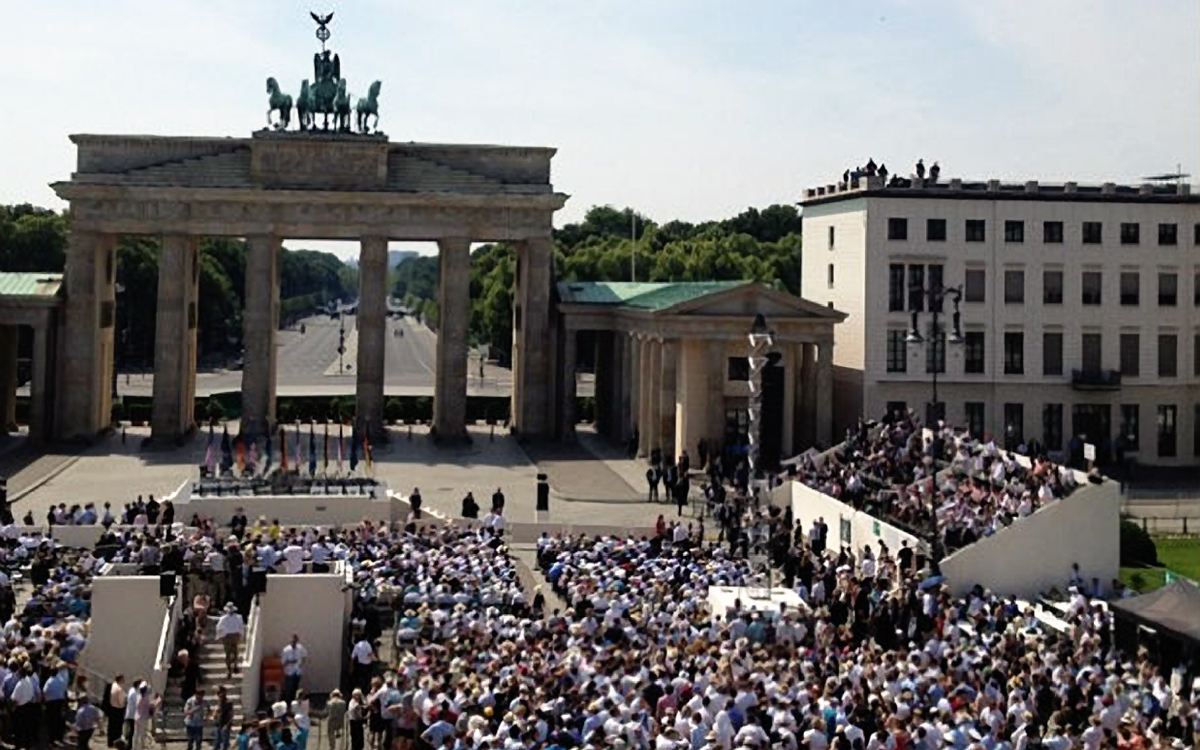
And instead of opening up the speech to the whole city, Obama spoke in front only about 5,000-6,000 spectators, all of them invited guests.

The White House pool report revealed that only 6,000 will be in attendance for Obama's Berlin speech on Wednesday:

“The stage for the president's speech is set up on the East side of the Brandenburg Gate,AP401450731793 in the old East Berlin. The sun is pounding down and there are around 6,000 invited guests according to German authorities. There are bleachers set up either side of the square, with a big two story riser facing the stage which has a row of bullet proof glass and 12 U.S., German and EU flags and the grand backdrop of the Gate. There is a large standing crowd between the bleachers.”

The actual crowd count at the Brandenburg Gate speech was 4,500.

His speech on Wednesday (you can click here for a detailed comparison vs. the 2008 speech) called for a reduction in global nuclear weapons (through more negotiations with Russia) and defended the idea of Western intervention in Syria. Hammering on the theme of "peace with justice," he also discussed closing Guantanamo Bay and taking action on climate change, calling it the "global flood of our time." (Much more on that here.) But it was notably different in tone than 2008's more sweeping view of the world, which was a speech more fitting for a candidate.

Nonetheless, directly out of the Brandenburg gate, the president commenced with injecting race and gender into the conversation when he said "Angela and I don't exactly look like previous German and American leaders." Obama then informed the audience, consigned by invitation to stand in the blistering heat listening to his blather, that Michelle, Malia, and Sasha, rather than endure his grueling speech, chose instead to experience the "beauty and the history of Berlin" (at American taxpayers' expense).

But probably the most amazing aspect of Obama's Berlin speech was his typical lack of self-awareness when making assertions that conflict with everything he does. For instance, although President Obama is actively persecuting the "unoriginated birthright of man," he quoted German philosopher Immanuel Kant, who said "freedom is the 'unoriginated birthright of man, and it belongs to him by force of his humanity.'"

Obama even posed questions Americans ask about him:

“Will we live free or in chains? Under governments that uphold our universal rights, or regimes that suppress them? In open societies that respect the sanctity of the individual and our free will, or in closed societies that suffocate the soul?”

In Berlin, Obama attempted to one-up Ronald Reagan's "Peace through Strength" strategy by stealing John F. Kennedy's "Peace with Justice" mantra and scheduled the revision to take place at Brandenburg Gate, where his social justice spiel paled in comparison to authentic Reagan strength.

The president's references were pitiful attempts to support the liberal dream of a daisy-holding, Kumbaya-singing utopia that the human condition prevents.

Ignoring nations stoking the nuclear flames, President "Ich bin ein Dumbkopf" cited JFK's famous 1963 "Ich bin ein Berliner" speech when suggesting that Germans "lift their eyes beyond the dangers of today to the day of peace with justice." Caught up in the rapture of the moment, Obama apparently missed the contradiction in mentioning Kennedy's assassination five months after he promoted "peace with justice."

Speaking of contradictions, Mr. Obama shared that Kennedy's words are "timeless becauseObama - speech they call upon us to care more about things than just our own self-comfort." This from a president who's about to embark on a $100 million African vacation, toting along a wife whose "self-comfort" demands recently included bunking in a $3,300-a-night Princess Grace suite in Ireland.

President Obama has been facing increasing scrutiny both at home and abroad as scandal after scandal rocks the administration. From Ireland the president went to Germany to talk about the dangers of global number of nuclear weapons, climate change and his views on social justice.

After encouraging youthful unemployed Germans to relinquish self-comfort, citizen of the world Obama shifted to "For we are not only citizens of America or Germany — we are also citizens of the world. And our fates and fortunes are linked like never before." That is, unless linking "fates and fortunes" means sharing a $3,300-a-night hotel room with Michelle Obama.

Never mentioning pressure cookers, hijacked airplanes, banana hammock bombers, or wild-eyed Muslims gunning down American soldiers, and after riding around in an armored limo and building a mysterious underground bunker beneath the White House, Obama proclaimed, "We may no longer live in fear of global annihilation, but so long as nuclear weapons exist, we are not truly safe."

President Obama also seemed to imply that food stamps and unemployment checks may be the answer to the threat of worldwide terrorism, which he claimed results from the "agony of an empty stomach or the anguish of unemployment."

Then, after dissing Catholic education in Ireland, Obama dredged up sins that penitent nations have already remediated when he unnecessarily brought up intolerance and abuses "based on race, or religion, gender or sexual orientation."

Obama then advanced a concept that he doesn't apply to Christians or American conservatives, which is that "When we stand up for our gay and lesbian brothers and sisters and treat their love and their rights equally under the law, we defend our own liberty as well."

That's when the "Peace with justice" rant began. Obama cited free enterprise and freedom, neither of which he's a huge fan of. From there, he segued into environmentalism, closing Guantanamo, ending the Afghan war, controlling the drones he has surveilling U.S. airspace, undermining the Constitution and calling it "balancing the pursuit of security with the protection of privacy," and meeting moral obligations that have nothing to do with morality.

Funny, Obama proves he's vulnerable to nuclear self-destruction whenever the Teleprompter is unavailable. Yet, he imagines peace can only be realized through sending a message to America's enemies that in a nuclear-aggressive environment the most powerful nation in the world is voluntarily reducing the number of its nuclear warheads.

Not to worry though; Barack quoted James Madison and then claimed that he too is moving "beyond a mindset of perpetual war." The president cited a 2016 'secure nuclear materials' summit, which despite the growing threat of international terrorism, Obama believes is a "step" toward "creating a world of peace with justice."

The problem is that the guy who said "Threats to freedom don't merely come from the outside. They can emerge from within" is the one threatening America's freedom, and the perpetual warfare he speaks of is not America's doing.

Appearing on MSNBC's Andrea Mitchell Reports on Wednesday, NBC's chief White House correspondent Chuck Todd came up with a long list of excuses for President Obama'sgatetodd poor speech performance in Berlin: "I want to give you a little context here there was an attempt to shrink the crowd size. Maybe they would have gotten 25, 30, 40,000 people. President Obama feeds off a crowd very well."

Todd then grasped at other reasons for the lackluster event: ".you had that very distracting glass and you could just see that the President himself wasn't feeding off of the crowd. And I think look, part of it, it was hot. Those folks were out there for two and a half hours it can sap your energy a little bit. And I just wonder if that added a little bit to this."

Barack Obama ended with a Martin Luther King Jr. quote crescendo:

"Injustice anywhere is a threat to justice everywhere."

In the end, so too does "loss of freedom in America threaten freedom everywhere." That loss is precisely why, both in Germany and here at home, free people must grasp the potentially harmful impact the 'peace-loving' guy riding around in a million dollar armored vehicle and standing behind eight inches of bulletproof glass seeks to impose on the Western world.

Thursday, March 14, 2013

Aristocrats vs. The Common Man

“The ordaining of laws in favor of one part of the nation, to the prejudice and oppression of another, is certainly the most erroneous and mistaken policy. An equal dispensation of protection, rights, privileges, and advantages, is what every part is entitled to, and ought to enjoy.” — Benjamin Franklin, Emblematical Representations — 1774

American colonial history represents a striking event in world history-the transatlantic migration of millions of people, from the arrival of Christopher Columbus in 1492, to the first permanent British settlement in America in 1607, to the signing of the Declaration of Independence in 1776.

English Puritans arriving in Massachusetts comprised the first of four great migrations to America. After the English Civil War a generation later, Royalist Cavaliers, Anglican Royalists, and sympathizers of the Crown fled Puritan-dominated England and settled in the Virginia area. The third transatlantic migration occurred between 1675 and 1725, when Quakers from the northern midlands of England arrived in the Delaware River Valley. The fourth of the great migrations was comprised of Scots-Irish who settled in the broad expanse of land from western Pennsylvania to the Shenandoah Valley.

The Puritans are especially noteworthy among these early immigrants to America. The Mayflower Compact, John Winthrop's sermon, "A Modell of Christian Charity," and Winthrop's speech to the Massachusetts General Court of July 3, 1645 — three Puritan documents-highlight their understanding of the purpose of civil society and the function of government as being wedded to the advancement and glory of God and the "better ordering and preservation" of each individual. These documents establish the early importance placed on the rule of law, the role of a covenant or compact to establish a "civil body politic," and the essentialness of ongoing deliberation for self-government.

These documents also layout noteworthy differences between the Puritans and the Founders. They declare the primary importance of community at the expense of individual rights, the foundation of any claim to individual liberties to be responsibilities, and the perpetual subjugation of "true liberty" to authority exercised rightly. But an important debate arose from this understanding of society and government, concerning the relationship between the authority of magistrates and the liberty of the people, which debate has remained an essential aspect of American self-government.

As these four migrations began to establish themselves as political powers within Colonial America two began gaining more influence — the descendants of the Puritans in Massachusetts and the descendants of the Royalist Cavaliers in Virginia. Each had a separate relationship with the mother country and the king. The Puritans had become a more mercantile society clustering to cities like Boston and Philadelphia while the Royalist gravitated to farming with cotton and tobacco being mainstay crops and a plantation system that required slavery. Our Founders would come from both camps.

One of the leading lights to emanate from the Puritan heritage was Benjamin Franklin. The son of a candle maker who came to the colonies in the late 1600s, young Benjamin Franklin had little formal schooling, and despised the idea of following in his father's trade. He was apprenticed to his brother's newspaper, the New England Courant, during which time he embarked on a rigorous self-education, reading widely in history, philosophy and such popular writing as that of Addison and Steele. By the age of 16 he was writing essays for the Courant under the pseudonym "Silence Dogood." After leaving his hometown of Boston for Philadelphia, Franklin continued his self-education while working in a printer's shop, and, after taking a two year journey to England, he settled down to run his own paper, The Pennsylvania Gazette. While Franklin was establishing himself as a printer and writer, he also found time for public projects, such as the founding of the "Junto," a group of mostly young tradesmen who were, like Franklin, establishing themselves in business and the community. Through the work of the Junto and the questions it dealt with, Franklin lead important projects in the community such as the creation of the first library, and the formation of the first fire company in Philadelphia. The Junto also took up questions of scientific inquiry into the natural world. Franklin's experiments and discoveries in electricity are well known, but, among many other things, he also advised Robert Fulton on the creation of the steam engine, and hypothesized that the common cold was not caused by cold temperatures, but, rather what he called "contagion."

The life and civic activities of Benjamin Franklin were in a real sense a kind of experiment: an experiment in human and political equality. Britain and the rest of Europe were aristocratic states and societies, and it was assumed that men and women of birth were superior to those of humbler origin. American society was without the aristocratic social structure with its explicit and implicit prejudices. Thus Franklin, the son of a candle maker, could become the most distinguished man in the colonies prior to the Revolutionary War based solely upon his genius and hard work. The growth of early America's civil society was proof of the principle of equality held by Franklin and others. Colonists began to understand that in building up their local institutions, they must do things for themselves, all the while meeting with opposition in colonial assemblies, and often being overruled by an incompetent and arbitrary royal governor. Indeed, it was the repeated quarrels between the people of the Colony of Pennsylvania and the Royal Proprietor, Thomas Penn, son of the great William Penn, which took Franklin to London as the colony's agent. While there he became the de facto agent for all the colonies and tried again and again to show the Board of Trade and Parliament how ill-advised their policies were, particularly the Stamp Act. But the philosophical currents of the day - those of the Enlightenment — were on the side of Franklin and the colonists, who soon would be known as revolutionaries.

This period called the Enlightenment, of which Franklin was the great embodiment in America, served as the important foundation for the American Revolution. The Enlightenment was a period of education for the American colonies, and, like young Franklin's education, it was largely self-imposed and therefore all the more valued by those undertook it. There is much scholarly argument surrounding the Enlightenment, a disputed term not only today, but in its own time. Was it a consistent body of thought? Was it holy irreligious or antireligious? Was the Enlightenment a uniform movement of thought or were there separate "Enlightenments" plural? It is important to remember that the Enlightenment is also called the neoclassical period, meaning that key figures of the period, particularly Americans during the Revolution, did not consider themselves to be inventing something new. Rather, they were rediscovering things that had always been true, though mankind had not always been able or eager to know them. The foundation of the American Enlightenment was science, a term which in the 18th Century still meant "knowledge" or inquiry generally. On the foundation of scientific inquiry, the American Enlightenment had four "pillars": religious liberty, political liberty, economic liberty and moral responsibility. This moral, political, and economic science that constituted the American Enlightenment aimed at supporting one chief end, what the founders understood as human happiness. And the nation they were forming would an example of a free, responsible self-governing people living and working in civil society under the rule of law in order to achieve their individual and collective happiness.

Franklin had a problem with European aristocrats controlling the dialog of our civilBenFranklinDuplessis society. These aristocrats and elites were not from the people, they were from an inbred society of men who gained their elevated positions not through merit or accomplishments, but through accident of birth. Yet they were the ones who were suggesting laws and regulations to the King of England for the governance of his colonies. Franklin wanted a group, or as he called it a club, of local tradesmen — men with a stake in the community and civil society, who would explore and discuss issue of the day. He called this club the Junto.

The Junto was a club for mutual improvement established in 1727 by Benjamin Franklin in Philadelphia. Also known as the Leather Apron Club, its purpose was to debate questions of morals, politics, and natural philosophy, and to exchange knowledge of business affairs. Franklin organized a group of friends to provide a structured form of mutual improvement. The group, initially composed of twelve members, called itself the Junto. The members of the Junto were drawn from diverse occupations and backgrounds, but they all shared a spirit of inquiry and a desire to improve themselves, their community, and to help others. Among the original members were printers, surveyors, a cabinetmaker, a clerk, and a bartender. Although most of the members were older than Franklin, he was clearly their leader.

Franklin describes the formation and purpose of the Junto in his autobiography:

“I should have mentioned before, that, in the autumn of the preceding year, [1727] I had form'd most of my ingenious acquaintance into a club of mutual improvement, which we called the Junto; we met on Friday evenings. The rules that I drew up required that every member, in his turn, should produce one or more queries on any point of Morals, Politics, or Natural Philosophy, to be discuss'd by the company; and once in three months produce and read an essay of his own writing, on any subject he pleased.

Our debates were to be under the direction of a president, and to be conducted in the sincere spirit of inquiry after truth, without fondness for dispute or desire of victory; and to prevent warmth, all expressions of positiveness in opinions, or direct contradiction, were after some time made contraband, and prohibited under small pecuniary penalties.”

Franklin wrote his autobiography largely to teach his son William (1731–1813) and other young men how to become successful. What better example of success than his own life?

Franklin was devoted to knowledge and through this devotion established the firs lending library in colonies. Here is an excerpt from his autobiography stating how he wanted to make books more available to his fellow citizens:

“At the time I established myself in Pennsylvania there was not a good bookseller’s shop in any of the colonies to the southward of Boston. In New York and Philadelphia the printers were indeed stationers; they sold only paper, etc., almanacs, ballads, and a few common school-books. Those who loved reading were obliged to send for their books from England; the members of the Junto had each a few. We had left the ale-house, where we first met, and hired a room to hold our club in. I proposed that we should all of us bring our books to that room, where they would not only be ready to consult in our conferences, but become a common benefit, each of us being at liberty to borrow such as he wished to read at home. This was accordingly done, and for some time contented us.

Finding the advantage of this little collection, I proposed to render the benefit from books more common by commencing a public subscription library. I drew a sketch of the plan and rules that would be necessary, and got a skillful conveyancer, Mr. Charles Brockden, to put the whole in form of articles of agreement, to be subscribed, by which each subscriber engaged to pay a certain sum down for the first purchase of books, and an annual contribution for increasing them. So few were the readers at that time in Philadelphia, and the majority of us so poor, that I was not able, with great industry, to find more than fifty persons, mostly young tradesmen, willing to pay down for this purpose forty shillings each, and ten shillings per annum. On this little fund we began. The books were imported; the library was opened one day in the week for lending to the subscribers, on their promissory notes to pay double the value if not duly returned. The institution soon manifested its utility; was imitated by other towns, and in other provinces. The libraries were augmented by donations; reading became fashionable; and our people, having no public amusements to divert their attention from study, became better acquainted with books, and in a few years were observed by strangers to be better instructed and more intelligent than people of the same rank generally are in other countries.”

Franklin was a self-educated man. He had no formal education beyond a few basic years when living at home prior to his being apprenticed in indentured servitude to his older brother. When talking about his own education Franklin had this to say:

“This library afforded me the means of improvement by constant study, for which I set apart an hour or two each day, and thus repaired in some degree the loss of the learned education my father once intended for me. Reading was the only amusement I allowed myself. I spent no time in taverns, games, or frolics of any kind; and my industry in my business continued as indefatigable as it was necessary. I was indebted for my printing-house; I had a young family coming on to be educated, and I had to contend with for business two printers, who were established in the place before me. My circumstances, however, grew daily easier. My original habits of frugality continuing, and my father having, among his instructions to me when a boy, frequently repeated a proverb of Solomon, “Do you see a man diligent in his calling? He shall stand before kings; he shall not stand before mean men.”1 I from thence considered industry as a means of obtaining wealth and distinction, which encouraged me, though I did not think that I should ever literally stand before kings, which, however, has since happened; for I have stood before five, and even had the honor of sitting down with one, the King of Denmark, to dinner.”

Franklin was not an atheist nor was he agnostic. He believed in a Deity who made the world and governed it. When it came to religion Franklin had this to say:

“I had been religiously educated as a Presbyterian; and though some of the dogmas of that persuasion, such as the eternal decrees of God, election, reprobation, etc., appeared to me unintelligible, others doubtful, and I early absented myself from the public assemblies of the sect, Sunday being my studying day, I never was without some religious principles. I never doubted, for instance, the existence of the Deity; that He made the world, and governed it by His providence; that the most acceptable service of God was the doing good to man; that our souls are immortal; and that all crime will be punished and virtue rewarded, either here or hereafter. These I esteemed the essentials of every religion; and, being to be found in all the religions we had in our country, I respected them all, though with different degrees of respect, as I found them more or less mixed with other articles, which, without any tendency to inspire, promote, or confirm morality, served principally to divide us and make us unfriendly to one another. This respect to all, with an opinion that the worst had some good effects, induced me to avoid all discourse that might tend to lessen the good opinion another might have of his own religion; and as our province increased in people, and new places of worship were continually wanted, and generally erected by voluntary contribution, my mite for such purpose, whatever might be the sect, was never refused.”

In speaking about morality Franklin stated:

“In the various enumerations of the moral virtues I met in my reading, I found the catalogue more or less numerous, as different writers included more or fewer ideas under the same name. Temperance, for example, was by some confined to eating and drinking, while by others it was extended to mean the moderating every other pleasure, appetite, inclination, or passion, bodily or mental, even to our avarice and ambition. I proposed to myself, for the sake of clearness, to use rather more names, with fewer ideas annexed to each, than a few names with more ideas; and I included under thirteen names of virtues all that at that time occurred to me as necessary or desirable, and annexed to each a short precept, which fully expressed the extent I gave to its meaning.

  1. These names of virtues, with their precepts were:
  2. Temperance—Eat not to dullness; drink not to elevation.
  3. Silence—Speak not but what may benefit others or yourself; avoid trifling conversation.
  4. Order—Let all your things have their places; let each part of your business have its time.
  5. Resolution—Resolve to perform what you ought; perform without fail what you resolve.
  6. Frugality—Make no expense but to do good to others or yourself, i.e., waste nothing.
  7. Industry—Lose no time; be always employed in something useful; cut off all unnecessary actions.
  8. Sincerity—Use no hurtful deceit; think innocently and justly, and, if you speak, speak accordingly.
  9. Justice—Wrong none by doing injuries or omitting the benefits that are your duty.
  10. Moderation—Avoid extremes; forbear resenting injuries so much as you think they deserve.
  11. Cleanliness—Tolerate no uncleanliness in body, clothes, or habitation.
  12. Tranquility—Be not disturbed at trifles, or at accidents common or unavoidable.
  13. Chastity—Rarely use venery but for health or offspring, never to dullness, weakness, or the injury of your own or another’s peace or reputation.
  14. Humility—Imitate Jesus and Socrates.

My intention being to acquire the habitude of all these virtues, I judged it would be well not to distract my attention by attempting the whole at once, but to fix it on one of them at a time, and, when I should be master of that, then to proceed to another, and so on, till I should have gone through the thirteen; and, as the previous acquisition of some might facilitate the acquisition of certain others, I arranged them with that view, as they stand above.”

Franklin had a firm belief in self-governance and that the main purpose of any government was to protect the rights of the civil society, through criminal and civil law, from those who would abridge those rights. He believed, like John Locke, that a man’s happiness was attained through his property — property he earned from his physical or mental efforts and was not due to any king or prince without his consent.

In 1776 when the Continental Congress was debating a break with the King of England449px-Writing_the_Declaration_of_Independence_1776_cph.3g09904 they appointed a committee of five including Franklin along with Thomas Jefferson, John Adams, Robert R. Livingston, and Roger Sherman to author a document that could be presented to the King. Adams was selected to chair the committee and he charged Jefferson with the task of witting the first draft while he and Franklin would edit Jefferson’s work. That document became our Declaration of Independence and stated:

“We hold these truths to be self-evident, that all men are created equal, that they are endowed by their Creator with certain unalienable Rights, that among these are Life, Liberty and the pursuit of Happiness.”

It should be noted that the word “unalienable” was suggested by Franklin to replace Jefferson’s phase “God given.”

This has been called "one of the best-known sentences in the English language", containing "the most potent and consequential words in American history." The passage came to represent a moral standard to which the United States should strive. This view was notably promoted by Abraham Lincoln, who considered the Declaration to be the foundation of his political philosophy, and argued that the Declaration is a statement of principles through which the United States Constitution should be interpreted.

Franklin was also known for his many scientific discoveries and inventions. He was the first to use the terms negative and positive when referring to electricity and his famous experiment with the kite, string and key to observe the effects of lightening brought him international fame. He was compared to Isaac Newton. He gave advice to Robert Fulton for his invention of the steam engine. When his eyesight began to fail he invented the bifocal lens and invented a stove named after him — a stove he gave the patent rights away so other could make fortunes from its manufacture. He invented a musical instrument, the Glass Armonica, for which Wolfgang Amadeus Mozart, George Frideric Handel, Ludwig van Beethoven, Richard Strauss, and more than 100 other composers composed works for.

He published pamphlets on public and personal safety including one on how to prevent household fires. He established the first volunteer fire department in the colonies, something thousands of towns and small cites have across the United States today.

When the Revolutionary War began Franklin was assigned to Paris by the Continental Congress to raise money, obtain arms and ask for French naval support — something he did with great success.

He was present in Philadelphia during the Constitutional Convention and added his wisdom to the conclave. It was Franklin who uttered the famous quip when asked by a woman outside of the convention hall what kind of government we will have Franklin replied “Madam, a Republic if we can keep it.”

Franklin was truly a Renaissance man in America’s Age of Enlightenment. With all of his many accomplishments and inventions he should best be known for his contributions to our civil society and our system of self- government — something we have been losing for the past 100 years to the elites, bureaucratic aristocrats and masterminds. So the next time a $100 dollar bill crosses your hand take a few seconds to think of the sage of Philadelphia. If I were asked to describe Franklin in today’s political terms I would call him a Libertarian.

Wednesday, October 31, 2012

Religious Liberty in the Administrative State

“No person, demeaning himself in a peaceable and orderly manner, shall ever be molested on account of his mode of worship, or religious sentiments, in the said territories.

Religion, morality, and knowledge being necessary to good government and the happiness of mankind, schools and the means of education shall forever be encouraged.” The Northwest Ordinance, 1787.

The Northwest Ordinance (formally An Ordinance for the Government of the Territory of the United States, North-West of the River Ohio, and also known as the Freedom Ordinance or "The Ordinance of 1787") was an act of the Congress of the Confederation of the United States, passed July 13, 1787. The primary effect of the ordinance was the creation of the Northwest Territory as the first organized territory of the United States out of the region south of the Great Lakes, north and west of the Ohio River, and east of the Mississippi River.

On August 7, 1789, President George Washington signed the Northwest Ordinance of 1789 into law after the newly created U.S. Congress reaffirmed the Ordinance with slight modifications under the Constitution. The Ordinance purported to be not merely legislation that could later be amended by Congress, but rather "the following articles shall be considered as Articles of compact between the original States and the people and states in the said territory, and forever remain unalterable, unless by common consent.

Arguably the single most important piece of legislation passed by members of the earlier Continental Congresses other than the Declaration of Independence, it established the precedent by which the federal government would be sovereign and expand westward across North America with the admission of new states, rather than with the expansion of existing states and their established sovereignty under the Articles of Confederation. It is the most important legislation that Congress has passed with regard to American public domain lands. The U.S. Supreme Court recognized the authority of the Northwest Ordinance of 1789 within the applicable Northwest Territory as constitutional in Strader v. Graham, 51 U.S. 82, 96, 97 (1851), but did not extend the Ordinance to cover the respective states once they were admitted to the Union.

The prohibition of slavery in the territory had the practical effect of establishing the Ohio River as the boundary between free and slave territory in the region between the Appalachian Mountains and the Mississippi River. This division helped set the stage for national competition over admitting free and slave states, the basis of a critical question in American politics in the 19th century until the Civil War.

The Natural Rights provisions of the ordinance foreshadowed the Bill of Rights, the first ten amendments to the U.S. Constitution. Many of the concepts and guarantees of the Ordinance of 1787 were incorporated in the U.S. Constitution and the Bill of Rights. In the Northwest Territory, various legal and property rights were enshrined, religious tolerance was proclaimed, and it was enunciated that since "Religion, morality, and knowledge, being necessary to good government and the happiness of mankind, schools and the means of education shall forever be encouraged." The right of habeas corpus was written into the charter, as was freedom of religious worship and bans on excessive fines and cruel and unusual punishment. Trial by jury and a ban on ex post facto laws were also rights granted.

The Northwest Ordinance was a clear, unambiguous expression of the beliefs of our Founders. There could be no doubt that this new Congress believed that education and morality should go hand in hand and that as long as the religious practices of one did not violate the social compact or encourage criminal acts such as human sacrifice or refusal to support the common defense of the nation. Religion was not only to be tolerated, it was to be encouraged.

In his 1781 Notes on the State of Virginia, Query XVIII: Manners Thomas Jefferson said:

“With the morals of the people, their industry also is destroyed. For in a warm climate, no man will labour for himself who can make another labour for him. This is so true, that of the proprietors of slaves a very small proportion indeed are ever seen to labour. And can the liberties of a nation be thought secure when we have removed their only firm basis, a conviction in the minds of the people that these liberties are of the gift of God? That they are not to be violated but with his wrath? Indeed I tremble for my country when I reflect that God is just: that his justice cannot sleep for ever: that considering numbers, nature and natural means only, a revolution of the wheel of fortune, an exchange of situation, is among possible events: that it may become probable by supernatural interference! The Almighty has no attribute which can take side with us in such a contest.--But it is impossible to be temperate and to pursue this subject through the various considerations of policy, of morals, of history natural and civil. We must be contented to hope they will force their way into every one’s mind. I think a change already perceptible, since the origin of the present revolution. The spirit of the master is abating, that of the slave rising from the dust, his condition mollifying, the way I hope preparing, under the auspices of heaven, for a total emancipation, and that this is disposed, in the order of events, to be with the consent of the masters, rather than by their extirpation.”

Here Jefferson is referring the immorality of slavery and the wrath of God that will descend on those who support this policy. Jefferson made no bones in referring to God, as he did in the Declaration four times, and warning that an immoral nation devoid of God would no doubt perish.

In his 1796 Farewell Address to the nation George Washington stated:

“Of all the dispositions and habits which lead to political prosperity, Religion and morality are indispensable supports. In vain would that man claim the tribute of Patriotism who should labour to subvert these great Pillars of human happiness, these firmest props of the duties of Men and citizens. The mere Politician, equally with the pious man ought to respect and to cherish them. A volume could not trace all their connections with private and public felicity. Let it simply be asked where is the security for property, for reputation, for life, if the sense of religious obligation desert the oaths, which are the instruments of investigation in Courts of Justice? And let us with caution indulge the supposition that morality can be maintained without religion. Whatever may be conceded to the influence of refined education on minds of peculiar structure, reason and experience both forbid us to expect that National morality can prevail in exclusion of religious principle. ’Tis substantially true, that virtue or morality is a necessary spring of popular government. The rule indeed extends with more or less force to every species of free Government. Who that is a sincere friend to it, can look with indifference upon attempts to shake the foundation of the fabric.”

Washington, however, offered on caveat to absolute religious freedom in his September, 1789 letter to the Annual Meeting of Quakers when he gently reminded them of their obligation to support the common defense. In his letter Washington stated:

“Government being, among other purposes, instituted to protect the persons and consciences of men from oppression, it certainly is the duty of rulers, not only to abstain from it themselves, but, according to their stations, to prevent it in others.

The liberty enjoyed by the people of these states of worshiping Almighty God agreeably to their consciences, is not only among the choicest of their blessings, but also of their rights. While men perform their social duties faithfully, they do all that society or the state can with propriety demand or expect; and remain responsible only to their Maker for their religion, or modes of faith, which they may prefer or profess.

Your principles and conduct are well known to me; and it is doing the people called Quakers no more than justice to say, that (except their declining to share with others the burden of the common defense) there is no denomination among us, who are more exemplary and useful citizens.

I assure you very explicitly, that in my opinion the conscientious scruples of all men should be treated with great delicacy and tenderness; and it is my wish and desire, that the laws may always be as extensively accommodated to them, as a due regard to the protection and essential interests of the nation may justify and permit.”

Once again we see how our Founders viewed the value of religion in the life of the nation and its schools.

Even the Wilsonian Progressives believed in the value of religion and morality in our national affairs and government policies. They believed in criminal and civil laws that would protect one citizen from the actions of another. This changed with the advent of the Post 1960s Progressives when they embarked on a campaign of anything goes sexual liberation and a complete intolerance for religious institutions.

Post-1960s Progressivism has steadily eroded religious liberty and the freedom of association in America. Measures such as the Patient Protection and Affordable Care Act and many anti-discrimination laws express a new understanding of rights that rejects the Founders’ view of religious liberty and the freedom of private associations to govern themselves. Recent Progressivism follows the early Progressive belief that effective freedom requires government to redistribute resources in order to provide equal access to the goods that promote mental development and that make life comfortable. This redistributive agenda is combined with a new emphasis on the empowerment of victim groups, sexual liberation, and an aversion to traditional Christianity and Judaism that requires government intervention in the internal affairs of private organizations. Religious liberty today is divorced from the freedom of association and the free exercise of religion, which the Founders understood to be essential for a free society.

The Founders’ conception of religious liberty was anchored in the belief that the natural right of liberty—and religious liberty—meant not only that all persons may worship God in the way each thinks best, but also that all are permitted to follow what they believe to be God’s laws in their daily life outside of church. The Founders understood, however, that actions based on religion are limited by the purpose of the social compact—the security of rights. No one has a right to disturb the public peace, to obstruct others in their religious worship, or to incite crimes.

While the Founders believed that religion, especially Christianity, is helpful to the cause of liberty because it encourages the virtues necessary for the survival of a free society, they held that government involvement in religious organizations must be limited by the very purpose of government: to secure the equal natural rights of citizens to life, liberty, and property. Denial of the rights to religious liberty and to freedom of association violates the right to liberty.

In practice, liberty—including religious liberty—means that individuals are free to organize and conduct their affairs as they see fit through self-governing private associations. Contrary to today’s practice, the Founders understood that churches, businesses, and other private associations had the right to determine all internal policies, including rules for membership, employment, and conduct, free from government interference. As long as these entities do not harm the rights to life, liberty, or property, they should be free to manage their internal affairs.

After 1965, Progressives adopted a new attitude towards religion and private associations, viewing both as threats to effective or positive freedom. The redistributive agenda of early Progressivism required the violation of the natural right to property, but in general the early Progressives supported the traditional family and liberal Christianity. Post-1965 Progressivism (in the interest of sexual liberation) explicitly attacks Christianity and rejects the older morality which supported the traditional family.

One of the first steps along this road to the rejection of morality in our public education system was the 1963 Supreme Court case of Abington v. Schempp. This was a case in which the Court decided 8–1 in favor of the respondent, Edward Schempp, and declared school-sponsored Bible reading in public schools in the United States to be unconstitutional. Associate Justice William Brennan wrote in his concurring opinion:

“[I]t is implicit in the history and character of American public education that the public schools serve a uniquely public function: the training of American citizens in an atmosphere free of parochial, divisive, or separatist influences of any sort. Attendance at the public schools has never been compulsory. [The Constitution reserves] such a choice to the individual parent. The choice which is thus preserved is between a public secular education with its uniquely democratic values, and some form of private or sectarian education, which offers values of its own.”

Not only did this decision fly in the face of the Northwest Ordinance and the intent of the Founders it set the stage for most of the tyrannical laws against religious beliefs we live with today. Used as stare deices for lower courts to follow in subsequent decisions involving the free practice of religion in public schools and the public square such as; banning the singing of Christmas Carols, not allowing Christmas trees on public property, punishing students for wishing a fellow student a “Merry Christmas” or exchanging a Christmas Card. This is tyranny by a minority group that views itself as victims as they feel offended by these practices — practices that do them no harm. This was not the intent of the Founders when speaking of religious tolerance.

Another landmark case along the road to our throwing organized religion’s moral convictions and tenants was the 2003 case of Lawrence v. Texas, decided by a 6-3 vote of the Court.

In this case the Court struck down the sodomy law in Texas and, by extension, invalidated sodomy laws in thirteen other states, making same-sex sexual activity legal in every U.S. state and territory. The Court overturned its previous ruling on the same issue in the 1986 case Bowers v. Hardwick, where it upheld a challenged Georgia statute and did not find a constitutional protection of sexual privacy.

Lawrence explicitly overruled Bowers, holding that it had viewed the liberty interest too narrowly. The Court held that intimate consensual sexual conduct was part of the liberty protected by substantive due process under the Fourteenth Amendment. Lawrence invalidated similar laws throughout the United States that criminalized sodomy between consenting adults acting in private, whatever the sex of the participants.

In this case Anthony Kennedy wrote for the majority:

“These matters, involving the most intimate and personal choices a person may make in a lifetime, choices central to personal dignity and autonomy, are central to the liberty protected by the Fourteenth Amendment. At the heart of liberty is the right to define one’s own concept of existence, of meaning, of the universe, and of the mystery of human life. Beliefs about these matters could not define the attributes of personhood were they formed under compulsion of the State.”

It seems that the Court uses the 14th Amendment time and time again to override the 10th Amendment

Justice Antonin Scalia wrote a dissent, which Chief Justice William H. Rehnquist and Justice Clarence Thomas joined. Scalia objected to the Court's decision to revisit Bowers, pointing out many decisions from lower courts that relied on Bowers that might now need to be reconsidered. He noted that the same rationale used to overturn Bowers could have been used to overturn Roe v. Wade, which the Justices in the majority in Lawrence had recently upheld in Planned Parenthood v. Casey. Scalia also criticized the majority opinion for failing to give the same respect to stare decisis that three of those in the majority had insisted on in Casey.

Scalia wrote that if the court was not prepared to validate laws based on moral choices as it had done in Bowers, state laws against bigamy, same-sex marriage, adult incest, prostitution, masturbation, adultery, fornication, bestiality, and obscenity would not prove sustainable.

He wrote that:

“Today's opinion is the product of a Court, which is the product of a law-profession culture, that has largely signed on to the so-called homosexual agenda, by which I mean the agenda promoted by some homosexual activists directed at eliminating the moral opprobrium that has traditionally attached to homosexual conduct. The Court has taken sides in the culture war, departing from its role of assuring, as neutral observer, that the democratic rules of engagement are observed.”

He cited the majority opinion's concern that the criminalization of sodomy could be the basis for discrimination against homosexuals as evidence that the majority ignored the views of most Americans:

“So imbued is the Court with the law profession's anti-anti-homosexual culture, that it is seemingly unaware that the attitudes of that culture are not obviously "mainstream"; that in most States what the Court calls "discrimination" against those who engage in homosexual acts is perfectly legal.”

He continued: "Let me be clear that I have nothing against homosexuals, or any other group, promoting their agenda through normal democratic means." The majority's "invention of a brand-new 'constitutional right'", he wrote, showed it was "impatient of democratic change."

The case attracted much public attention, and a large number of amici curiae ("friends of the court") briefs were filed. Its outcome was celebrated by gay rights advocates, who hoped that further legal advances might result as a consequence. And it did!

Now we have another special victim group demanding a redistribution of resources and special protection under the color of law. If a religious institution or secular organizations like the Boy Scouts they are taken to court by the Gay Rights activists demanding their rights to be a part of the organization even if they are not welcomed. If a business like the photographer in New Mexico refuses to photograph a same sex wedding the photographer is fined $6,637.97. What if a Gay photographer would only photograph same sex commitment ceremonies? Would they suffer the same government sanctions. I doubt it. In this case Gay Rights trump religious rights.

To implement the new view of freedom from Christianity and moral self-restraint, government involves itself ever more pervasively in the internal affairs of churches and businesses. Since these private associations all have employees, they are thus subject to anti-discrimination provisions that actively promote affirmative action policies geared toward sexual liberation and the redistribution of resources to supposed victim groups. Private associations are not allowed to govern themselves, and businesses are often prohibited from treating religion as a positive good. Religious liberty is increasingly confined to the freedom to worship. The natural right to liberty and the specific application of that right as religious liberty and the freedom of association are denied by the contemporary Progressive view of religious liberty.